
What is On-Chain Send in Bybit Pay?
On-Chain Send allows you to transfer cryptocurrency directly to an external wallet on the blockchain. With QR Pay, you can scan supported wallet address QR codes to initiate a transaction quickly and securely.
Who can use the On-Chain Send in Bybit Pay?
On-Chain Send in Bybit Pay is available to users who have completed KYC verification on their Bybit account. However, this feature is not available to users whose country of residence is Korea, India, or Kazakhstan.
How do I start an On-Chain Send with QR Pay?
You may access QR Pay via Bybit Homepage → More → Bybit Pay → QR Pay or tap the QR Scanner icon on the homepage. For more information, you may read this article.
What happens after I scan a wallet address QR code?
You will see a “Proceed to On-chain Send” prompt. Tap Confirm to continue. Please ensure that the wallet address is correct before proceeding, as once the transaction is sent on-chain, it cannot be revised.
Why can I only see certain asset types when selecting a cryptocurrency?
Please note that only assets supported on the recipient’s destination network will be displayed, ensuring a successful transfer.
What should I check before confirming the transaction?
Please ensure that you have selected the correct network and that the amount meets the minimum withdrawal requirements shown on the page. Additionally, if the transaction requires a Tag/Memo (e.g., XRP, XYM, XLM, XEM), please ensure it is filled in correctly to avoid asset loss.
Can QR Pay scan all types of wallet QR codes?
QR Pay supports scanning wallet address QR codes that are compatible with Bybit’s supported network and assets. If the QR code does not contain a valid wallet address, the scan will not proceed.
What should I do if the QR scan fails?
You can try the following steps:
- Ensure the QR code is clear and complete
- Adjust the distance or lighting
- Update the Bybit App to the latest version
- Check whether the address is supported by Bybit
- Verify whether your account has any restrictions
Will there be a transaction fee for On-Chain Send?
Yes. A transaction fee applies based on the coin and blockchain network you select and will be displayed during the confirmation. Please review all details carefully before submitting.
Is there a transaction limit for On-Chain Send per user?
Yes. The transaction limit for On-Chain Send is shared with your on-chain withdrawal limit. For more details, please refer to this article.
When will the recipient receive the crypto?
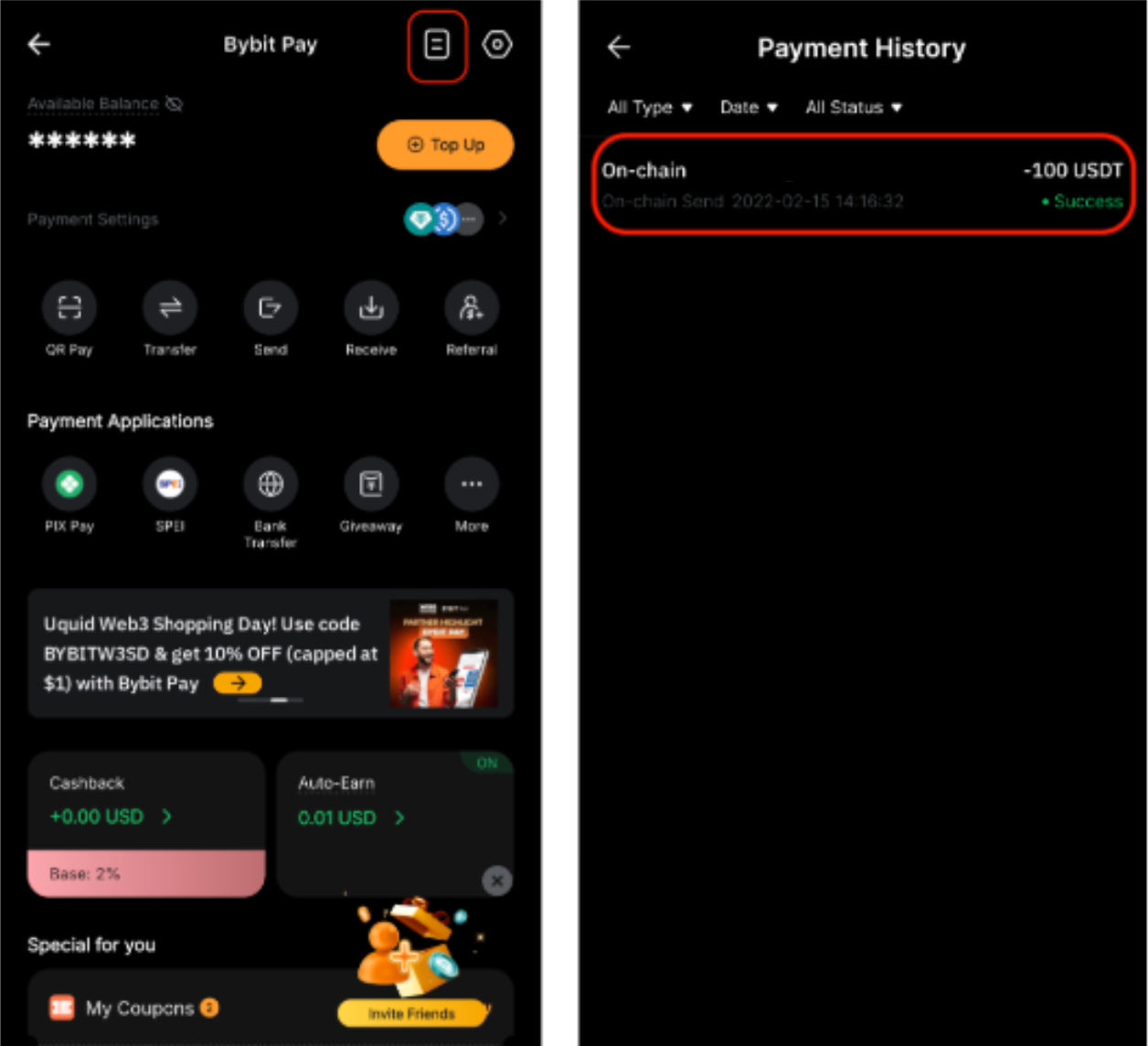
Please note that the transfer speed depends on network congestion and the asset’s blockchain confirmation time. You can always track the transfer status on the Payment History page for your transaction.
Where can I view my On-Chain Send history?
Go to the Bybit Pay page and tap the Payment History icon in the upper-right corner.
Can I cancel or reverse an On-Chain Send transaction?
No. Once the transaction is broadcast to the blockchain, it cannot be canceled or reversed. Therefore, please double-check all transaction details before confirming.
If I have completed an On-Chain Send transaction via Bybit Pay but sent it to the wrong recipient, what should I do?
Please note that once the transaction has been successfully processed and sent out of Bybit, it is no longer within Bybit’s control. You may reach out to the customer support of the recipient's wallet for assistance.
I can see that the transaction status is complete, but why hasn’t the recipient received it in their wallet?
Please contact the customer support of the destination wallet provider or exchange and provide them with the transaction details for assistance.
What if my account is under a withdrawal restriction, such as a 24-hour withdrawal restriction (e.g., after security changes like unbinding Google Authenticator)? Can I still use On-Chain Send on Bybit Pay?
No. When your account is under a 24-hour withdrawal restriction, On-Chain Send will also be unavailable until the restriction is lifted. For example, if there is a 24-hour withdrawal restriction, you will only be able to proceed after the restriction period ends.