Bybit x FXStreet FX Report: EUR/USD hits 1.18 as defense spending and dollar uncertainty fuel rally
AI Summary
Show More
Quickly grasp the article's content and gauge market sentiment in just 30 seconds!
Key Highlights:
EUR/USD has surged 13.5% since early March, reaching its highest level since September 2021
Military investment momentum in Germany and across the EU is generating fresh capital inflows
NATO-aligned budgets could lift EU defense spending to 5% of GDP by 2029
US tariff uncertainty is weakening demand for the dollar globally
EUR is gaining despite a lower ECB interest rate (2%) versus the Fed funding rate (4.5%)
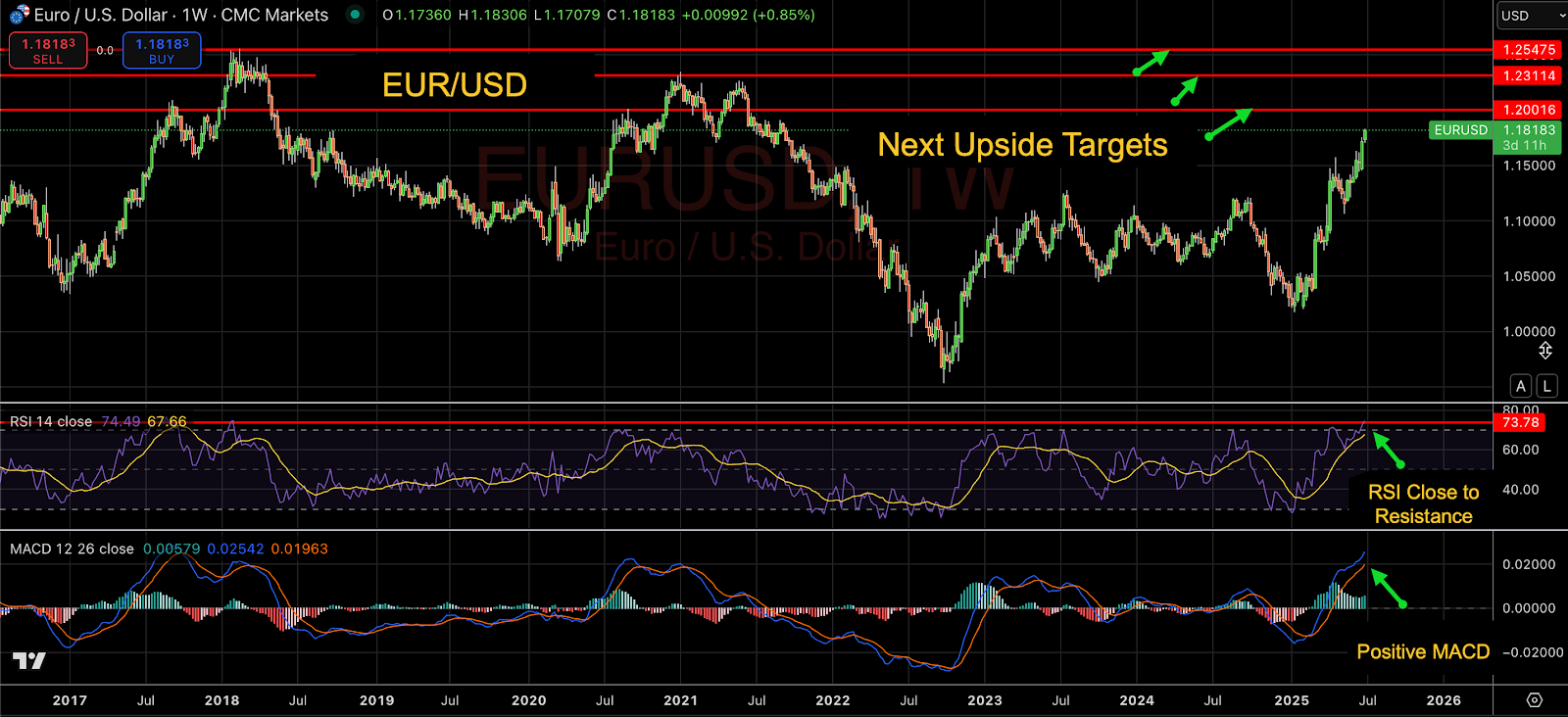
RSI on the weekly chart has reached its highest level (74) since 2018
Key resistance levels are 1.19, 1.20 and 1.255 if momentum continues
Introduction: EUR becomes strongest major FX on military and macro drivers
The euro (EUR) has emerged as the top-performing major currency in recent months, driven by a unique mix of European defense spending and global dollar weakness. While the US economy shows signs of slowing, Europe is benefiting from a fresh investment cycle — centered on national security, NATO commitments and fiscal expansion.
EUR/USD is now trading near 1.18, its highest level since September 2021, marking a 13.5% gain since early March. This is a notable move for a major currency pair, for which such swings are rare outside of extreme environments — and are often amplified through leverage.
Germany leads EU military investment push
At the heart of Europe’s fiscal momentum is Germany. In March 2025, the German parliament approved expanded borrowing for defense, triggering a sharp rally in military-linked stocks such as Rheinmetall, which is up nearly 200% year-to-date.
Following pressure from US President Trump, EU members are boosting their NATO spending to meet the new 5% GDP target by 2029. Germany, in particular, is now planning to double its defense budget over the next four years, based on June reports.
This wave of military investment is pulling global capital into European equity markets. The DAX 40 is up 20% year-to-date, compared to just 5% for the S&P 500, and the euro is tracking that bullish divergence.
Tariff risks weigh on the US dollar
While Europe expands, the US dollar is weakening, partly due to growing concerns around tariffs. Tariffs reduce trade volume, cut into US imports and ultimately shrink global demand for dollars. When countries like China or Germany export less to the US, they hold fewer dollars in reserve, lowering long-term demand for the greenback.
Two major deadlines loom:
July 9: Potential 50% US tariffs on European imports
August 12: Deadline for new US tariffs on Chinese goods
Even without confirmation, the uncertainty surrounding these tariffs is generating downside pressure on the dollar. If implemented, global capital could continue shifting away from the USD toward assets perceived as more stable — including the EUR.
ECB interest rate gap not holding the euro back
It’s especially notable that the euro is gaining despite a lower interest rate. The European Central Bank (ECB) currently holds its rate at 2%, while the Federal Reserve is maintaining a significantly higher 4.5%.
In typical conditions, this interest rate differential would favor the dollar, since higher yields attract capital inflows. If US rates drop below expectations, it could amplify EUR/USD gains even further — particularly if EU fiscal policy remains expansionary.
Technical analysis: EUR/USD eyes 1.19 and 1.20 in breakout move
As noted, EUR/USD is trading around 1.18, marking its highest level since before the Russia–Ukraine war. From a technical perspective, the pair has cleared multiple resistance zones, and is now approaching key levels:
1.19: A double-top formation last tested in 2021
1.20: A major psychological round number, last reached in June 2021
1.23 and 1.255: Long-term highs from January 2021 and February 2018 (respectively)
Given the strength and duration of the current move, traders should also monitor the weekly chart for broader momentum signals.
Relative strength index (RSI) on the weekly chart is at 74 — its highest level since 2018, when it peaked at 77.
Moving average convergence divergence (MACD) remains in positive territory, with the 12-period EMA above the 26-period EMA, indicating no reversal yet.
However, traders should watch for signals of exhaustion: If the MACD turns negative or the RSI hits 77, a short-term pullback may occur.
Momentum remains strong, but caution is warranted as the pair nears overbought territory.
Conclusion: EUR leads global FX rally amid investment surge and USD headwinds
The euro continues to outperform, fueled by structural shifts in EU defense policy, a surge in German spending and a weakening dollar under pressure from tariffs. With a strong technical breakout underway, and macro tailwinds aligning, EUR/USD could extend its rally toward 1.20, 1.23 or even 1.255 — levels not seen in years.
While momentum remains intact, much of the upside may already be priced in for the short term. Traders should monitor resistance at 1.19–1.20, while watching macro developments around UStariffs and both ECB and US Federal Reserve interest rate guidance.
The euro is currently the strongest major currency on the board — and unless the dollar finds support, that leadership may continue into Q3 2025.
Grab Up to 100 USDT in Rewards
Also, enjoy 555% APR on Bybit Earn products!