t
tokenterminal
268تسجيل الإعجاب0شارك في الدردشة3المعجبون0تابِع
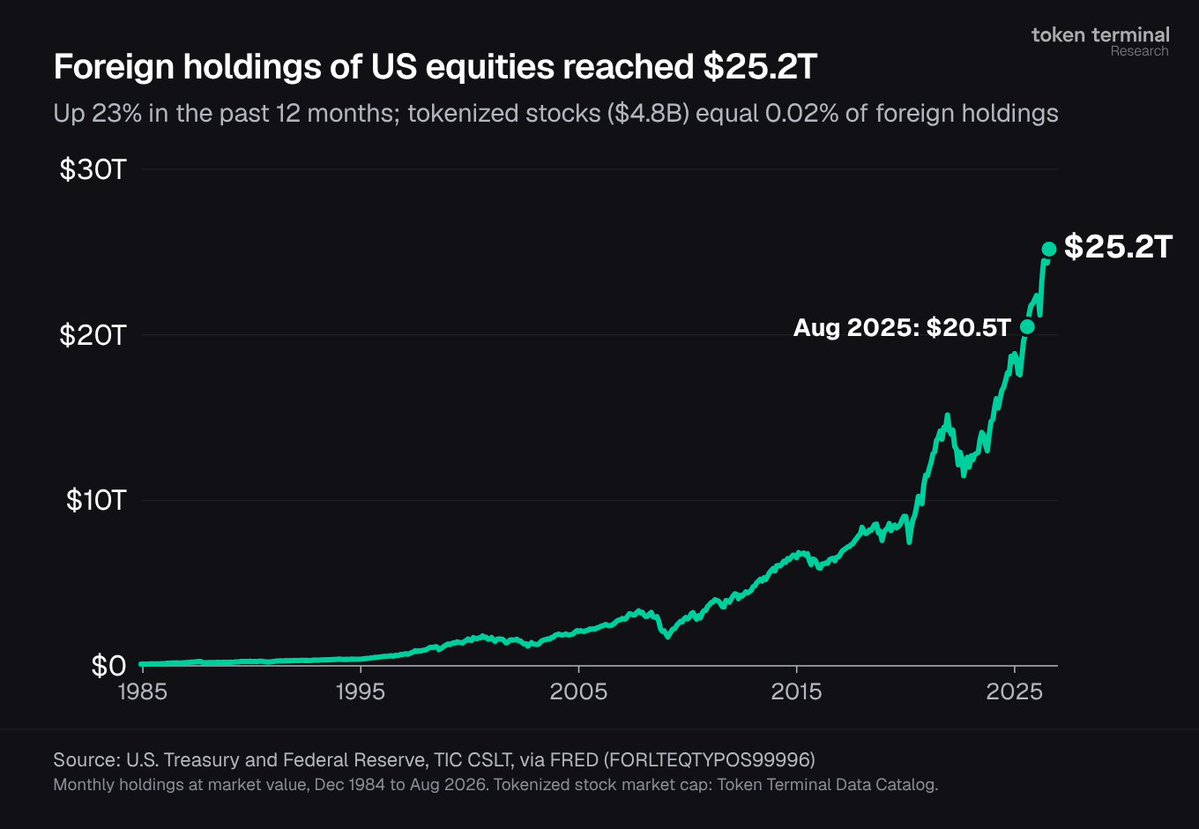
Foreign investors held $25.2T of U.S. equities as of August 2026, up 23% YoY. By comparison, tokenized stocks sit at about $4.8B in market cap—roughly 0.02% of that base. The takeaway is straightforward: tokenization isn’t about manufacturing new demand for U.S. equities. The demand is already there; the opportunity is in infrastructure—more accessible rails, smoother settlement, and higher on-chain usage as activity migrates over time.
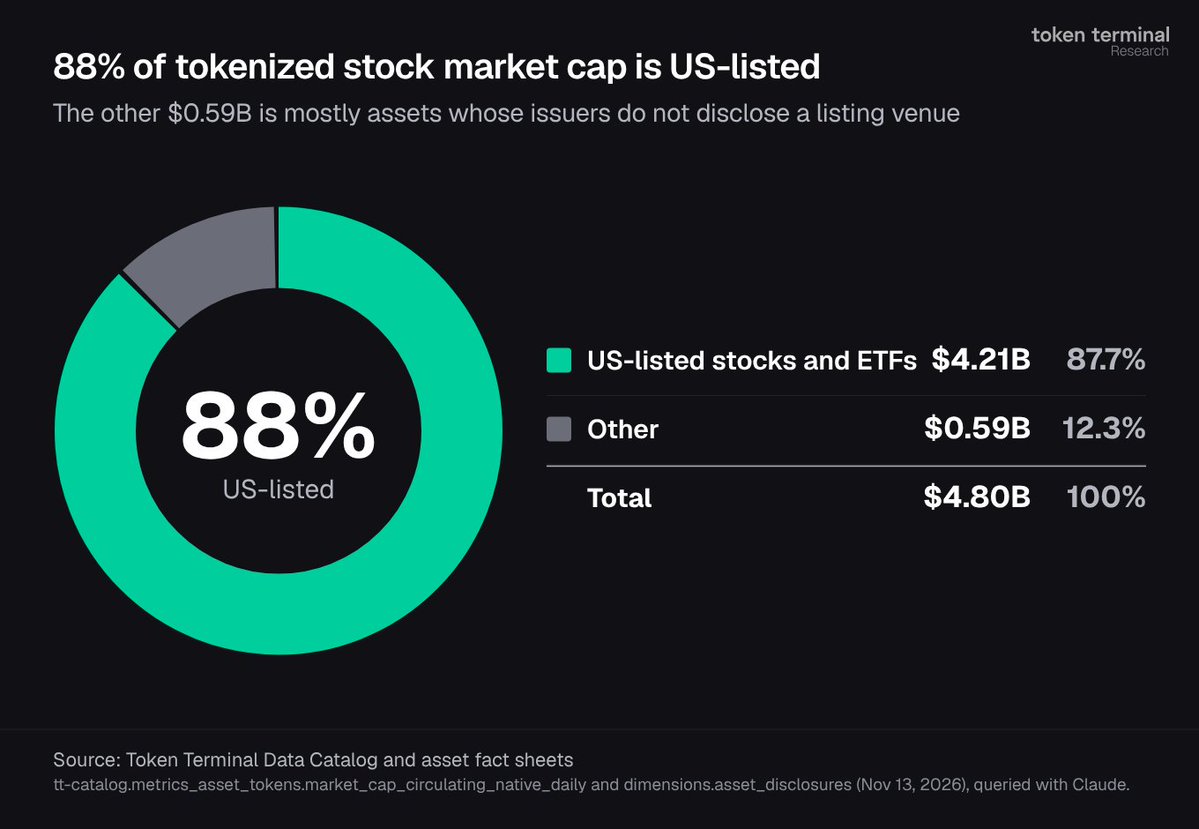
U.S.-listed stocks and ETFs make up $4.21B of tokenized equity market cap—about 88%—showing where most onchain equity activity is concentrated today. Stablecoins proved the playbook: put dollars onchain, and usage follows from a global user base. Tokenized stocks are now applying that same model to U.S.-listed securities, expanding access and driving more day-to-day trading and settlement activity onchain over time.
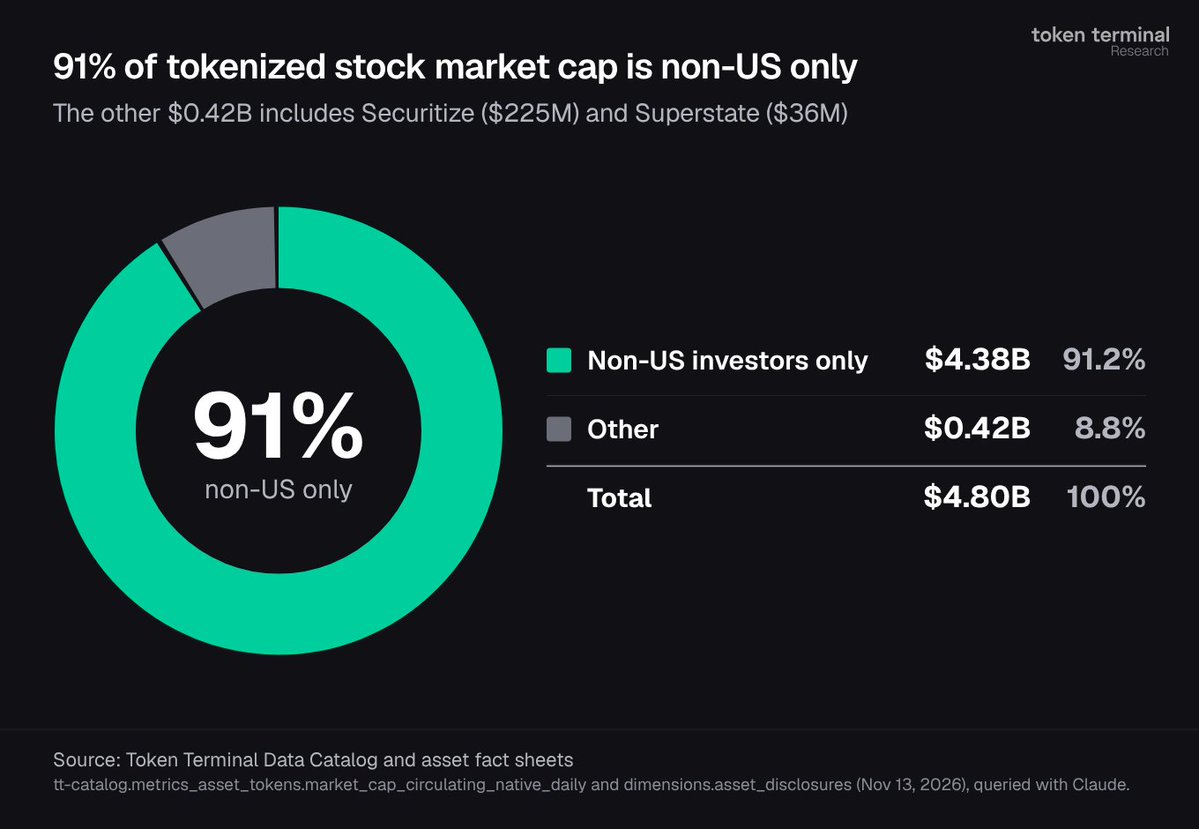
تمثل المنتجات غير الأمريكية فقط 4.38 مليار دولار - أي حوالي 91% - من القيمة السوقية للأسهم المرمزة، مما يؤكد أن الطلب على الأسهم المرمزة مدفوع بشكل كبير بالوصول من خارج الولايات المتحدة. من الناحية العملية، فإن معظم عروض الأسهم المرمزة هي أصول أمريكية تم تجميعها للمستثمرين خارج الولايات المتحدة، وهو ما يعكس الطريقة التي تعمل بها العملات المستقرة على توسيع نطاق التعرض للدولار خارج الحدود الأمريكية.
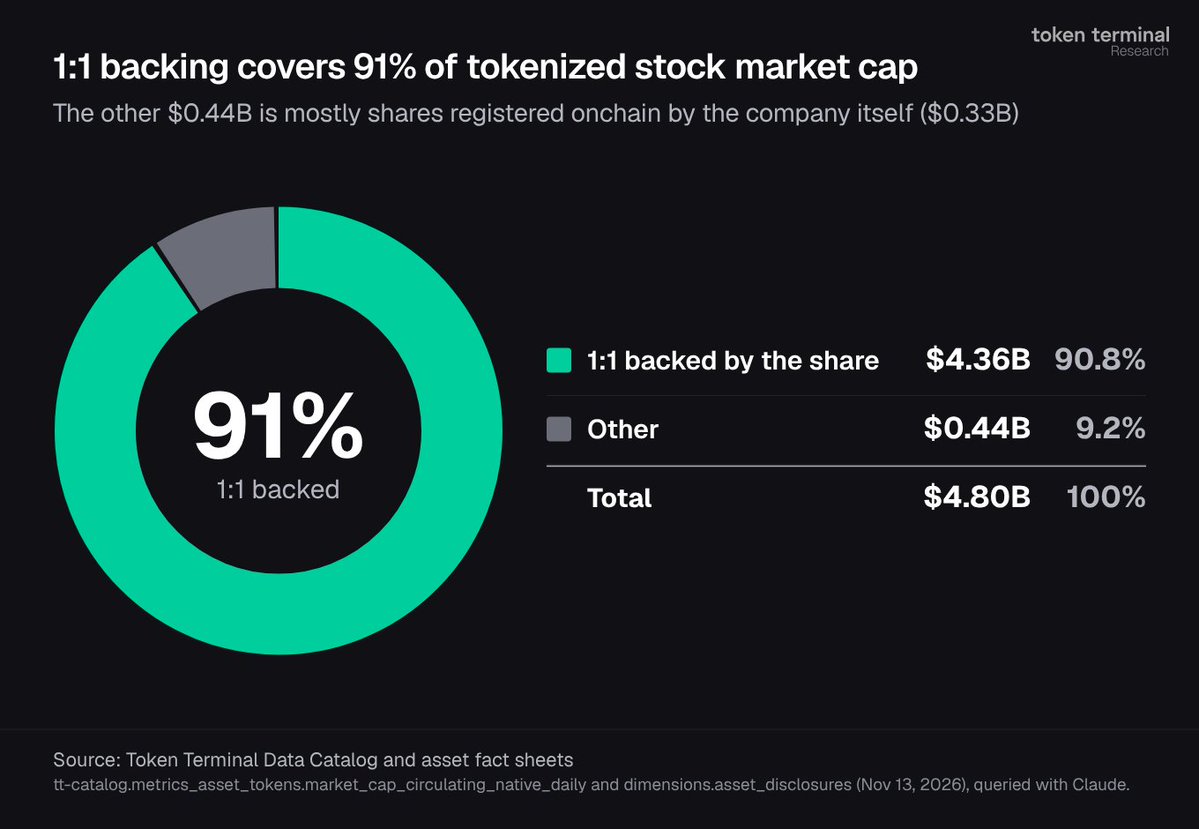
Tokenized stocks are still overwhelmingly 1:1 backed: products collateralized by underlying shares total $4.36B, representing 91% of the tokenized stock market cap. Supply growth is constrained by custody—minting additional tokens requires acquiring and holding more shares. In other words, rising usage and issuance of tokenized stocks mechanically translates into increased demand for the underlying equities.
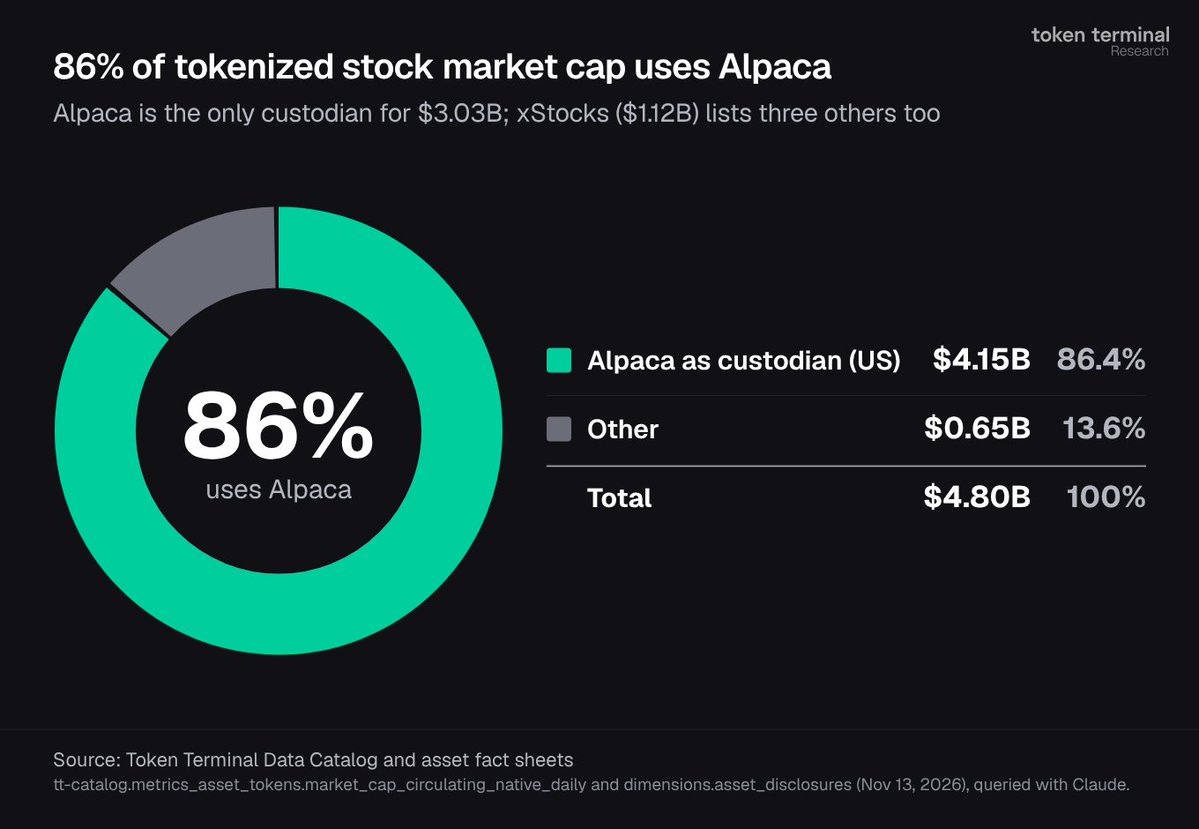
Products that designate U.S. broker Alpaca as custodian represent $4.15B in tokenized equities market cap—about 86% of the total—highlighting where custody demand and on-chain equity activity are concentrating as tokenized stocks scale. More broadly, tokenization is steadily pulling non-U.S. buyers into U.S. equities, with U.S.-based firms holding the underlying shares under U.S. regulatory oversight, reinforcing the infrastructure trend rather than a one-off move.
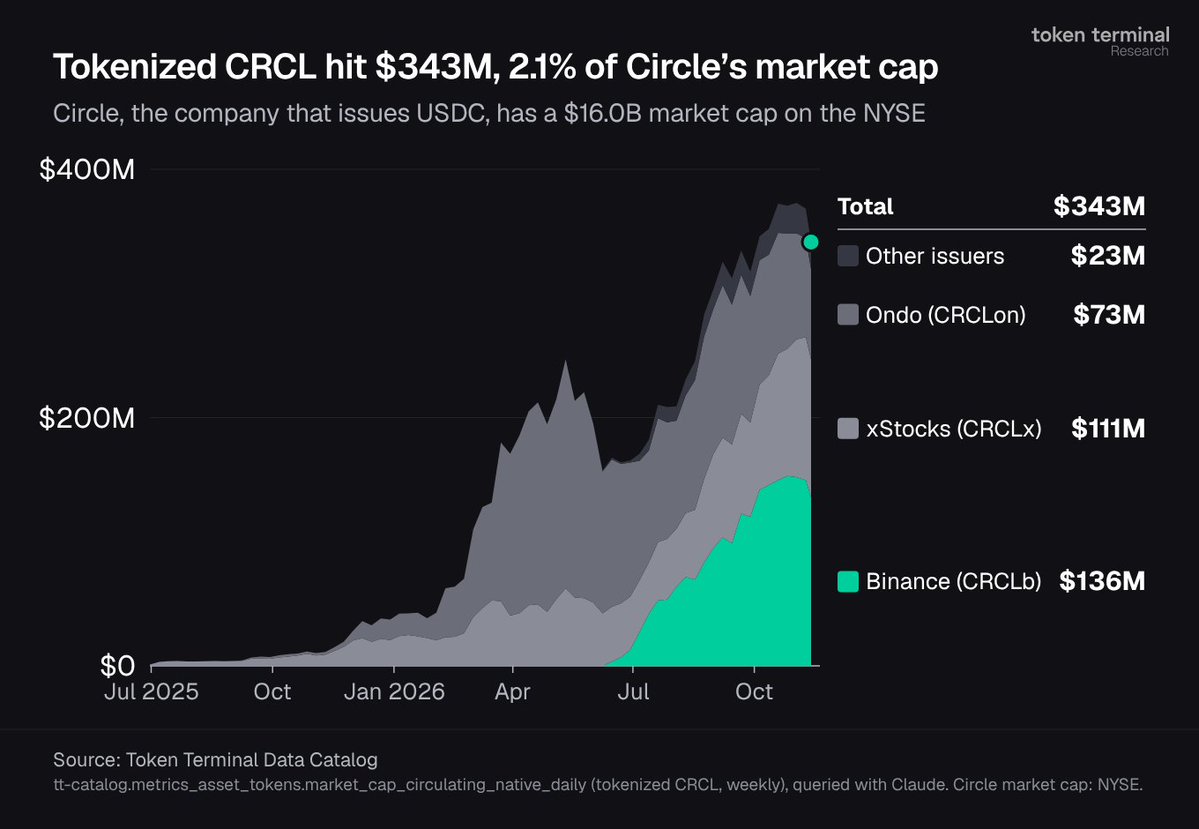
Tokenized Circle stock has grown to a $343M market cap, now roughly 2.1% of Circle’s total equity value—an early but notable signal of steady demand for onchain equity exposure. Issuance is concentrated among a few venues: Binance accounts for about $136M, with xStocks at $111M and Ondo at $73M, suggesting liquidity and distribution are forming around the largest rails. For non-U.S. investors, these products are increasingly becoming a practical alternative path to access Circle shares, pointing to a broader trend of tokenized equities gaining real usage rather than a one-off spike.
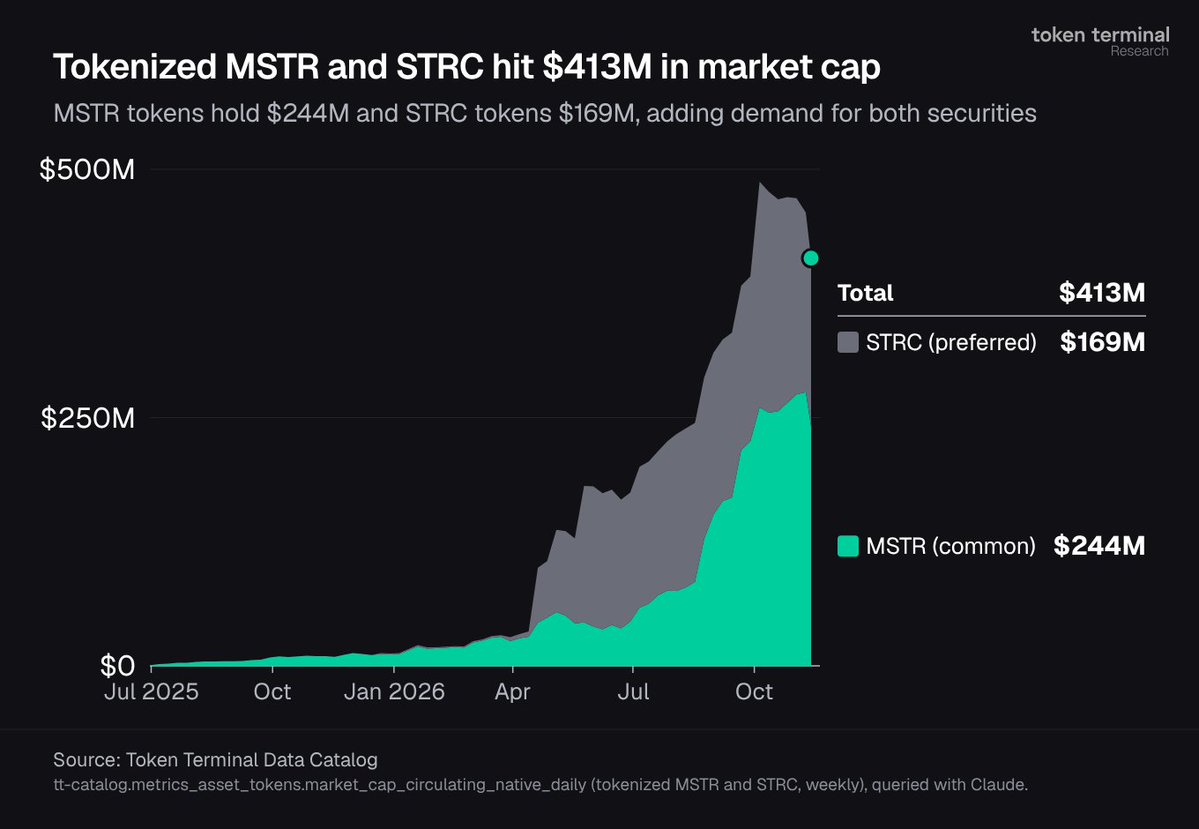
Tokenized Strategy equity products have grown to a combined ~$413M market cap, split between ~$244M in tokenized MSTR and ~$169M in tokenized STRC. Strategy continues to fund BTC accumulation by issuing both common and preferred shares, and the onchain wrappers are becoming a meaningful, incremental demand channel for those same financing instruments—reflecting a broader trend of tokenization expanding distribution and liquidity beyond traditional markets.
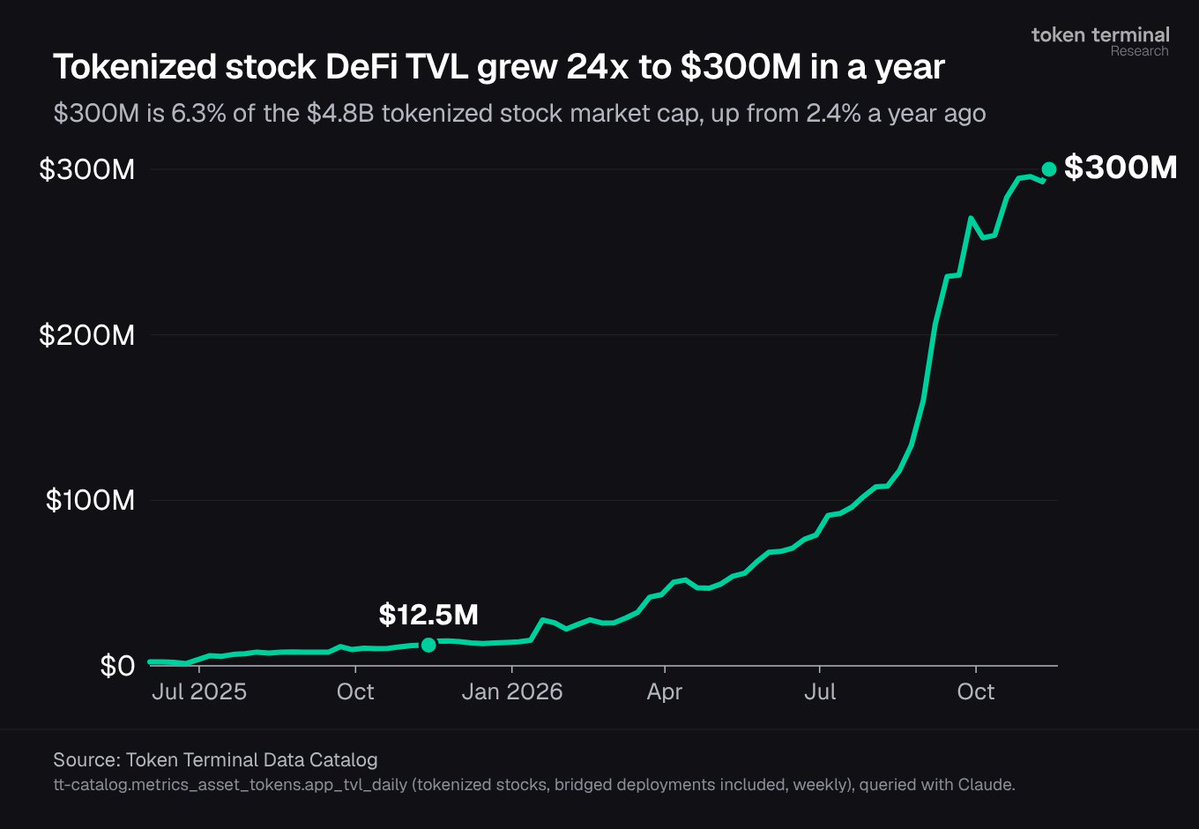
Tokenized stock deposits across DeFi venues have expanded sharply over the last year, rising 24x to roughly $300M. That growth is showing up in the fundamentals: DeFi deposits now account for 6.3% of total tokenized stock market cap, up from 2.4% a year ago—signaling deeper on-chain utilization rather than a one-off spike. As activity increases, tokenized stocks are being used more like productive collateral: investors can borrow against them or supply them into trading pools to earn fees.
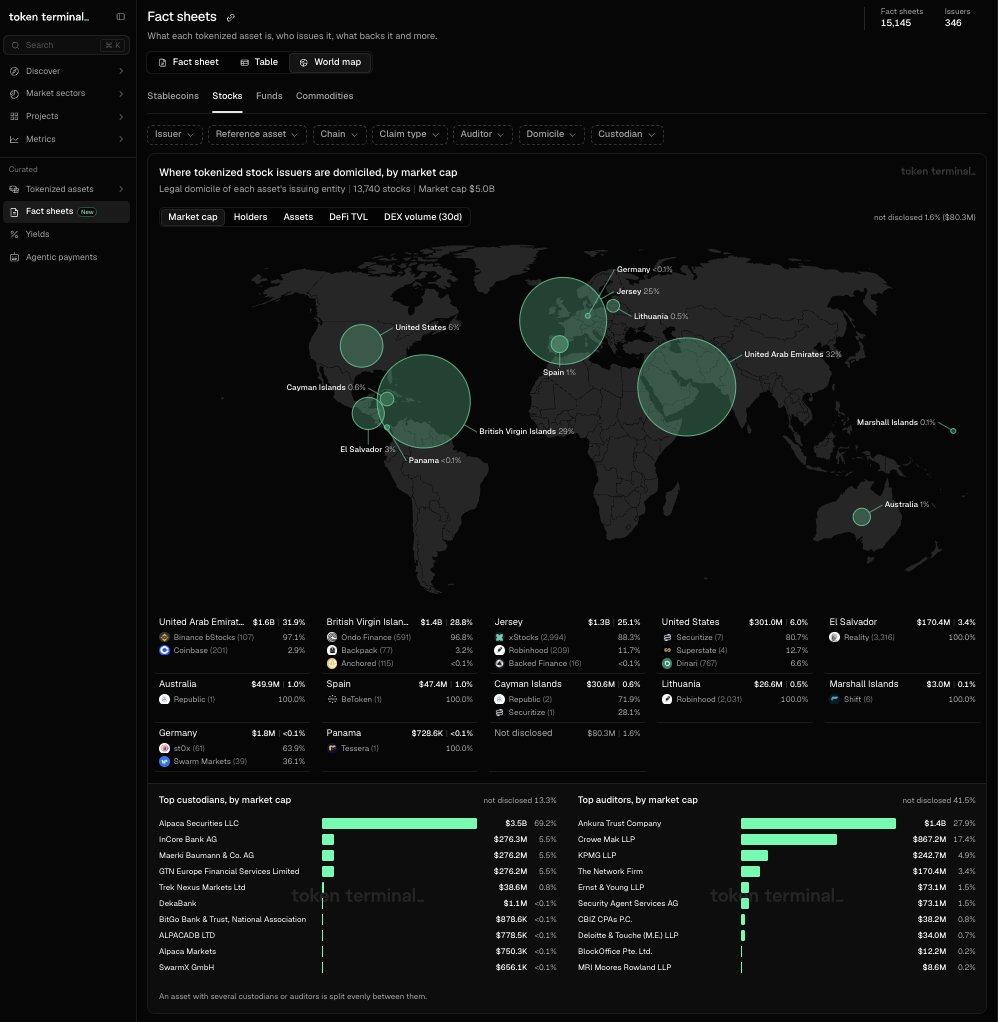
Across the globe, jurisdictions are stepping up efforts to attract top tokenized-asset issuers—competing to become the go-to base as on-chain issuance, transaction activity, and protocol-generated revenue continue to trend upward.
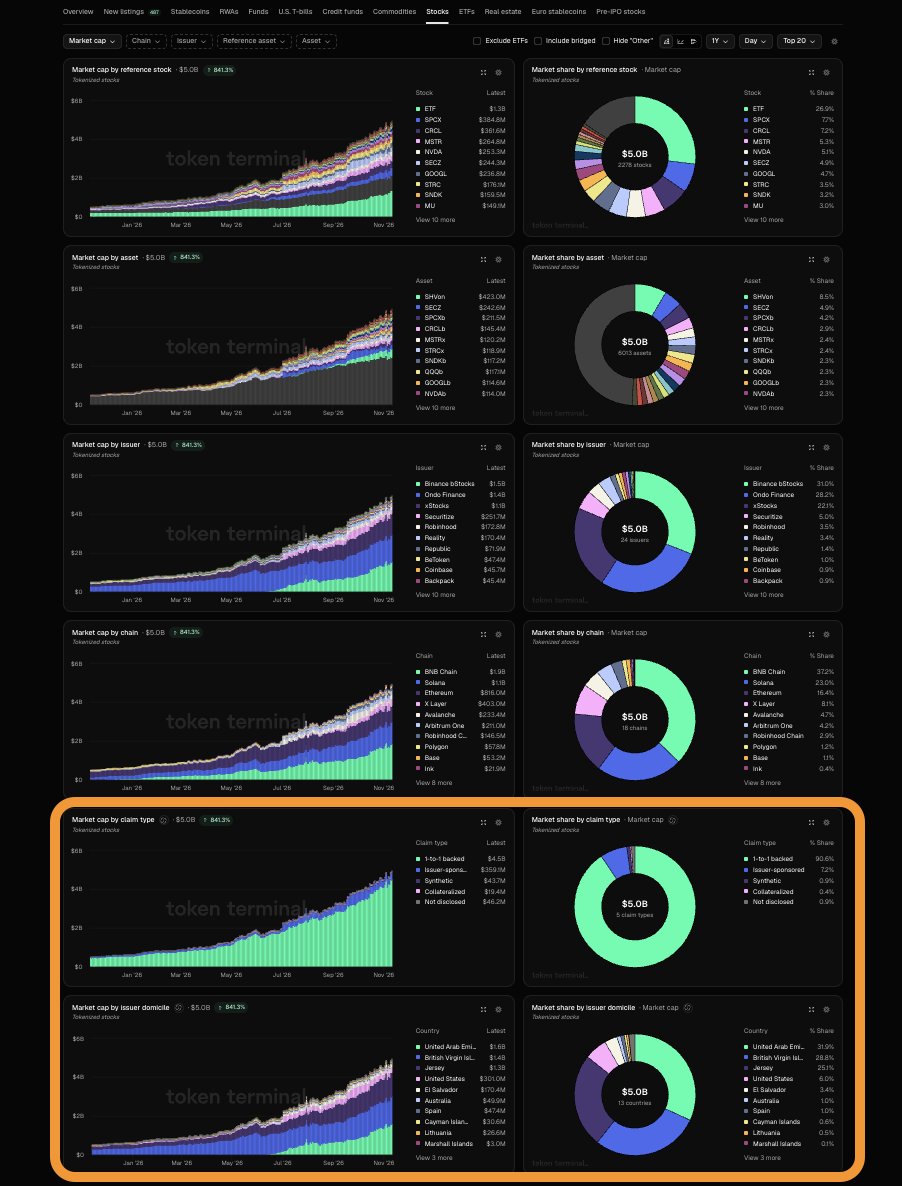
Fundamental Data update: we’ve added claim type and issuer domicile breakdown charts across all tokenized asset pages to make protocol revenue, usage, and user/transaction activity trends easier to read at a glance.
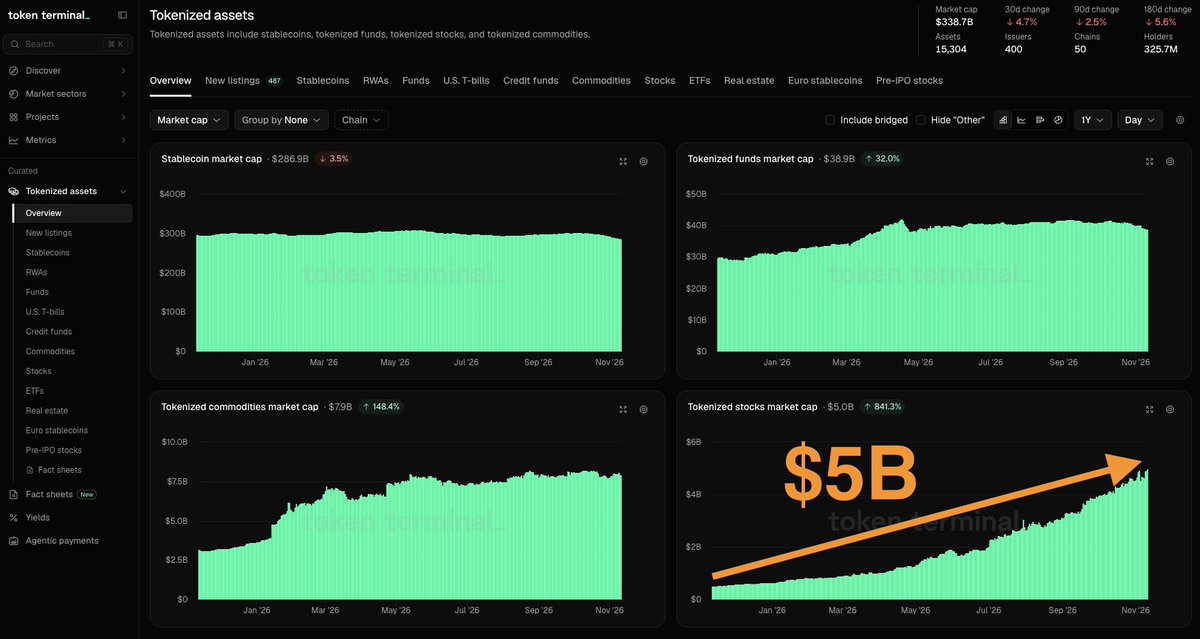
tokenized stocks are having a moment market cap just cleared $5B up ~9x YoY, pointing to rapidly rising usage and on-chain activity rather than a one-off spike
A few weeks ago, we rolled out a major expansion to Token Terminal Fact Sheets—standardized disclosures for tokenized assets that pair our onchain metrics with the legal, operational, and economic context behind each asset, so you can better understand what’s driving the underlying activity over time. Fact Sheets now have their own dedicated section on the platform:
Euro stablecoin supply has expanded sharply over the last 3 years, rising 4.4x from $213.0M to $931.4M—signaling sustained growth in euro-denominated onchain liquidity rather than a short-term spike. Circle’s EURC has been the main driver, contributing $517.5M (72% of total growth), with $312.4M of that increase occurring on Ethereum.
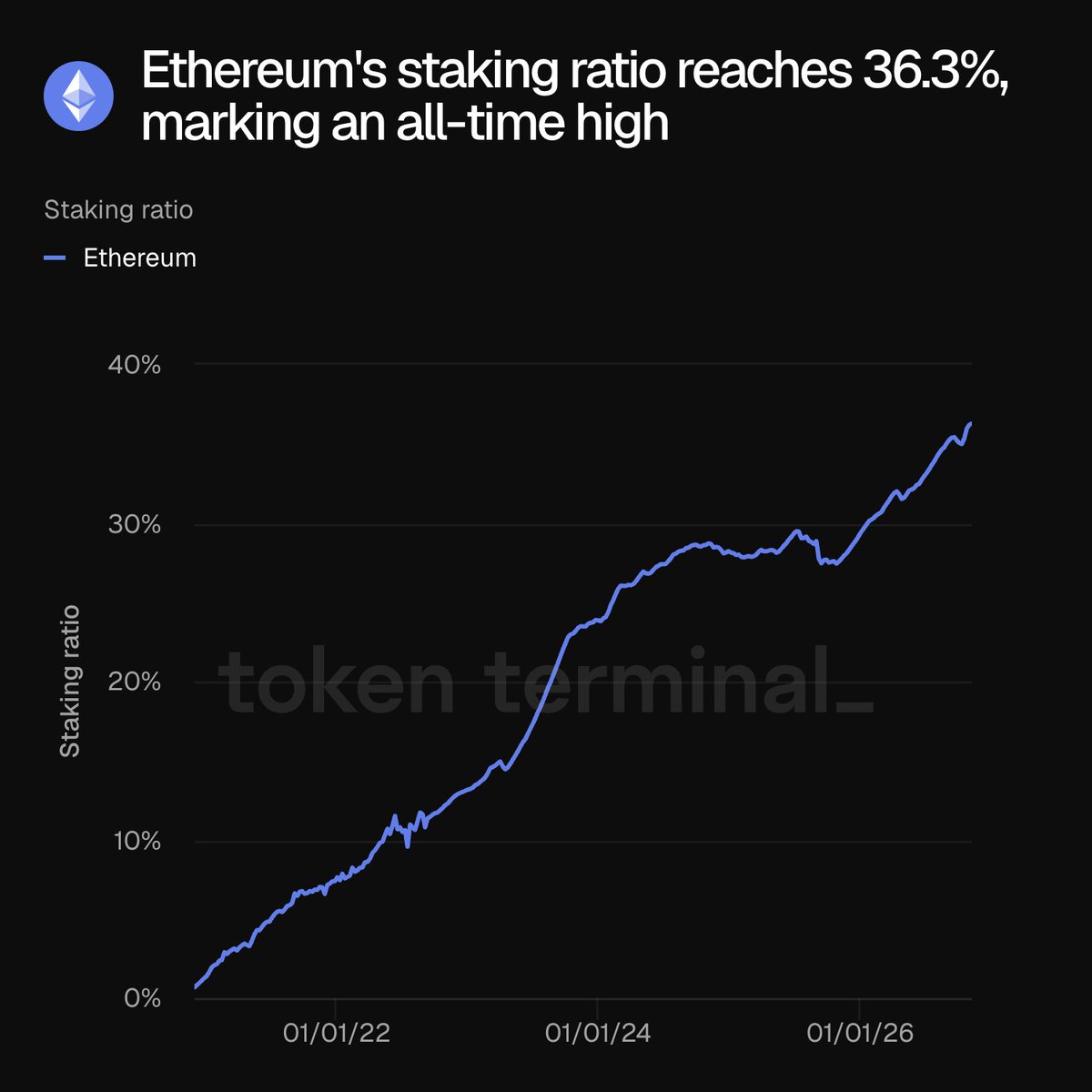
Ethereum’s staking ratio just hit a new all-time high at 36.3%. More of the ETH supply is now locked in staking, pointing to a steady shift in holder behavior: ETH is increasingly being treated as a long-term store of value rather than short-term liquidity.
Since July, Robinhood’s stock tokens have generated $14.9B in cumulative volume across Uniswap deployments on Robinhood Chain, spread over 49,060 pools—pointing to broad, sustained on-chain usage rather than a single venue driving activity. Volume hit a cycle high of $1.15B on Sep 4, and while the 7-day run-rate is now 86% lower, the bigger takeaway is how activity has normalized after an early spike. Liquidity is still relatively concentrated at the top: the largest pool (USDG-NVDA on v3) has done $1.36B in volume, accounting for 9.1% of total trading.
تشير الأساسيات إلى حيث تتركز الأنشطة: فإيرادات البروتوكول، والاستخدام، وتدفقات المستخدمين/المعاملات تتجمع حول الجهات المصدرة الرائدة—@bstocksfinance و@Ondo و@xStocksFi و@Securitize و@RobinhoodCrypto و@coinbase وغيرها. أما في جانب التمويل اللامركزي (DeFi)، فإن أحجام التداول المستدامة والمستخدمين المتكررين يظهرون بشكل أكثر ثباتاً على @pendle_fi و@Uniswap و@kamino و@Raydium و@aave و@PancakeSwap وغيرها.
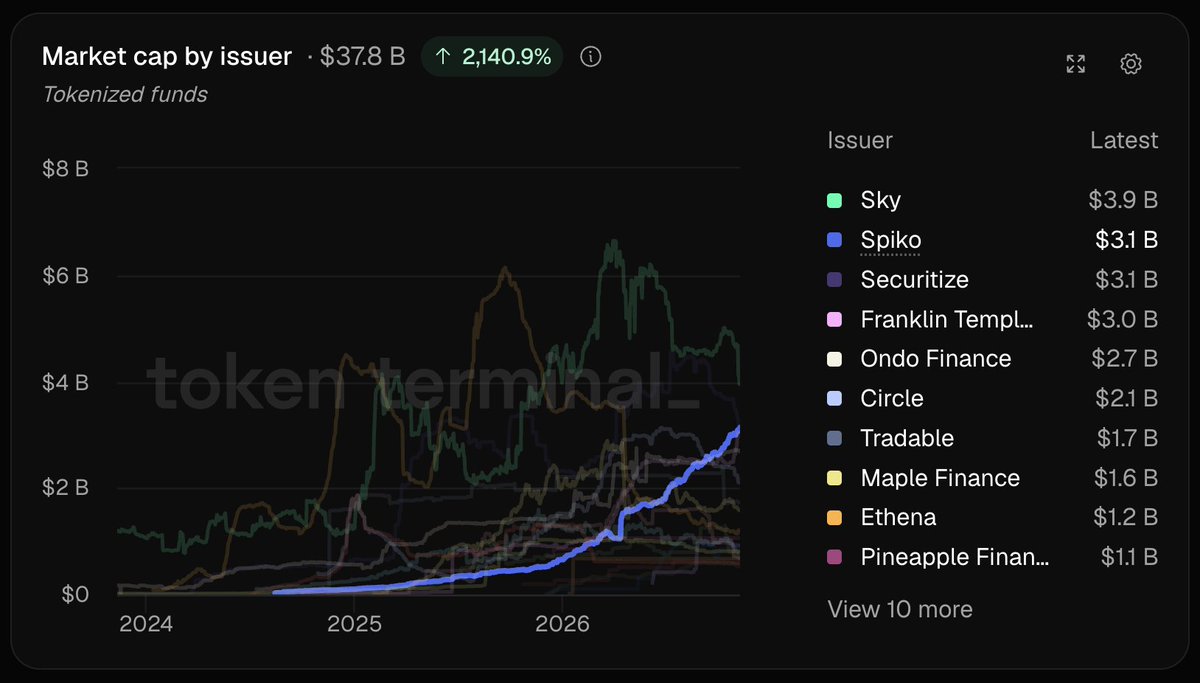
Spiko’s tokenized AUM has climbed to $3.1B, up from under $1B at the start of 2026—showing sustained growth in on-chain fund flows rather than a one-off spike. That steady expansion has pushed Spiko to #2 on the tokenized fund issuer leaderboard, trailing only Sky at $3.9B.
Tokenized stocks have surged 894% YoY, reaching $4.8B in total value—now the fastest-growing RWA segment by a wide margin. But it’s been hard to track the trend with confidence: standardized, granular fundamentals on issuance and on-chain activity have been limited. That’s what we’re fixing. Our dataset maps 5,859 tokens to 2,156 underlying equities, spanning 23 issuers and 18 chains—built to follow the category’s growth through real usage, not one-off price moves.