o
opentensor
97تسجيل الإعجاب0شارك في الدردشة9المعجبون0تابِع
يُعد الذكاء الاصطناعي اللامركزي وسيلة ضرورية للحد من هيمنة الهيئات التنظيمية، فهو يمنع احتكارات الذكاء الاصطناعي من استخدام القواعد والقيود لإقصاء المنافسة. تقدم Bittensor مساراً عملياً لبناء ذلك البديل، ولتمتلك فعلياً جزءاً مما تساعد في إنشائه.
One Bittensor subnet alone is driving almost $35M in annualized GPU rental spend. @lium_io is quickly emerging as a real contender in the cloud compute market.
Bittensor’s @chutes_ai trained Parallax 8B on hundreds of consumer GPUs spread across the globe. And in their latest preview, it’s taking on 256 AI requests at the same time—on a single gaming GPU. AI compute isn’t going to live only inside massive data centers.
تُعد عملة TAO الخاصة بـ Bittensor شبكة ذكاء اصطناعي لامركزية، تعمل من خلال آلية "الشبكات الفرعية" (subnets) على إشراك نماذج الذكاء الاصطناعي المختلفة في منافسة ضمن مجموعة موحدة من القواعد، حيث تحصل النماذج ذات الأداء الأفضل على مكافآت.
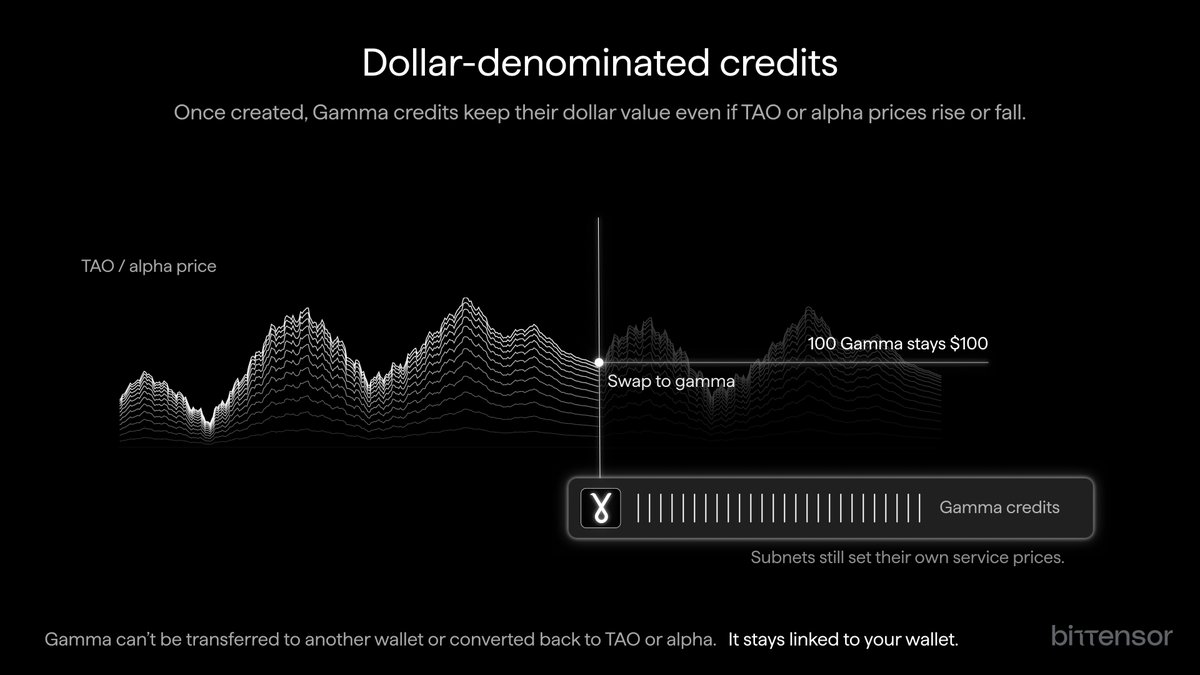
بمجرد إصدارها، تحتفظ أرصدة Gamma بقيمتها بالدولار الأمريكي بغض النظر عن تقلبات أسعار TAO أو alpha. يستمر مقدمو الخدمة في تحديد وتعديل أسعارهم الخاصة. لا يمكن تحويل Gamma إلى محفظة أخرى ولا يمكن استبدالها مرة أخرى بـ TAO أو alpha.
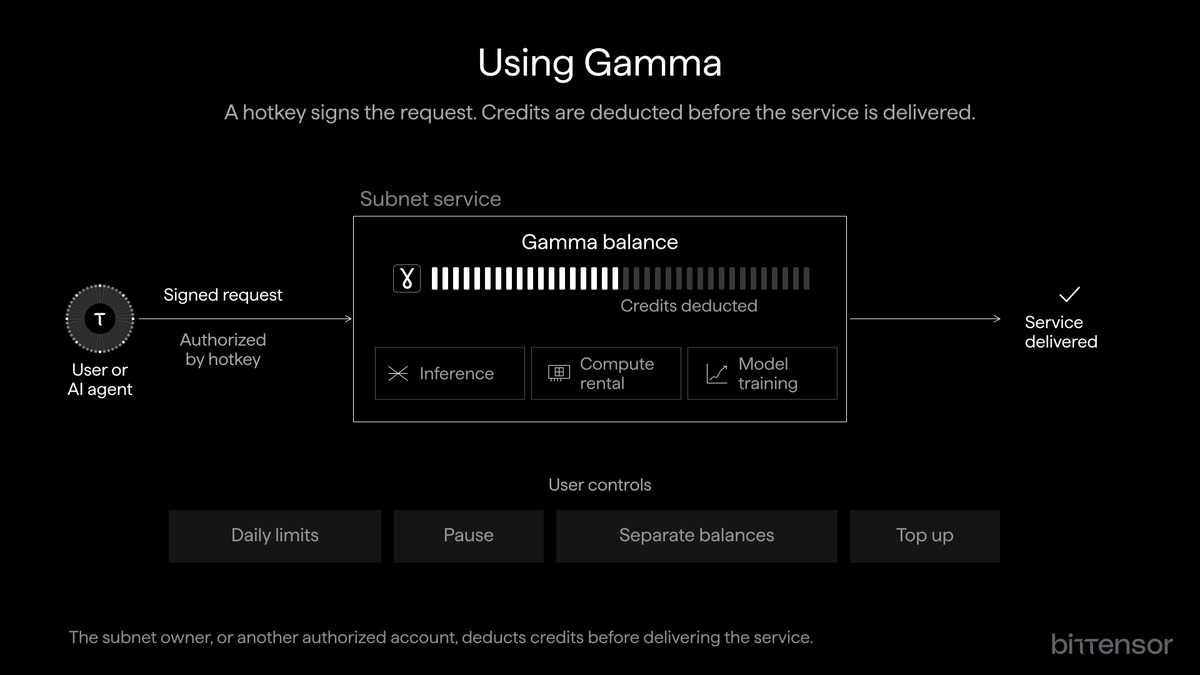
To use a subnet’s service, a user (or an AI agent) sends a request signed with a hotkey from their Bittensor wallet. Before the service is provided, the subnet owner—or any account they’ve authorized—charges the needed credits by subtracting them from that hotkey’s Gamma balance. Users can cap how much they spend per day, temporarily stop deductions, or split funds across different apps and AI agents with separate balances. They can also add more credits anytime without switching hotkeys.
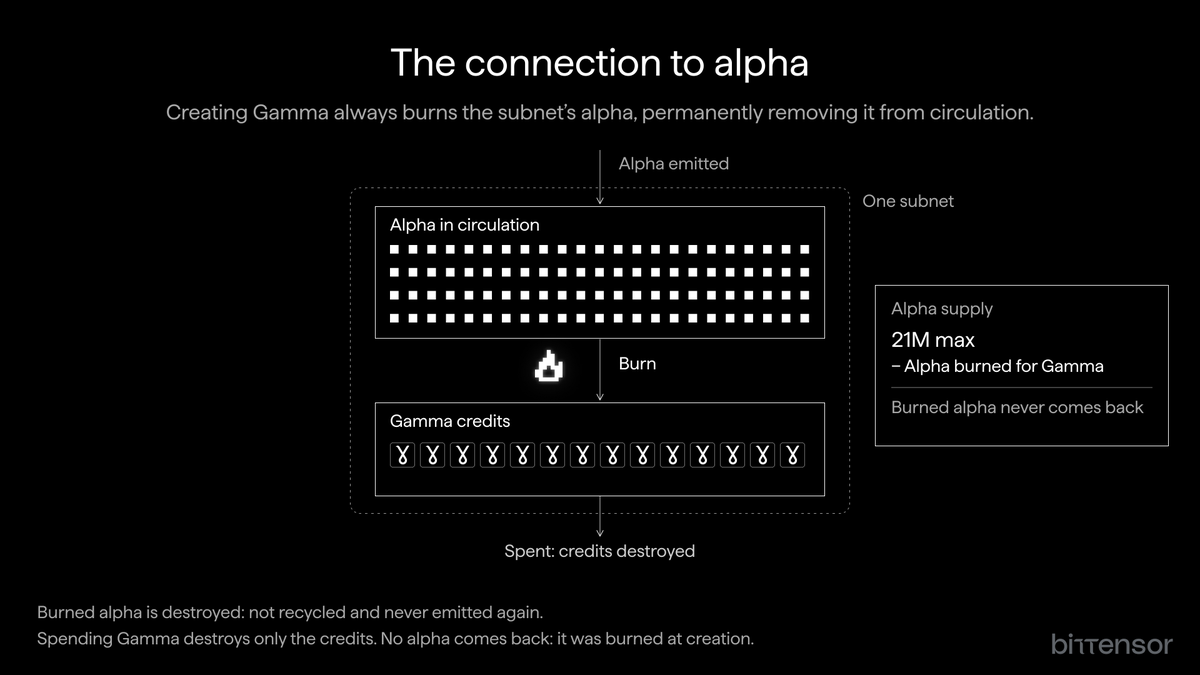
Minting Gamma always burns the subnet’s alpha, taking those tokens out of circulation for good. If a customer pays in TAO, the protocol first uses that TAO to buy alpha from the subnet’s pool. So whenever someone buys a subnet’s service credits, it directly triggers an alpha burn. Both the minting of credits and how they’re spent are written on-chain and visible to everyone.
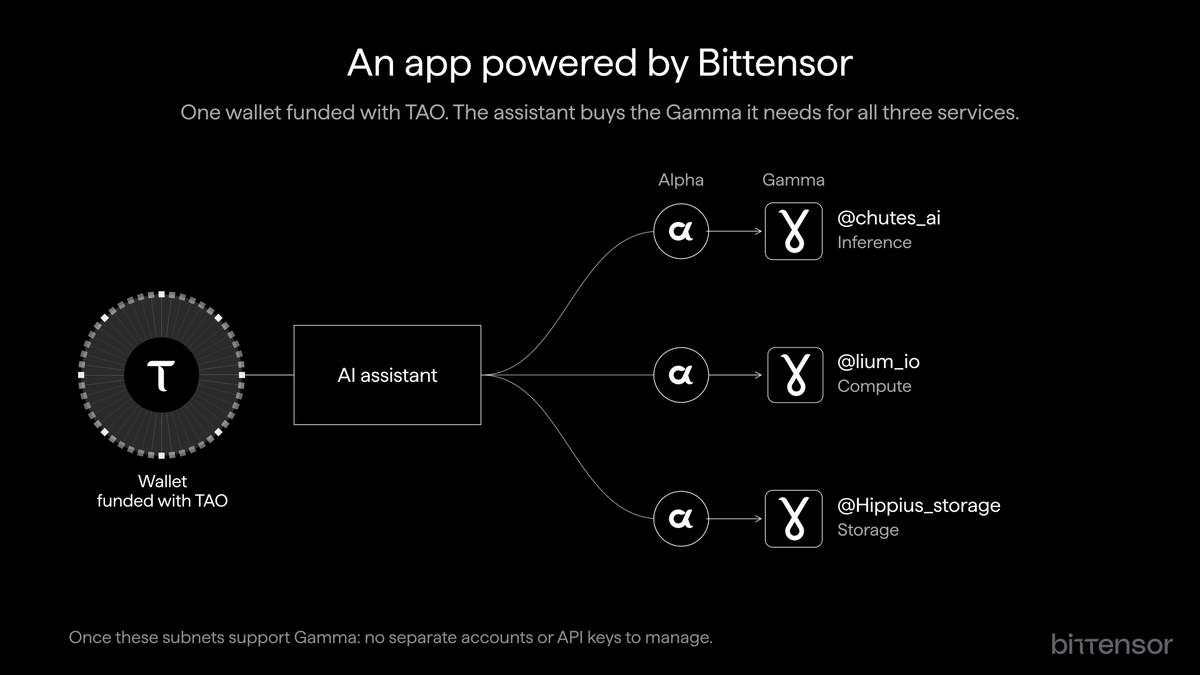
An AI assistant could route inference through @chutes_ai, spin up compute on @lium_io, and save files with @Hippius_storage. When these subnets add Gamma support, users can simply hook up a Bittensor wallet loaded with TAO, and the assistant will purchase the Gamma credits it needs across all three services. No need to leave the app to create separate Chutes/Lium/Hippius accounts, juggle API keys, or even care which subnets are running behind the scenes.
Providers on a subnet can post on-chain links to their services, making it easy for developers and AI agents to discover and use them. Gamma offers builders a straightforward, shared way to access those services and handle payments. The goal is to turn Bittensor into the go-to backend for AI products that anyone can build on and use.
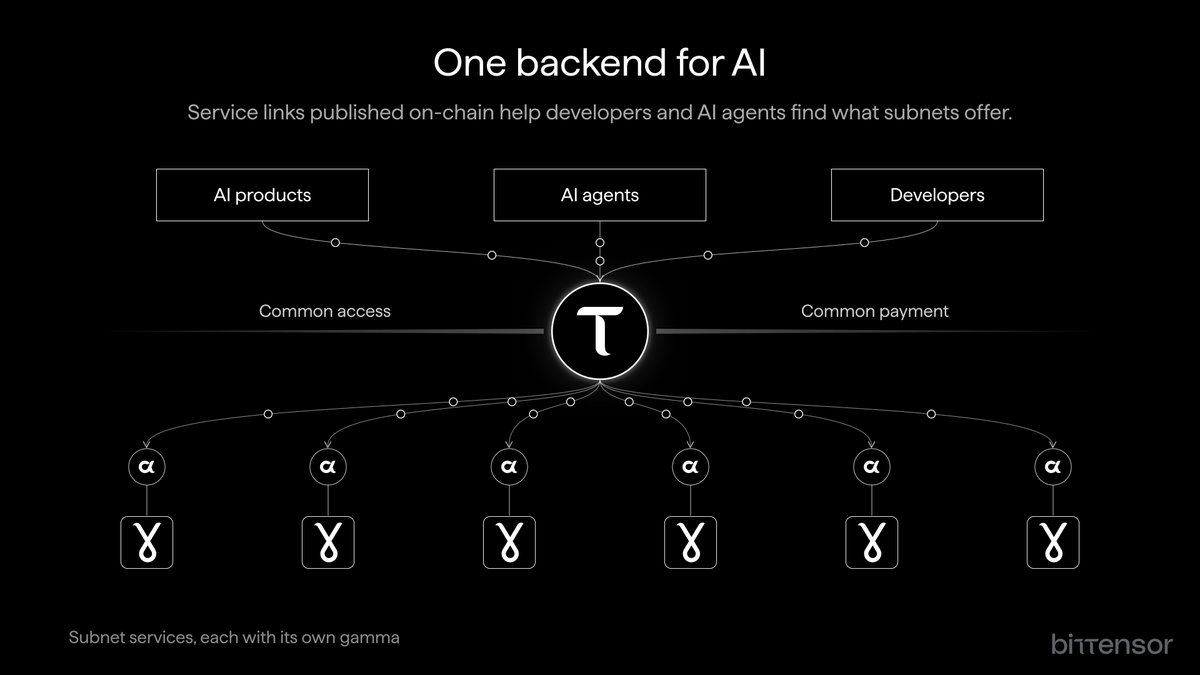
Introducing Gamma Tokens A built-in way to pay across Bittensor’s AI economy. With a Bittensor wallet, users and AI agents can tap into subnet services and pay on the spot—no need to set up separate accounts or juggle API keys for every subnet.

Google Drive now has a decentralized rival built on Bittensor. Hippius_cloud’s encrypted storage app is officially live on both iPhone and Android.
Building decentralized AI on Bittensor (TAO) — a decentralized AI network where subnets let different models compete for rewards? Apply for the Hacker House in Bangkok this December. We’re co-hosting with @injective. Applications close tomorrow!
Bittensor 的 TAO 本质上是在做一张“去中心化的 AI 网络”。它不是把算力和模型都集中到某一家平台,而是用子网(subnet)的结构把不同类型的 AI 能力拆开来跑:有人做推理、有人做训练、有人做数据、有人做工具……每个子网就像一个赛场。 在这个机制里,模型和服务提供方要靠真实表现说话——谁的输出更好、更稳定、更有价值,谁就能在竞争中拿到更多奖励;表现差的自然会被边缘化,收益也会下降。TAO 的作用则是把这种“用结果定收益”的激励系统串起来,让参与者愿意持续投入算力、模型和优化。 简单说,Bittensor 想做的是:用市场化的竞争和奖励,把分散的 AI 能力组织成一个开放网络,让模型之间在同一套规则下互相较量、不断迭代。
Bittensor 的 TAO 是一个去中心化的 AI 网络,核心思路是用“子网”把不同类型的 AI 模型组织起来,让它们在各自的赛道里互相竞争、比拼效果;表现更好的模型就能拿到更多奖励。
Bittensor 子网 @chutes_ai 已与 Tencent Cloud 达成合作。 作为 @TencentHunyuan 全新旗舰模型 Hy4 的首批上线伙伴之一,Chutes 现已通过 API 提供 Hy4 接入。 在 Bittensor 上,第一时间用上顶尖 AI 模型早已是常态。
In just 24 hours, four Bittensor subnets helped push the AI frontier forward. In the latest Novelty Search, @const_reborn spotlights standout progress from @MacrocosmosAI, @trishoolai, @reliquary_ai, and @chronollm—spanning decision models, AI safety, decentralized training, and historical LLMs. Researchers from ChronoLLM, REAX, and Reliquary also jump in to share fresh findings and results. Full episode in the first comment.
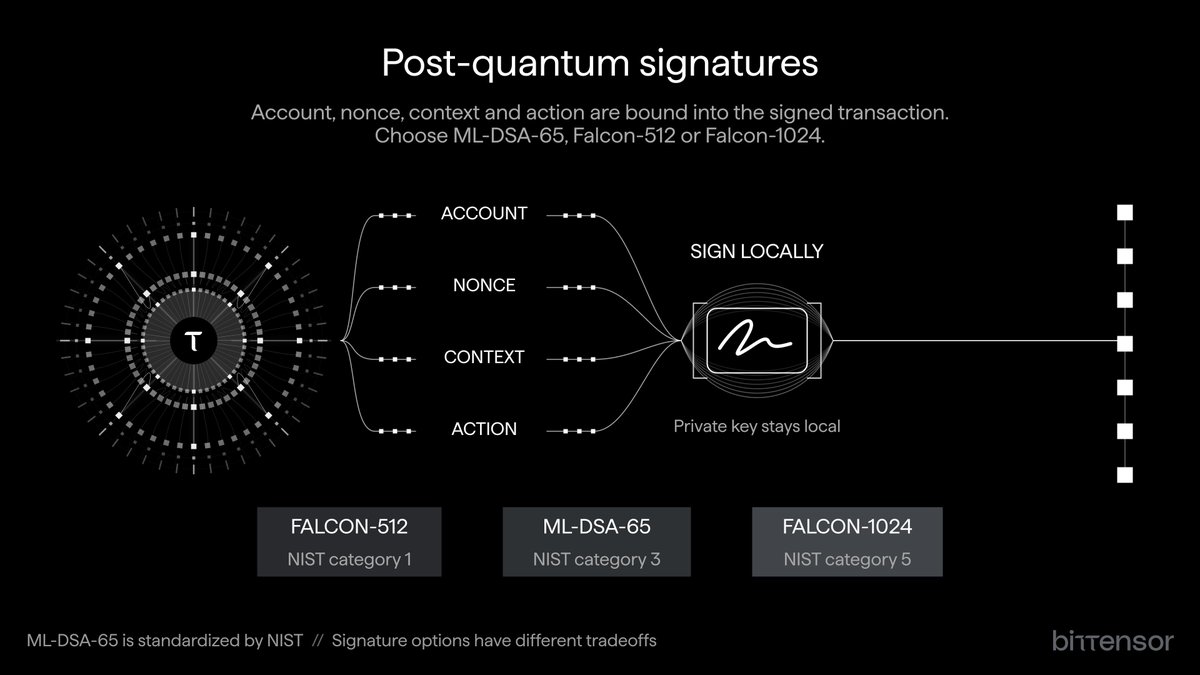
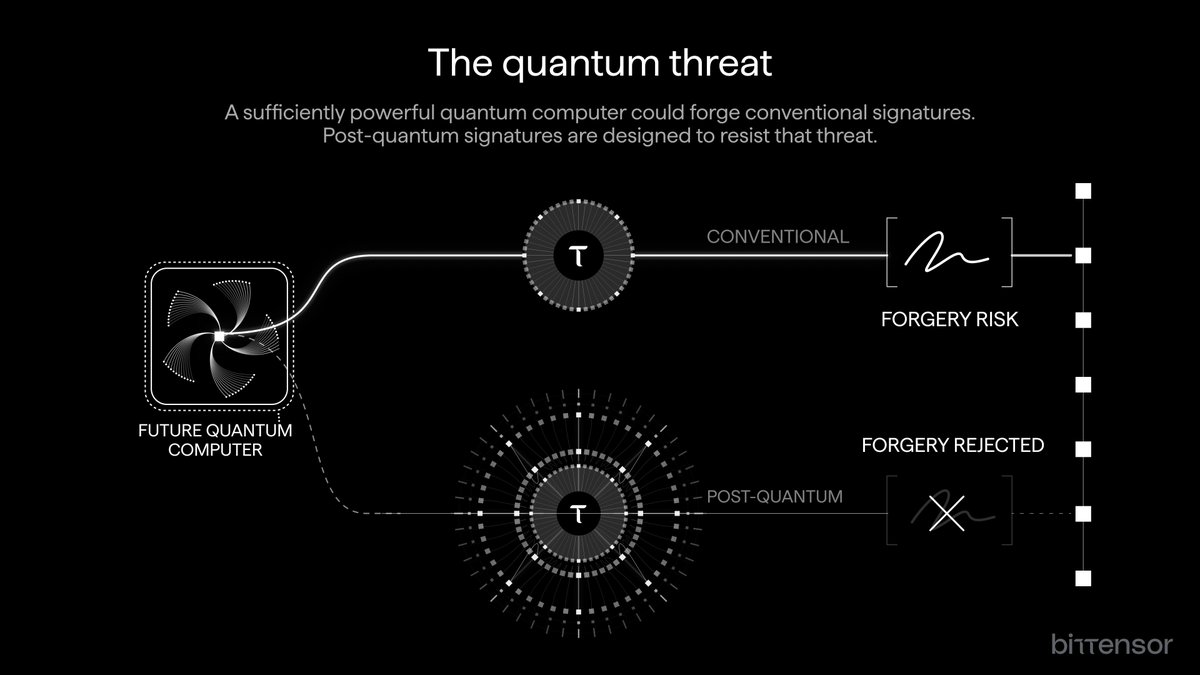
Bittensor has rolled out quantum-resistant wallets. With AI reigniting questions around cryptographic security, users now get post-quantum signature support—plus an option to automatically rotate and replace their signing keys.
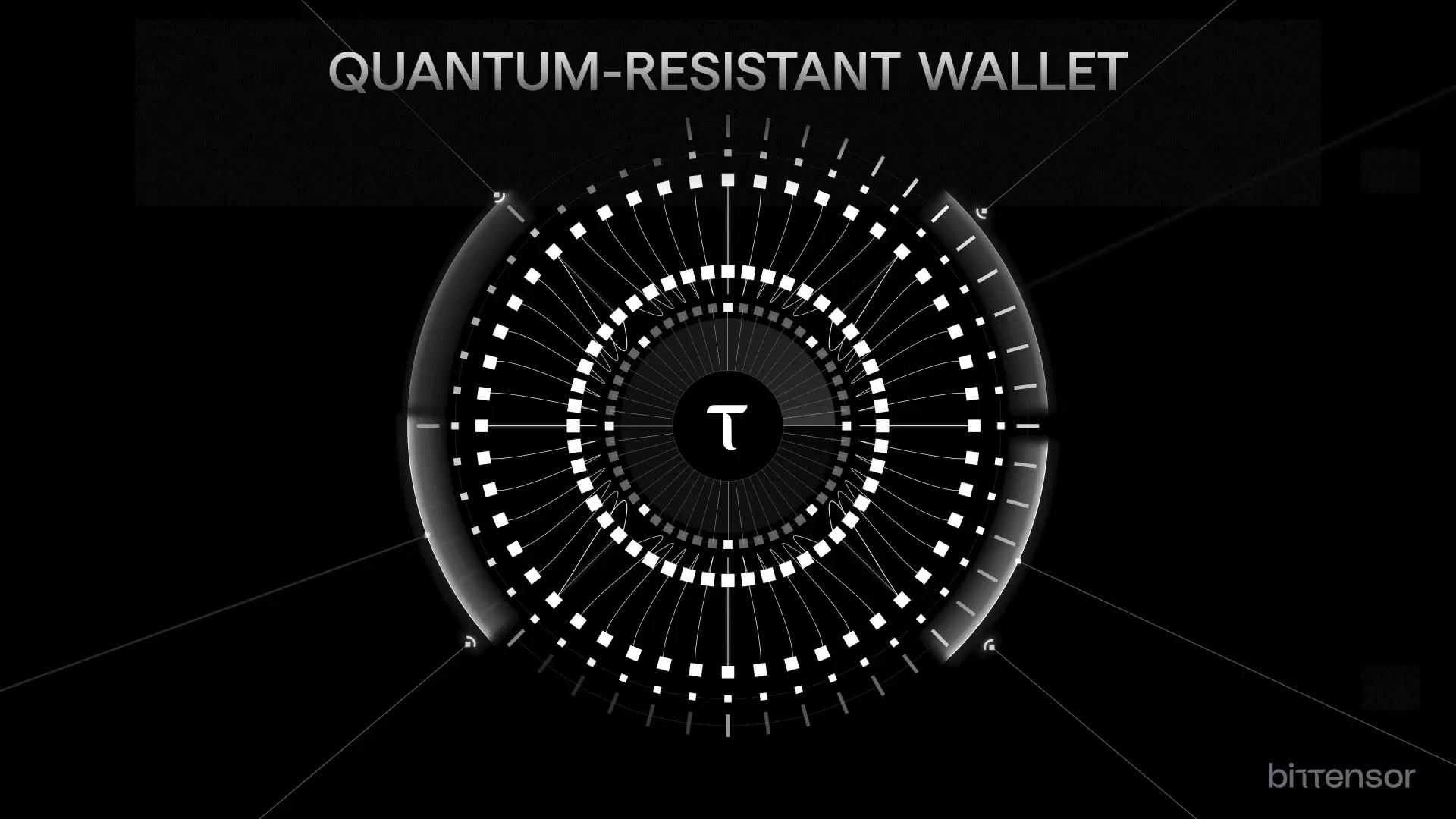
In October, a wave of AI-generated mathematical research sparked worries that conventional digital signatures could be vulnerable to new kinds of attacks. There’s also the quantum angle: if someone gets their hands on a powerful enough quantum computer, they could potentially forge signatures and approve transactions as if they were the legitimate account owner. That’s why post-quantum signatures exist—they’re built to hold up even against quantum-enabled attacks.
Bittensor’s quantum-resistant wallets come with three post-quantum signature choices: ML-DSA-65, Falcon-512, and Falcon-1024. ML-DSA-65 is a NIST-standardized scheme from the U.S. National Institute of Standards and Technology. Each option makes different trade-offs between security strength, signature size, and signing performance.