MAXJOHNS
5264Like0Shares122Fans222Follow
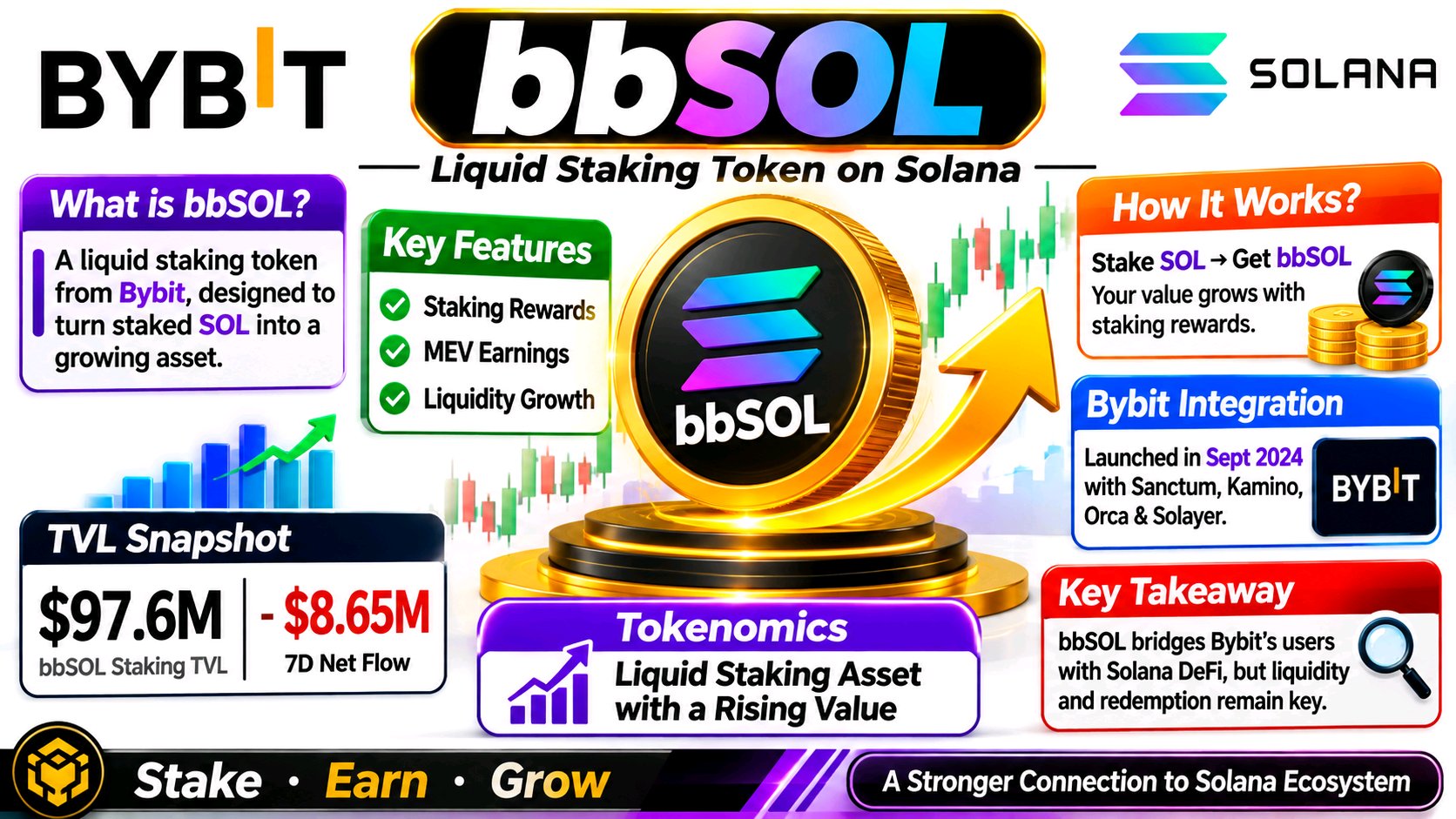
What stands out about bbSOL is that its real value is not simply earning Solana staking rewards. The more important question is whether Bybit can turn a centralized exchange's user base into sustained liquidity across Solana DeFi. That distinction matters because bbSOL is not an independent blockchain or a conventional governance token. It is a liquid staking asset issued through Bybit, with its value designed to appreciate against SOL as staking rewards accumulate. What caught my attention about bbSOL is the gap between its institutional story and the liquidity actually moving through its markets. Bybit introduced bbSOL in September 2024 with Sanctum, Kamino, Orca and Solayer. The product turns staked SOL into a liquid receipt: staking rewards, MEV and liquidity-related earnings accrue through a rising bbSOL-to-SOL exchange rate rather than regular cash payouts. Bybit’s documentation also makes the trade-off clear: a 0.1% deposit fee applies, and larger redemptions can take an epoch, roughly two to three days. So “liquid” does not mean frictionless under every condition. prnewswire.com +2 The more interesting development is distribution. Bybit announced Anchorage Digital custody support in October 2025, potentially making bbSOL easier for institutions to hold. But institutional access is not the same as institutional demand. DeFiLlama’s latest snapshot lists roughly $97.6 million in bbSOL staking TVL and an approximately $8.65 million negative seven-day net flow. That suggests capital has recently been leaving, despite the expanded custody route. Bybit Press +1 This is the tension traders should focus on: bbSOL’s value proposition depends on SOL staking economics, but its market quality depends on redemption confidence and usable DeFi liquidity. A yield-bearing token can still trade with meaningful slippage or discount if exits become crowded. I would watch net flows, bbSOL/SOL pricing, pool depth and redemption conditions before treating new integrations as adoption. The key question is whether institutional access turns into persistent on-chain liquidity—or remains mostly a distribution headline. #ByXIMPACT $BBSOLUSDT
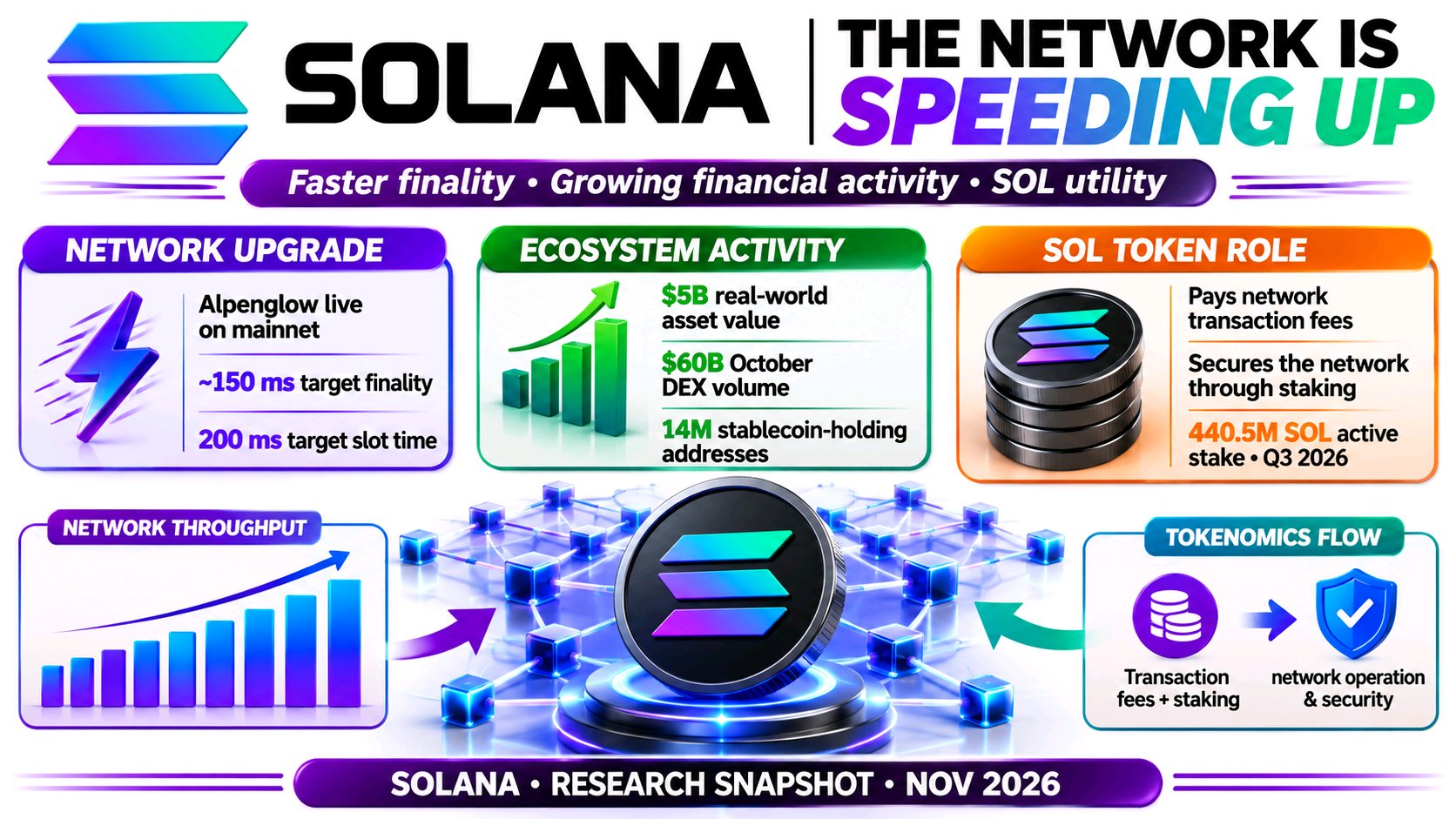
What stands out to me about Solana right now is the difference between its underlying network activity and the pressure building around SOL in the market. The two are not moving in the same direction, and that distinction deserves attention. Solana’s infrastructure has continued to develop: Alpenglow reached mainnet in October, targeting finality of roughly 150 milliseconds, while target slot times fell to 200 milliseconds. The Foundation also reported $5 billion in real-world asset value and $60 billion in DEX volume for October. DeFiLlama now shows about $4.6 billion in DeFi TVL, $13.96 billion in stablecoins and 2.33 million active addresses in 24 hours. That is meaningful activity, but it does not make SOL immune to market pressure. SOL has been trading around $72, down roughly 16% in seven days. Futures open interest stands near $4.1 billion, down 8.45% in 24 hours, while liquidations reached about $89 million, mostly from longs. Solana DEX volume is also down around 19% week over week, with perpetuals volume falling about 37%. Traders appear to be cutting risk as on-chain trading cools, rather than abandoning the network altogether. I would watch whether TVL, stablecoin supply and active addresses stabilize, while spot demand returns and open interest rebuilds without excessive leverage. Alpenglow and institutional tokenization are meaningful milestones, but sustained usage and liquidity still need to translate into durable demand for SOL. That gap is the part I’m watching. #ByXIMPACT $SOLUSDT
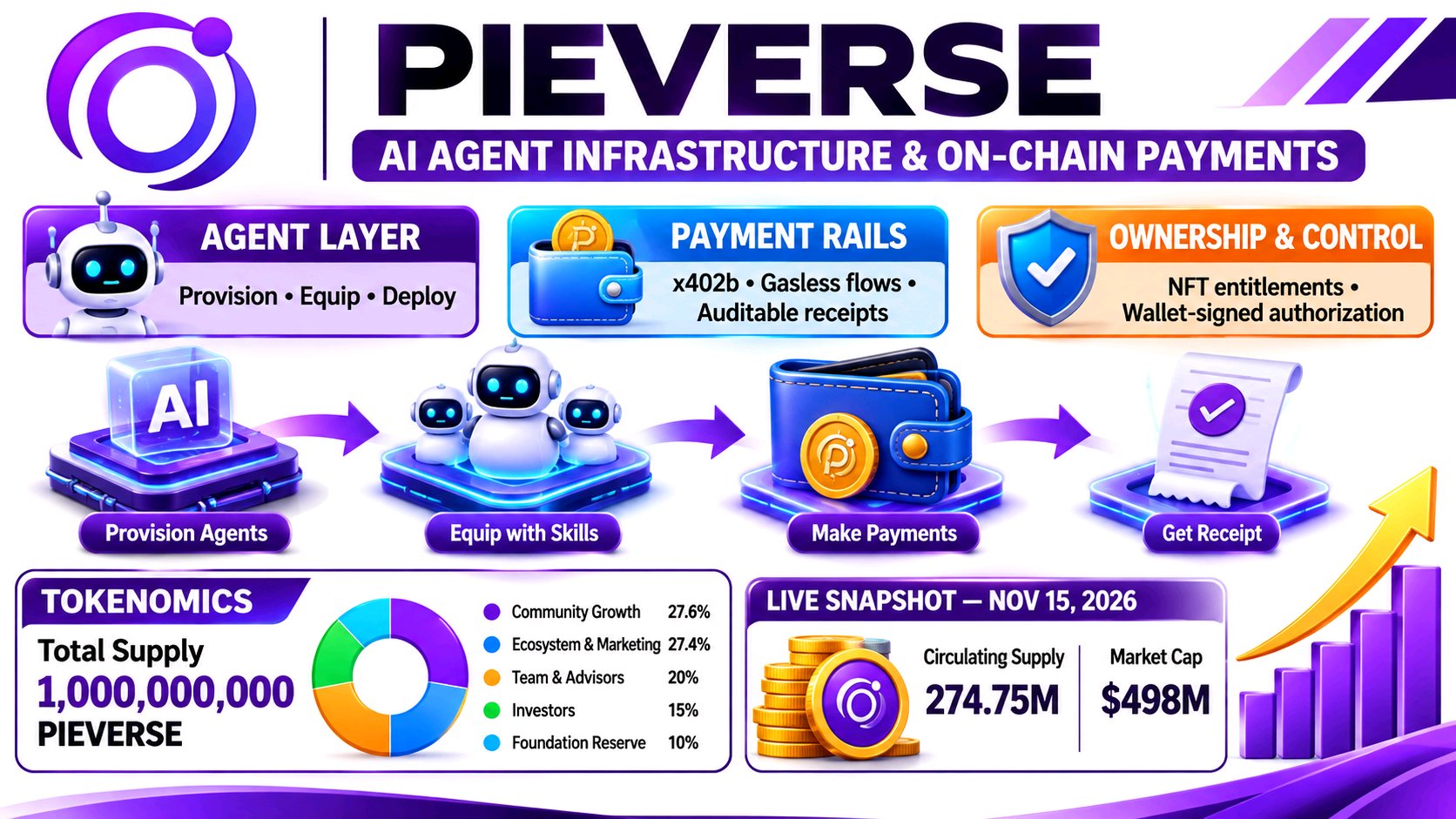
What stands out in Pieverse is the timing: its market valuation has expanded sharply just as the project reaches an important transition in token distribution. The interesting question is whether ecosystem adoption can keep pace with the supply entering circulation. What caught my attention in Pieverse is the collision between a fast-growing AI-agent story and a major change in token supply. The project’s current site describes tools for provisioning Web3 agents, equipping them through a Skill Store, and verifying ownership with NFT entitlements. Its earlier whitepaper focused more heavily on gasless, auditable agent payments, so the product direction is evolving rather than standing still. Pieverse +1 Agents need wallets, permissions, payment rails and usable services, not just better models. Pieverse is trying to connect those pieces, and its November 11 partnership with Four.meme points toward distribution through BNB Chain’s on-chain launch ecosystem. But a partnership announcement is not proof of recurring users or fee revenue. X Web Viewer +1 That distinction matters now because the token’s one-year lockup ended on November 14, with team, advisor and investor allocations beginning linear vesting. Those groups represent 35% of the fixed one-billion supply. The exact first release amount is not clearly stated in the reporting, so I would avoid treating headline unlock estimates as confirmed circulating supply. Coinranking +1 Market positioning adds another layer. CoinGecko showed PIEVERSE around $1.81, roughly 19% below its $2.23 all-time high, while perpetual open interest was about $86 million and around 17% of market cap; funding remained positive. That suggests derivatives activity is meaningful beside spot demand. CoinGecko I would watch whether spot volume absorbs newly available tokens, whether open interest cools, and whether agent usage produces measurable fees. Can adoption grow faster than dilution? #ByXIMPACT $PIEVERSEUSDT
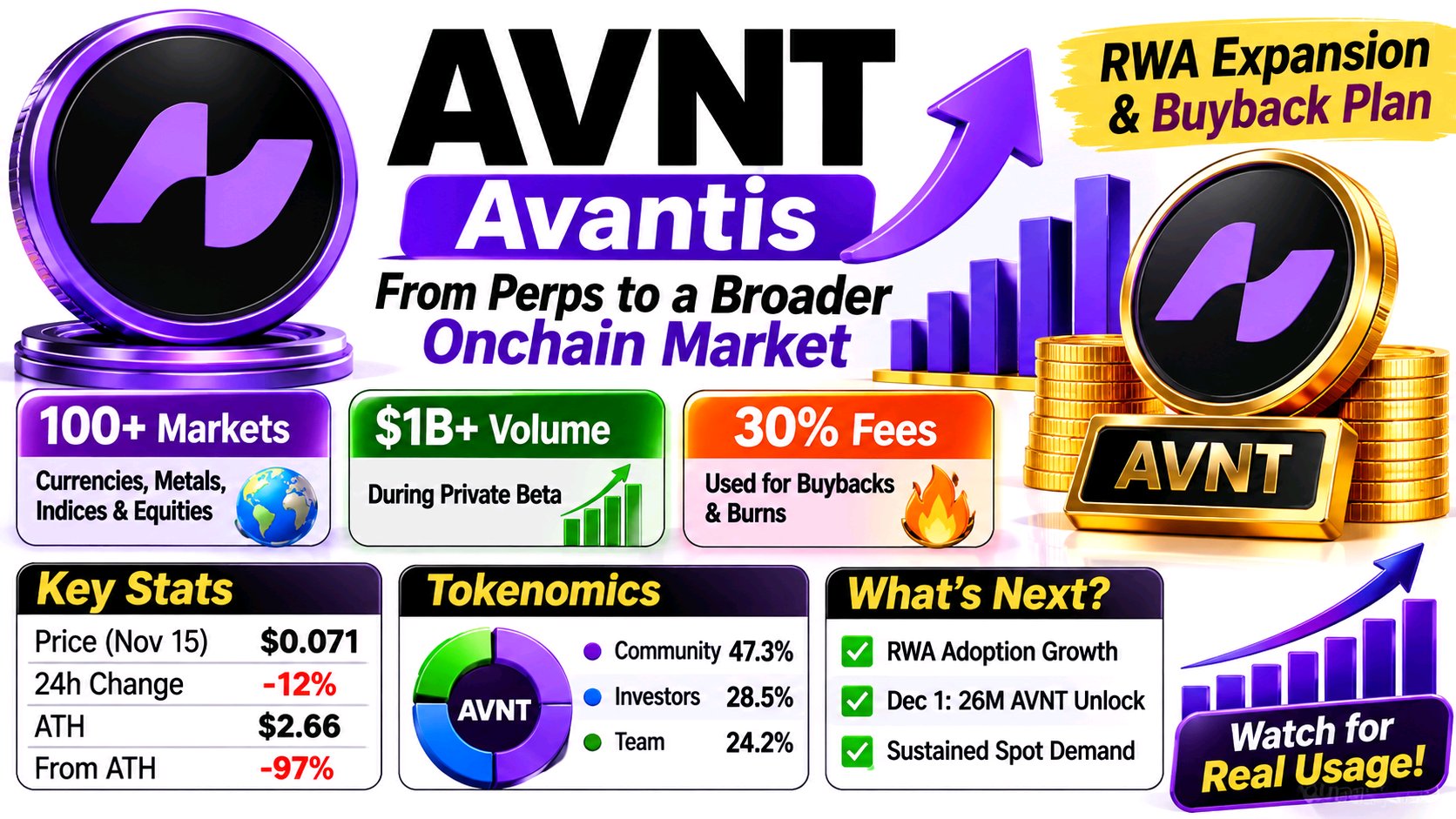
What caught my attention in AVNT is the gap between the exchange’s expanding ambition and the token’s market behaviour. Avantis is now Veranta, but the ticker remains AVNT. The September rebrand was more than a name change: the team is moving from crypto perpetuals toward a broader onchain market for currencies, metals, indices and equities. Its announcement says 100+ real-world markets are already supported. During private beta, the platform reportedly processed over $1 billion in volume, 100,000 trades and $200,000+ in revenue; open interest roughly tripled from $10 million to $30 million. Global Onchain Markets +1 There is also a direct token-economics link. Since March, 30% of eligible opening, closing and profitable-trade fees have funded open-market AVNT buybacks and burns. That connects activity to supply reduction, although the impact depends on fee generation, not headline volume alone. Veranta +1 The market is not rewarding that story yet. On November 15, AVNT traded near $0.071, down about 12% in 24 hours and roughly 97% below its $2.66 peak. Futures volume was around five times spot volume, open interest had fallen 12.8%, and funding was negative. That suggests leveraged positions are unwinding, not clear fresh spot accumulation. CoinGlass For me, the test is whether broader RWA activity produces sustained eligible fees, verifiable burns and deeper spot liquidity. I would also watch the scheduled 26 million AVNT release on December 1. Can adoption close the gap before new supply becomes the market’s bigger concern? NAUT #ByXIMPACT $AVNTUSDT
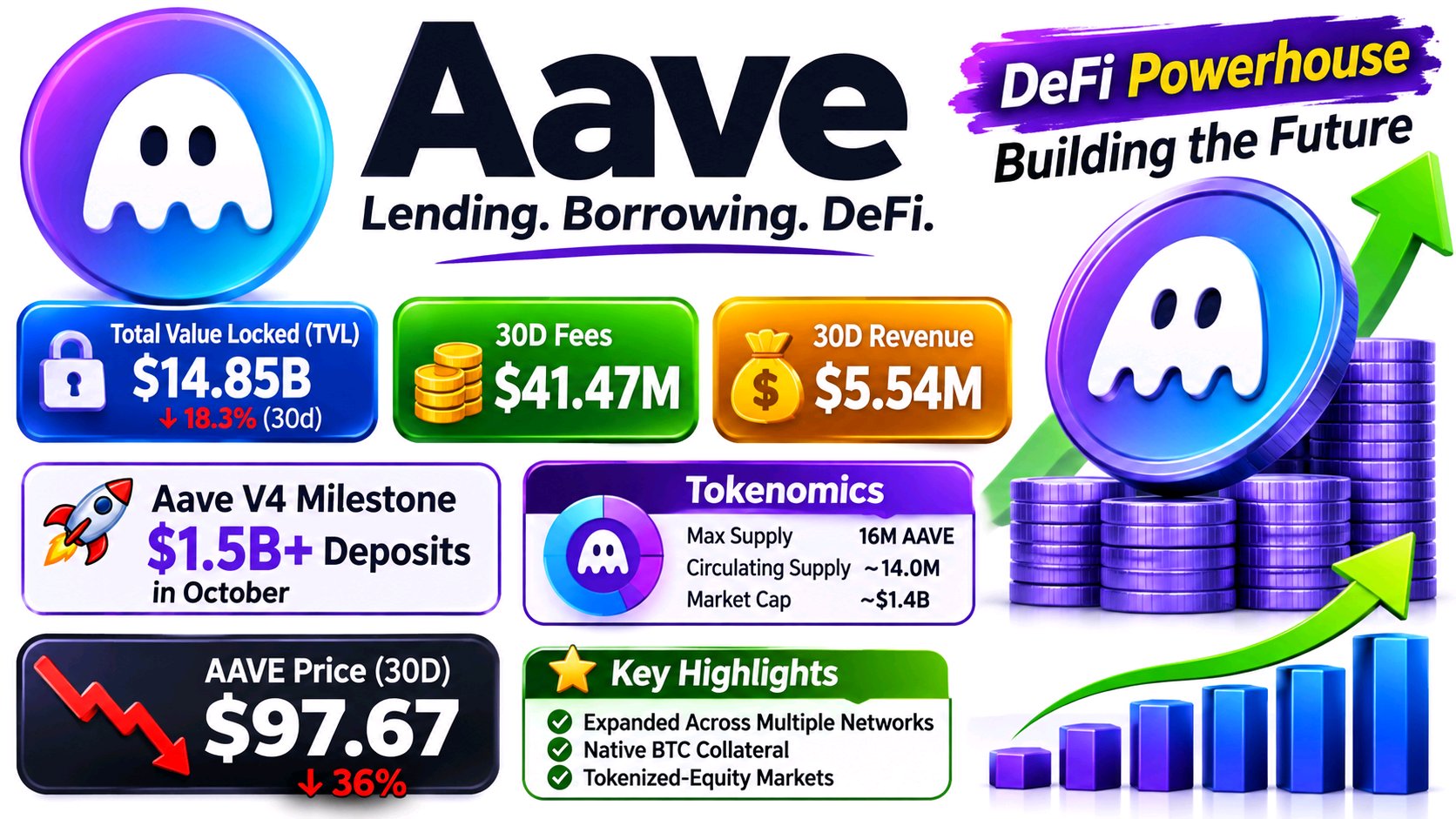
What I find interesting about Aave right now is the disconnect between its underlying business activity and the way the market is treating its token. AAVE has fallen sharply, yet the lending protocol is still generating substantial economic activity. According to DefiLlama, Aave held approximately $14.85 billion in TVL on November 15, while generating $41.47 million in fees and $5.54 million in protocol revenue over the previous 30 days. However, TVL declined 18.3% during that period, suggesting liquidity is leaving even while the protocol continues earning meaningful fees. DefiLlama There is another development worth watching. Aave Labs reported that V4 surpassed $1.5 billion in deposits during October, expanded across several networks, and welcomed its first external market curator. Native Bitcoin collateral and tokenized-equity markets also show how Aave is trying to expand beyond conventional crypto lending. October 2026 - Development - Aave +1 This creates an interesting contrast: the product infrastructure is expanding, but broader liquidity conditions remain less supportive. DefiLlama showed AAVE near $97.67, down roughly 36% over 30 days. The market is therefore pricing more than protocol revenue: falling deposits, weaker risk appetite, and uncertainty about future growth. The DAO’s revenue-funded buyback program carries a $50 million annual budget, but it cannot guarantee price support. DefiLlama +1 For traders, I would watch whether TVL stabilizes, V4 deposits turn into sustained borrowing and fees, and spot volume confirms any recovery. Can expanding infrastructure eventually translate into durable liquidity and stronger token value capture? #ByXIMPACT $AAVEUSDT
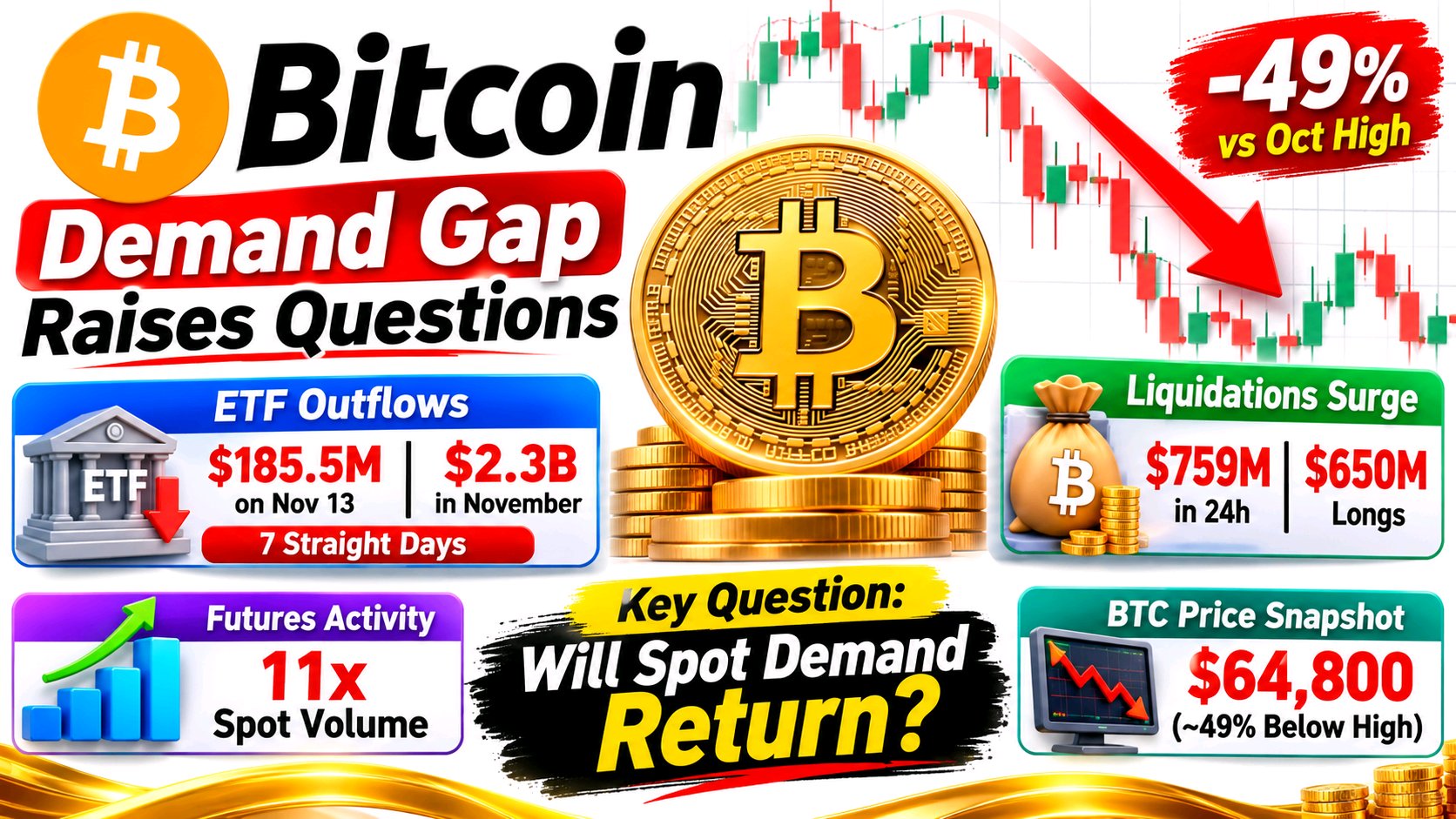
What caught my attention in Bitcoin this week is the gap between its fixed-supply story and the demand actually reaching the market. Bitcoin’s issuance schedule has not changed, but the marginal buyer matters more in the short term than the familiar 21-million-coin limit. U.S. spot Bitcoin ETFs recorded about $185.5 million in net outflows on November 13, extending the withdrawal streak to seven sessions. November outflows had reached roughly $2.3 billion through that date. This is a measurable reversal in an important channel of institutional demand, not proof that long-term holders have abandoned BTC. Derivatives are amplifying the pressure. CoinGlass reported roughly $759 million in 24-hour liquidations, around $650 million from long positions, while futures volume was about eleven times spot volume. Bitcoin was near $64,800 in that snapshot, almost 49% below its October 2025 high. That combination matters: ETF redemptions suggest weaker spot demand, while crowded leverage can turn declines into forced selling. Neither metric alone explains the whole move, and liquidation totals vary by venue and measurement window. I would watch whether ETF flows turn positive and whether spot volume expands during a recovery. If price stabilizes as open interest falls, leverage may be clearing. If outflows persist and rallies depend mainly on futures, the bounce deserves skepticism. The key question is whether genuine spot demand returns before another wave of positioning builds. #ByXIMPACT $BTCUSDT
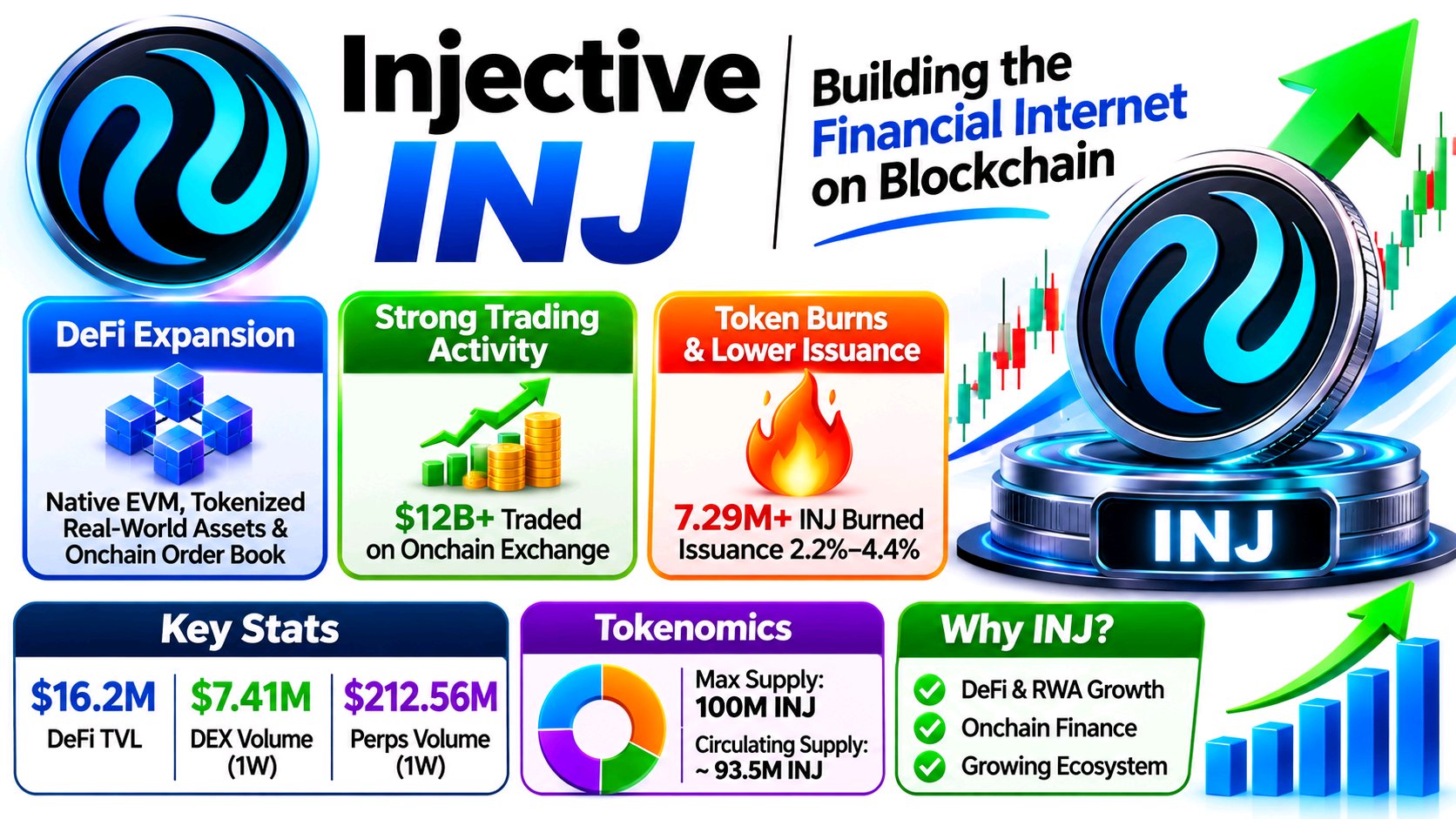
What caught my attention in INJ is the gap between Injective’s expanding financial ambitions and the much smaller amount of capital currently sitting in its DeFi ecosystem. The network is no longer just an exchange-focused chain. Its November 8 anniversary review describes native EVM, tokenized real-world assets, stock and FX markets, and USDC settlement. Injective also reports more than $12 billion traded on its onchain orderbook over the past year. The exchange module handles order books, matching and settlement onchain, giving these markets a shared financial infrastructure. injective.com +1 But usage needs to be separated from capital depth. DefiLlama recorded roughly $16.2 million in DeFi TVL on November 14, alongside $15.96 million in stablecoins. Weekly DEX volume was down 26.1% to $7.41 million, while perps volume fell 10.2% to $212.56 million. That is meaningful activity, but it does not yet demonstrate broad, steadily growing liquidity. DefiLlama The token story also deserves a closer look. Injective says more than 7.29 million INJ have been burned, while its 2026 issuance reduction lowered the targeted annual range to 2.2%–4.4%. Yet an SEC filing reports total supply of 122.9 million INJ in September, showing burns do not automatically make supply shrink; issuance still matters. injective.com +1 For traders, I would watch whether new RWA and stablecoin rails translate into sustained TVL, deeper order books and rising fees. If activity grows without liquidity following, the expansion story remains incomplete. Can Injective turn product breadth into durable capital demand? #ByXIMPACT $INJUSDT
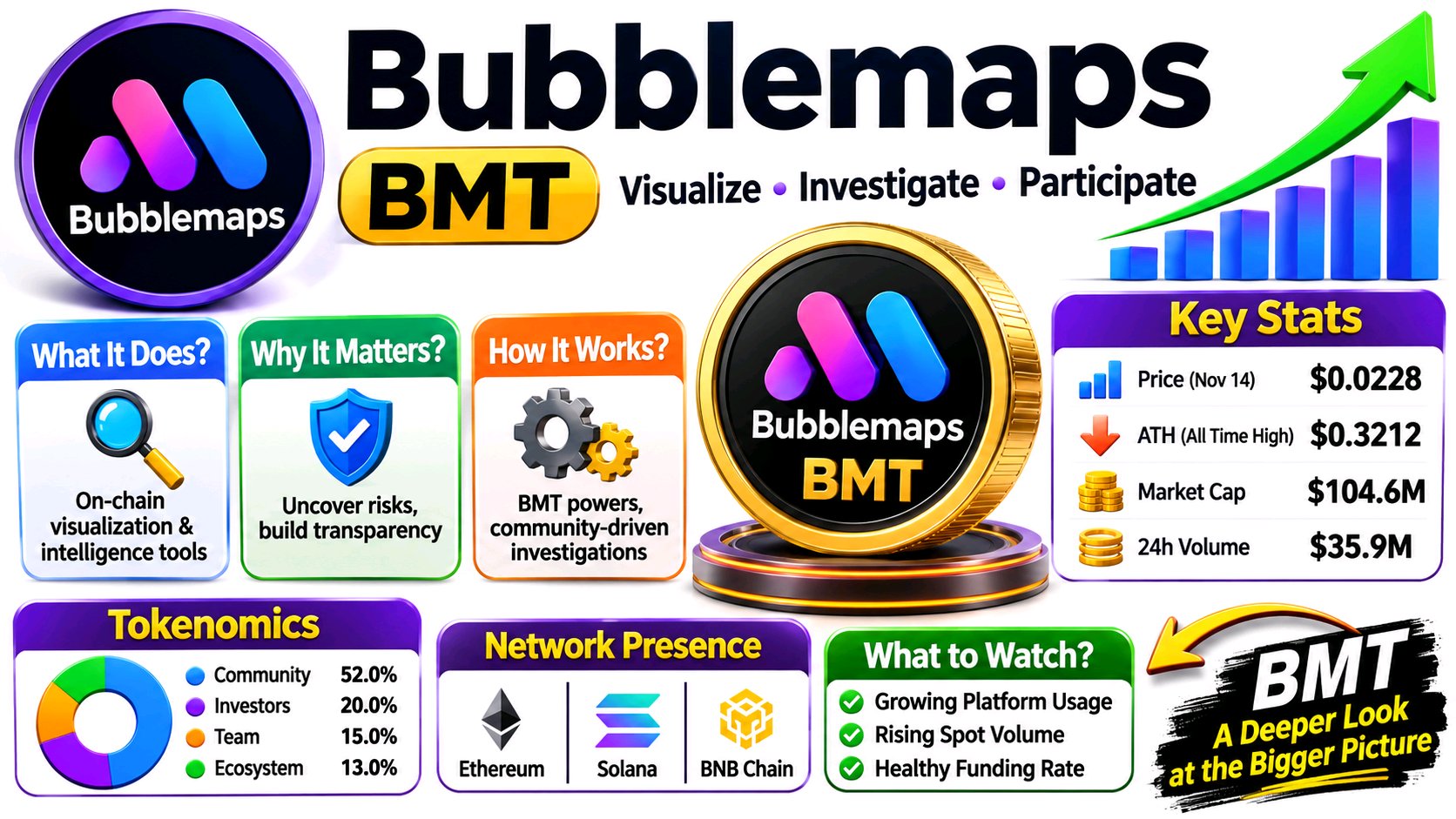
What interests me about BMT is the gap between what Bubblemaps is building and what the market is trading. Bubblemaps is more than a wallet-visualisation tool. V2 maps token holders, wallet clusters and historical distribution across multiple chains, including Solana, Ethereum and BNB Chain. Intel Desk turns community investigations into public case records. BMT links these products to participation: holders allocate tokens to prioritise cases, fund independent bounties and unlock advanced analytics. The token therefore has a role inside the workflow, not merely a ticker attached to a product. Bubblemaps +2 But utility and demand are different things. Bubblemaps documents how BMT voting and deposits work, yet public data does not establish how much recurring platform activity becomes sustained token demand. That is the metric I want to see. Bubblemaps Wiki +1 The market structure adds another layer. CoinGlass placed BMT near $0.0228 on November 14, roughly 93% below its $0.3212 peak. Futures volume was about $63.5 million against $35.9 million spot volume, with open interest near $9.6 million. Derivatives activity outweighed spot participation, while funding was sharply negative in that snapshot. CoinGlass That can reflect crowded positioning and short-side pressure, not necessarily durable accumulation. Traders should watch whether spot volume expands with price, whether open interest rises without destabilising funding, and whether Intel Desk and V2 usage becomes measurable. BMT’s longer-term case depends on people repeatedly needing its tools, not simply trading the narrative. Can product engagement become visible, persistent token demand? #ByXIMPACT $BMTUSDT
What caught my attention in Grass is the gap between operating progress and the way GRASS is priced. It is no longer just an idea about sharing spare bandwidth; it is building a commercial data business on that network. In its July 2026 holder update, Grass reported $17 million in first-half revenue, matching all of 2025, and monthly operating costs of roughly $2–3 million. It projected $65–75 million in 2026 training-data revenue, although that is guidance, not realized income. The October launch of its Contents API adds another product: Grass reported retrieving 97% of URLs in its 100-site benchmark, versus 84% for Firecrawl and 76% for Parallel. These are company-run results, but they show a shift from selling datasets toward live web retrieval for AI systems. That connection matters. Training-data sales can finance wider crawling, while broader coverage may make search and real-time retrieval more useful. Yet business growth does not automatically create token demand. Grass says Stage 2 participant rewards are funded by network revenue in USDC, without adding new GRASS emissions. Meanwhile, GRASS traded near $0.42 on November 14, down about 17% over seven days, while CoinGecko listed roughly $54 million in perpetual open interest. I would watch whether API usage turns into repeat revenue and whether spot demand absorbs continuing token releases. The key question is whether a growing data business creates durable demand for GRASS, rather than value for the network alone. #ByXIMPACT $GRASSUSDT

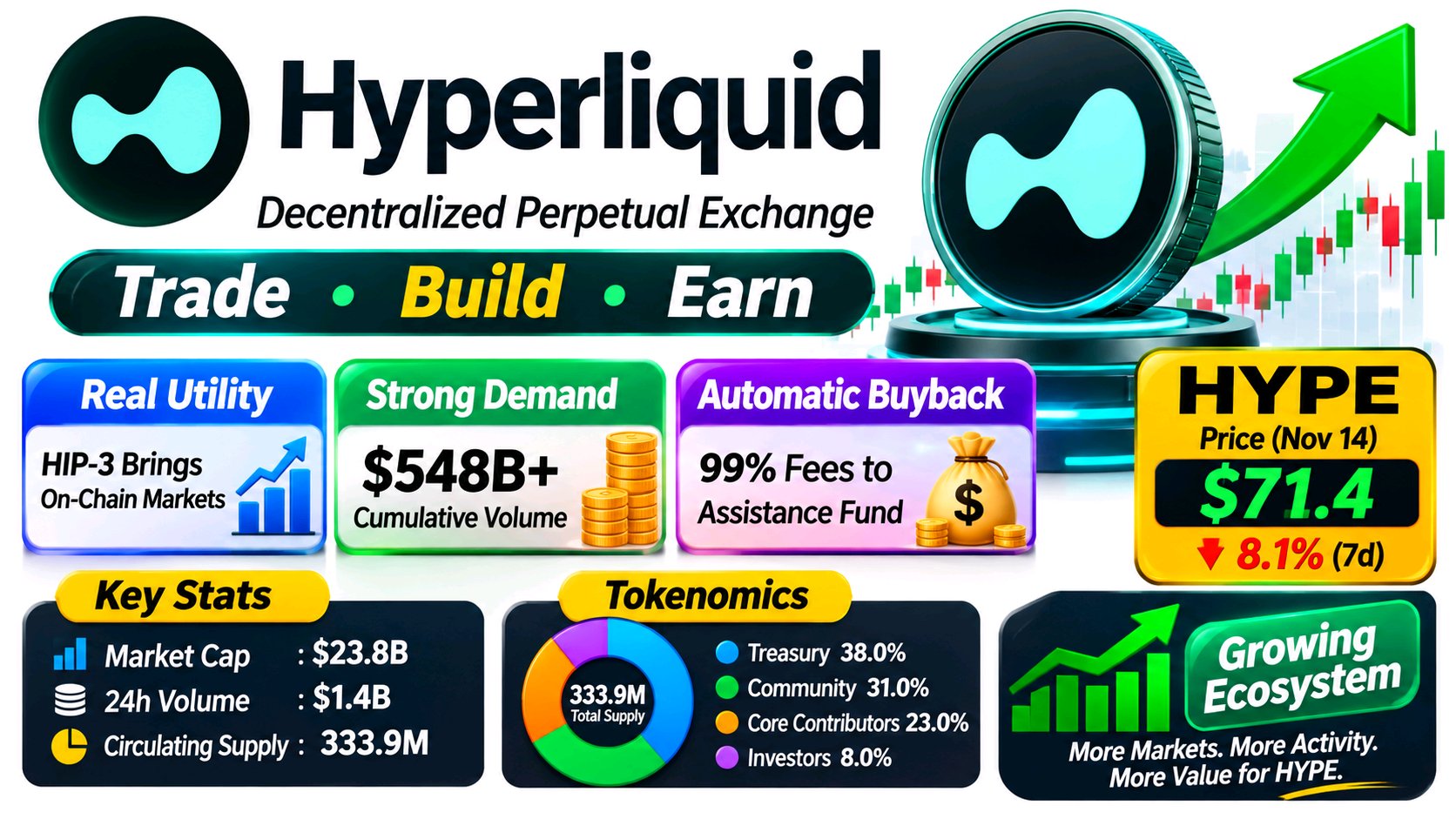
What stands out in Hyperliquid is that HYPE is increasingly connected to something more measurable than exchange popularity: the expansion of the trading infrastructure itself. The important question is whether that activity can translate into durable token demand. The evidence is HIP-3. It lets third-party builders launch perpetual markets for equities, commodities and indices, but requires them to bond HYPE as collateral. A September SEC filing says these markets accounted for about 30% of Hyperliquid’s trailing 30-day trading volume and had generated over $548 billion in cumulative volume since launch. That connects product adoption to a direct token use, rather than a vague utility claim. sec.gov There is a second link: Hyperliquid’s documentation says 99% of eligible protocol fees flow to the Assistance Fund, which automatically buys HYPE; the SEC filing reports 47.1 million tokens had been acquired and permanently removed by September 8. Activity can therefore support demand through deployment collateral and fee-funded purchases. Hyperliquid Docs +1 But the market is not rewarding the story automatically. On November 14, HYPE traded around $71.4, down 8.1% over seven days, while futures volume was roughly ten times spot volume and open interest had slipped 2.5% in 24 hours. CoinGlass That divergence is worth watching. Traders should track whether HIP-3 activity remains meaningful, fee-funded buying keeps pace with vesting supply, and spot demand confirms derivatives activity. The real test is whether expanding markets produce persistent token demand, not simply impressive volume. #ByXIMPACT $HYPEUSDT
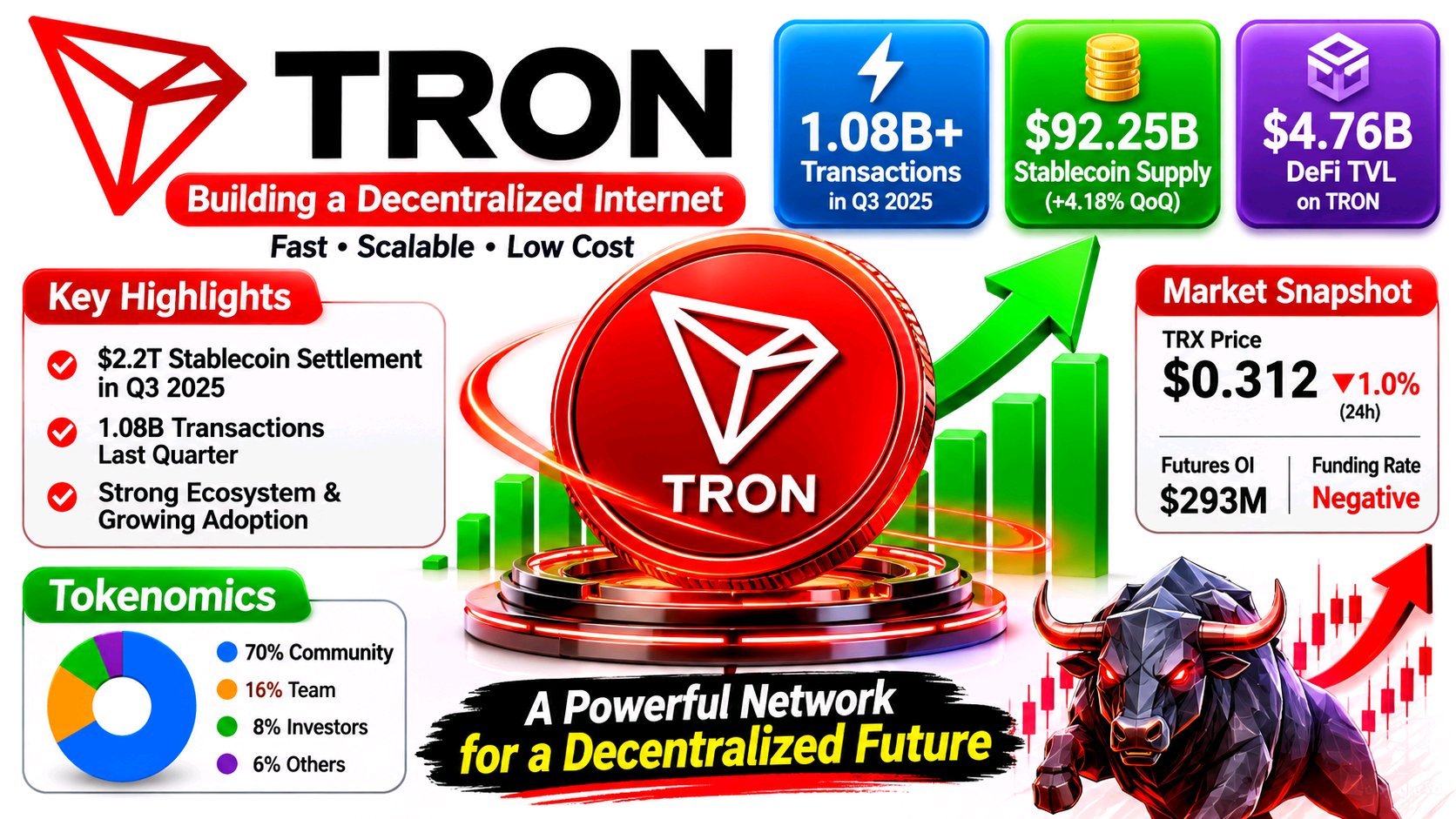
What stands out in TRON is the gap between its enormous stablecoin activity and the much weaker trading activity developing around its own token. That distinction matters because network adoption and TRX market demand are not necessarily moving together. TRON DAO’s Q3 report puts average stablecoin supply at $92.25 billion, up 4.18% quarter over quarter, with approximately $2.2 trillion in quarterly stablecoin settlement. It also reports 1.08 billion transactions during the quarter. DefiLlama’s November 14 snapshot still shows roughly $93.9 billion in stablecoins and $4.76 billion in DeFi TVL, although weekly DEX volume had fallen 46.9% to $370.8 million. TRON DAO: Moving Trillions, Empowering Billions +1 That contrast is important. TRX is used for fees, staking, governance and DeFi collateral, while staking also supplies Bandwidth and Energy. Fees can burn TRX, but block and voter rewards issue new tokens, so network activity alone does not guarantee net scarcity. TRON Developer Hub +1 The market is showing a different kind of tension: TRX was near $0.312, down about 1% over 24 hours, while aggregate futures open interest remained around $293 million and funding was negative. That suggests leveraged positioning is still active despite spot weakness; it is not proof of an imminent reversal. CoinGlass +1 I would watch whether stablecoin balances and actual transfer activity keep holding up, whether DEX activity recovers, and whether spot demand starts confirming any improvement in derivatives positioning. TRON’s infrastructure looks busy. The question is how much of that activity ultimately accrues to TRX. #ByXIMPACT $TRXUSDT
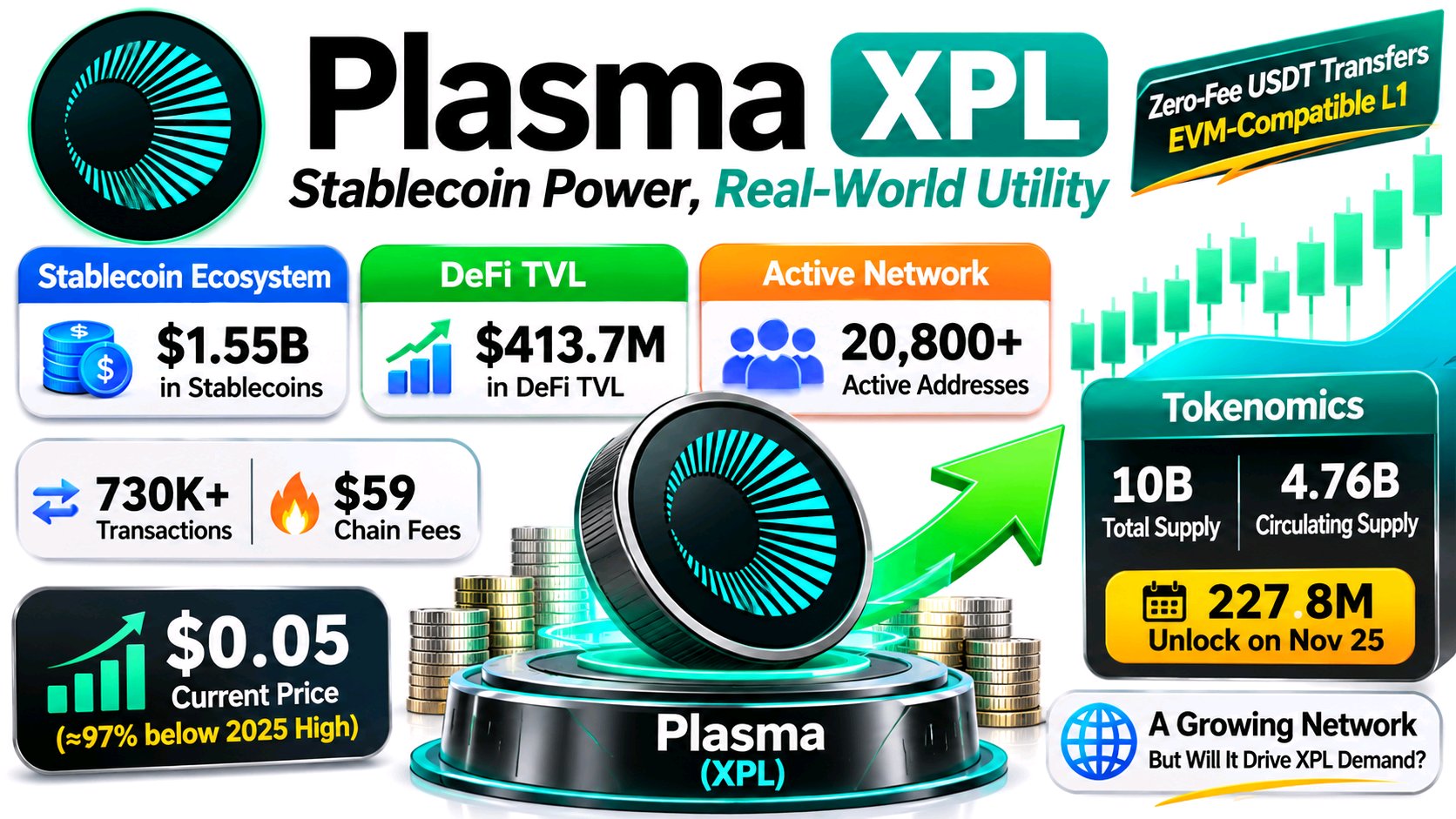
What caught my attention in Plasma is that its network can be busy while its token economics still look difficult to justify. Plasma is an EVM-compatible Layer 1 built around stablecoin settlement, with zero-fee USDT transfers and gas options designed to reduce payment friction. The adoption numbers are not trivial: DefiLlama reported about $1.55 billion in stablecoins, $413.7 million in DeFi TVL, roughly 20,800 active addresses and 730,000 transactions on November 13. Yet the same snapshot showed only about $59 in chain fees, while applications generated around $109,000 in fees. That distinction matters: activity is happening, but much of the economic value is being captured by applications rather than the base chain. This is where XPL’s story becomes more complicated. The token is intended for gas, DeFi liquidity and incentives, and future validator security, while Plasma says base transaction fees are burned. But zero-fee USDT transfers and alternative gas options weaken the assumption that more payment volume must create immediate XPL demand. Supply adds another pressure point. Around 4.76 billion XPL are circulating from a 10 billion genesis allocation, with roughly 227.8 million scheduled to unlock on November 25. Meanwhile, XPL trades near $0.05, around 97% below its 2025 high. I would watch whether stablecoin balances translate into sustained app usage, meaningful XPL demand and stronger fee capture, while tracking spot buying against the unlock and futures positioning. Network growth is encouraging; token value capture is the test. #ByXIMPACT $XPLUSDT
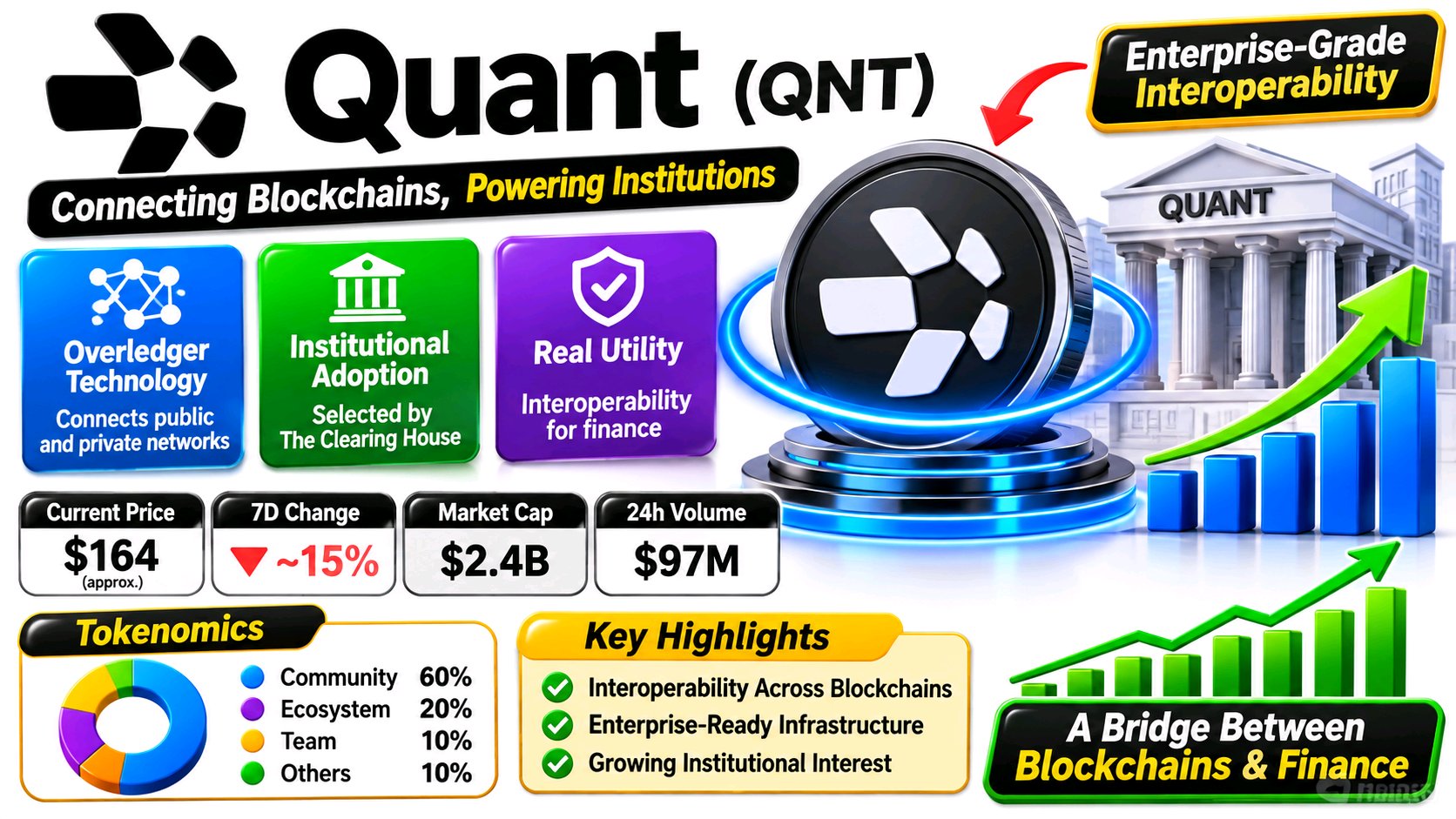
What makes QNT particularly interesting is the gap between Quant's growing role in institutional financial infrastructure and the way the market is currently treating its token. The important question is whether expanding enterprise adoption can eventually translate into measurable demand for QNT, rather than simply strengthening the company's reputation. What caught my attention about Quant is that its institutional footprint is becoming more concrete while QNT’s market structure is struggling to reflect that progress. Overledger is not another standalone chain. Its architecture connects public and permissioned ledgers through an API, connectors and orchestration layer, letting applications coordinate activity across networks. The September 24 selection by The Clearing House gives that proposition a serious test: Quant will provide interoperability and transaction orchestration for a US tokenised-deposit network linked to RTP and CHIPS payment rails. The network is expected to become available to institutions in the first half of 2027, so this is a selection, not proof of scaled live usage. The Clearing House +1 The token connection deserves scrutiny. Quant’s FAQ says customers can pay Overledger subscriptions in USD or QNT. QNT has a role in access and licensing, but enterprise adoption does not automatically create open-market buying pressure. That distinction matters. Frequently asked questions +1 Market data adds context. CoinGecko showed QNT around $164 on November 14, roughly 15% lower over seven days, with perpetual open interest near $73 million and derivatives volume far exceeding spot. That suggests leveraged positioning remains important; it does not show whether institutions are accumulating. CoinGecko I would watch the 2027 network rollout, recurring Overledger usage, and whether QNT-denominated payments increase. For traders, a recovery supported by stronger spot volume would matter more than another partnership headline. The real test is whether institutional integration becomes measurable token demand. #ByXIMPACT $QNTUSDT
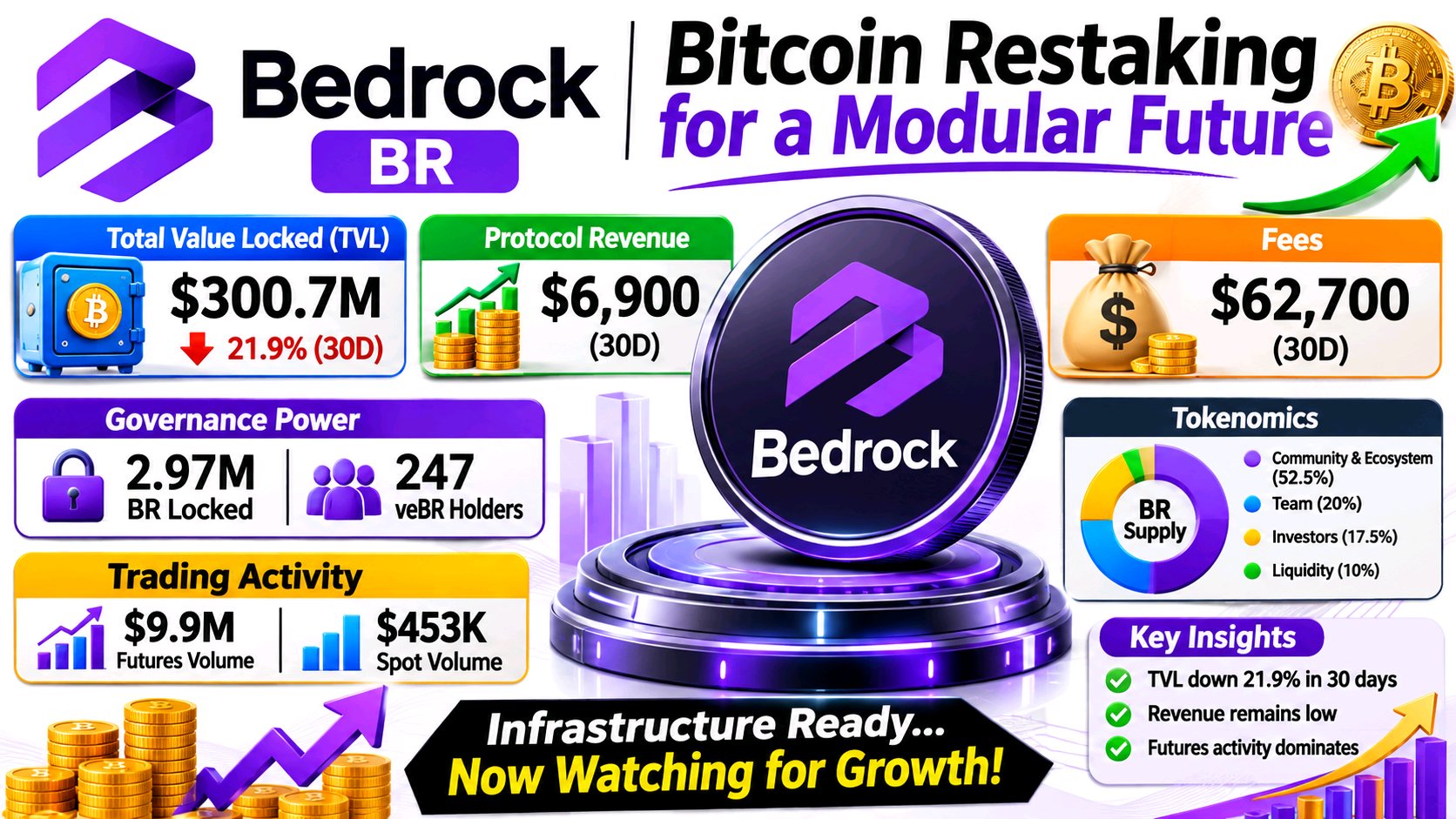
What caught my attention in Bedrock is the distance between the scale of its restaking products and the activity currently translating into measurable revenue. Bedrock is not just a BR governance token. Its ecosystem spans liquid restaking products such as uniBTC, uniETH and brBTC, connecting assets to external staking and restaking networks. DefiLlama puts Bedrock’s overall TVL near $300.7 million on November 12, but reports a roughly 21.9% decline over the previous 30 days. That is a meaningful contraction, not proof that users have abandoned the protocol, but it does make growth harder to assume. The revenue picture deserves equal attention. DefiLlama estimates about $62,700 in fees over 30 days, while protocol revenue was only around $6,900. That distinction matters: activity across products does not automatically become value captured by the protocol or its token holders. BR’s role is primarily governance and incentives, with holders able to lock it into veBR for voting power. The DAO dashboard shows roughly 2.97 million BR locked and 247 veBR holders. Meanwhile, CoinGlass reported futures volume around $9.9 million against just $453,000 in spot volume, with open interest near $20.7 million. That suggests derivatives are currently driving much more trading activity than spot demand. I would watch whether TVL stabilizes, governance participation broadens, and spot volume starts confirming futures-led moves. Bedrock has infrastructure; the next test is whether usage, revenue and token demand begin moving together. #ByXIMPACT $BRUSDT
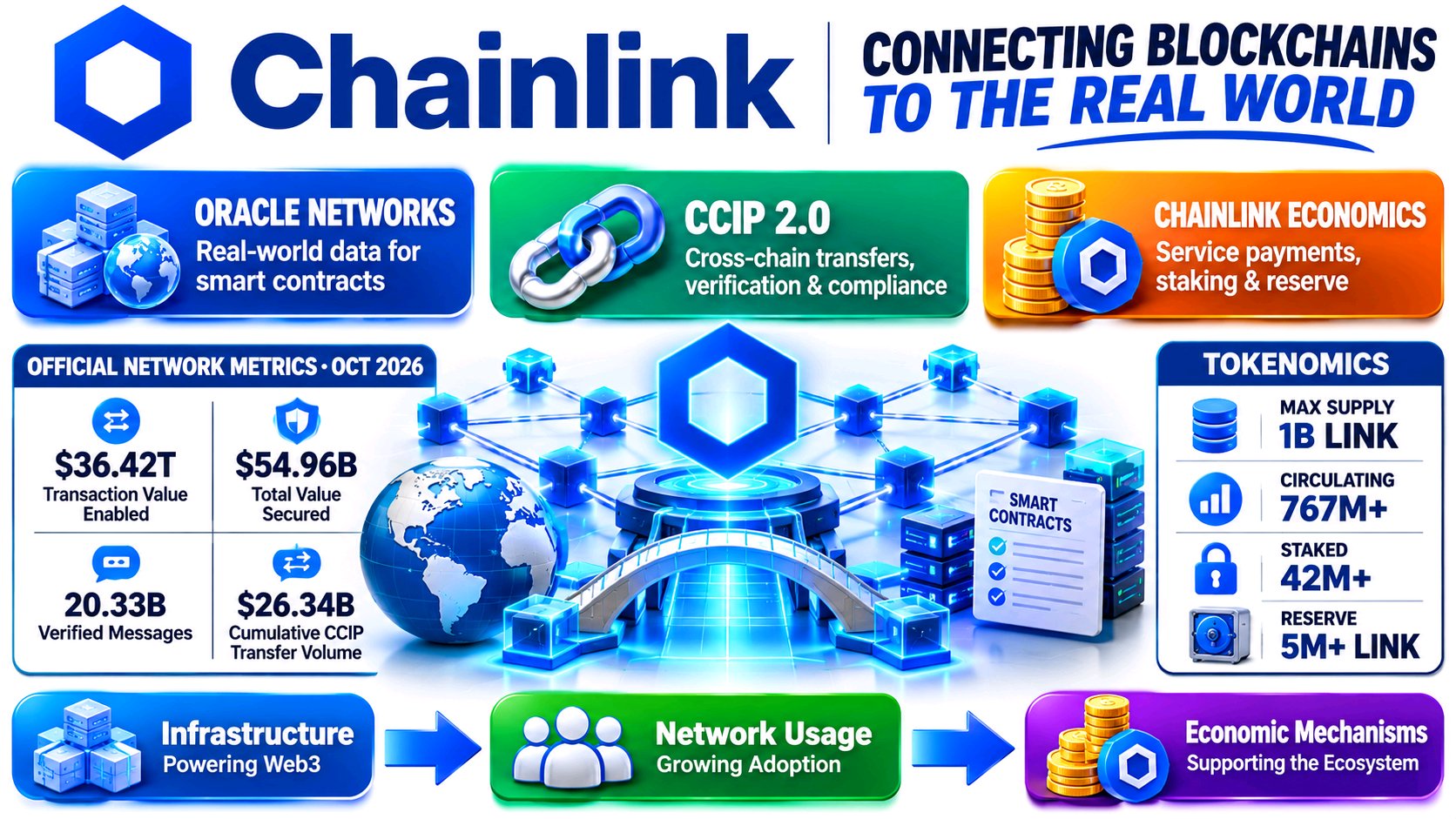
What caught my attention about Chainlink is the growing difference between its infrastructure adoption and the market's current treatment of LINK. That gap deserves more attention than another announcement about partnerships. Chainlink is no longer just about supplying price feeds. Its ecosystem connects smart contracts with external data, cross-chain infrastructure, proof of reserve, and institutional financial systems. CCIP is particularly important because it addresses how assets and information move between otherwise disconnected networks. The developments are becoming more concrete. Chainlink announced CCIP 2.0 in September 2026, alongside work connecting financial institutions to Swift's blockchain ledger. Coinbase also selected Chainlink for tokenized stock infrastructure in August. These developments suggest that interoperability is becoming a practical requirement rather than simply a technical narrative. Chainlink There is also an economic connection worth watching. LINK is used to pay for network services, support security, and incentivize reliable performance. Chainlink's official economics dashboard reports approximately 767 million circulating LINK against a maximum supply of one billion, alongside more than 42 million LINK staked. Chainlink +1 But adoption does not automatically translate into immediate token demand. On November 13, LINK was trading around $9.68, down roughly 4% over 24 hours. Derivatives data also showed declining open interest, suggesting some position reduction rather than straightforward accumulation. COINOTAG +1 I would watch whether spot buying returns, revenue-backed LINK accumulation strengthens, and price can recover with healthier volume. Until then, adoption and market confirmation remain two different stories. #ByXIMPACT $LINKUSDT
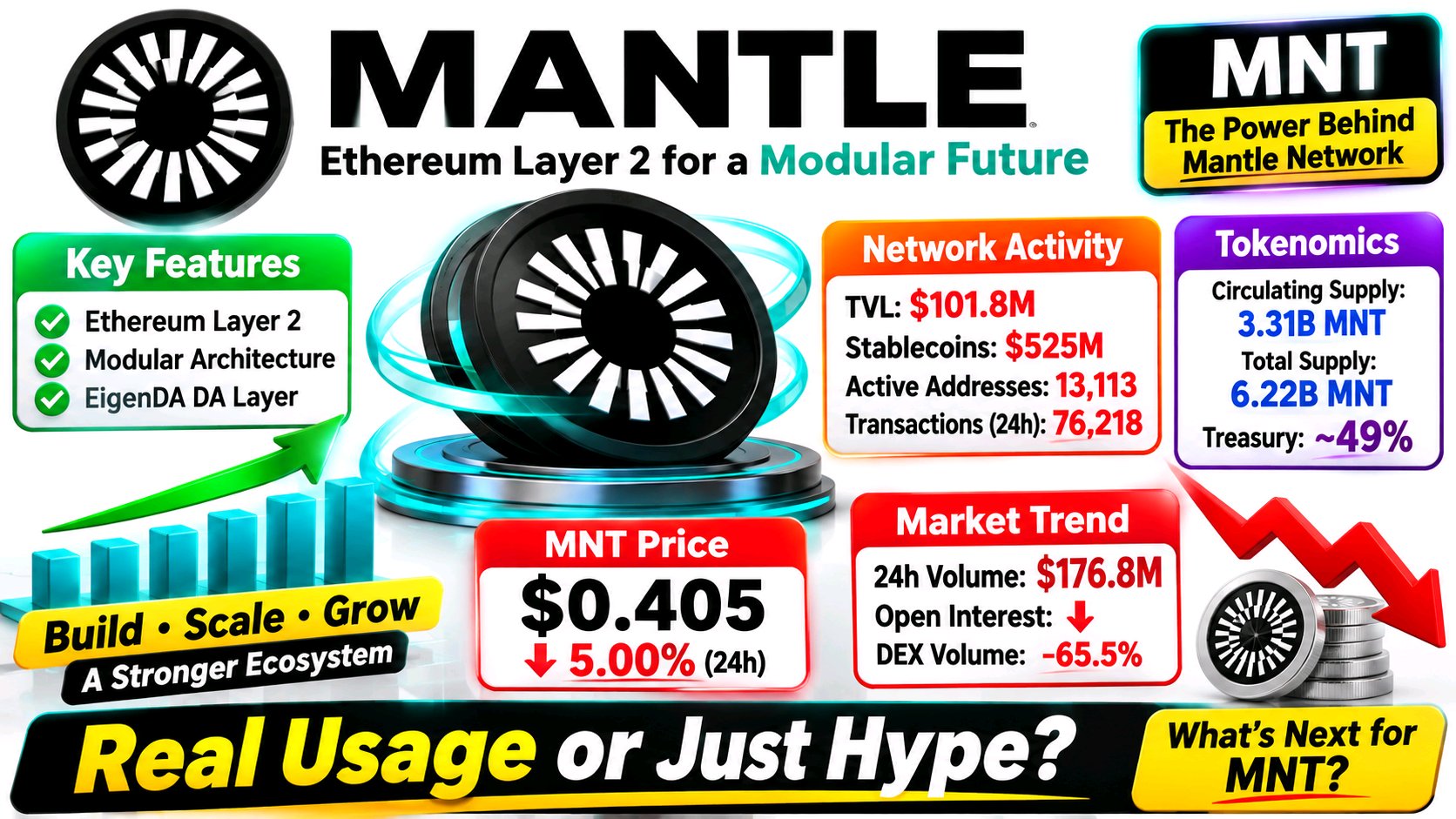
What caught my attention in Mantle is the gap between visible network activity and the amount of MNT still controlled by its treasury. Mantle is an Ethereum Layer 2 with a modular design and EigenDA data availability. MNT pays network fees and gives holders governance rights over ecosystem and treasury decisions. But token utility does not automatically create token demand. GitHub +1 DeFiLlama’s November 13 snapshot showed about $101.8 million in DeFi TVL, roughly $525 million in stablecoins, 13,113 active addresses and 76,218 transactions in 24 hours. That is measurable usage, though one day cannot prove a lasting trend. The same snapshot showed around $30.45 million in net outflows, while weekly DEX volume was down about 65.5%. DefiLlama +1 Supply adds another layer. Around 3.31 billion MNT circulate against total supply near 6.22 billion. No dated cliff unlock is currently listed, but roughly 49% remains in the Mantle treasury, with future allocation dependent on governance. That is not an imminent unlock, but it is still a significant supply-allocation question. DefiLlama +1 At roughly $0.405 on November 13, MNT was down about 5% in 24 hours, while futures open interest was also falling. That points more toward positions being reduced than fresh leverage building. CoinGlass +1 I would watch whether stablecoin liquidity and on-chain activity recover, whether treasury proposals alter expected supply, and whether spot demand improves before treating a price bounce as confirmation. The bigger question is whether real network usage can become persistent demand for MNT. #ByXIMPACT $MNTUSDT
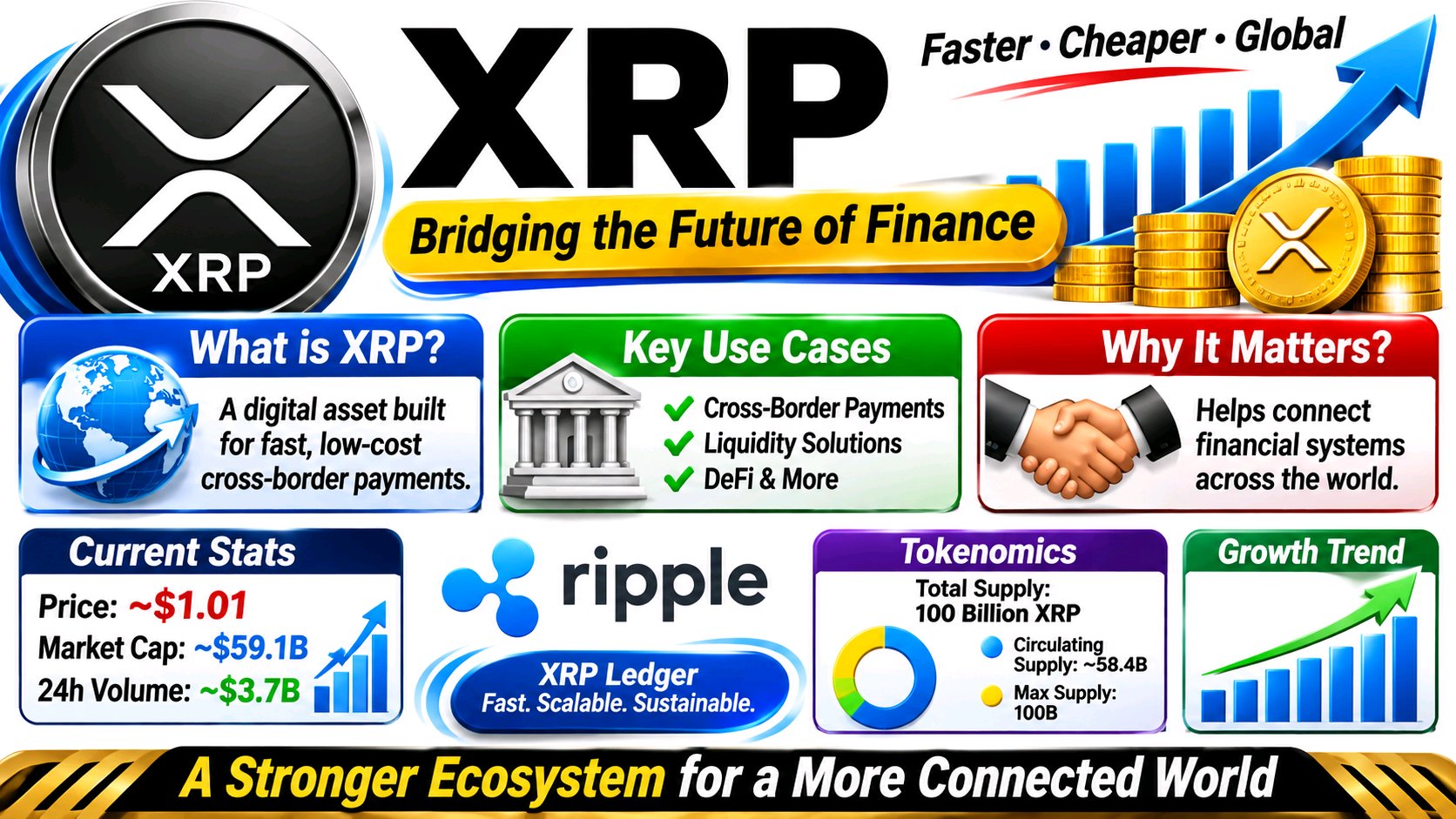
What stands out in XRP's current market structure is the gap between its institutional investment narrative and what traders are actually doing. The distinction between long-term ecosystem development and short-term market demand is becoming particularly important. What caught my attention in XRP is the gap between Ripple’s institutional stablecoin push and demand visible for XRP itself. Ripple’s October 28 Coinbase rollout made RLUSD available across Coinbase’s retail, exchange and Prime platforms, while Standard Chartered had launched institutional custody for RLUSD on XRPL. These are meaningful distribution and custody steps. But RLUSD is a dollar stablecoin; its adoption does not automatically require institutions to hold XRP. Ripple +1 That distinction shows up in network data. DefiLlama puts XRPL stablecoin value near $908 million on November 13, with RLUSD representing about 90%. Yet DeFi TVL is around $32 million and 24-hour DEX volume about $5.76 million. The ledger is active, but stablecoin scale has not translated into equally deep on-chain trading or DeFi liquidity. Stablecoin value also fell roughly 8% over seven days, so one snapshot is not a straight-line adoption trend. DefiLlama +1 XRP still has a real role: it is the ledger’s native asset, pays transaction costs, and can bridge currencies; Ripple’s On-Demand Liquidity also uses it as a bridge asset. The question is how much institutional activity actually routes through XRP. xrpl.org +1 Meanwhile, XRP traded near $1.01, down about 14% over seven days. Futures volume was roughly four times spot volume, with long liquidations dominating. I would watch whether stablecoin balances stabilize, DEX liquidity expands, and spot demand improves relative to leverage. That connection matters more than another partnership headline. #ByXIMPACT $XRPUSDT
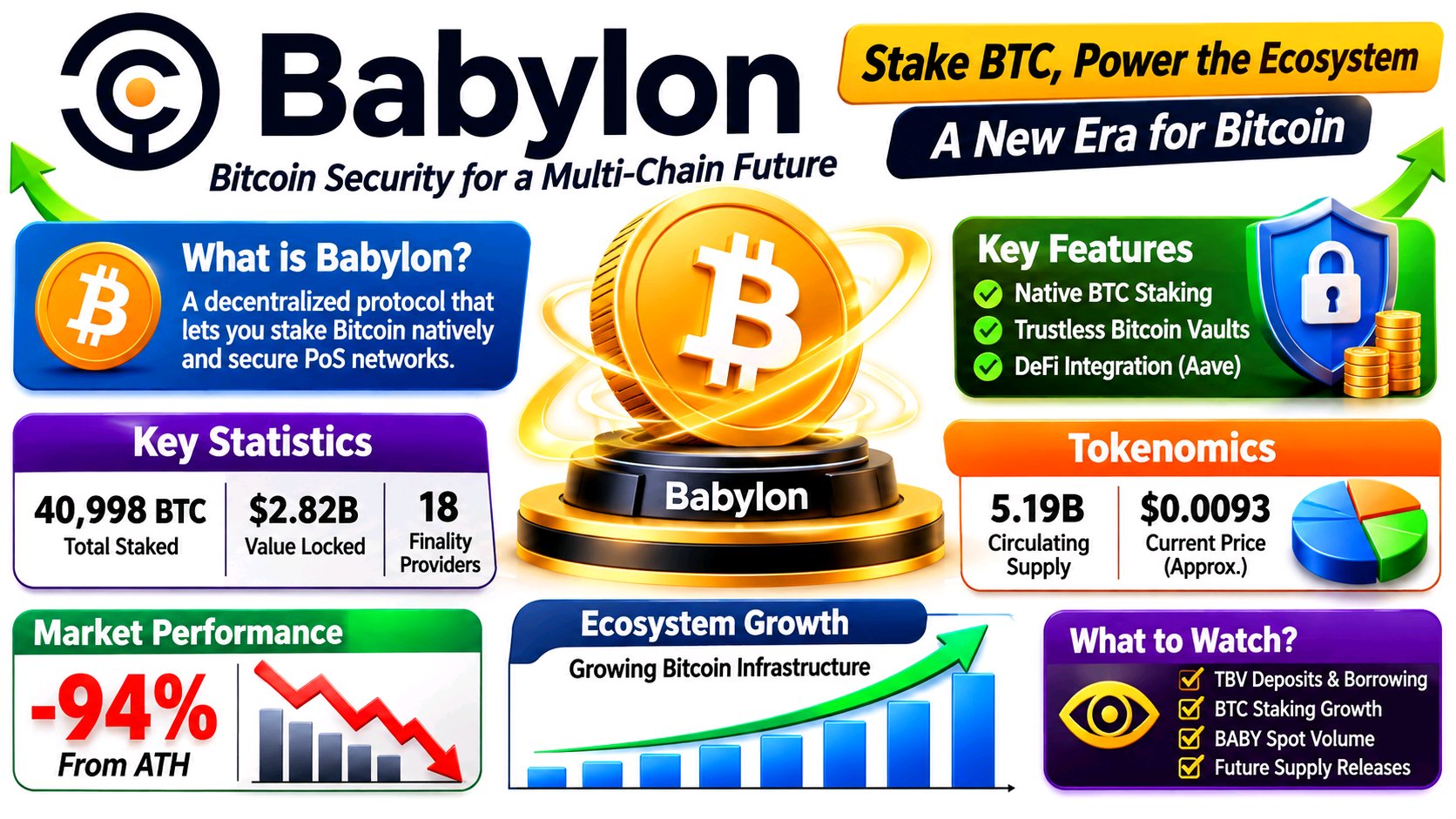
What caught my attention in Babylon is the gap between its Bitcoin infrastructure and the market’s treatment of BABY. The protocol’s proposition is tangible: BTC is staked natively on Bitcoin, without wrapping or surrendering custody, while Babylon Genesis coordinates security for connected networks. Its live dashboard shows roughly 40,998 BTC staked, worth about $2.82 billion, with 18 active finality providers. That is committed capital, not merely a wallet-count headline. \[1\] Babylon is also moving beyond staking. Its Trustless Bitcoin Vaults are designed to let native BTC back borrowing on external applications. Aave’s governance process has advanced an integration proposal, and Babylon documents Aave v4 as the first TBV application. But this is an infrastructure pathway, not proof that large-scale borrowing demand or fee income has arrived. \[2\] BABY’s role is less direct than BTC’s. It pays Genesis fees, supports governance and staking, and participates in co-staking incentives. Yet BABY trades near $0.0093, about 94% below its reported all-time high, with roughly 5.19 billion tokens circulating. Derivatives data shows around $5.9 million in open interest against less than $1 million in daily spot volume. Leverage is therefore outweighing visible spot activity. \[3\] I would watch actual TBV deposits and borrowing, sustained BTC staking, recovery in BABY spot volume, and future supply releases. The central question is whether Babylon can convert Bitcoin utility into recurring economic activity that reaches BABY, rather than simply expanding the infrastructure around it. #ByXIMPACT $BABY1USDT
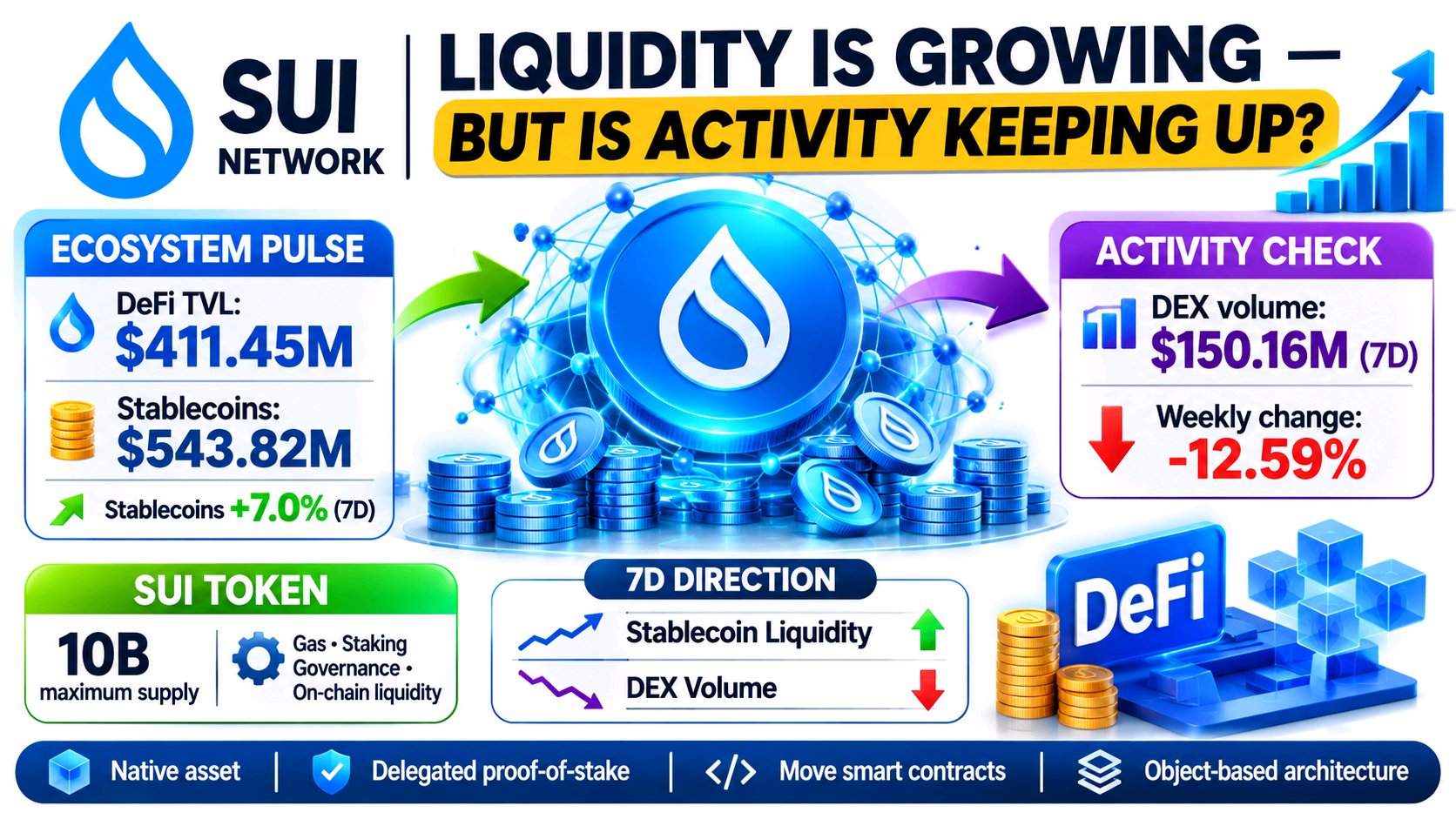
What stands out to me about SUI right now is the disconnect between stablecoin growth and actual DeFi activity. Liquidity appears to be entering the ecosystem, but that does not automatically mean users are deploying it. As of November 12, DeFiLlama reported approximately $411.45 million in Sui DeFi TVL, while stablecoin supply reached $543.82 million, up around 7% over seven days. Yet weekly DEX volume fell 12.59% to roughly $150 million. That combination deserves more attention than any single headline. DefiLlama +1 I also think the distinction between available liquidity and productive liquidity is important. Sui's object-based architecture, Move smart contracts and Mysticeti consensus are designed for efficient execution, while SUI itself pays transaction fees and secures the network through delegated staking. Sui Documentation +2 The market is not rewarding the ecosystem yet. SUI was trading near $0.80 on November 13, down approximately 7.6% over seven days. CoinGlass also showed futures volume around 6.2 times spot volume, with open interest near $481 million. That suggests derivatives are playing a much larger role in trading activity than spot demand. CoinGlass +1 For me, the next confirmation should come from rising DEX volume alongside stablecoin growth, improving TVL and stronger spot participation. I would also watch whether open interest stabilizes without excessive long positioning. Sui has infrastructure and liquidity, but the real question is whether that liquidity starts producing sustained economic activity. That's the difference I want to see before drawing stronger conclusions. #ByXIMPACT $SUIUSDT
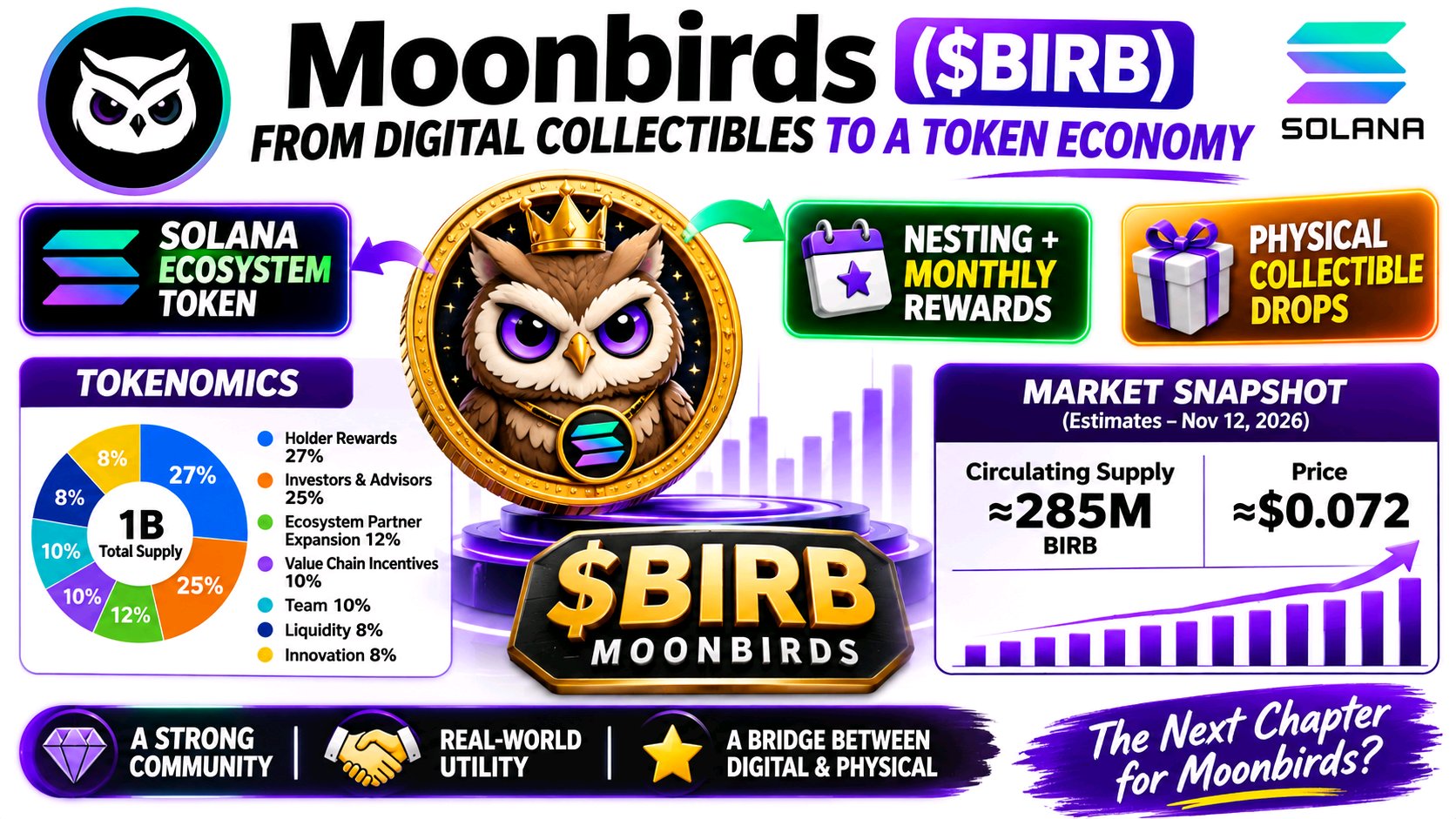
What caught my attention about Moonbirds ($BIRB) is the attempt to turn an established NFT identity into a broader token-based ecosystem. That transition is interesting, but the real test is whether community participation can become sustainable economic activity. BIRB operates on Solana and is designed to support ecosystem incentives, community rewards, governance participation, and future integrations. The project is no longer simply about owning a digital owl collectible; it is trying to connect its intellectual property with a wider consumer-focused economy. The tokenomics reveal an important detail. Its maximum supply is 1 billion BIRB, with 27% allocated to holder rewards, 25% to investors and advisors, 10% to the team, and 12% to ecosystem partnerships. According to the official schedule, team and investor allocations face a 12-month lockup before monthly vesting begins. This makes circulating supply and future distribution important factors to monitor. moonbirds.com +1 The more interesting development is the evolution of Nesting. Moonbirds now directs holders to its Collector Profile, where monthly BIRB allocations continue and nested NFTs can earn eggs redeemable for upcoming physical collectible drops. This connects digital ownership with tangible products, rather than relying entirely on token speculation. claim.moonbirds.com +1 The market, however, remains cautious. On November 12, BIRB traded around $0.073, with approximately $4.6 million in spot volume against $17.2 million in futures volume. Open interest stood near $8.6 million, while its weekly decline approached 18%. That suggests derivatives activity deserves attention, but it does not prove genuine ecosystem demand. CoinGlass My focus would be whether physical collectible activity, recurring participation, and actual token usage grow together. I would also watch monthly distributions, circulating supply, spot liquidity, and whether futures positioning starts supporting rather than dominating price action. Moonbirds has an interesting bridge between digital culture and physical commerce, but can that bridge create lasting demand for BIRB? #ByXIMPACT $BIRBUSDT