
Traditional financial markets operate within fixed trading hours, limiting traders' ability to respond to breaking news and major global events outside market hours. To address this limitation and provide 24/7 access to Futures on traditional assets, Bybit introduced TradFi Perpetual Contracts.
This enables traders to react immediately to significant political or economic developments, even when the underlying traditional markets are closed.
TradFi perpetual contracts currently cover two main categories of underlying assets:
- Commodities: such as precious metals and crude oil
- Stocks: including major market equities such as US stocks
What Are TradFi Perpetual Contracts
How to Access TradFi Perpetual Contracts
Trading Fees
Index Price
Mark Price
Risk Disclaimer
What Are TradFi Perpetual Contracts
Bybit TradFi Perpetual Contracts are USDT-denominated and USDT-settled Perpetual Contracts that track the price of traditional financial (TradFi) assets. These contracts allow traders to gain exposure to the price movements of traditional assets without holding the underlying asset.
TradFi Perpetual Contracts follow the same margin, funding rate, and liquidation mechanisms as standard USDT perpetual contracts. However, certain parameters — such as index price calculation and mark price deviation limits — are specifically adjusted to better reflect the characteristics of traditional markets.
Notes:
— TradFi Perpetual Contracts are derivatives and do not represent ownership of the underlying asset. Holding the contract does not grant any shareholder rights (such as voting rights) or involve physical delivery of commodities or other interests in the underlying asset.
— When the underlying asset undergoes corporate actions such as stock splits, or stock consolidations, Bybit will adjust the relevant contracts accordingly in accordance with applicable rules. Such adjustments are only intended to reflect the impact of the corporate actions on the contracts and do not represent that the user actually receives dividends or enjoys any shareholder rights.
— The dividend's economic effect is reflected in pricing and funding through arbitrage between the perpetual and the underlying shares.
How to Access TradFi Perpetual Contracts
On the Futures trading page, open the symbol dropdown menu in the top-left corner and navigate to Perpetual → USDT → Commodity / Stock.
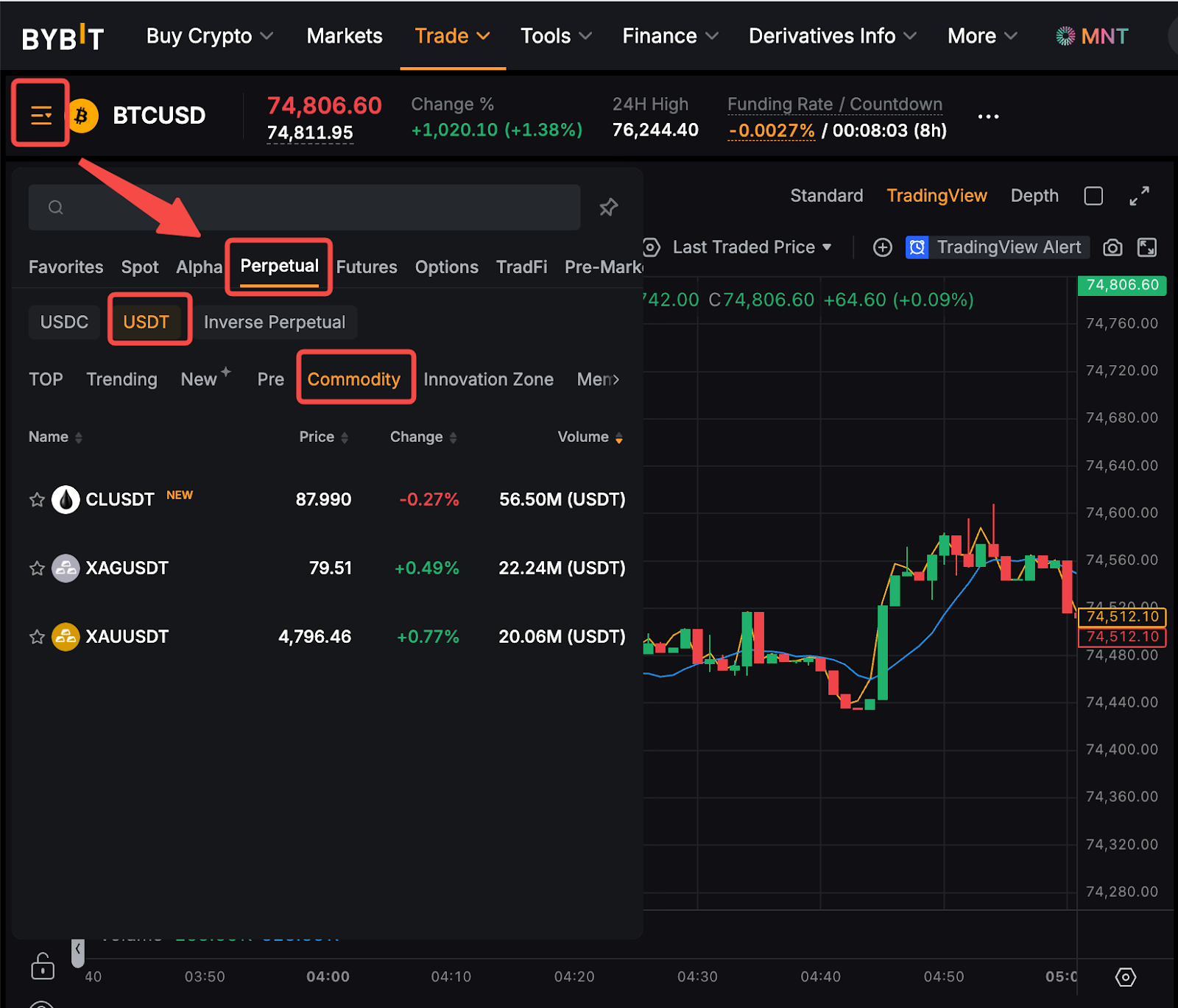
Trading Fees
Trading fees for TradFi Perpetual Contracts follow the same fee structure as regular USDT Perpetual Contracts and are subject to discounts based on your VIP level. For more details on the Bybit fee structure, please refer to this article.
Index Price
The index price of TradFi Perpetual Contracts is calculated based on the following methodology to ensure fair and reliable pricing during traditional market closures or periods of low liquidity.
Notes:
— Bybit reserves the right, at its sole discretion, to determine what constitutes the “opening period” and the “market closed period.”
— Bybit may adjust the timeframe of any trading session or the applicable calculation mode.
Mark Price
The Mark Price for TradFi Perpetual Contracts is calculated using the same mechanism as regular USDT Perpetual Contracts:
Mark Price = Median (Price 1, Price 2, Last Traded Price)
For more details, refer to Mark Price Calculation (Perpetual Contract).
Mark Price Deviation Constraints
Since the underlying assets are derived from traditional markets, Bybit applies deviation constraints to the Mark Price to ensure it remains closely aligned with the Index Price, to minimize the impact of potential market manipulation and reduce the risk of unnecessary liquidations.
The upper limits of deviation for different contract types are as follows:
- Stock Contracts (Single Stocks): +5%
- ETF Contracts and Commodity Contracts: +3%
Actual Mark Price = clamp ( Calculated Mark Price, Index Price × (1 − Maximum Deviation Limit), Index Price × (1 + Maximum Deviation Limit))
Example (Stock)
Assume the following:
- Index Price = 5,150
- Calculated Mark Price = 4,890
- Deviation Constraint = ±5%
- Allowed Range = 4,892.5 ~ 5,407.5
- Final Mark Price = 4,892.5 (lower limit applied)
Note: The example is provided for illustrative purposes only and may not reflect actual market conditions.
Risk Disclaimer
Trading TradFi Perpetual Contracts involves significant market risks. Please ensure that you fully understand the following risks before trading:
- Gap Risk: Events such as earnings releases or major news may cause significant price gaps, which may trigger liquidation.
- Liquidity Risk: During underlying market closures, contract liquidity may be significantly reduced, resulting in wider bid-ask spreads.
- Leverage Risk: The use of leverage may result in the loss of your entire margin within a short period of time.
- No Asset Ownership: Holding contracts position does not represent ownership of the underlying asset and does not grant any rights, including ownership, dividend entitlement, or voting rights.
- Regulatory Risk: Users in certain jurisdictions may be restricted from accessing this product due to regulatory requirements.
No Ownership Disclaimer
- Trading TradFi Perpetual Contracts does not constitute ownership of any underlying stocks, equities, securities, commodities, or tokenized assets.
- Users holding these contracts do not own the underlying assets and are not entitled to dividends, interest, or distributions. They also do not have any voting rights, shareholder privileges, or governance rights, nor do they have any rights to subscription, preferential purchase, conversion, or redemption. Unless explicitly reflected by Bybit through pricing or contract adjustments, users will not benefit from any corporate actions.
Disclaimer
– TradFi Perpetual Contracts are not associated with, sponsored, endorsed or affiliated with the issuer of the relevant underlying commodity or the exchange on which it is listed.
– Futures trading in traditional assets involves significant market risk and price volatility, especially outside the underlying asset's regular market hours. In the event of adverse price movements, your entire margin balance may be liquidated. Bybit is not responsible for any losses you may incur and does not provide financial advice. For more details, please refer to our Terms and Conditions for TradFi Perpetuals.