Oil hits $100! Why is the world freaking out?
AI Summary
Show More
Quickly grasp the article's content and gauge market sentiment in just 30 seconds!
Brent and WTI crude prices almost hit $120 respectively - highest since June 2022; Bybit Learn cited prospects of triple-digit oil since last week (Tue, Mar 3)
$100 oil driven by Middle East conflict - Strait of Hormuz's tanker traffic at near-halt; Iraq, Kuwait, and UAE begin slashing oil output
Oil shock may lead to stagflation (high inflation, slow/no growth), prevent Fed rate cuts, force ECB rate hike
$100 oil in 2026 is fundamentally worse than in 2022: no substitute for Strait of Hormuz, joint release of G7 strategic reserves may only offer temporary relief
Bloomberg Intelligence expects $133 WTI Crude if Strait of Hormuz is fully blocked for extended period
Oil prices have exploded past $100 per barrel for the first time since 2022!
Brent crude (Bybit: UKOUSD) - the global oil benchmark - even surged as high as $119.713 on Monday before settling around $107 at the time of writing.
WTI Crude (Bybit: USOUSD) - the US oil benchmark - almost touched hit $119.50, before easing back closer to the psychologically-important $100/bbl level.
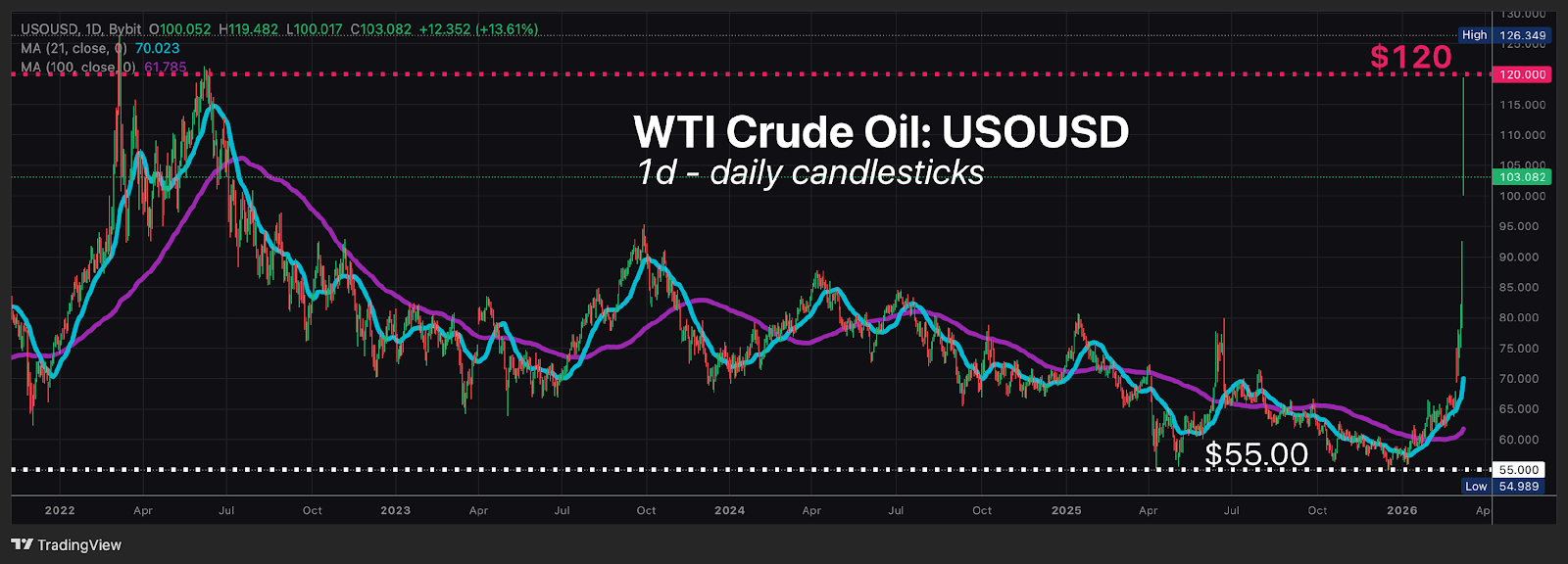
ICYMI: We warned about the prospects of triple-digit oil since last Tuesday, March 3rd. Did you miss this spectacular trade?
Why has oil soared past $100?
The U.S.-Israeli war with Iran, which began on February 28, 2026, is effectively choking global oil flows.
Tanker traffic through the Strait of Hormuz - the world's most critical energy chokepoint which handles roughly 20% of global oil trade - has essentially grounded to a halt.
Major oil-producing nations in the region, including Iraq, Kuwait, and the UAE, have slashed production as storage tanks overflow with crude that can't be shipped. Iraq's output is down 60%, and its storage capacity may be reached in 65 days (UAE, Kuwait, Iran = in 20 days or less)
Econs 101: Prices move up when supply goes down, assuming all else (including demand) remains equal.
$100 Oil - Who's hurting most?
The world's biggest oil importers, especially in Asia, are getting hammered.
China, the largest oil importer globally, along with India and Japan, all rely heavily on Middle Eastern crude.
Given this oil shock, no surprise that on Monday, March 9th:
Japan's benchmark Nikkei 225 index plunged 5.2%
India's benchmark Nifty 50 index tumbled 2.7%
These Asian benchmark stock indexes are set for their biggest one-day drops respectively since President Trump's 'Liberation Day' tariff announcements in April 2025.
How $100 oil in 2026 differs from 2022?
When oil hit $100 in 2022, Russia's Ukraine invasion and sanctions were the drivers. That was a supply disruption you could work around.
Today's crisis is fundamentally worse.
The Strait of Hormuz closure represents the worst disruption since the 1970s — a physical blockage of a waterway handling roughly 20% of global oil trade.
Even OPEC's spare capacity can't offset this loss.
Strategic Reserves: A Temporary Fix
Strategic petroleum reserves are government-owned emergency stockpiles of crude oil maintained to cushion supply shocks.
The Financial Times today reported that G7 finance ministers would discuss a joint release of their oil reserves.
That phone call among G7 finance ministers is slated for 12:30PM UTC today - Monday, March 9th.
This type of joint-releases of strategic stockpiles has only ever happened 5 times before, including the 2 times in response to the 2022 Russia-Ukraine war.
The news helped calm markets somewhat.
However, the math doesn't fully erase global concerns:
1.2 billion barrels in reserve held by G7 (568 million barrels held by U.S. Strategic Petroleum Reserve)
300-400 million barrels (25-30% of the joint stockpiles) may be released by G7
106.5 million barrels a day (bpd) = OPEC's forecast for global oil consumption this year (forecasts made prior to the Middle East conflict)
In short, even massive releases from strategic reserves may provide only temporary relief.
$100 Oil - The Inflation Threat
Oil at $100 also threatens to reignite global inflation and upend central bank plans.
Global bond markets tumbled today as investors priced in higher inflation and deteriorating growth i.e. stagflation.
For the Federal Reserve, which hoped to resume rate cuts by year-end, the oil shock complicates matters dramatically.
Fed officials already signaled rates should stay steady amid sticky inflation, with markets now expecting a less-than-50% chance of the Fed being able to cut rates twice more in 2026.
That's in stark contrast to 2 more Fed rate cuts in 2026 fully expected by markets just this time last month.
In Europe, it's more dramatic.
Traders now fully price in two 25-basis-point ECB rate HIKES in 2026, a stunning reversal from days ago when rate cuts were expected.
Beyond $100 Oil - What's Next?
Goldman Sachs warns the rally isn't over. With no de-escalation signs, markets are pricing in prolonged supply crunches.
Bloomberg Intelligence antipates WTI Crude peaking at $133 if Tehran completely blocks off the Strait of Hormuz for an extended period of time.
Let's also revisit the other forecasts cited in our March 3rd report:
JPMorgan warns oil could hit $120 per barrel.
Other analysts are even contemplating scenarios where oil could reach $150 per barrel.
For consumers, expect to pay higher prices for goods and services (inflation).
For investors, a harsher market environment looms.
Until the Strait reopens, $100+ oil may be the new reality — one that strategic reserves can soften but not solve, threatening stagflation in major economies, and force central banks into an uncomfortable policy U-turn.
Grab Up to 100 USDT in Rewards
Also, enjoy 555% APR on Bybit Earn products!