ALIENCRYPT
6105Me gusta0Compartir en el chat79Aficionados91Seguir
ALIEN CRYPTO Crypto market analysis, trading setups, price action & market insights. Trade smart. Stay disciplined.
ALIEN CRYPTO Crypto market analysis, trading setups, price action & market insights. Trade smart. Stay disciplined.
ACTUALIZACIÓN DIARIA DE $WLFI — PRIMERA RECOMPRA COMPLETADA A MEDIDA QUE AUMENTA LA PRESIÓN World Liberty Financial ha pasado del anuncio a la ejecución. El proyecto completó su primera recompra de WLFI por valor de 1 millón de dólares en menos de 72 horas, con las compras realizadas on-chain a través de Aster en BNB Chain y visibles en un monedero público. Se adquirieron aproximadamente 21 millones de tokens en el tramo inicial. El programa de recompra se dio a conocer poco después de las elecciones de mitad de mandato en EE. UU., cuando WLFI cayó bruscamente junto con otros activos vinculados a Trump. La empresa ha indicado que la financiación podría provenir de las comisiones generadas por las reservas que respaldan su stablecoin USD1, entre otras fuentes. El objetivo declarado es fomentar la participación activa en la gobernanza y trasladar más poder de voto a los titulares a largo plazo. Los responsables han descrito las recompras como una estrategia continua cuyo ritmo dependerá del crecimiento del ecosistema y de los recursos disponibles. Esto es importante porque crea un vínculo directo entre la adopción de USD1 y la demanda de WLFI. Si la stablecoin sigue generando ingresos por reservas, el presupuesto de recompra podrá ampliarse. Si el crecimiento se ralentiza, es probable que el programa siga siendo modesto. El primer tramo de 1 millón de dólares es relativamente pequeño en comparación con el tamaño de mercado del token, pero establece un mecanismo público y verificable que la comunidad puede seguir. Entre bastidores, el proyecto sigue operando bajo un intenso escrutinio. Investigadores independientes, incluidos Coffeezilla en colaboración con la investigadora Molly White, han examinado los vínculos de inversión reportados con los EAU y el uso de USD1 en operaciones de mayor envergadura. World Liberty ha negado haber actuado mal o haber ejercido influencias indebidas. Por otro lado, la larga disputa con Justin Sun sobre los tokens congelados sigue activa, y las recientes presentaciones judiciales añaden otra capa de fricción legal. En el ámbito on-chain, los monederos afiliados han seguido haciendo staking de cantidades significativas de WLFI, lo que indica que los grandes titulares siguen bloqueando tokens incluso cuando el precio se ha consolidado cerca de los mínimos recientes. Lo que la comunidad debería observar a continuación es la escala y la frecuencia de las futuras recompras, cualquier otra información sobre los ingresos de las reservas de USD1 y cómo el nuevo entorno del Congreso moldea la atención regulatoria sobre el proyecto. No se han publicado calendarios confirmados para compras adicionales; la empresa ha dejado el calendario y el tamaño a su discreción. **Mi perspectiva diaria** La primera recompra on-chain es un paso concreto tras semanas de presión. No elimina los obstáculos políticos y legales, pero ofrece a los titulares una métrica transparente a seguir. En las próximas semanas, la verdadera prueba será si la actividad de USD1 y el compromiso con la gobernanza crecen lo suficiente como para que el programa de recompra sea significativo y no solo simbólico. Para un proyecto tan vigilado, la coherencia y la transparencia importarán más que cualquier anuncio aislado. #ByXIMPACT $WLFIUSDT
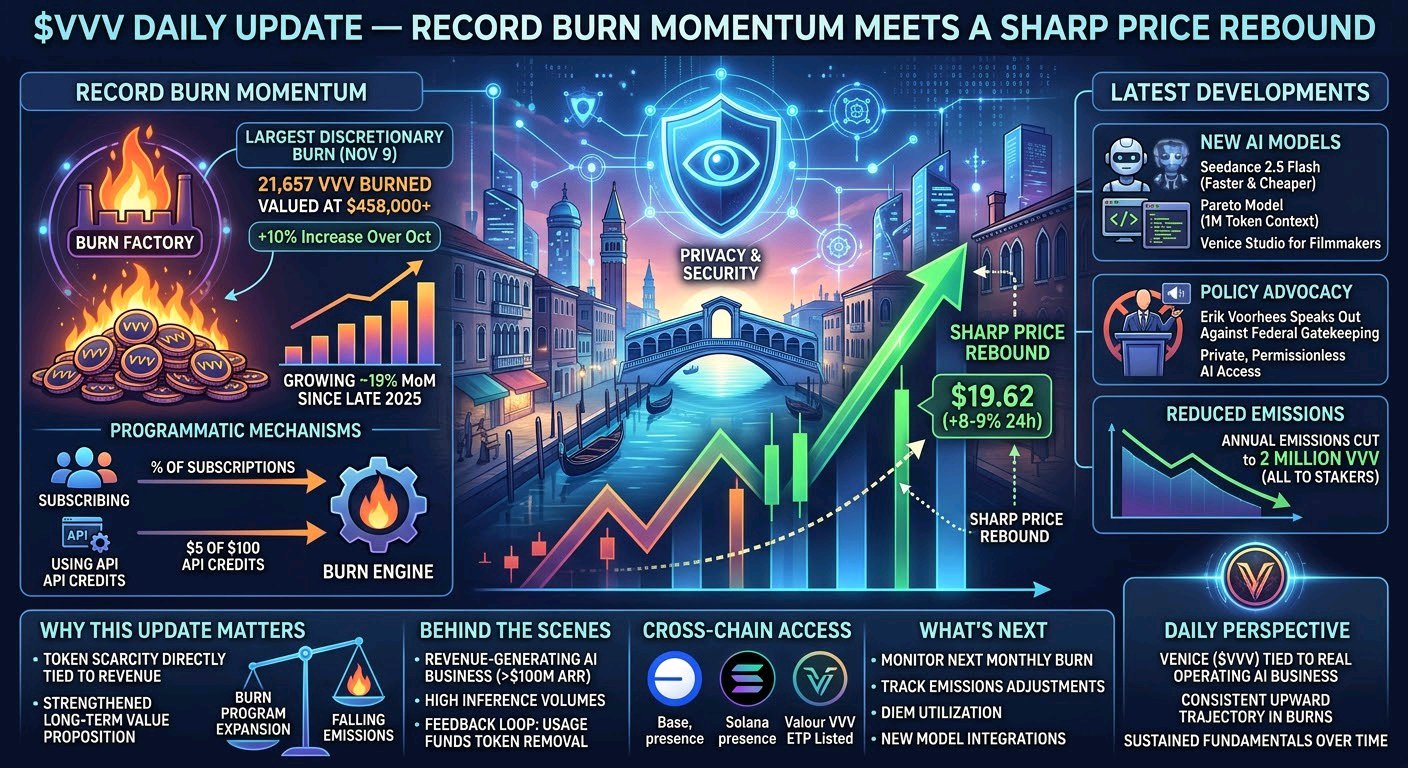
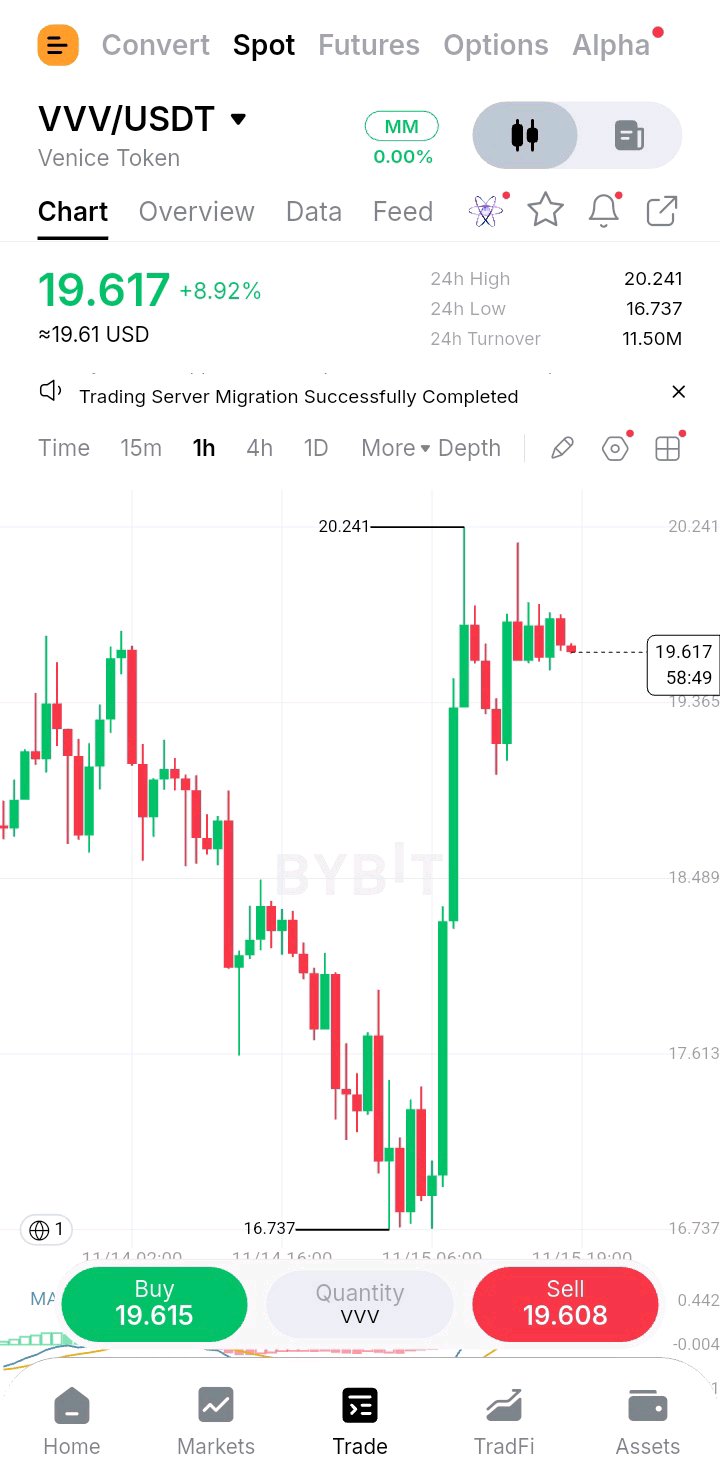
$VVV ACTUALIZACIÓN DIARIA — EL MOMENTUM DE LA QUEMA RÉCORD SE ENCUENTRA CON UN AGUDO REBOTE DE PRECIO** Venice Token ($VVV), el token de utilidad que impulsa la plataforma de IA privada y sin censura de Venice.ai, muestra una energía renovada hoy tras un periodo de volatilidad. En los gráficos, VVV cotiza cerca de los 19,62 $ con ganancias de aproximadamente el 8-9% en las últimas 24 horas, recuperándose de un mínimo cercano a los 16,74 $ tras la presión sufrida a principios de semana. # Últimos acontecimientos El catalizador reciente más claro sigue siendo la mayor recompra y quema mensual discrecional de Venice hasta la fecha. El 9 de noviembre, el proyecto retiró 21.657 VVV (valorados en aproximadamente 458.000 $ en el momento de la quema). Esto supuso un aumento de aproximadamente el 10% respecto a la quema de octubre y continuó una clara tendencia alcista en el tamaño de estas quemas discrecionales, que han crecido a un promedio de casi el 19% mes a mes desde finales de 2025. Junto a las quemas discrecionales, Venice continúa con su mecanismo programático: una parte de los ingresos por suscripciones y 5 $ de cada 100 $ en compras de crédito API se utilizan para comprar y eliminar permanentemente VVV de la circulación. Las emisiones anuales ya se redujeron a 2 millones de VVV (todos dirigidos a los stakers) a partir del 1 de octubre, una cifra significativamente menor a las tasas anteriores. La quema discrecional de noviembre cubrió aproximadamente una octava parte de la cifra de emisión mensual. La actividad en el lado del producto se ha mantenido activa. Venice ha seguido lanzando nuevos modelos y herramientas en los últimos días, incluido el acceso anticipado a Seedance 2.5 Flash (posicionado como más rápido y más rentable), promociones en torno a Venice Studio para cineastas y adiciones como el modelo Pareto de Unbiased con una ventana de contexto de un millón de tokens. El fundador Erik Voorhees también intervino públicamente alrededor del 12 de noviembre en contra de las propuestas de fuertes restricciones federales a los modelos de IA de frontera, reforzando el posicionamiento central de la plataforma en torno al acceso privado y sin permisos. ### Por qué importa esta actualización El creciente programa de quema vincula directamente los ingresos de la plataforma (suscripciones + créditos API) con la escasez del token. Aunque las emisiones mensuales aún superan la escala de quema actual, la expansión constante de las recompras junto con la reducción de las emisiones muestra un camino deliberado hacia mecanismos de escasez más sólidos. Para un token cuya utilidad principal es el staking para obtener rendimiento, acceso Pro y la acuñación de DIEM (crédito de IA diario), cualquier reducción creíble en la inflación neta fortalece la propuesta de valor a largo plazo para los titulares y agentes que utilizan el sistema. El rebote del precio hoy, ocurriendo contra el telón de fondo de los nuevos datos de quema y el continuo lanzamiento de productos, sugiere que el mercado todavía responde a estos fundamentos incluso después del retroceso más amplio desde los máximos de septiembre cerca de 34-35 $. ### ¿Qué ocurre entre bastidores? Venice sigue operando como un negocio de IA generador de ingresos (reportado previamente en o por encima de una tasa anualizada de 100 millones de dólares, con afirmaciones de cifras superiores hacia finales de año) mientras procesa volúmenes de inferencia extremadamente altos. La estructura dual de quemas mensuales discrecionales más quemas automáticas por uso real crea un bucle de retroalimentación: más actividad en la plataforma financia más eliminación de tokens. El suministro circulante ha estado en el rango alto de los 40 millones, con un suministro total aún mayor debido a las emisiones en curso (pero reducidas). La disponibilidad multicadena (Base como principal, con presencia en Solana vía Sunrise anteriormente) y los puntos de acceso regulados como el ETP de VVV de Valour listado a principios de noviembre amplían aún más la base de titulares más allá de los criptonativos. ### ¿Qué debería observar la comunidad a continuación? Haga un seguimiento del próximo anuncio de quema discrecional (típicamente a principios del mes siguiente) para ver si la trayectoria de crecimiento continúa. Siga cualquier ajuste adicional de emisiones, métricas de utilización de DIEM y actualizaciones oficiales sobre ingresos o crecimiento de usuarios. Las integraciones de nuevos modelos y los cambios de precios en la propia plataforma de Venice a menudo preceden a los cambios en el uso que alimentan el motor de quema. Distinga las acciones de tokenomics confirmadas de los movimientos más amplios del mercado: el precio puede divergir del uso durante periodos, como se ha visto recientemente. ### Mi perspectiva diaria Venice destaca porque el token está vinculado a un negocio de IA operativo real con ingresos reales en lugar de pura narrativa. La quema récord de noviembre no es llamativa en tamaño absoluto en relación con el suministro total, pero la trayectoria ascendente constante en las quemas combinada con las emisiones ya reducidas es la historia que importa. Cuando una plataforma de IA centrada en la privacidad sigue lanzando modelos, ampliando el acceso y eliminando sistemáticamente tokens financiados por su propio flujo de caja, la configuración sigue siendo uno de los experimentos más limpios en el diseño de tokens de IA-cripto. El rebote de hoy mantiene viva la conversación. En este espacio, los fundamentos sostenidos tienden a reafirmarse con el tiempo: observe cómo evolucionan el programa de quema y las métricas de uso a partir de aquí. #ByXIMPACT $VVVUSDT
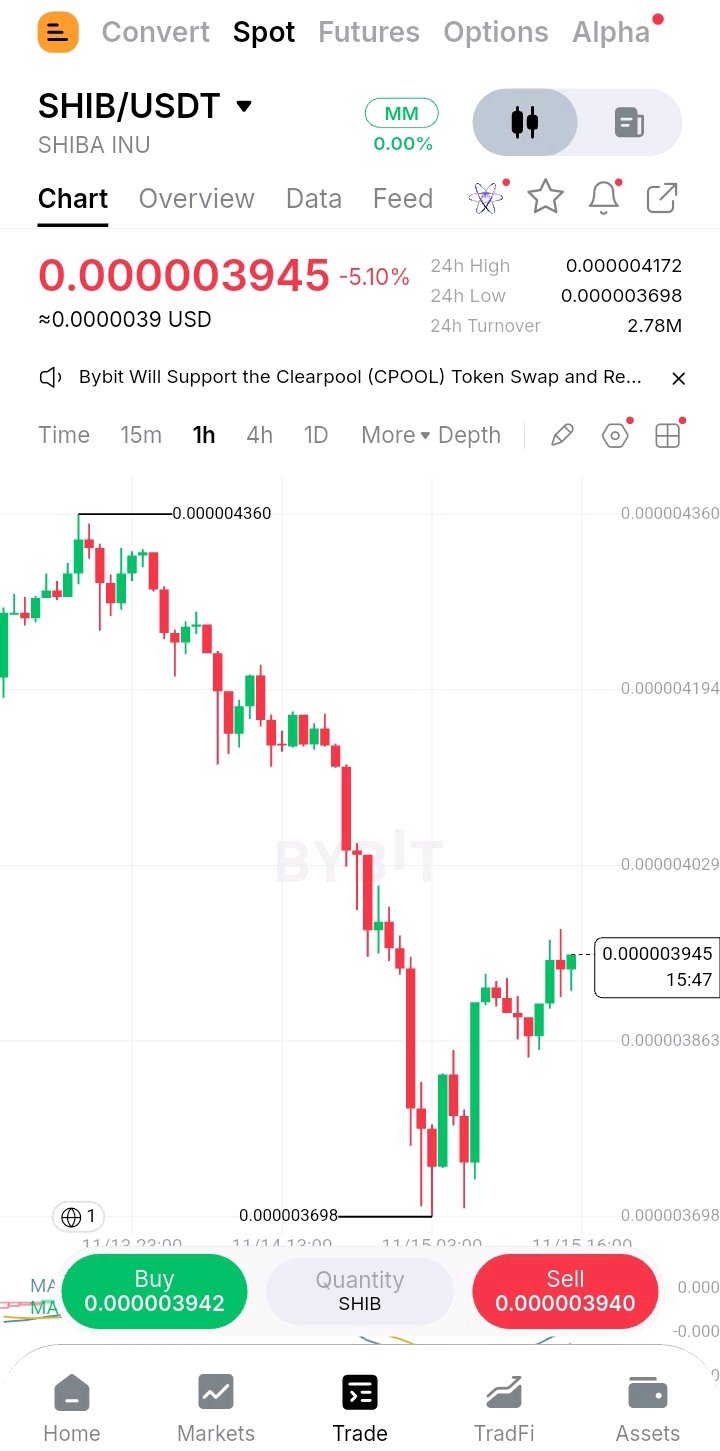
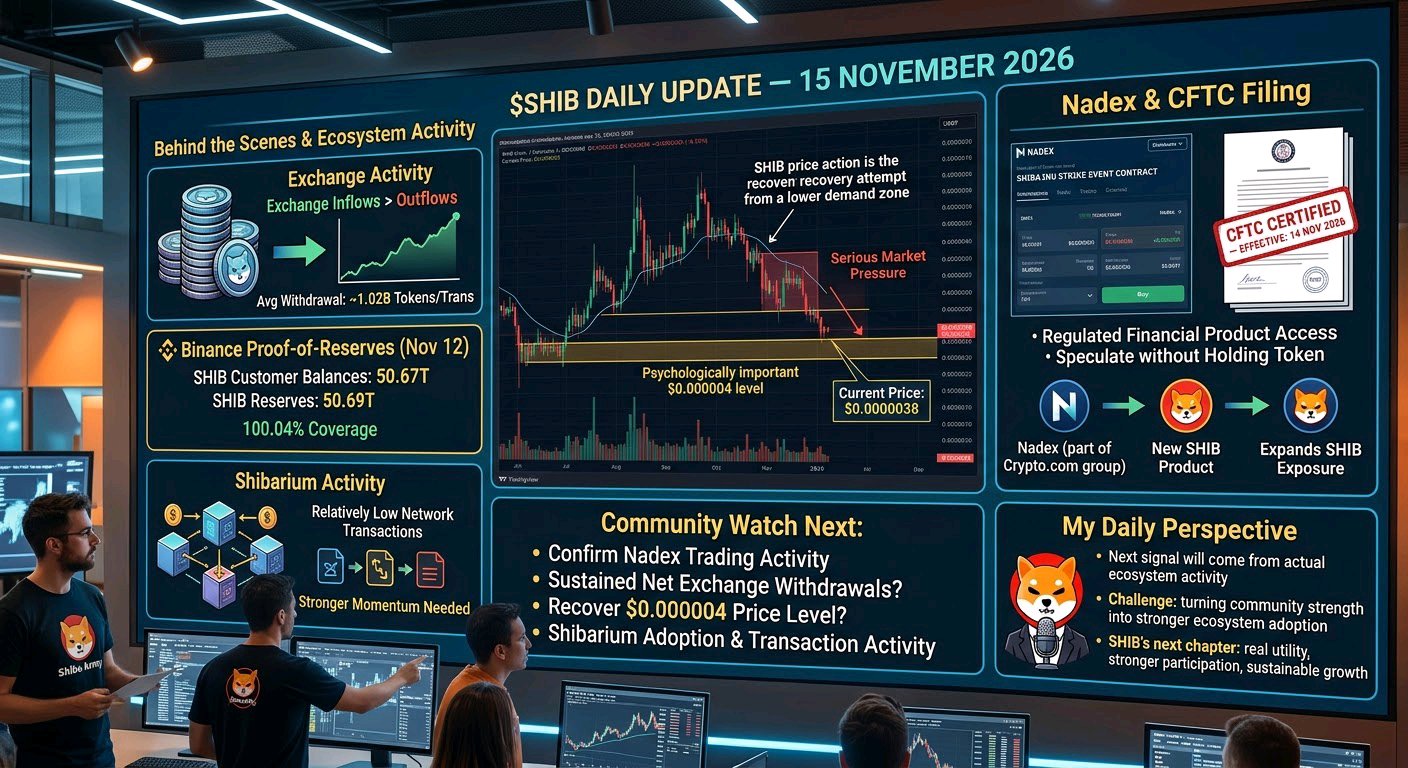
ACTUALIZACIÓN DIARIA DE $SHIB — SHIBA INU VUELVE A ESTAR EN EL PUNTO DE MIRA Shiba Inu ($SHIB) está atrayendo la atención a medida que los operadores siguen de cerca su última actividad en el mercado y los desarrollos de su ecosistema. El gráfico subido destaca un posible intento de recuperación desde una zona de demanda inferior, con los compradores tratando de defender los mínimos recientes. Sin embargo, un rebote técnico por sí solo no confirma una reversión de tendencia sostenida. ### El mayor avance: Nadex introduce un producto de trading vinculado a SHIB El 10 de noviembre de 2026, North American Derivatives Exchange (Nadex), parte del grupo Crypto.com, presentó una certificación oficial para un nuevo contrato de evento "Strike" de Shiba Inu ante la Comisión de Comercio de Futuros de Productos Básicos (CFTC) de EE. UU. La presentación establece que el producto tenía la intención de estar disponible a partir del 14 de noviembre o después. Permite a los operadores especular con el precio de SHIB sin comprar ni mantener el token directamente. Este es un desarrollo importante porque amplía la exposición de SHIB a productos financieros regulados. Sin embargo, el acceso a derivados no se traduce automáticamente en una demanda adicional en el mercado al contado. assets.ctfassets.net +1 ### SHIB se enfrenta a una seria presión de mercado El desarrollo positivo llega en un momento difícil para los titulares de SHIB. El 14 de noviembre, SHIB cayó por debajo del nivel psicológicamente importante de 0,000004 $, alcanzando precios no vistos desde la primavera de 2021. Los informes de mercado también destacaron la debilidad en todo el sector de las memecoins, junto con una presión de venta más amplia en el mercado de criptomonedas. A fecha de 15 de noviembre, los datos de mercado situaban a SHIB alrededor de los 0,0000038 $, aunque los precios varían entre los proveedores de datos y los intercambios. 15 de noviembre de 2026 +1 ### ¿Qué está pasando entre bastidores? Hay tres desarrollos que vale la pena monitorear: * Actividad de intercambio: Se informa que los retiros promedio de SHIB aumentaron a aproximadamente 1.020 millones de tokens por transacción. Sin embargo, las entradas a los intercambios se mantuvieron más altas que las salidas, por lo que esto aún no es una prueba clara de acumulación. * Reservas de Binance: Su informe de prueba de reservas del 12 de noviembre mostró 50,69 billones de SHIB frente a 50,67 billones de SHIB en los saldos de los clientes, lo que representa aproximadamente una cobertura del 100,04%. * Actividad de Shibarium: Las transacciones de red reportadas se mantuvieron relativamente bajas, lo que sugiere que la actividad del ecosistema aún necesita un impulso más fuerte. 15 de noviembre de 2026 +1 ### ¿Qué debería observar la comunidad a continuación? Lo importante a vigilar es: * Confirmación de la actividad comercial real para el contrato de SHIB de Nadex. * Si los flujos de intercambio de SHIB cambian hacia retiros netos sostenidos. * Mejoras en la adopción y actividad de transacciones de Shibarium. * Si los compradores pueden recuperar el nivel de precio de 0,000004 $. Estos son desarrollos para monitorear, no catalizadores alcistas confirmados. ### Mi perspectiva diaria En mi opinión, SHIB está entrando en un período importante. El desarrollo de Nadex le da al proyecto una exposición adicional en los mercados financieros regulados, pero la debilidad actual del precio muestra que la confianza del mercado aún no se ha recuperado. Creo que la próxima señal significativa provendrá de la actividad real del ecosistema y de una demanda de compra sostenida, en lugar de otro rebote de precio temporal. Shiba Inu ha construido una comunidad masiva a lo largo de los años. El desafío ahora es convertir esa fuerza de la comunidad en una adopción del ecosistema más sólida y en una confianza de mercado duradera. El próximo capítulo de SHIB debería tratar sobre utilidad real, una mayor participación y un crecimiento sostenible. La comunidad tiene motivos para observar de cerca. El próximo movimiento necesita confirmación, no solo entusiasmo. #SHIB #ShibaInu #CryptoNews #BinanceSquare Nota sobre la precisión de la imagen: El gráfico subido parece contener un error decimal en su precio de entrada. Su entrada mostrada es inconsistente con los objetivos listados y los precios recientes de mercado de SHIB. Verifique esos niveles antes de publicarlos como una configuración de trading. ByXIMPACT $SHIBUSDT
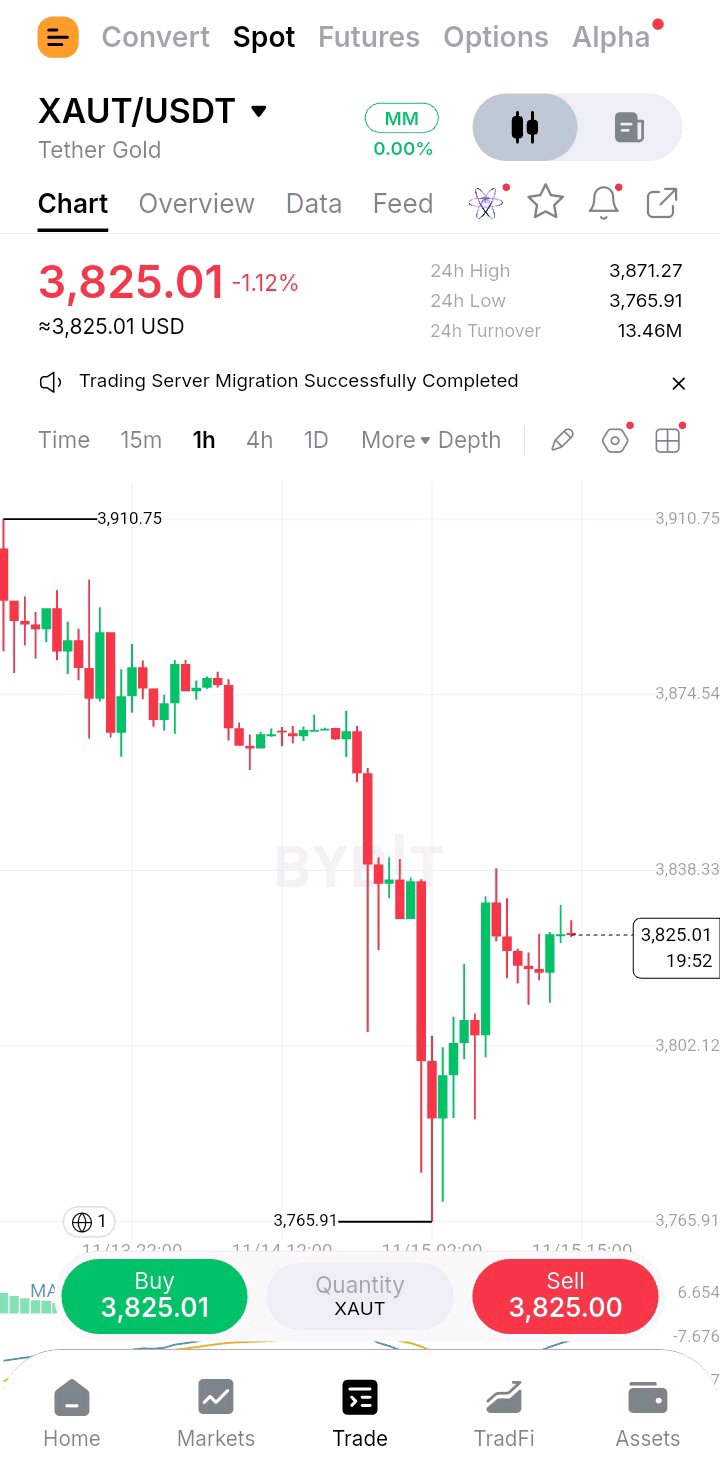
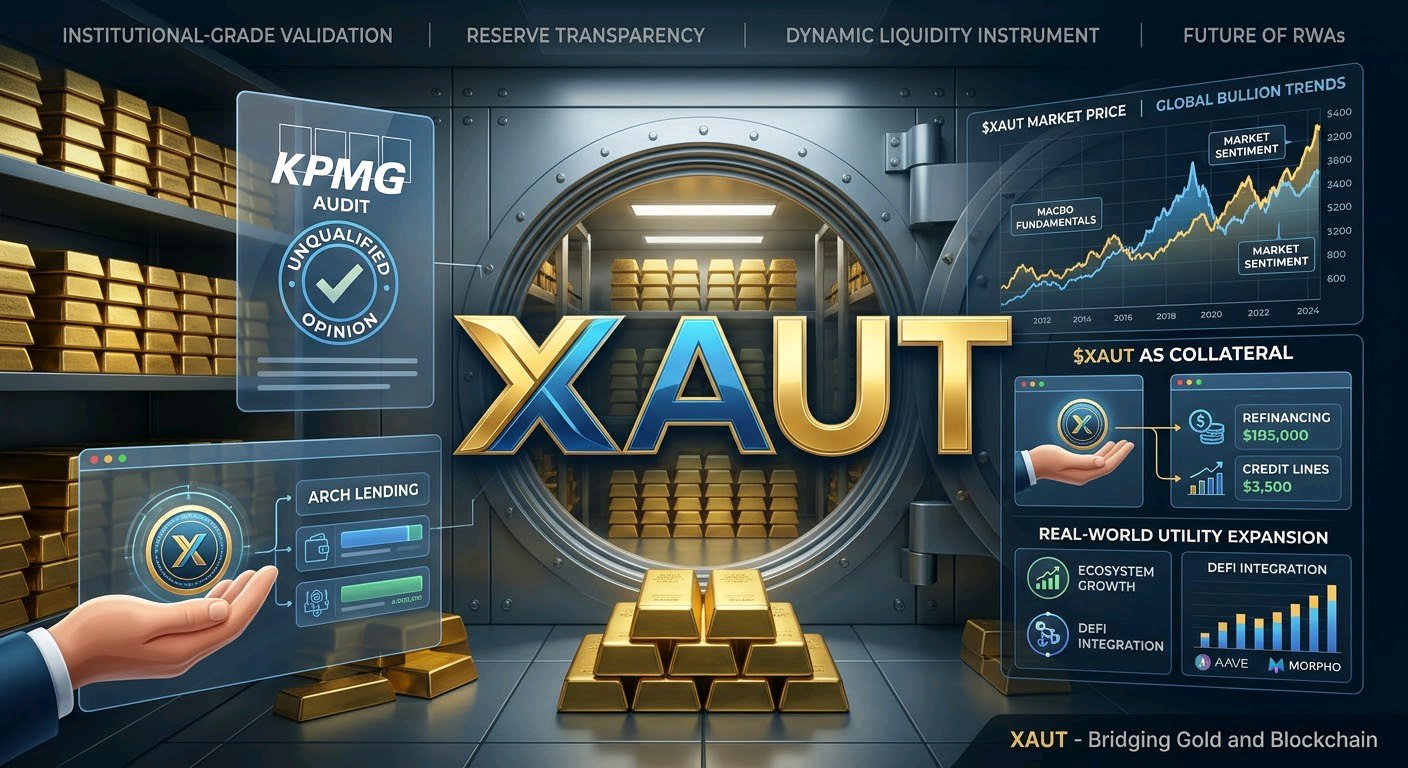
$XAUT IS BACK IN FOCUS — AUDIT MILESTONES MEET REAL-WORLD UTILITY EXPANSION Latest Developments Tether Gold ($XAUT) has captured fresh market attention following a major transparency milestone and a broader macro pullback in the tokenized commodity sector. On November 12, Tether announced that KPMG U.S. issued an independent, unqualified audit opinion on TG Commodities' financial statements for the year ending December 31, 2025. The rigorous audit verified that every circulating token was backed by physically allocated gold bars stored securely in professional vaults. This regulatory and reporting clarity coincides with recent ecosystem growth, including lending integrations such as Arch Lending's program allowing $XAUT holders to utilize their digital bullion as collateral for refinancing and credit lines. Why This Update Matters For the real-world asset (RWA) and tokenized gold sectors, institutional-grade validation from a Big Four accounting firm directly addresses long-standing questions regarding reserve transparency. While blockchain ledgers allow instant proof of token supply, verifiable physical audits bridge the trust gap for conservative institutional participants and high-net-worth investors. Furthermore, expanding financial utility—moving beyond passive holding into credit markets—transforms $XAUT from a static safe-haven asset into a dynamic liquidity instrument within digital finance. What's Happening Behind the Scenes? On-chain metrics and sector analyses highlight a structural evolution in how tokenized gold is handled. Although the tokenized gold market has experienced dramatic volume expansion through 2026, industry reports emphasize that true decentralized finance (DeFi) integration—such as deployment as collateral on lending protocols like Aave and Morpho—is still in its early growth phases. Community discussions and institutional desk activities remain heavily tied to broader macroeconomic gold price fluctuations, as physical bullion trends dictate short-term sentiment across tokenized equivalents. What Should the Community Watch Next? Observers should monitor whether the recent KPMG assurance catalyzes broader institutional adoption and whether additional lending platforms integrate $XAUT into their core collateral frameworks. Additionally, tracking on-chain vault ratios, upcoming reserve attestations, and how liquidity behaves around key macro resistance and support levels will be critical for assessing near-term market health. My Daily Perspective Tokenized gold sits at a fascinating intersection between traditional safe-haven preservation and modern blockchain agility. While short-term price movements naturally mirror broader bullion corrections, the steady march toward rigorous Big Four auditing and expanded DeFi utility proves that digital precious metals are maturing past mere hype. As transparency standards rise, projects that successfully combine physical accountability with seamless on-chain utility will define the future of RWAs. Stay tuned, and keep a close eye on the charts as the market digests these structural updates! #ByXIMPACT $XAUTUSDT
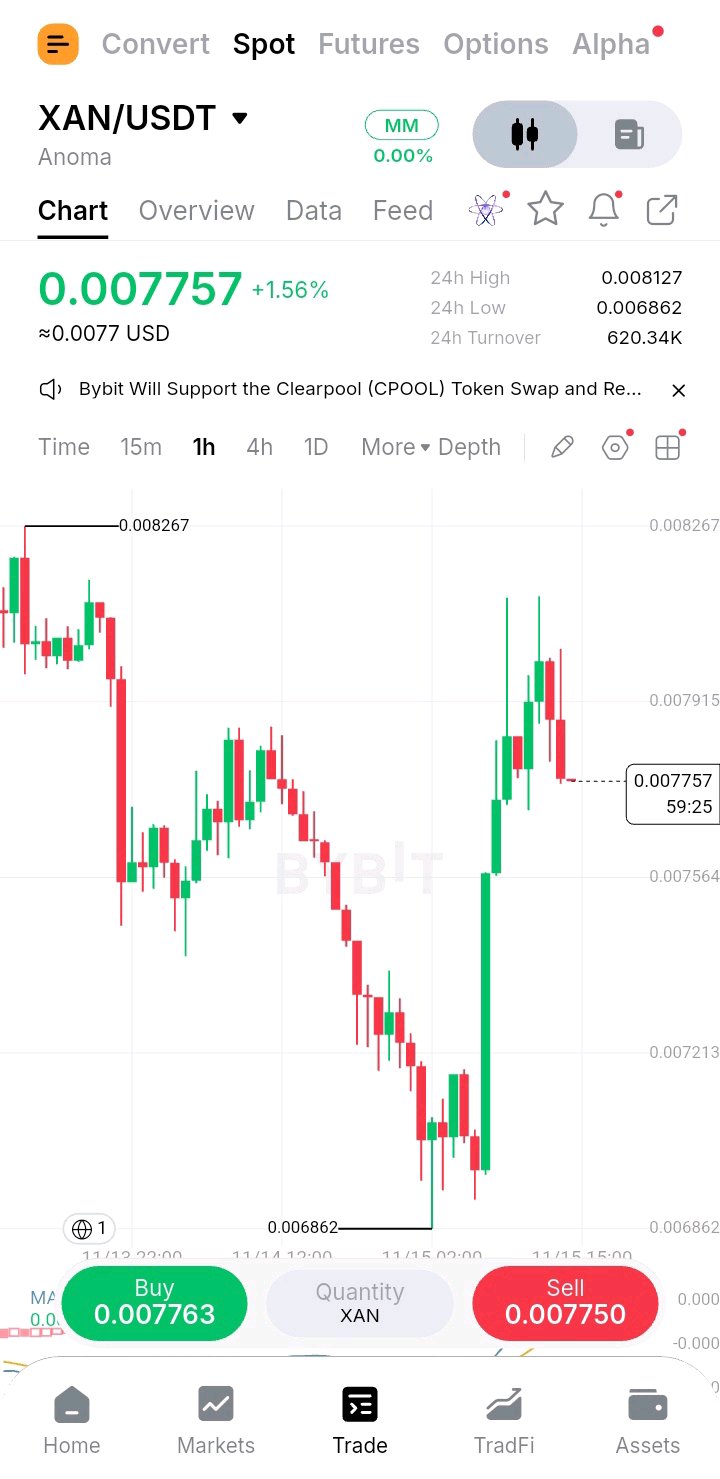
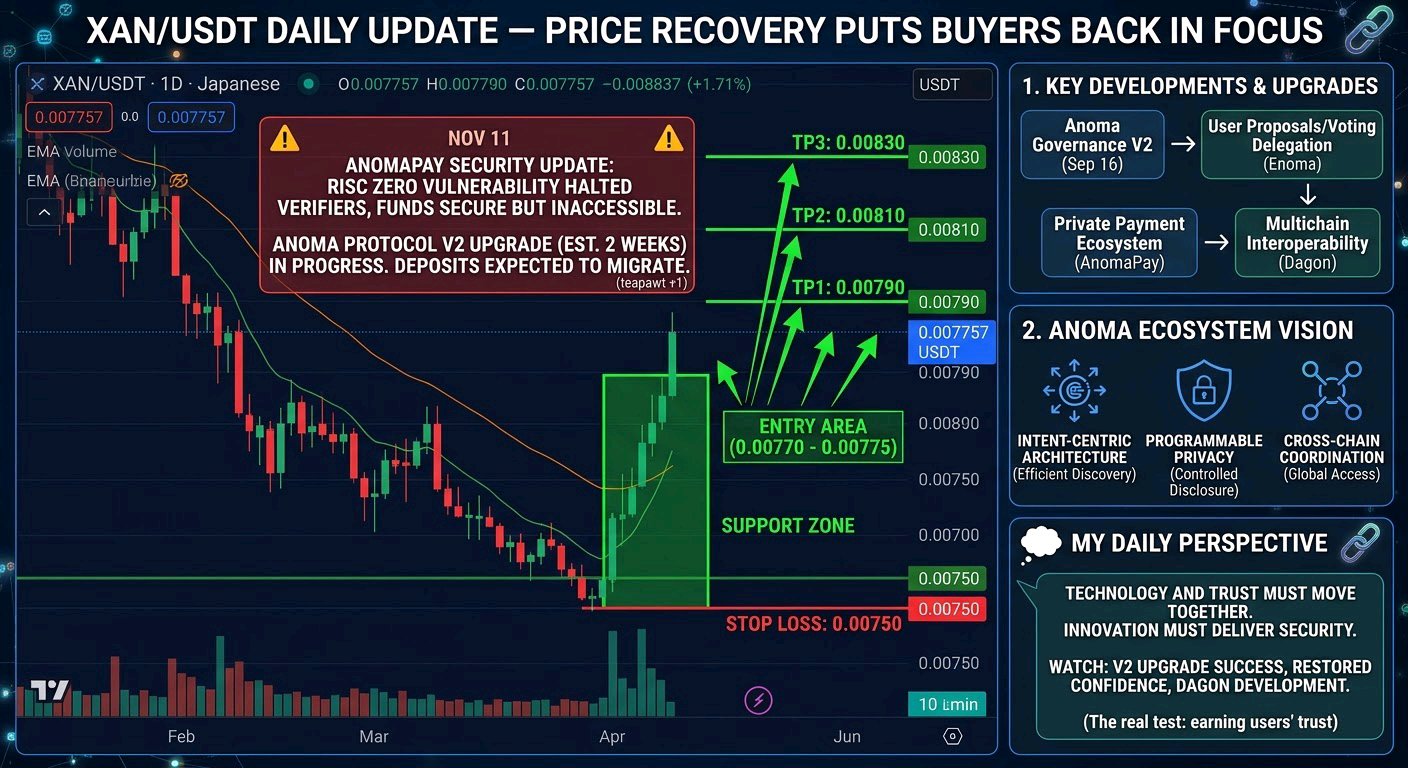
ACTUALIZACIÓN DIARIA DE XAN/USDT: LA RECUPERACIÓN DEL PRECIO VUELVE A PONER A LOS COMPRADORES EN EL FOCO XAN/USDT está atrayendo atención tras una fuerte recuperación desde su zona de soporte. El gráfico subido muestra a los compradores interviniendo tras un prolongado movimiento a la baja, lo que crea un cambio potencial en el impulso del mercado a corto plazo. El gráfico destaca un precio actual de aproximadamente 0,007757 USDT, con un área de entrada alrededor de 0,00770–0,00775. Sin embargo, la estructura de resistencia más amplia sigue siendo importante y la recuperación aún necesita confirmación. # 1. Últimas novedades: Actualización de seguridad de AnomaPay Desarrollo importante — 11 de noviembre de 2026 El mayor acontecimiento reciente en torno a Anoma es un problema de seguridad que involucra al sistema de pruebas RISC Zero utilizado por AnomaPay. El 11 de noviembre, Anoma anunció que había detenido a los validadores afectados tras identificar vulnerabilidades que podrían poner en riesgo los fondos de los usuarios. El equipo declaró que los fondos depositados permanecen seguros, pero están temporalmente inaccesibles. Se espera que el cambio al Protocolo Anoma V2 tarde aproximadamente dos semanas, incorporando actualizaciones de seguridad de RISC Zero. Se espera que los depósitos se migren automáticamente después de la actualización. teapawt +1 Este es un desarrollo importante porque la seguridad y la confianza del usuario son esenciales para cualquier ecosistema de pago centrado en la privacidad. ## 2. Por qué importa esta actualización Anoma está construyendo una infraestructura diseñada para hacer que las aplicaciones Web3 estén más conectadas a través de una arquitectura centrada en la intención, privacidad programable y coordinación entre cadenas. Sin embargo, el incidente de AnomaPay destaca un desafío importante: la tecnología innovadora también debe ofrecer una seguridad confiable y un acceso ininterrumpido a los fondos de los usuarios. Una actualización exitosa a la V2 podría ayudar a restaurar la confianza. Los retrasos o nuevas vulnerabilidades podrían ejercer presión adicional sobre la reputación del proyecto. ## 3. ¿Qué está pasando entre bastidores? Anoma ya ha introducido varios desarrollos en el ecosistema: * 16 de septiembre de 2026: Se lanzó Anoma Governance V2, dando a los titulares de XAN la capacidad de proponer y votar sobre cambios en el protocolo del token. * La gobernanza incluye la delegación de votos y un proceso de propuesta estructurado. * AnomaPay ha ampliado su ecosistema de pagos privados a través de múltiples redes. * Su hoja de ruta más amplia incluye Dagon, centrado en la interoperabilidad multicadena, y un mayor desarrollo del protocolo. El Blog de Anoma +2 Estos desarrollos muestran que el trabajo de Anoma va más allá de los movimientos de precios de los tokens a corto plazo. ### 4. Situación del mercado de XAN La última instantánea de mercado disponible del 14 de noviembre mostró a XAN cotizando alrededor de 0,0076 $, con una debilidad diaria de aproximadamente el 5 % y una presión vendedora continua. COINOTAG +1 El gráfico subido destaca: * Precio actual en el gráfico: 0,007757 * Zona de soporte: alrededor de 0,00750 * Área de entrada: 0,00770–0,00775 * Resistencia: zona de oferta superior * TP1: 0,00790 * TP2: 0,00810 * TP3: 0,00830 * Stop loss: 0,00750 Estos son niveles del gráfico que has proporcionado, no precios reales verificados de forma independiente. Un movimiento sostenido por encima de la resistencia cercana podría fortalecer el escenario de recuperación. Sin embargo, perder el soporte debilitaría la estructura alcista. ### 5. ¿A qué debería estar atenta la comunidad? Tres desarrollos merecen atención: * Actualización de Anoma V2: La esperada actualización de seguridad y restauración del acceso a AnomaPay. * Mejoras de seguridad: Confirmación de que la vulnerabilidad de RISC Zero se ha solucionado. * Desarrollo de Dagon: Progreso hacia un ecosistema multicadena más interconectado. El cronograma de la V2 es una estimación anunciada por el equipo, no una actualización confirmada y completada. teapawt +1 ### 6. Mi perspectiva diaria Personalmente, creo que XAN se encuentra en una etapa importante donde la tecnología y la confianza deben ir de la mano. Anoma tiene una visión interesante para los pagos centrados en la privacidad y las aplicaciones entre cadenas. Sus mejoras en la gobernanza también dan a los titulares de tokens un papel más directo en el futuro del proyecto. Pero no quiero ignorar el reciente problema de seguridad de AnomaPay. La pérdida temporal de acceso a los fondos depositados es algo serio, incluso cuando el equipo dice que esos fondos siguen estando seguros. Para el mercado, estaré observando si los compradores pueden defender el área de soporte y si el proyecto realiza su actualización a la V2 con éxito. Mi opinión: XAN merece atención, pero el próximo gran catalizador debería ser la recuperación de la confianza mediante mejoras de seguridad verificadas, no solo un rebote de precios a corto plazo. La verdadera prueba para Anoma es simple: crear tecnología innovadora es importante, pero ganarse la confianza de los usuarios es aún más importante. #Anoma #XAN #CryptoNews #BinanceSquare Nota de investigación: No se identificó ningún anuncio importante nuevo en la última ventana de 24-48 horas. El anuncio de seguridad del 11 de noviembre es el desarrollo reciente verificado más importante identificado en esta investigación. #ByXIMPACT $XANUSDT
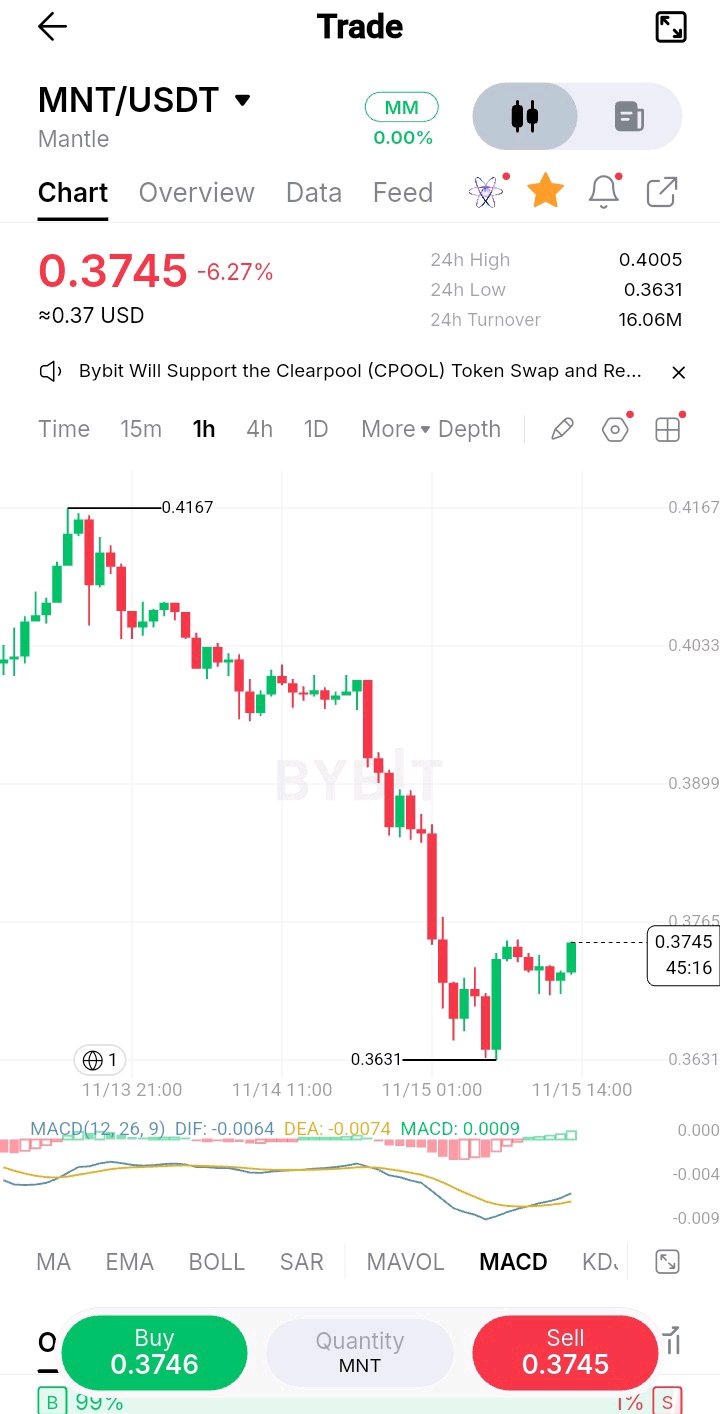
ACTUALIZACIÓN DIARIA DE $MNT: UNA CORRECCIÓN DE ERRORES SILENCIOSA QUE DICE MUCHO SOBRE MANTLE** Mantle (MNT) cotiza alrededor de 0,37 $ tras unas 24 horas flojas. Ninguna noticia negativa específica sobre Mantle explica la caída. Lo más interesante es lo que ha ocurrido entre bastidores esta semana. **Últimos acontecimientos** El 5 de noviembre, la firma de seguridad Blockaid reveló un error de "state-root" (raíz de estado) en Reth, el cliente de ejecución ascendente utilizado en varias redes EVM. Los nodos sin parchear podrían producir raíces de estado incorrectas, bloquearse durante la sincronización o devolver pruebas erróneas a través del método eth_getProof. Mantle respondió con op-reth v1.6.3, anunciado alrededor del 7 de noviembre. En lugar de saltar a la versión más reciente, el equipo aplicó el parche a su propia línea de producción. Mantle asegura que los activos de los usuarios están seguros, que no es necesaria ninguna acción por parte de los usuarios y que no hace falta migración de bases de datos. Se insta a los operadores de nodos a actualizar. No se ha informado de ninguna vulnerabilidad ni pérdida de fondos. Base y BNB Chain también actuaron ante el mismo problema. Por otro lado, el 28 de octubre el equipo principal de contribuidores de Mantle publicó su propuesta de presupuesto para el cuarto ciclo (julio de 2026 a junio de 2027): 40 millones de USDx y 150 millones de MNT. Está abierta a debate, y los delegadores de MNT deben completar sus asignaciones de delegación antes de que comience la votación. **¿Por qué es importante esta actualización?** Una raíz de estado incorrecta no significa automáticamente que se hayan robado fondos. Puede significar una sincronización rota o pruebas poco fiables, y los puentes y aplicaciones dependen de esas pruebas. Un incidente corto y contenido, sin pérdidas, demuestra que el equipo puede parchear rápidamente, lo cual es importante para cualquier red que intente atraer a instituciones. La propuesta de presupuesto es importante por otra razón. Muestra cómo planea Mantle desplegar su tesorería durante el próximo año y coloca a los delegadores de MNT directamente en el ciclo de toma de decisiones. **¿Qué ocurre entre bastidores?** Mantle sigue construyendo infraestructura entre cadenas. En julio, su Super Portal, construido con Bybit, migró a Chainlink CCIP. Actualmente conecta MNT entre Ethereum y Solana, con más rutas previstas. La hoja de ruta de la asociación entre Mantle y Bybit también apunta a un uso más amplio de MNT en operaciones, pagos y ahorros. **¿Qué debería vigilar la comunidad a continuación?** - **Confirmado:** el periodo de debate de la propuesta de presupuesto y la fecha límite de delegación antes de que se abra la votación. No he podido verificar una fecha de votación. - **Confirmado:** el cumplimiento de la actualización de los operadores de nodos para la v1.6.3. Los nodos sin parchear son el riesgo restante. - **No confirmado:** cualquier informe posterior (post-mortem) por parte de Mantle o Blockaid. No se ha anunciado nada. **Mi perspectiva diaria** El mercado se tiñe de rojo hoy, pero la señal más reveladora es operativa. Las redes se ponen a prueba cuando algo falla, y Mantle se mantuvo en línea, envió un parche específico y dijo a los usuarios claramente qué hacer (nada). Eso no acapara titulares, pero es el tipo de fiabilidad de la que depende la adopción a largo plazo. La votación del presupuesto es la próxima prueba real de la participación de la comunidad. En el mundo cripto, las noticias más ruidosas mueven el gráfico, pero las correcciones silenciosas mueven la confianza. *No es un consejo financiero. Haz siempre tu propia investigación (DYOR).* #ByXIMPACT $MNTUSDT
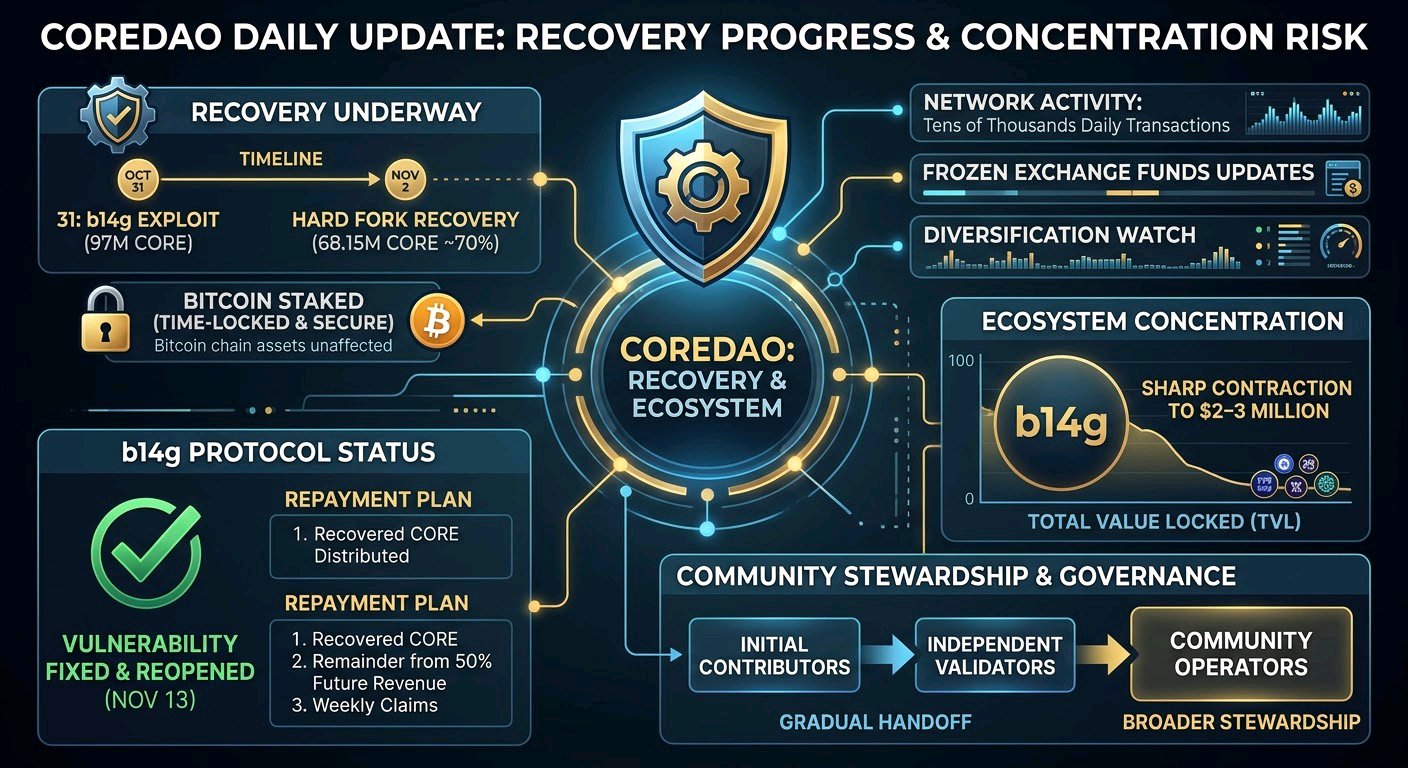
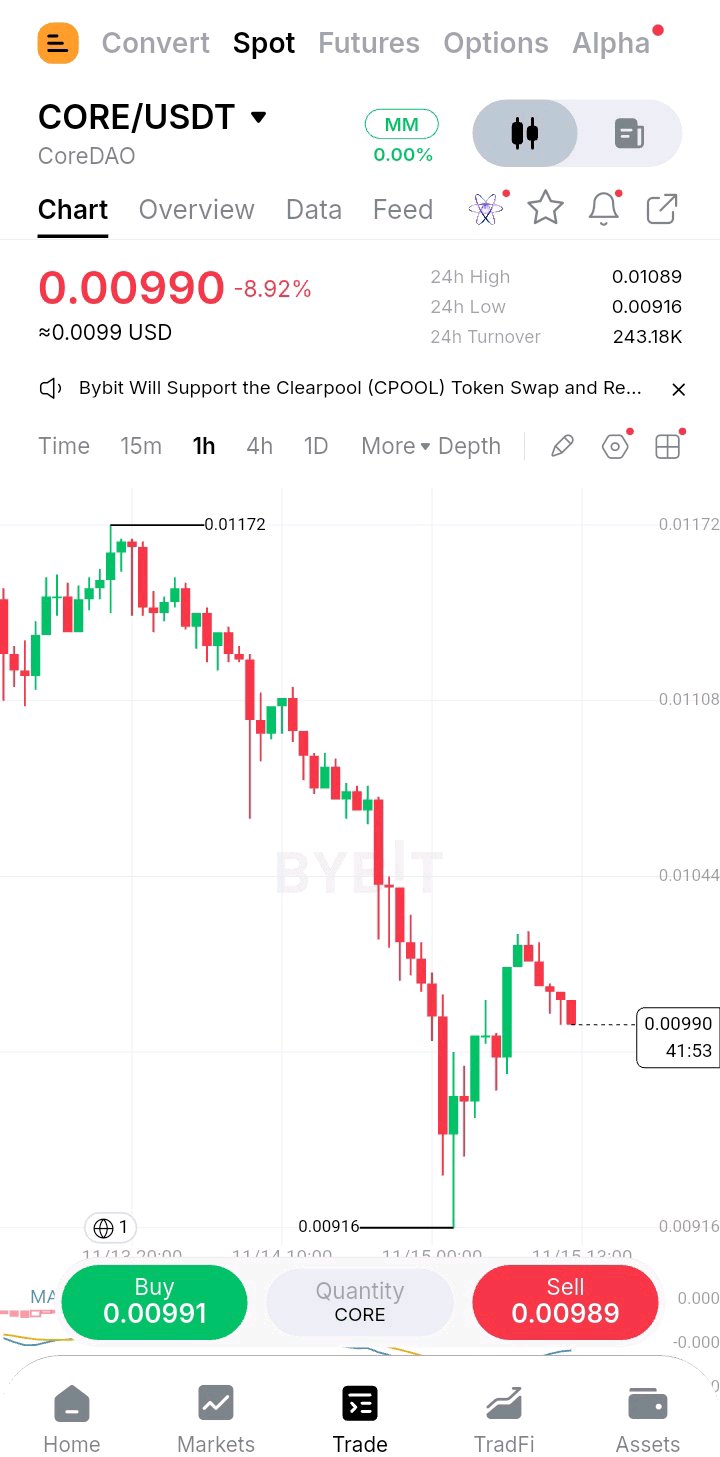
$CORE DAILY UPDATE — RECOVERY UNDERWAY AS ECOSYSTEM CONCENTRATION COMES INTO FOCUS** CoreDAO finds itself in a quiet but revealing stretch. The network remains operational and secure, yet recent data and protocol activity highlight both the progress of recovery efforts and the challenges of a highly concentrated DeFi landscape. # Latest Developments On October 31, the b14g dual-staking protocol suffered an exploit that drained approximately 97 million CORE from 91 staking orders. The issue stemmed from a zero-amount withdrawal path that the contracts did not properly guard against. Core DAO confirmed that the base network, consensus, validators, and direct staking contracts were unaffected. Bitcoin staked through b14g remained time-locked on the Bitcoin chain and was not compromised. A Core hard fork on November 2 recovered roughly 68.15 million CORE (about 70% of the stolen amount) through a one-time state update that did not alter total supply or reverse other transactions. Additional tokens linked to the attacker were frozen on exchanges. By November 13, b14g had deployed a fix for the vulnerability and reopened deposits, withdrawals, staking, and reward claims. The protocol’s repayment plan prioritizes returning the recovered CORE to affected users, with the remainder to be covered over time from 50% of future Core staking revenue, claimable weekly. At the same time, DeFi TVL on Core has contracted sharply. Recent reports put total value locked around $2–3 million, with the large majority still concentrated in b14g itself. This marks a steep decline from earlier periods when the ecosystem supported hundreds of millions in locked value. ## Why This Update Matters The rapid recovery of the majority of funds and the reopening of b14g demonstrate that Core’s infrastructure and coordination with partners can respond effectively to incidents. At the same time, the extreme concentration of remaining TVL in a single protocol underscores a structural risk: when one project accounts for nearly all DeFi activity, any disruption there quickly becomes an ecosystem-wide story. The earlier shift toward greater decentralization—independent validators taking over block production and initial contributors stepping back from DAO roles—continues in the background. That transition, announced in late October, was framed as the start of broader community stewardship. How that process evolves while the network digests the recent exploit will shape confidence in Core’s long-term governance model. ### What’s Happening Behind the Scenes? Network activity continues at a steady, if modest, level. Transaction counts remain in the tens of thousands daily even as liquidity and TVL have compressed. The focus for many participants has shifted from growth metrics to the practical execution of the repayment process and the health of the remaining DeFi footprint. b14g’s decision to reopen after the fix and publish a clear recovery framework is a concrete step. Whether users return capital and whether other protocols can expand will determine if the concentration risk eases in the coming weeks. ### What Should the Community Watch Next? Key items on the radar include the actual distribution of recovered CORE to affected stakers, any further updates on frozen exchange funds, and signs of diversification in Core’s DeFi TVL. The gradual handoff of development and stewardship responsibilities to community operators remains an open process without a fixed timetable—progress there will be measured by visible independent contributions rather than announcements alone. No major new product launches or partnership announcements have emerged in the most recent 48 hours. The current phase is defined more by cleanup and stabilization than by expansion. ### My Daily Perspective Core is navigating a classic post-incident period: the technical response has been relatively swift, yet the market is pricing in both the recovery and the lingering concentration risk. The fact that the base layer held firm is important. Equally important is whether the ecosystem can rebuild liquidity and activity beyond a single dominant protocol. For now, the story is less about sudden catalysts and more about steady execution—returning funds, restoring confidence, and seeing whether community-led growth can take root. Those who stay engaged will be watching the repayment claims and any movement in secondary protocols as the clearest near-term signals. The network is still standing. The next chapter depends on how thoroughly the current repair work is completed and how quickly diversification returns. #ByXIMPACT $COREUSDT
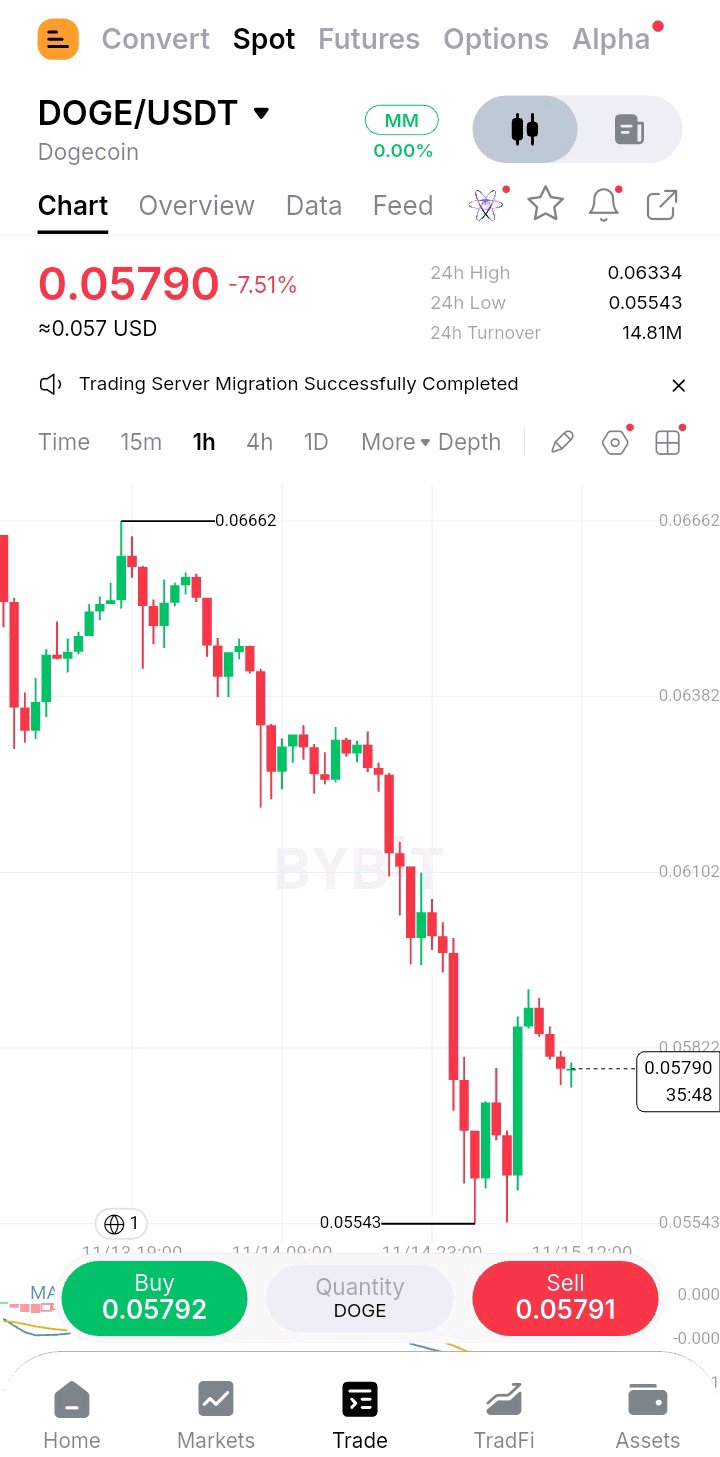
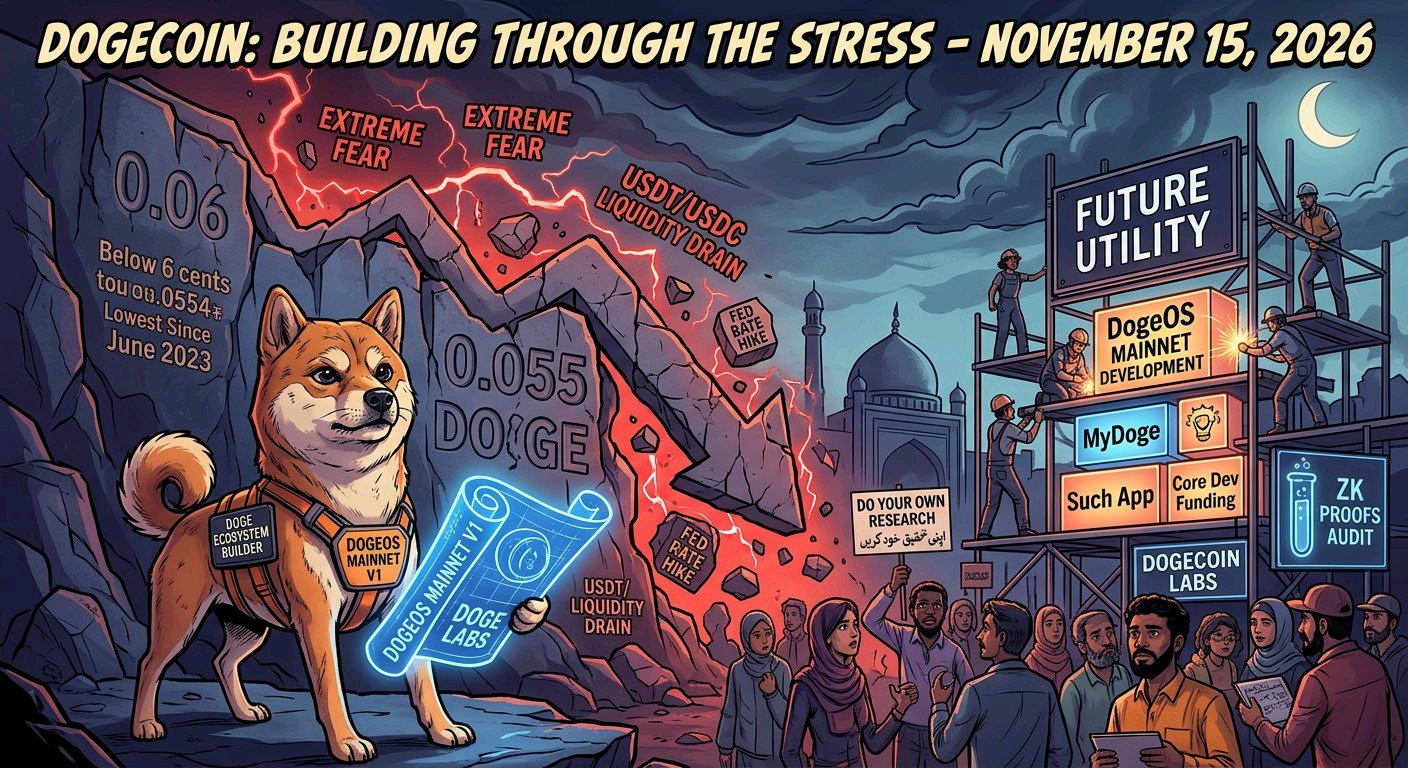
$DOGE IS BACK IN FOCUS, BUT NOT FOR THE REASONS HOLDERS WANTED** Dogecoin slid below the 6-cent mark overnight into Sunday, November 15, 2026. It touched about $0.0554 on Kraken, its lowest level since June 2023. The Bybit screenshot shows the same move: a 24h range of $0.05543 to $0.06334, and a roughly 7.5% daily drop at the time of capture. **Latest Developments** DOGE closed Saturday at about $0.0573 on Kraken, its lowest daily close since at least late 2022, per CryptoTicker (Nov 15). That is roughly 62% below its 2026 closing high of $0.1517 on January 5. Trading volume was heavy. About 256 million DOGE changed hands on Kraken on Saturday, nearly five times the recent daily average. There was no confirmed Dogecoin-specific trigger. DOGE fell with the whole market, only harder. Bitcoin lost around 3.5% over the same stretch, while DOGE lost more than twice that. The macro pressure behind it: - **Rates:** Futures markets were pricing roughly an 88.5% chance of a Fed rate hike on December 8–9, per CME FedWatch via Bitcoin.com. - **ETF outflows:** About $1.07B left US spot Bitcoin ETFs between November 9 and 13 (Farside data, via Coinpaper). - **Thinner liquidity:** Coinbase Institutional data shows the combined supply of USDT, USDC and DAI shrank by about $11.5B in 30 days. - **Sentiment:** The Fear & Greed Index read 10 on Sunday. **Why This Update Matters** Dogecoin trades on attention more than on fundamentals. When the market sits in extreme fear, the largest meme coin tends to feel it first. The ETF picture adds to this. US Dogecoin ETFs have gone a month without inflows, as reported on November 14. The products exist, but fresh demand through them has dried up. **What's Happening Behind the Scenes** While the chart bleeds, the builders keep building: - **DogeOS mainnet:** On November 11, DogeOS CEO Jordan Jefferson told The Block that development of version one is complete, audits are done, and mainnet is "very, very close." The public testnet has been live since September 30. - **Dogecoin Labs:** Launched last month, it brings MyDoge, DogeOS, Such App and teams from the Dogecoin Foundation and House of Doge under one commercial roof. The stated aim is to fund core development without relying only on donations. - **Builders:** Jefferson says more than 100 builders are working on DogeOS-related projects. - **Futures positioning:** On OKX, DOGE open interest fell about 6.5% in coin terms during the evening slide. Roughly 79% of accounts were still long as of Sunday morning, which leaves leveraged longs exposed if the drop continues. **What Should the Community Watch Next?** *Confirmed:* - The Fed meeting on December 8–9. - The June 2023 low near $0.0545, the next level where DOGE last traded before this week. *Unconfirmed:* - The DogeOS mainnet. No date has been announced, so "very close" is a progress update, not a schedule. - The DogeOS bridge currently relies on a validator majority and a trusted execution environment signer. Dogecoin does not verify its ZK proofs natively. Security disclosures and further audits are worth following. - Whether ETF demand returns once the market stabilizes. **My Daily Perspective** Today's story is not a failed project. It is a stressed market. The price is telling one story, extreme fear and forced selling. The development side is telling another, an application layer slowly forming around a coin that never had one. Those two stories rarely meet on the same day. Utility does not stop a crash, and a crash does not erase progress. What matters is whether the ecosystem ships while sentiment is at its lowest. Dogecoin has always been the coin that survives on community and attention. Now it has to show it can earn both. *Not financial advice. Always DYOR.* Is project ki tasveer bana ke dein. #ByXIMPACT $DOGEUSDT
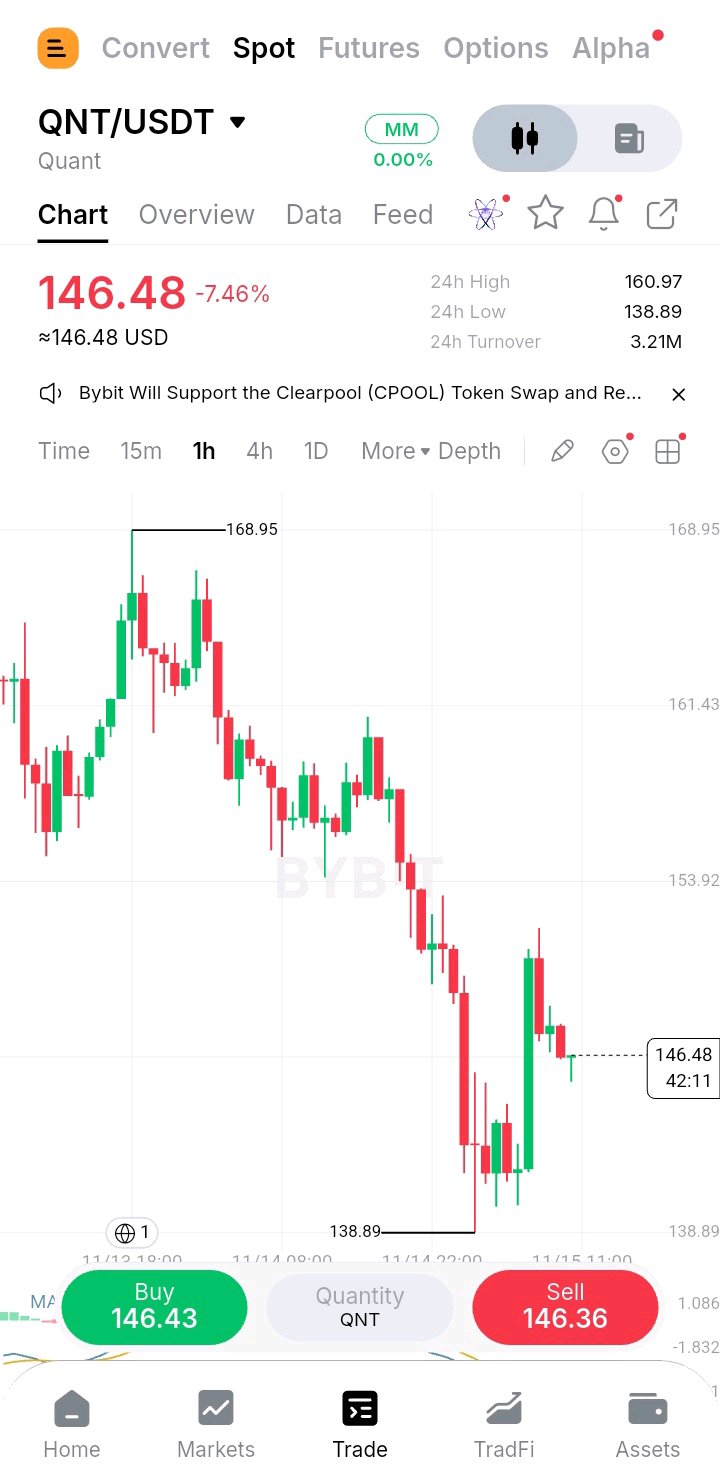
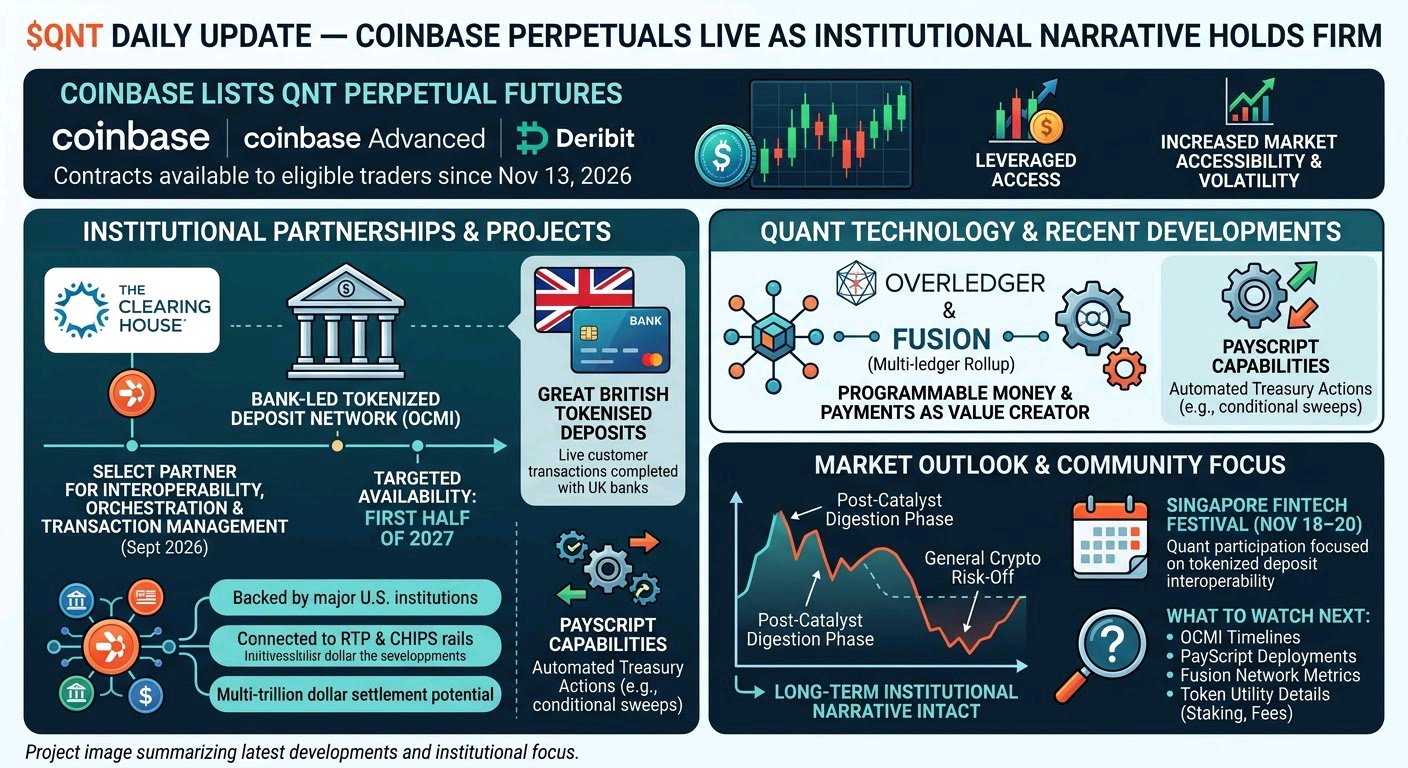
DAILY UPDATE — MARKET PRESSURE MEETS NEW DERIVATIVES ACCESS AS INSTITUTIONAL ROADMAP HOLDS** Quant (QNT) is trading near 146 USDT on major platforms like Bybit, reflecting a sharp pullback of roughly 7-8% in the latest 24-hour window after testing higher levels earlier in the week. The move aligns with broader crypto market risk-off sentiment rather than any project-specific setback. # Latest Developments Coinbase launched perpetual futures trading for QNT on November 13, 2026 (alongside GRAM, GRASS, and ZRO). The contracts became available on Coinbase, Coinbase Advanced, and via Deribit in select jurisdictions, expanding leveraged exposure and hedging options for both retail and institutional participants. Around the same period, Quant published a perspective piece on “Payments as a value creator” (November 12), outlining how programmable money and PayScript can turn payments from a cost center into a product layer for banks. The team also highlighted ongoing work around tokenised deposits, noting live pilot activity in Singapore and confirming their presence at the Singapore Fintech Festival (November 18–20). These updates sit against the still-dominant fundamental backdrop: The Clearing House’s selection of Quant in late September 2026 to power the interoperability, orchestration, and transaction-management layer for its On-Chain Money Initiative. That US bank-backed network for tokenised deposits is targeted to open to participating institutions in the first half of 2027. # # Why This Update Matters The Coinbase perpetual futures listing increases market access and potential liquidity, but it also amplifies short-term volatility—especially in a risk-off environment. Traders now have easier tools to express both bullish and bearish views, which can accelerate moves in either direction. The institutional side remains the longer-term story. Quant continues to position itself as infrastructure for programmable money and tokenised deposits across regulated environments (US Clearing House initiative, prior UK live customer transactions, Singapore pilots). While token utility and revenue capture details are still evolving, the repeated selection by major banking consortia keeps Quant relevant in the real-world asset and interbank settlement conversation. ## What’s Happening Behind the Scenes? Network and ecosystem activity continues to center on Overledger and the Fusion multi-ledger rollup (live since June 2026). Official communications emphasize connectivity to existing payment rails (RTP, CHIPS) and the ability to layer programmable logic on top of proven banking infrastructure rather than replacing it. Recent posts stress interoperability questions that arise as more banks issue tokenised deposits: bank-to-bank settlement, links to ISO 20022 rails, and cross-border/currency handling. No major new security incidents, tokenomics changes, or governance proposals have surfaced in the latest cycle. Price action appears driven primarily by macro crypto pressure and technical selling after the post-September rally, consistent with analysis noting the absence of Quant-specific negative catalysts. ## What Should the Community Watch Next? - Progress updates on The Clearing House On-Chain Money Initiative timeline (integration work and H1 2027 availability target). - Any concrete outcomes or announcements from the Singapore Fintech Festival presence (November 18–20). - Further clarity on how institutional deployments may translate into sustained demand or utility for the QNT token. - Broader market recovery or continued risk-off conditions, given QNT’s recent correlation with overall crypto sentiment. Confirmed schedules remain limited; most near-term catalysts are execution milestones rather than sudden launches. ### My Daily Perspective Quant is in a classic post-catalyst digestion phase. The September banking partnership delivered one of the more credible institutional validations in the sector, and the subsequent price discovery was aggressive. The current pullback, occurring alongside new derivatives access and a soft market, tests whether the narrative can hold without continuous positive headlines. What stands out is the consistency of the underlying work—tokenised deposits moving from concept to live pilots in multiple jurisdictions, plus infrastructure designed for regulated environments. That does not guarantee short-term price strength, but it keeps the project in a different category from purely speculative narratives. The next meaningful signals will likely come from execution updates on the US network and any tangible expansion of live usage, rather than additional listings. Until then, the market is simply recalibrating expectations around a multi-year institutional roadmap. #ByXIMPACT $QNTUSDT
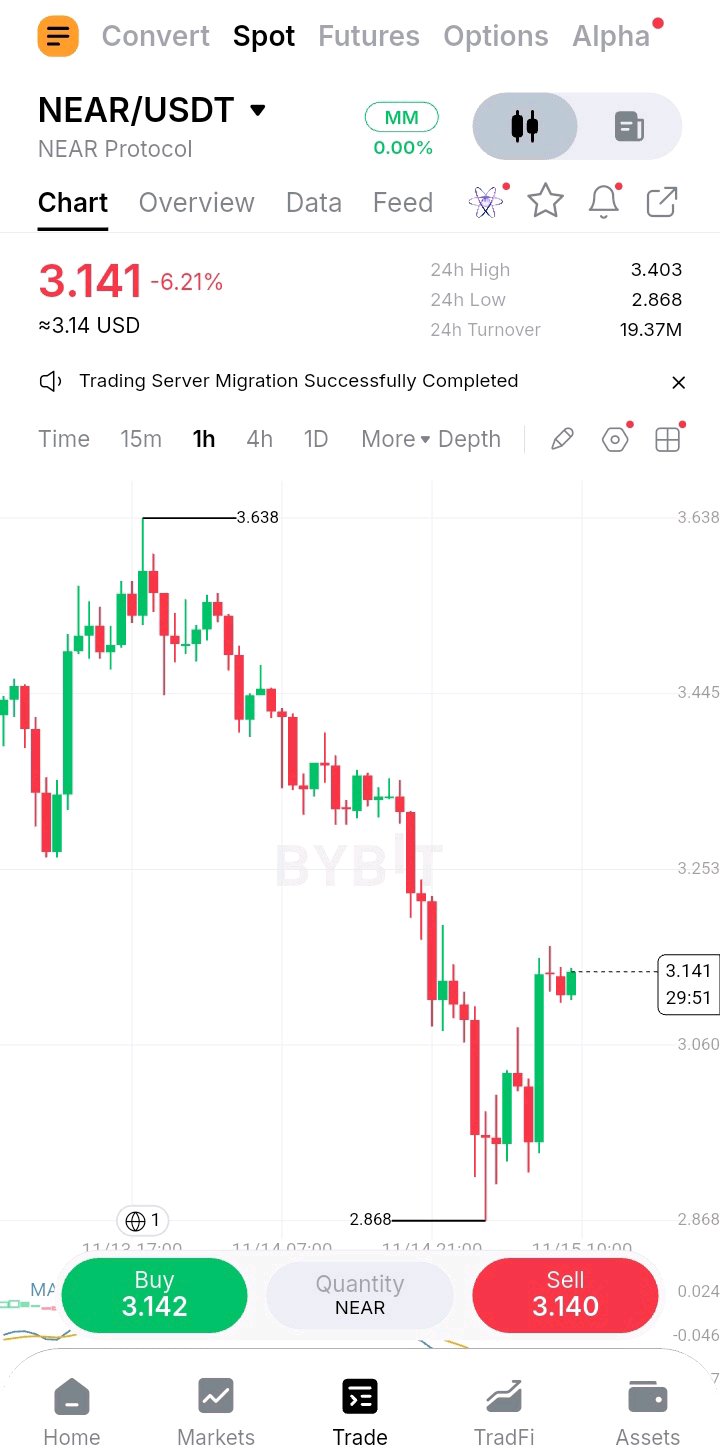
$NEAR DAILY UPDATE: THE PRICE IS UNDER PRESSURE, BUT THE TOKENOMICS STORY IS MOVING** **Latest Developments** NEAR had a rough weekend. The token briefly fell as low as $2.88 overnight into November 15, its lowest level since mid-September. The screenshot shows the same story: a 24-hour range of roughly $2.87 to $3.40, a bounce back to around $3.14, and a daily move of about -6%. One-hour liquidations on November 14 were all long positions (about $1.06M across Binance, Bybit and OKX), which suggests overleveraged longs were being flushed out. The price drop isn't the whole story. Here is what happened on the project side: - **Issuance cut approved (Nov 2):** NEAR's House of Stake approved HSP-029 on November 2, lowering the annual issuance cap from 2.5% to 1.6% over a 24-month ramp. The official vote listing shows 99.96% support. - **Hackathon wrapped up:** The NEAR Hackathon closed submissions on November 14 at 23:59 UTC, with a $250,000 prize pool across 13 tracks. An investment thesis track was added on Nov 14, asking participants to use on-chain data and live dashboards to make evidence-based cases about the network's long-term prospects. **Why This Update Matters** HSP-029 is the second time NEAR has tightened supply. The cap was previously cut from 5% to 2.5% in October 2025. The proposal is projected to keep about 11.8 million NEAR from entering circulation over two years, which means less dilution for holders who don't stake. There is a trade-off. The proposal's own modeling puts gross staking yield falling from about 5.27% to 3.37%. Lower supply growth can support the long-term case, but lower rewards can squeeze smaller validators. Those projections are modeled estimates, not guaranteed outcomes. The market's reaction was not enthusiastic. NEAR dropped roughly 7% on the Tuesday after the vote passed. That fits a pattern where good news for supply doesn't override a weak broad market. **What's Happening Behind the Scenes** The hackathon is a useful signal of developer activity. A $250K prize pool and 13 tracks suggest the ecosystem is still investing in builders during a drawdown. The new thesis track is also a creative move, because it puts on-chain data at the center of the conversation about NEAR's future. Derivatives activity is also elevated. Headlines on November 15 reported NEAR open interest hitting $1.1 billion, the first time since September. High open interest plus sharp moves is how liquidation cascades like this weekend's tend to happen. **What Should the Community Watch Next?** - **Confirmed:** The Security Council's veto window on HSP-029 runs until November 16, so that date is the next checkpoint. - **Confirmed:** A 90-day grace period follows, after which validators must adopt a protocol upgrade for the change to become binding. The cut is not live yet. - **Pending:** The hackathon results. No winners had been announced in what I found. - **Market:** Whether the $2.87 low holds on a retest. Nothing structural has changed in the protocol to explain the drop. It looks like part of a broader risk-off move. **My Daily Perspective** NEAR is in an uncomfortable spot. The fundamentals story is tightening supply, a busy builder community and active governance, while the chart is a reminder that tokenomics don't shield a coin from a weak market. A governance win doesn't prevent a leverage flush. What matters now is follow-through: whether the veto window passes cleanly, whether validators adopt the upgrade, and whether hackathon projects turn into live products. Price is loud, but delivery is what lasts. *Not financial advice. Always do your own research.* #ByXIMPACT $NEARUSDT
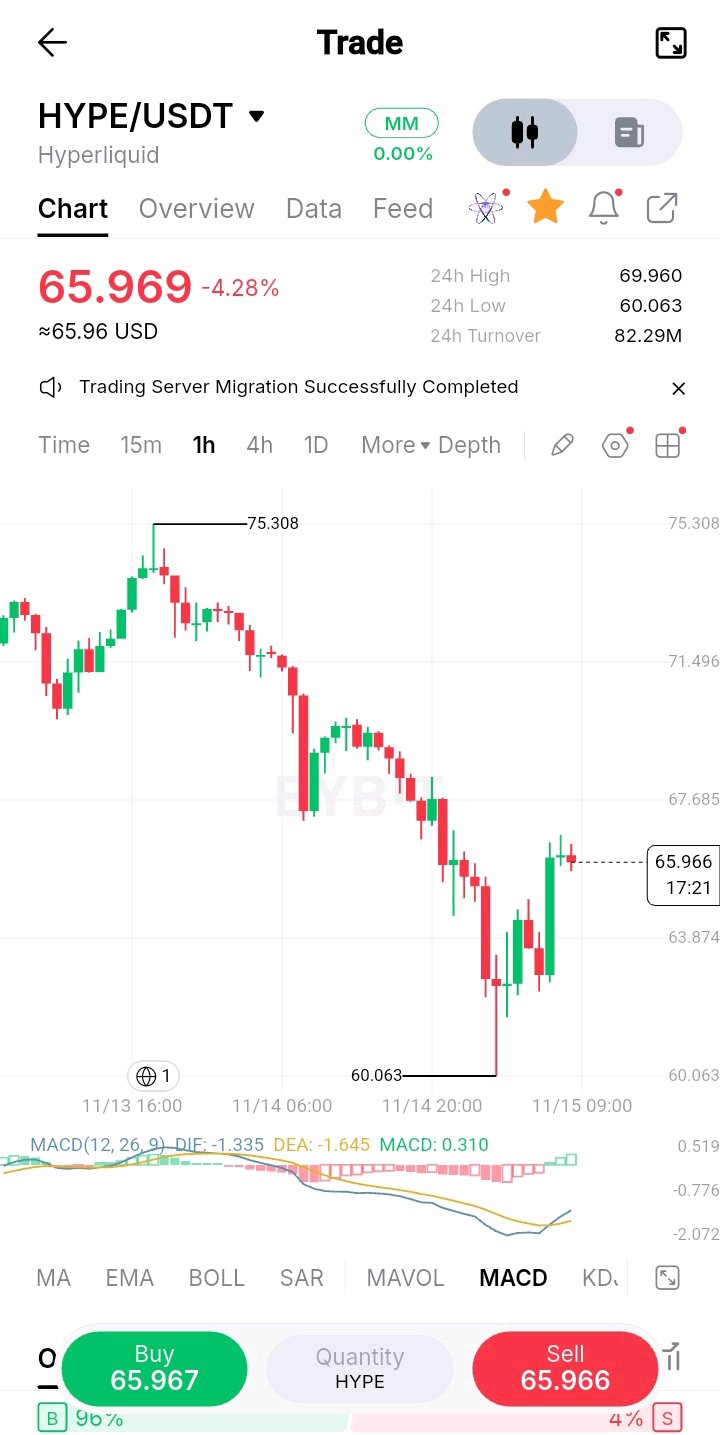
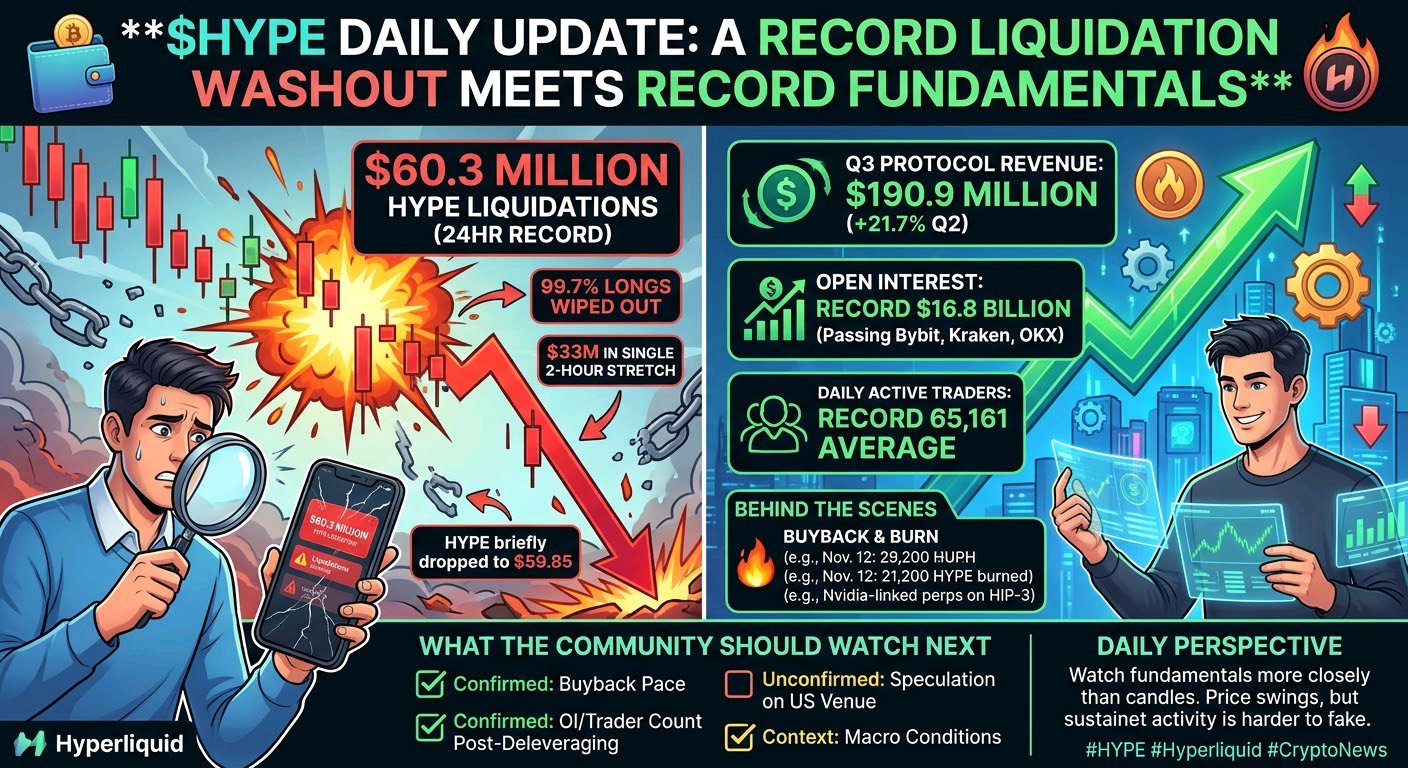
$ACTUALIZACIÓN DIARIA DE HYPE: UNA PURGA DE LIQUIDACIONES RÉCORD SE ENCUENTRA CON FUNDAMENTALES RÉCORD** Hyperliquid ha tenido 24 horas turbulentas. Una fuerte venta golpeó al token mientras el protocolo seguía registrando números sólidos. **Últimos acontecimientos** Hyperliquid registró 60,3 millones de dólares en liquidaciones de HYPE en 24 horas, su total diario más alto para el activo en al menos un año, y el 99,7% de las posiciones liquidadas eran largos. Unos 33 millones de dólares de esa cifra fueron eliminados en un tramo de dos horas. HYPE cayó brevemente a 59,85 $. El récord diario anterior era de 50,9 millones de dólares, establecido el 21 de noviembre de 2025. La venta se produjo justo después de un sólido informe de fundamentales. El 14 de noviembre, un informe del tercer trimestre situó los ingresos del protocolo en 190,9 millones de dólares, un 21,7% más que en el segundo trimestre. El interés abierto alcanzó un récord de 16,8 mil millones de dólares, superando a Bybit, Kraken y OKX. Los traders activos diarios promediaron un récord de 65.161. **Por qué importa esta actualización** El récord de liquidaciones muestra lo concurrido que se había vuelto el posicionamiento en largo. También muestra lo rápido que se deshace el apalancamiento. Una limpieza tan unilateral a menudo elimina las manos más débiles, aunque no garantiza una reversión. Las cifras del tercer trimestre importan porque provienen del uso, no del sentimiento. El aumento del interés abierto y el número récord de traders demuestran que la demanda de la plataforma está creciendo incluso mientras el precio del token cae. **Qué ocurre entre bastidores** Continúan las recompras. El 12 de noviembre, Hyperliquid recompró y quemó 21.200 HYPE en 24 horas, gastando 1,53 millones de dólares. Las quemas totales ascienden ahora a unos 50,47 millones de HYPE, más del 5% del suministro. Debido a que las recompras se financian en dólares, los precios más bajos permiten retirar más tokens con el mismo presupuesto. La actividad del ecosistema también está creciendo. Los futuros perpetuos vinculados a Nvidia en la infraestructura HIP-3 de Hyperliquid están atrayendo mucho trading a medida que los traders buscan exposición las 24 horas. Una advertencia: una mayor rotación de futuros no crea automáticamente una demanda spot equivalente para el token. **Qué debería observar la comunidad a continuación** - **Confirmado:** el ritmo de recompra y quema a medida que los precios se mantienen bajos. Los rastreadores de datos lo actualizan a diario. - **Confirmado:** si el interés abierto y los números de traders se mantienen después de este evento de desapalancamiento. - **Sin confirmar:** el mercado también está discutiendo un posible lugar en EE. UU. para productos relacionados con Hyperliquid. Trátelo como especulación hasta que haya un anuncio oficial. - **Contexto:** el mercado cripto más amplio está bajo presión. Los informes vinculan la caída de HYPE a una venta generalizada, por lo que las condiciones macro importan aquí tanto como las noticias del proyecto. **Mi perspectiva diaria** La historia de hoy es una pantalla dividida. El gráfico de precios parece doloroso, pero el protocolo está registrando ingresos récord, interés abierto récord y un número récord de traders, todo mientras quema suministro. La acción del precio a corto plazo puede ser salvaje después de una limpieza de liquidaciones, y nadie puede prometer lo que vendrá después. Lo que importa es si las cifras de uso siguen aumentando una vez que el polvo se asiente. Los precios oscilan, pero la actividad sostenida de la red es más difícil de falsificar. Observe los fundamentales más de cerca que las velas. *No es asesoramiento financiero. Investigue siempre por su cuenta.* #ByXIMPACT $HYPEUSDT $BTCUSDT
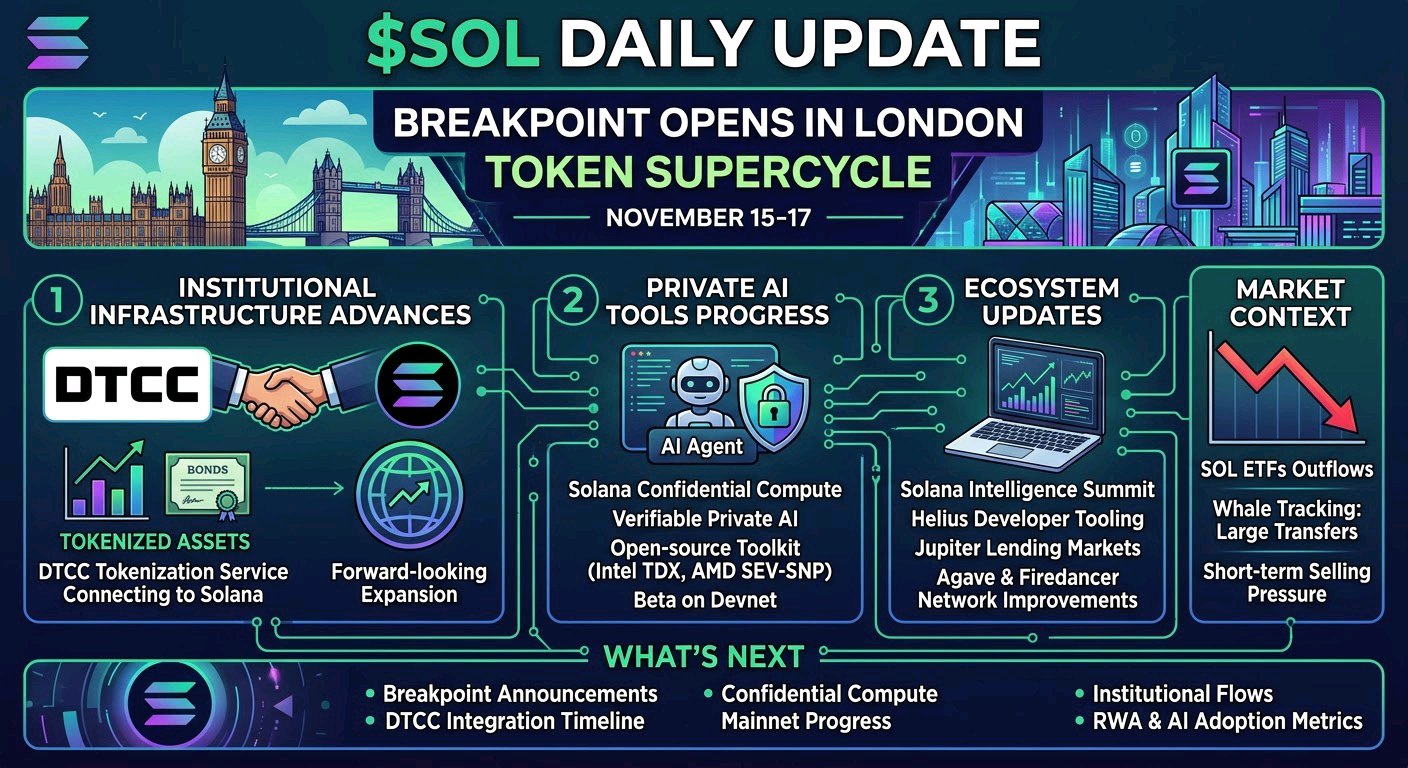
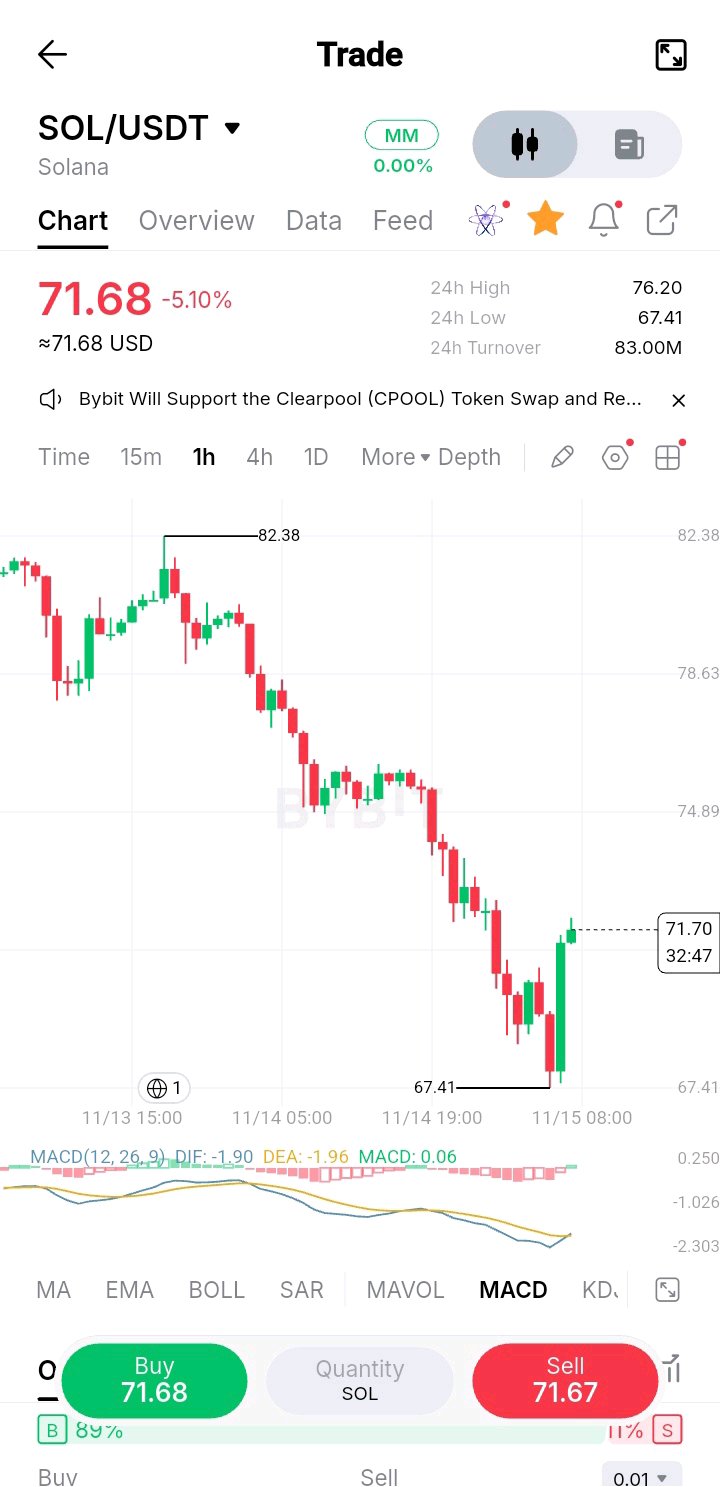
**ACTUALIZACIÓN DIARIA DE $SOL — BREAKPOINT COMIENZA EN LONDRES MIENTRAS LA INFRAESTRUCTURA INSTITUCIONAL Y LAS HERRAMIENTAS DE IA PRIVADAS AVANZAN** La conferencia anual insignia de Solana, Breakpoint 2026, comienza hoy en Londres. El evento de tres días en Olympia London (15-17 de noviembre) marca la primera vez que el encuentro llega al Reino Unido y se espera que atraiga a miles de constructores, instituciones, inversores y responsables políticos en torno al tema del “Token Supercycle” (Superciclo de tokens). La programación se centra en stablecoins, pagos, activos del mundo real (RWA) tokenizados, actividad impulsada por IA y la infraestructura necesaria para respaldarlos. La actividad previa a la conferencia ya incluyó la Solana Intelligence Summit, los Premios de la Comunidad, la cumbre técnica Scale or Die y otros eventos paralelos. Las listas de ponentes han contado con voces de Revolut, antiguas figuras políticas del Reino Unido, DTCC, Mastercard y una variedad de equipos del ecosistema. Solo unos días antes, el 12 de noviembre, Depository Trust & Clearing Corporation (DTCC) anunció planes para conectar su Servicio de Tokenización a Solana en la segunda mitad de 2027. Los activos elegibles custodiados por la DTC (acciones, bonos, bonos del Tesoro e instrumentos similares) estarían disponibles en forma tokenizada en la red, manteniendo al mismo tiempo las protecciones tradicionales para los inversores. Solana se convierte en otra cadena importante en la hoja de ruta multired de la DTCC. El servicio en sí solo entró en funcionamiento a finales de octubre, por lo que el enlace con Solana es una expansión con visión de futuro y no un lanzamiento inmediato. El 13 de noviembre, la Fundación Solana y Nito lanzaron Solana Confidential Compute en beta en la devnet. El kit de herramientas de código abierto permite a las aplicaciones verificar que los modelos de IA u otros programas se están ejecutando dentro de hardware confidencial certificado (actualmente compatible con Intel TDX y AMD SEV-SNP, con soporte para GPU NVIDIA en desarrollo). Tras una verificación única en cadena, cualquier programa puede comprobar el registro con un bajo coste computacional. El objetivo es una IA privada verificable sin necesidad de que los usuarios confíen simplemente en las afirmaciones de un operador. Por ahora, sigue sin auditarse y está destinado al uso de desarrollo. Estos desarrollos se sitúan en un contexto de continua presión vendedora a corto plazo. Los ETF de Solana al contado en EE. UU. registraron una racha de salidas de varias sesiones, y aparecieron grandes transferencias (incluidos movimientos de varios millones de SOL hacia plataformas institucionales) en el reciente seguimiento de ballenas. El mercado ha estado digiriendo condiciones generales de aversión al riesgo, incluso mientras continúa el trabajo institucional y técnico a largo plazo. **Por qué es importante** Breakpoint es el momento de mayor visibilidad del año para los constructores y socios de Solana. Los anuncios, las demostraciones de productos y las señales de asociación que surgen del evento suelen marcar la pauta para los meses siguientes. El punto de la hoja de ruta de la DTCC, aunque todavía falta más de un año, sitúa a Solana dentro de la infraestructura central de post-negociación de los mercados estadounidenses, una importante señal de credibilidad para la tokenización de activos regulados. Confidential Compute aborda una barrera práctica para los agentes de IA y las aplicaciones sensibles a la privacidad que desean garantías criptográficas en lugar de afirmaciones de marketing. **Lo que sucede entre bastidores** Los equipos del ecosistema siguen lanzando productos. Phantom añadió recientemente la capacidad de compartir operaciones como vídeo. Jupiter amplió los mercados de préstamos y las superficies de producto. Helius lanzó herramientas adicionales para desarrolladores. En el lado de los activos del mundo real, la actividad en torno a la renta variable tokenizada y la infraestructura de stablecoins sigue siendo activa. El trabajo de rendimiento de la red y las mejoras del cliente (Agave, Firedancer) continúan en paralelo con el programa de la conferencia. **Lo que la comunidad debería observar a continuación** - Anuncios concretos de productos o asociaciones que surjan durante las sesiones de Breakpoint y los eventos paralelos. - Cualquier detalle adicional sobre el cronograma de integración de DTCC o los requisitos técnicos. - El progreso de Confidential Compute hacia la red principal después de su auditoría de seguridad. - Si los flujos institucionales se estabilizan o se invierten tras la actual racha de salidas. - Métricas de adopción continuas en pagos, RWA y aplicaciones relacionadas con la IA. **Mi perspectiva diaria** Solana está atravesando un período en el que los datos de precios y flujos a corto plazo parecen pesados, mientras que la historia de la infraestructura a largo plazo sigue avanzando. La llegada de Breakpoint en este preciso momento le da al ecosistema un escenario de alto perfil para demostrar el progreso en los temas exactos (tokenización, raíles institucionales y herramientas prácticas de IA) que destacan los recientes anuncios. La brecha entre el sentimiento del mercado a corto plazo y los cronogramas institucionales de varios años no es nueva en el mundo cripto, pero es especialmente visible esta semana. Los próximos días en Londres mostrarán si los constructores y socios pueden convertir esa brecha en un impulso más claro. La conferencia es el lugar al que hay que prestar atención. #ByXIMPACT $SOLUSDT
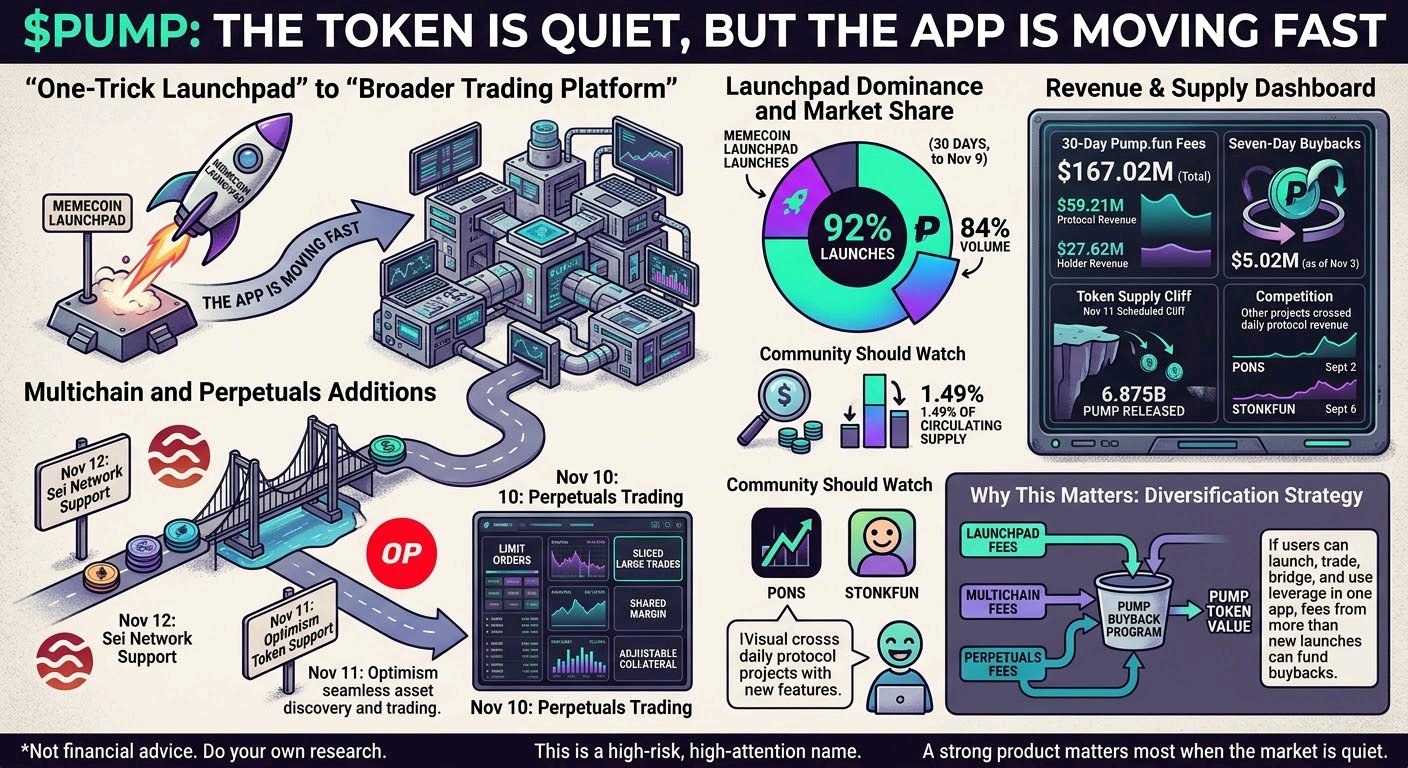
$PUMP: EL TOKEN ESTÁ TRANQUILO, PERO LA APP SE MUEVE RÁPIDO** Pump.fun ya no se comporta como una plataforma de lanzamiento de memecoins de un solo uso. Durante la última semana, el equipo ha impulsado la aplicación hacia una plataforma de trading más amplia. **Últimos desarrollos** - **12 de nov:** Pump.fun añadió soporte para la red Sei, permitiendo a los usuarios operar con tokens del ecosistema Sei y realizar bridges de activos entre cadenas dentro de la app. - **11 de nov:** La app anunció soporte para tokens de Optimism, para que los usuarios puedan descubrir y operar con esos tokens sin necesidad de realizar puentes (bridging) manualmente. - **10 de nov:** El trading de perpetuos obtuvo órdenes limitadas, división de grandes operaciones, margen compartido y colateral de posición ajustable. - **9 de nov:** Los datos hasta esa fecha mostraban que Pump.fun acaparaba el 92% de los lanzamientos de memecoins y el 84% del volumen de trading durante los 30 días previos. **Por qué esto es importante** Las adiciones multichain y de perpetuos apuntan a un cambio de estrategia. Si los usuarios pueden lanzar, operar, realizar puentes y usar apalancamiento en una sola app, Pump.fun puede obtener comisiones de mucho más que solo nuevos lanzamientos de tokens. Esto es importante porque esas comisiones financian el programa de recompra de PUMP. La cifra de dominio de la plataforma de lanzamiento también demuestra que el producto principal sigue liderando su categoría. **Tras bambalinas** Los ingresos y el suministro son las cifras a seguir: - Durante 30 días, las comisiones de Pump.fun totalizaron $167.02M, con $59.21M en ingresos del protocolo y $27.62M en ingresos para los holders. - Las recompras reportadas a siete días fueron de aproximadamente $5.02M al 3 de noviembre. - Un acantilado (cliff) programado para el 11 de noviembre estaba fijado para liberar 6.875B de PUMP, alrededor del 1.49% del suministro circulante. - La competencia es real. Pons superó a Pump.fun en ingresos diarios del protocolo el 2 de septiembre, y StonkFun hizo lo mismo el 6 de septiembre. Como contexto sobre la historia de la recompra, en abril el proyecto quemó aproximadamente el 36% del suministro circulante y se comprometió a una recompra financiada por ingresos. **Qué debería observar la comunidad a continuación** - **Confirmado:** Si las recompras semanales se mantienen a medida que fluctúan las comisiones. - **Confirmado:** Cómo responden los usuarios a las nuevas funciones multichain y de perpetuos. - **No confirmado:** Si las nuevas funciones aumentan los ingresos por comisiones. Aún no hay datos que lo muestren. - **No confirmado:** Efectos futuros de los desbloqueos en el suministro. Trate cualquier afirmación sobre ellos como especulación. **Mi perspectiva diaria** La historia a seguir es la diversificación de ingresos. Un líder en plataformas de lanzamiento que añade perpetuos y trading cross-chain está intentando ser menos dependiente de los ciclos de las memecoins. Si eso funciona, se verá en las comisiones y las recompras, no en los titulares. Las comisiones han estado cayendo y los competidores se han llevado algunos días de ingresos diarios, por lo que este es un nombre de alto riesgo y mucha atención. Un producto sólido es lo que más importa cuando el mercado está tranquilo. *No es asesoramiento financiero. Haz tu propia investigación.* --- Dos notas para ti: - He omitido los niveles de entrada, TP y SL del gráfico, ya que este formato es solo de noticias. - No pude confirmar el precio de PUMP hoy. La última cifra que encontré fue $0.003737 en Binance el 8 de noviembre, así que verifícalo antes de publicar si quieres mencionar el precio. #ByXIMPACT $PUMPUSDT
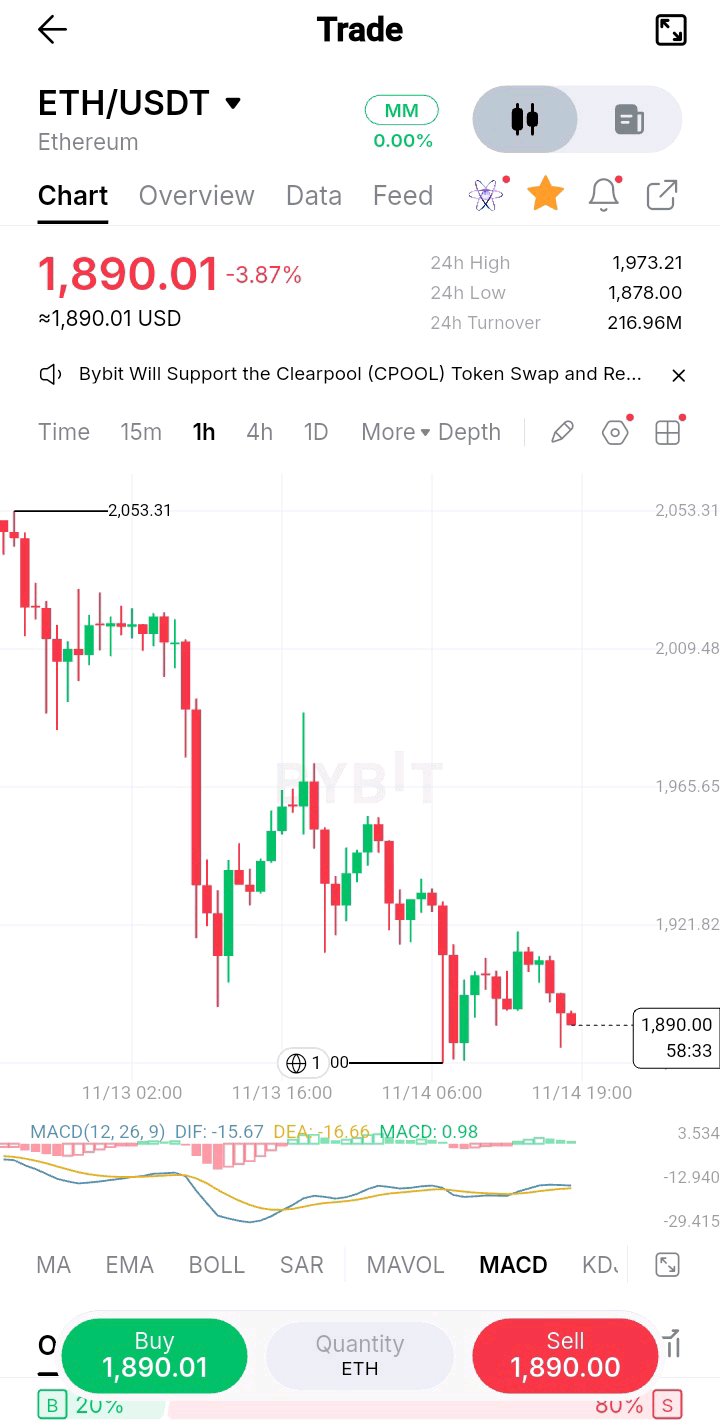
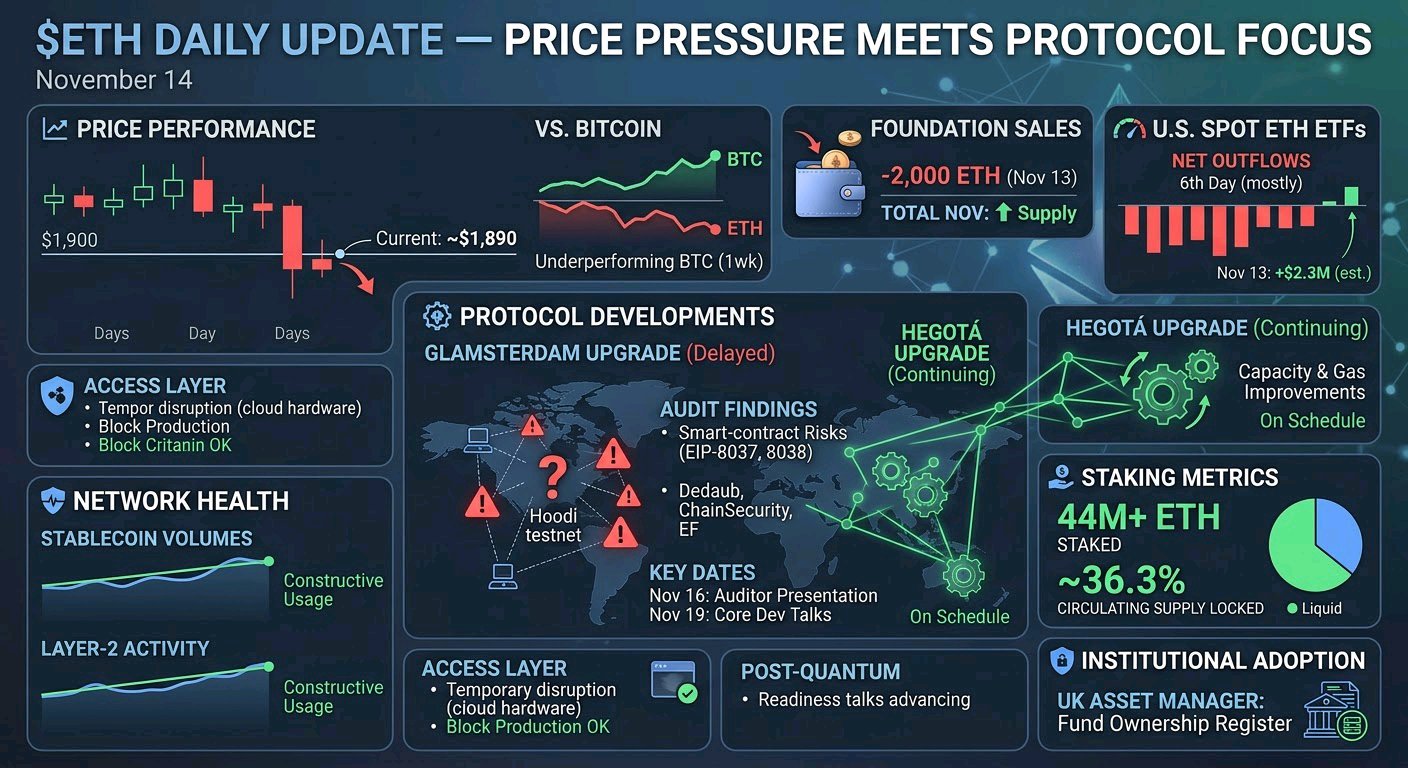
**ACTUALIZACIÓN DIARIA DE $ETH: LA PRESIÓN DEL PRECIO SE UNE AL ENFOQUE EN EL PROTOCOLO** Ethereum cotiza cerca del nivel de los 1.890 $ el 14 de noviembre tras caer por debajo de los 1.900 $, extendiendo un retroceso de varios días en el que el activo ha tenido un rendimiento inferior al de Bitcoin durante la última semana. El movimiento ha coincidido con salidas continuas de los ETF de ETH al contado en EE. UU. y ventas adicionales desde monederos vinculados a la Ethereum Foundation. ### Últimos acontecimientos Los ETF de Ethereum al contado en EE. UU. registraron otra sesión de salidas netas en el periodo reciente, con un informe que señalaba un sexto día consecutivo de retiradas antes de que apareciera una pequeña entrada neta de aproximadamente 2,3 millones de dólares en datos incompletos del 13 de noviembre. Los monederos vinculados a la Foundation vendieron otros 2.000 ETH el 13 de noviembre, sumándose a las ventas anteriores de noviembre que han aumentado la oferta circulante durante la tendencia bajista. En cuanto al protocolo, la actualización Glamsterdam sigue retrasada en la red de prueba (testnet) Hoodi. Los auditores identificaron riesgos de compatibilidad en los contratos inteligentes vinculados a los cambios de reajuste de gas en las EIP-8037 y EIP-8038. Los resultados de Dedaub, ChainSecurity y la Ethereum Foundation están programados para su presentación y debate abierto el 16 de noviembre, seguidos de nuevas conversaciones entre los desarrolladores principales el 19 de noviembre. El trabajo paralelo en la posterior actualización Hegotá continúa sin interrupciones. Un informe separado señaló interrupciones temporales en la capa de acceso vinculadas a un problema de hardware de un proveedor de la nube. La producción de bloques y la capa de consenso siguieron funcionando con normalidad. La actividad de staking ha alcanzado un nuevo máximo, con aproximadamente el 36,3 % de la oferta circulante bloqueada y más de 44 millones de ETH en staking. ### ¿Por qué es importante esta actualización? La combinación de los reembolsos de los ETF y las ventas de la Foundation ha añadido una presión vendedora medible en un momento en que los activos de riesgo más amplios también están débiles. Al mismo tiempo, el retraso de Glamsterdam demuestra que los desarrolladores dan prioridad a la seguridad del contrato sobre el calendario. Esa cautela protege la capa de DeFi y aplicaciones existente, incluso si retrasa las próximas mejoras de capacidad y fijación de precios del gas. La participación récord en staking sigue restringiendo la oferta líquida y señala que los inversores a largo plazo y los validadores mantienen su compromiso a pesar de la debilidad del precio a corto plazo. Los experimentos institucionales, incluido el uso de Ethereum por parte de un importante gestor de activos del Reino Unido como registro de propiedad legal para un fondo regulado, siguen añadiendo señales de adopción silenciosa más allá de la mera acción del precio. ### ¿Qué está pasando entre bastidores? Las métricas de uso de la red siguen siendo constructivas incluso a pesar del retroceso del precio. Los volúmenes de stablecoins y la actividad de capa 2 (Layer-2) siguen reflejando una actividad económica real en la cadena. Los desarrolladores principales están acelerando simultáneamente las discusiones sobre la preparación poscuántica, con propuestas que avanzan para un registro de material de clave más temprano y una línea de tiempo más clara hacia cuentas resistentes a la computación cuántica. Los problemas temporales de acceso relacionados con la nube pusieron de relieve la dependencia continua de muchas carteras y servicios de la infraestructura centralizada, incluso mientras el protocolo base se mantenía resistente. ### ¿Qué debe observar la comunidad a continuación? La presentación de los auditores del 16 de noviembre y el debate de todos los desarrolladores principales del 19 de noviembre aclararán si Glamsterdam necesita cambios en las especificaciones o si puede seguir adelante con un calendario revisado en la red de pruebas. Los datos sobre los flujos de los ETF durante el resto de la semana mostrarán si la reciente racha de salidas se está rompiendo realmente. Cualquier otra actualización sobre el alcance de Hegotá o los hitos poscuánticos también dará forma a la conversación sobre la hoja de ruta de 2027. ### Mi perspectiva diaria Ethereum vive actualmente una tensión familiar: los flujos de capital a corto plazo y la presión macroeconómica están pesando sobre el token mientras la capa de protocolo sigue avanzando en seguridad, capacidad y resistencia criptográfica a largo plazo. La cifra récord de staking y los continuos experimentos institucionales sugieren que la demanda estructural de la red no ha desaparecido con el precio. La verdadera prueba en los próximos días es si los desarrolladores pueden resolver limpiamente las cuestiones de compatibilidad de Glamsterdam y si los flujos de los ETF se estabilizan. En un mercado que a menudo sobreindexa las velas diarias, el trabajo más silencioso en actualizaciones e infraestructura sigue siendo lo más importante para los años venideros. #ByXIMPACT $ETHUSDT
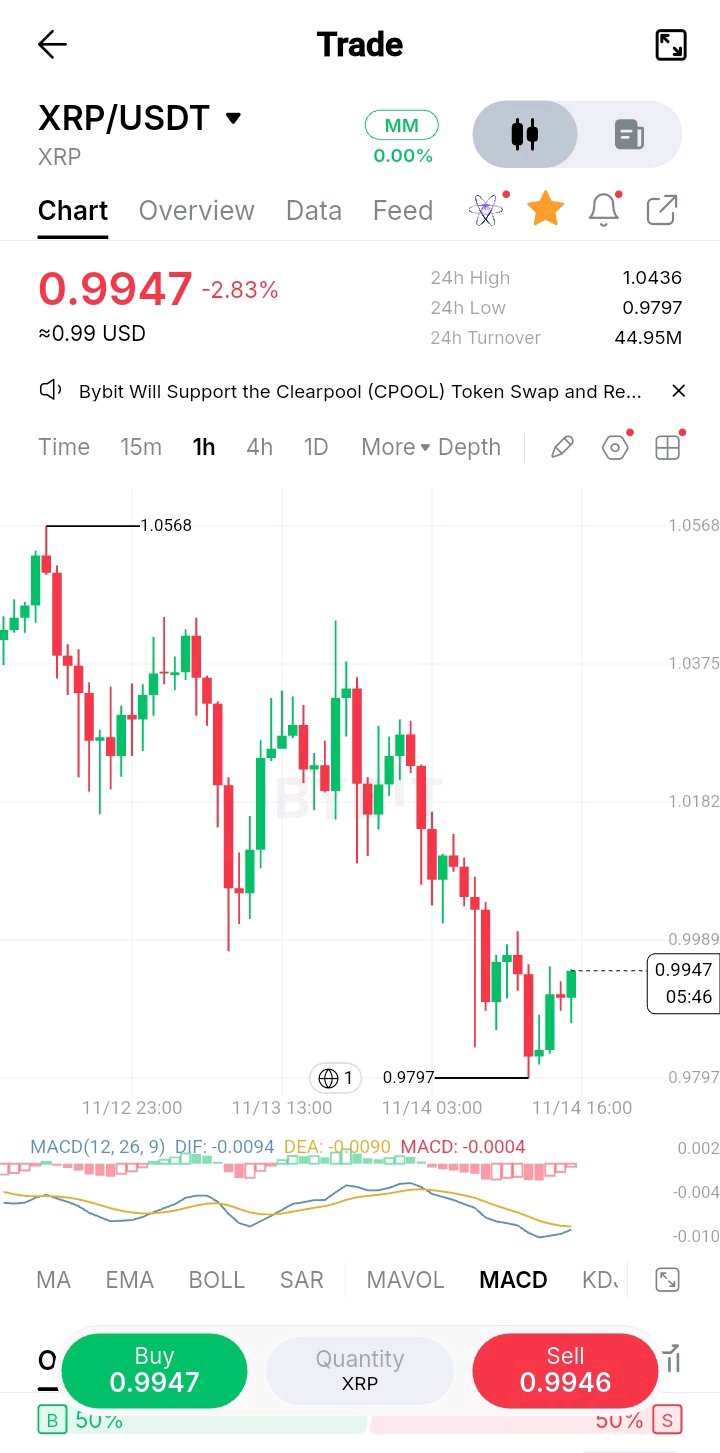
DAILY UPDATE — TRADING UNDER $1 AS MARKET PRESSURE MEETS QUIET ECOSYSTEM PROGRESS** XRP is trading near $0.99 on Saturday, November 14, 2026, after briefly slipping below the psychological $1 level for the first time since August. The token is down roughly 2.8–3% on the day, with 24-hour ranges showing highs near $1.04 and lows around $0.98. The move comes amid a broader crypto sell-off that pushed Bitcoin below $67,000 and triggered significant long liquidations across the market. Spot XRP ETFs recorded approximately $18 million in outflows over a recent 48-hour window, though total assets under management remain in the $1.1–1.7 billion range depending on the tracker. Franklin Templeton’s latest SEC filing (covering the period through September 30) showed its XRP ETF holding about 293 million XRP valued at roughly $440 million at the time, with holdings having risen substantially during the third quarter. On the positive side, Ripple’s RLUSD stablecoin continues its climb and has surpassed PayPal’s PYUSD to become the seventh-largest stablecoin by market capitalization, currently sitting near $2.78 billion. This growth reflects ongoing institutional and exchange adoption of the dollar-backed token issued on both the XRP Ledger and Ethereum. Meanwhile, the XRP Ledger’s proposed native lending protocol is slowly advancing. Validator support for the key LendingProtocol and SingleAssetVault amendments recently reached the low-to-mid 20s (out of the roughly 35 trusted validators), still short of the 29 votes needed to begin the two-week activation countdown. Developers have already shipped patches and refinements ahead of any potential launch. A large on-chain movement of approximately 133 million XRP (valued around $137 million at the time) between unidentified wallets also drew attention in the past day, though no clear context has been confirmed. **Why this update matters** The break below $1 tests short-term sentiment and highlights how XRP remains highly correlated with the broader market during risk-off periods. At the same time, the steady rise of RLUSD and the incremental progress on XRPL lending infrastructure show that utility and institutional infrastructure work continues regardless of price action. ETF outflows are notable but have not erased the substantial base of holdings built since the products launched. Clearpool’s expansion onto the XRP Ledger (with Bybit supporting the CPOOL-to-CLEAR token swap) adds another institutional-lending-focused project to the ecosystem. **What’s happening behind the scenes** Network activity and validator discussions around the lending amendments remain active. Institutional names such as Franklin Templeton continue to maintain and report meaningful XRP exposure through regulated vehicles. Ripple’s own business expansion (including RLUSD adoption and prime brokerage developments) proceeds on a separate track from the token’s daily price swings, a dynamic that community discussions have repeatedly highlighted. **What the community should watch next** Key near-term items include further validator progress on the lending amendments (still several votes short), the scheduled XRP Ledger software updates expected in early December, the next monthly escrow unlock, and any shift in ETF flows once the current market pressure eases. Confirmed timelines remain limited; much of the lending work is still in the voting and refinement stage rather than live deployment. **My daily perspective** Days like this separate noise from signal. The price is under pressure and the $1 level is being tested in real time, yet the underlying ledger work and stablecoin traction have not paused. RLUSD’s climb into the top-tier stablecoin ranks and the measured advance of XRPL lending tools matter more for the medium-term picture than any single session’s red candles. Whether the current support holds or gives way further will shape short-term trading, but the quieter infrastructure developments are what long-term observers should keep on their radar. The story is still being written on both the price chart and the ledger. #ByXIMPACT $XRPUSDT
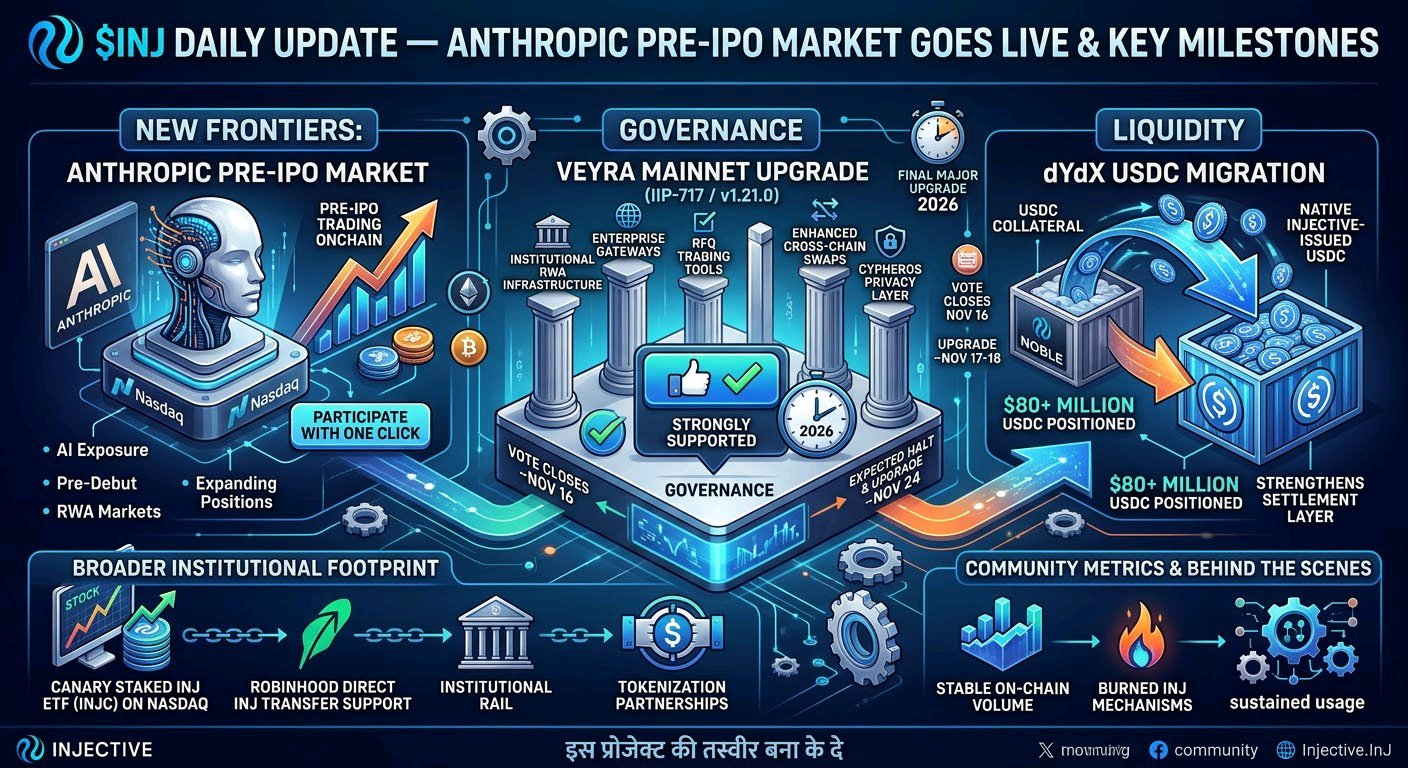
$INJ IS BACK IN FOCUS: THE ETF ERA HAS STARTED** Injective had a big week. Wall Street access arrived, the network turned five, and a new product for institutions went live. **Latest Developments** 🔹 **First U.S. staked INJ ETF is live.** Canary Capital's Staked INJ ETF (ticker INJC) began trading on Nasdaq on November 5, 2026. Nasdaq's own notice confirmed the listing date. The fund holds INJ and stakes most of it, and staking rewards go into the fund's net asset value instead of being paid out as cash. Injective CEO Eric Chen rang the Nasdaq opening bell on November 6. 🔹 **Injective turned 5.** The mainnet anniversary was November 8. Over the past year the network reported $12.86B in onchain trading, with $1.8B of that in perpetuals on real-world assets such as stocks and commodities. The INJ Community BuyBack has burned 517,692 INJ over 14 rounds, and total burn since 2021 stands at 7,295,039 INJ. 🔹 **Institutional Rail launched.** On November 2, Injective introduced a new offering that gives institutions access to block production. **Why This Matters** An ETF puts INJ inside ordinary brokerage accounts. Investors who would never touch a crypto exchange can now get exposure, and staking rewards are built into the fund. That is a different kind of demand from retail speculation. The ETF is also early, so keep expectations realistic. Crypto ETF launches don't guarantee price gains. Reporting after the debut noted the fund held about $16.1M in net assets after two sessions, with the share count unchanged at 600,000. That means the asset growth reflected price moves, not fresh inflows. The real test is whether sustained inflows follow. **What's Happening Behind the Scenes** 🔹 **Network usage.** Canary's launch materials cite over $1B in tokenized assets, more than 3.13B transactions, and about 257,300 monthly active addresses as of October 2026. 🔹 **Upgrades.** June's Vulcan upgrade cut oracle update costs by 90%. September's Meridian upgrade added regulated token issuance. The native EVM, live since November 2025, lets Ethereum developers build on Injective with familiar tools. 🔹 **Tokenomics.** In January 2026, governance lowered issuance to 2.2%–4.4% annually, and the buyback burns continue. 🔹 **Community.** A 10-day Hacker House in Bangkok with AWS and Animoca Brands was announced on October 29. **What Should the Community Watch Next?** *Confirmed:* - Whether INJC attracts real inflows and trading volume after its first weeks. - Two other INJ ETF applications are still pending: 21Shares and REX-Osprey. Their timing is unconfirmed. - The upcoming CypherOS platform for institutional privacy, outlined in Injective's October whitepaper. No firm launch date has been given. *Not confirmed:* Price targets and "next leg up" talk you see online are opinion, not news. **My Daily Perspective** Injective is clearly pushing toward institutional finance: ETF access, RWA markets, regulated issuance and privacy tooling. Listings only open the door, though. Lasting value will depend on real onchain activity and sustained demand, not headlines. The price has been steady near $8 since the listing, and the market seems to be waiting for proof. That's why this story is worth following past the launch week. *Wall Street found the door. Now the network has to give it a reason to stay.* *Not financial #ByXIMPACT $INJUSDT
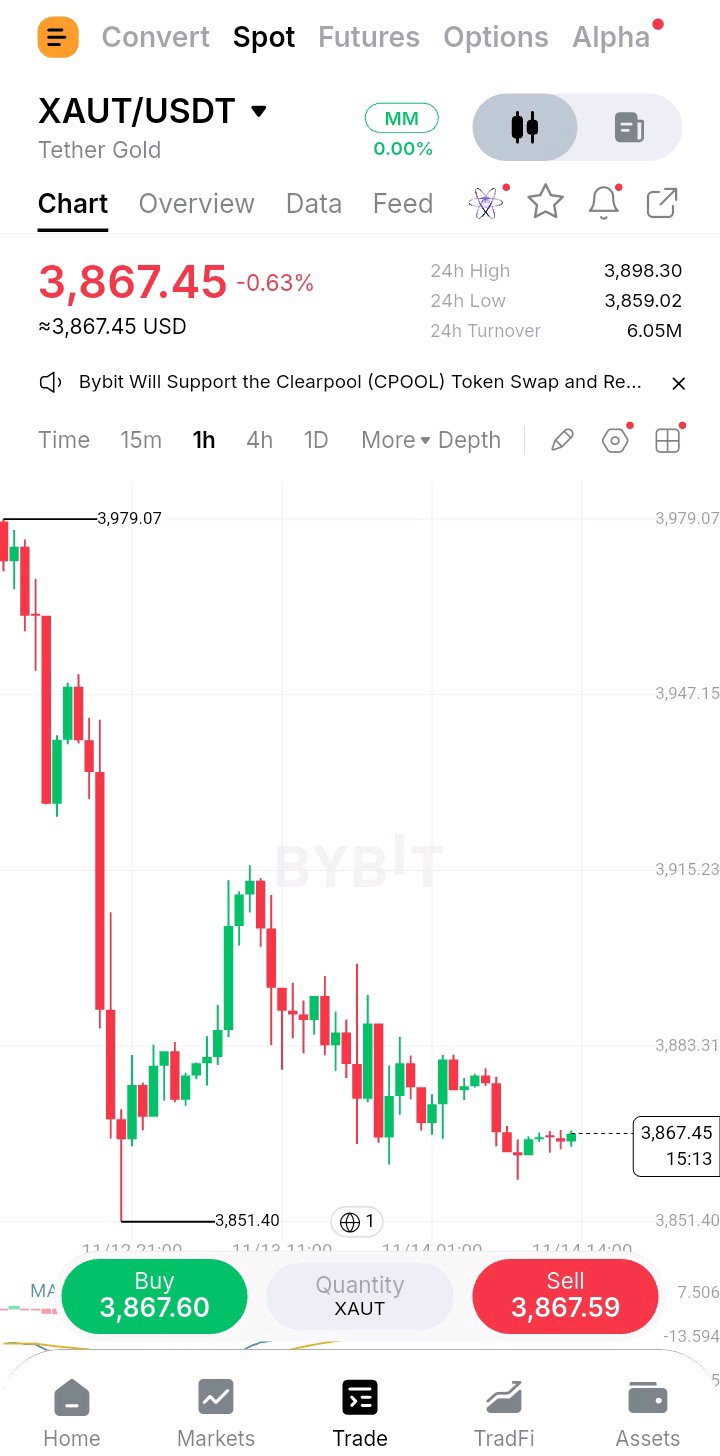
$XAUT IS BACK IN FOCUS: THE GOLD TOKEN JUST GOT ITS BIGGEST TRUST UPGRADE YET** Gold is under pressure and Tether Gold ($XAUT) is trading around $3,867 (Bybit, Nov 14, -0.63% on the day). But the real story today isn't the price. It's the audit. **LATEST DEVELOPMENTS** **Nov 12: KPMG audit.** Tether announced that KPMG U.S. completed an independent audit of the Tether Gold (XAU₮) financial statements for the year ended December 31, 2025, and the audited statements show the token fully backed by allocated physical gold. Tether's CEO Paolo Ardoino highlighted that KPMG counted every single bar as part of the audit. **Nov 4: Q3 reserve report.** Physical gold backing XAUT stood at 827,418 troy ounces (about 25.7 metric tons) on Sept. 30, up 59% from year-end 2025. Tether says customer holdings have grown 73% since the start of the year, with backing reaching a record $3.44 billion. The reserve comprises 2,057 bars, 766 of them added this year, stored in Switzerland to LBMA good-delivery standard. **WHY THIS MATTERS** Analysts note that the biggest hurdle for tokenized gold is trust: holders have to believe the physical metal is really there. A Big Four audit that counts the bars directly addresses that hurdle. Pair it with the growth numbers. Tether cites the World Gold Council's estimate that digital gold could unlock US$700 billion in demand. Verified backing is what institutions and cautious holders look for before moving size into a product like this. **WHAT'S HAPPENING BEHIND THE SCENES** - **Demand kept rising through a volatile summer.** Holders kept adding exposure even while the metal itself swung sharply. - **The token is getting more use cases.** In June, XAUT was brought to crypto lender Ledn, giving holders a way to borrow against their gold instead of selling it. - **Tether's wider gold position softened slightly.** Total disclosed gold holdings, including the gold held in reserve for USD₮, fell by about three tonnes in Q3 to 165 tonnes. That is a balance-sheet figure, separate from XAUT's own backing. **THE MARKET BACKDROP** The screenshot shows a sharp drop from the 3,979 area, a bounce, and then a quiet consolidation near 3,867 after a 24h range of roughly 3,859 to 3,898. Gold came under pressure after higher-than-expected US inflation data, and October inflation figures were the main fundamental focus on Nov 13. For comparison, the Q3 reserve valuation used gold at about $4,157 per ounce, so the metal has pulled back from where it stood at quarter-end. **WHAT TO WATCH NEXT** - **Confirmed:** Tether publishes quarterly attestations, so expect the next reserve update after year-end. Exact dates haven't been announced. - **Macro:** Inflation data and rate expectations are what's moving gold right now, and XAUT follows spot gold one-for-one. - **Unconfirmed:** Whether the audit translates into new exchange integrations, lending partners, or institutional demand is speculation until announced. **MY DAILY PERSPECTIVE** Price will move with the gold market, and nobody can promise where it goes next. What changed this week is the quality of the claim behind the token. A year ago, "backed by real gold" was Tether's word. Now an independent auditor has counted the bars. In tokenized gold, trust is the product. This week, XAUT added to it. *Not financial advice. Always do your own research. #ByXIMPACT $XAUTUSDT
**$SUI DAILY UPDATE — ECOSYSTEM PRESSURE MEETS QUIET PROGRESS** Sui is navigating a tough stretch. The token trades near $0.77 after another session of pressure, while the network confronts real ecosystem friction alongside some constructive under-the-radar moves. ### Latest Developments Suiet, one of the earlier self-custodial wallets built specifically for Sui, is sunsetting. API services end after November 14, 2026. Users have been told to back up recovery phrases and migrate to other compatible wallets. The Chrome extension is expected to follow shortly. This comes on the heels of the Suiball hardware wallet project also winding down and refunding preorders. DeFi total value locked has fallen more than 22% over the past month, settling near the low $400 million range. Daily active users dropped sharply year-over-year according to recent data, even as monthly transaction counts held up better. These exits and metrics have weighed on sentiment. At the same time, stablecoin supply on Sui climbed more than 10% over 30 days to approximately $538 million as of November 13 — a notable divergence while the broader market’s stablecoin supply contracted. USDC accounts for the large majority of that balance. Gasless stablecoin transfers continue to support this growth. Hashi, Sui’s native Bitcoin collateral protocol, has quietly gone live on mainnet. The app now accepts real BTC deposits, with roughly 14.43 hBTC in circulation backed one-to-one by BTC reserves. Official marketing still lags the on-chain reality, and the previously announced $500 million+ in institutional commitments remain largely undeployed at this stage. The Verifiable Agent Arbiter (developed with Google Cloud) continues to receive attention as part of Sui’s agentic infrastructure push. Cryptographic proofs of AI agent activity are designed to be anchored on Walrus and coordinated on Sui, while detailed telemetry stays under enterprise control. This fits the broader narrative of building rails for autonomous agents that can transact and prove compliance. ### Why This Update Matters Wallet and infrastructure exits highlight the challenge of sustaining a full ecosystem stack when activity and capital slow. Lower TVL and fewer daily users reduce the gravity that keeps developers and liquidity providers engaged. Yet the stablecoin growth and early Hashi deposits suggest that payments and Bitcoin-adjacent finance still find product-market fit on Sui even in a quieter market. The agent infrastructure work positions Sui for a potential future where AI agents handle meaningful volume of payments and coordination. Whether that translates into sustained network demand remains the open question. ### What’s Happening Behind the Scenes? Samsung Wallet’s planned USDC-on-Sui integration for eligible U.S. Galaxy devices (targeting tens of millions of users with gasless transfers) is still expected later this month. Cross-chain USDC flows via Cetus and CCTP v2 have improved connectivity. Mercado Bitcoin has expanded access to SUI and related assets for Brazilian users. These distribution and liquidity efforts sit alongside the more visible consolidation in wallets and DeFi. ### What Should the Community Watch Next? - Completion of the Suiet migration window and any further infrastructure exits. - Actual deployment of Hashi capital beyond the initial small reserves. - The Samsung Wallet USDC rollout timeline and early usage numbers. - Any further protocol changes (including the planned package publish/upgrade fee in a future version). - Whether stablecoin growth continues and translates into broader DeFi or payments activity. ### My Daily Perspective Sui is in a classic mid-cycle stress test. The technology and partnerships remain ambitious — agent verification, Bitcoin finance primitives, consumer wallet distribution — but the near-term data shows contraction in users and capital. The projects that survive these periods tend to be the ones that keep shipping useful infrastructure while the noise settles. Today’s combination of a wallet sunset deadline, early Hashi activity, and resilient stablecoin balances captures the current dual reality. The next few weeks of Samsung integration and Hashi traction will reveal whether the constructive signals can begin to outweigh the exits. #ByXIMPACT $SUIUSDT $BTCUSDT
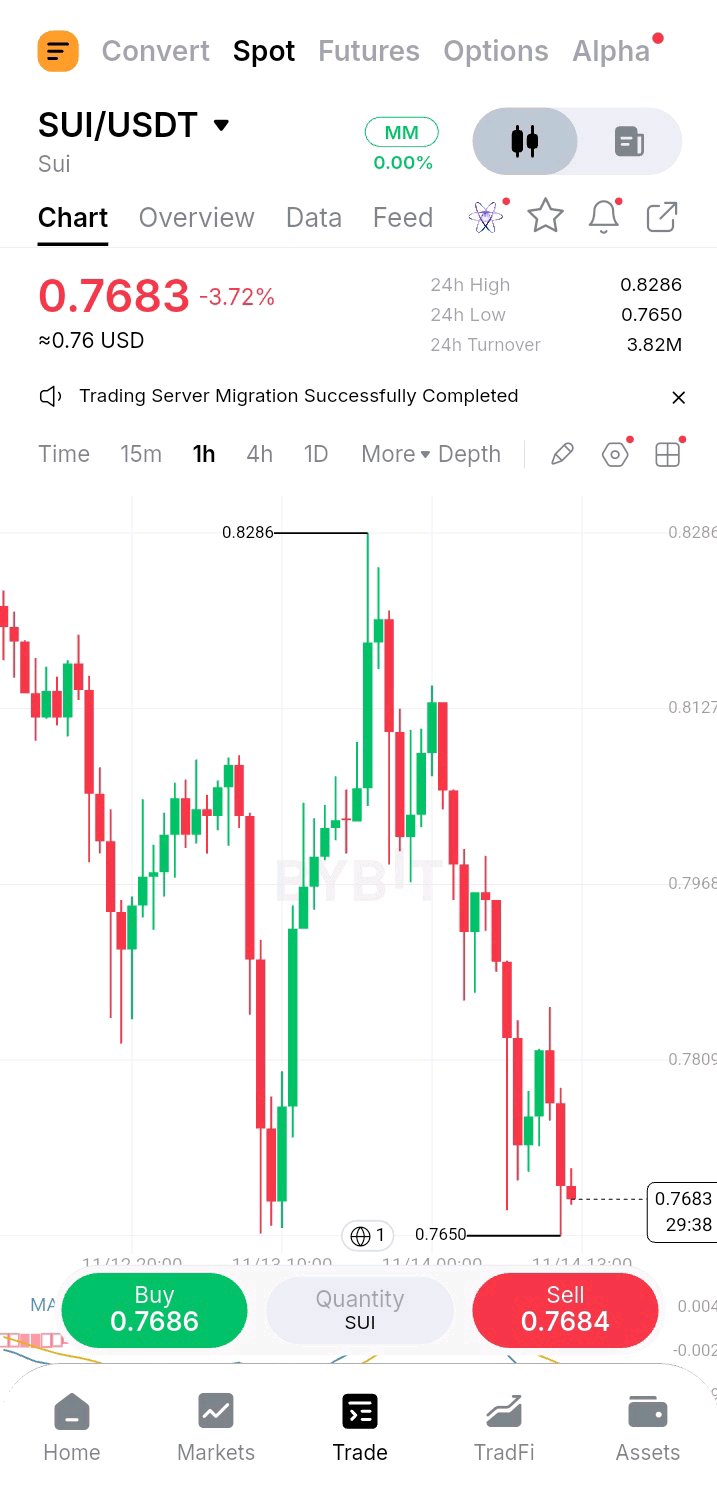
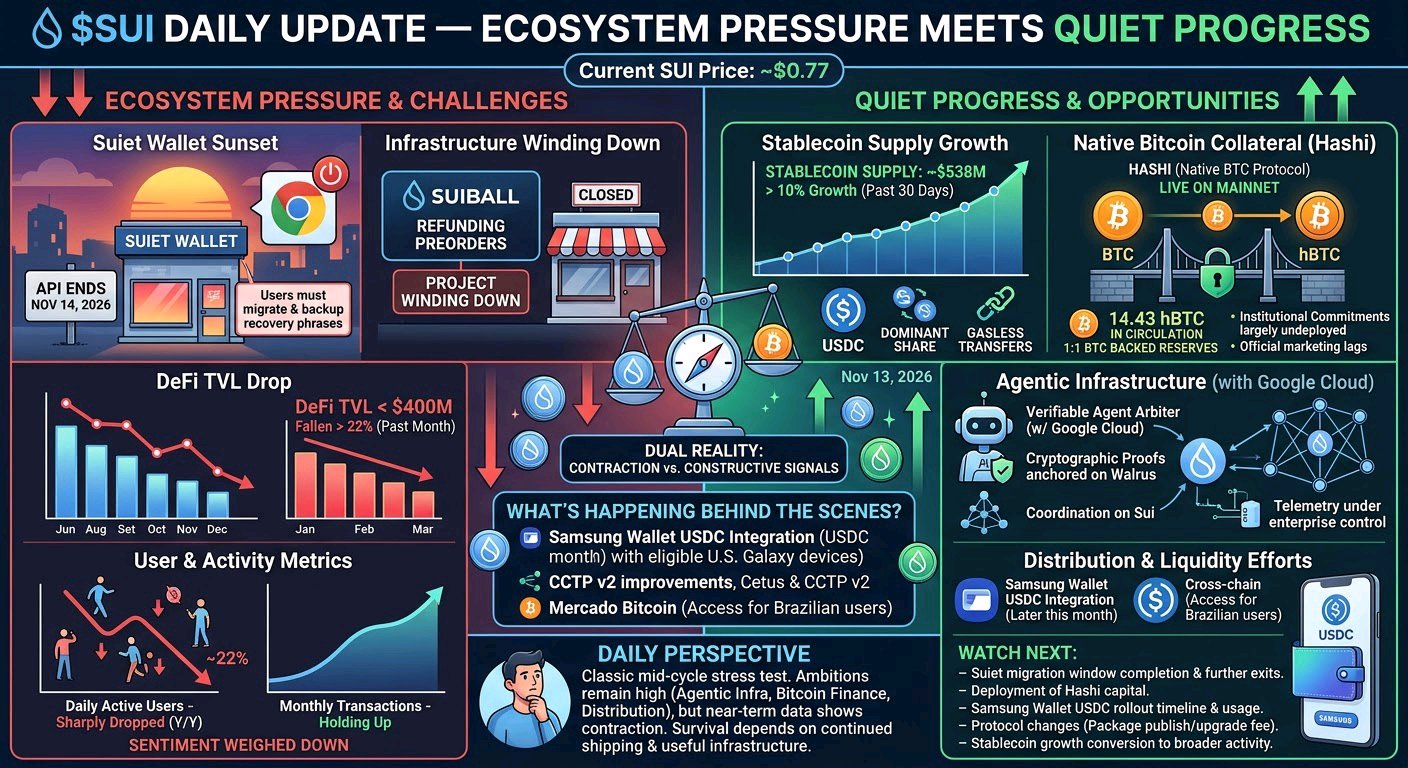
$AVA DAILY UPDATE — AVA 3.0 DROPS WITH A CLEAR TRAVALA-FIRST ROADMAP** Just two days ago, on November 12, the AVA Foundation and Travala officially unveiled AVA 3.0. This is not another vague vision statement. It is a focused, Travala-centred roadmap that doubles down on real-world travel utility, transparent buybacks, and measurable member value. AVA 3.0 builds directly on the foundation of AVA 2.0. The AVA Smart Program already serves more than 180,000 members who lock AVA to unlock up to 13% savings on travel plus additional perks. Members can also pay with AVA for discounted bookings and earn rewards through the Travala AI Agent, which is live on BNB Chain in partnership with Binance Pay. The buyback engine remains central. Every month the AVA Foundation buys AVA on the open market to fund member givebacks, and Travala matches those purchases before locking its share permanently into the AVA Strategic Reserve. The recently introduced Buyback Multiplier can scale Travala’s match up to 3x, pushing total monthly buybacks as high as 4x the givebacks generated by members. More bookings create more rewards, which in turn drive larger buybacks and further permanent locks. The numbers so far are concrete: the Foundation has bought back 5,604,414 AVA to date. Of that, 779,691.92 AVA (roughly 1.1% of circulating supply) sits permanently locked in the Strategic Reserve. Overall, about 17.5% of circulating supply is already locked, with a long-term target of 30%. Next up: increased lock requirements for new Smart members are expected this month (existing members keep their current levels and can use the new Smart Boost feature). AVA+ Partners, which will let other crypto projects lock AVA to have their tokens accepted as payment on Travala, is slated for Q1 2027. # Why This Matters This is one of the clearer utility-focused roadmaps in the sector. Instead of chasing abstract DeFi experiments, AVA 3.0 ties token demand to actual travel bookings, member discounts, and permanent supply reduction. When more people book travel and claim rewards, the buyback machine scales automatically. That creates a feedback loop between platform growth and token scarcity that is rare in practice. ### What’s Happening Behind the Scenes Travala continues to post solid operational numbers. October’s monthly gross revenue came in above $7.4 million. The AI Travel Agent and broader product improvements are live, and the ecosystem is steadily locking more AVA while expanding real payment utility. Mainstream coverage, including from Business Insider, has already picked up the AVA 3.0 announcement, signalling that the project’s travel-plus-crypto positioning is getting noticed outside pure crypto circles. ### What the Community Should Watch Next - Exact timing and details of the November Smart Program lock-level increases and Smart Boost rollout. - Progress updates on AVA+ Partners ahead of the targeted Q1 2027 launch. - Any further development of the agentic travel tools and AI features that recognise Smart membership tiers. - Ongoing monthly buyback results and growth in locked supply toward the 30% goal. These are confirmed directions from the official roadmap, not speculation. ### My Daily Perspective AVA 3.0 feels like a maturity move. The team is choosing to deepen what already works—travel bookings, member rewards, and transparent buybacks—rather than inventing new narratives. In a market full of short-lived hype cycles, a project that keeps shipping real utility and steadily removing tokens from circulation is worth paying attention to. The next few months of execution on the Smart Program updates and AVA+ Partners will show how effectively that Travala-first focus converts into stronger ecosystem metrics. Real travel. Real buybacks. Real utility. That is the story right now. #ByXIMPACT $BTCUSDT $AVAUSDT
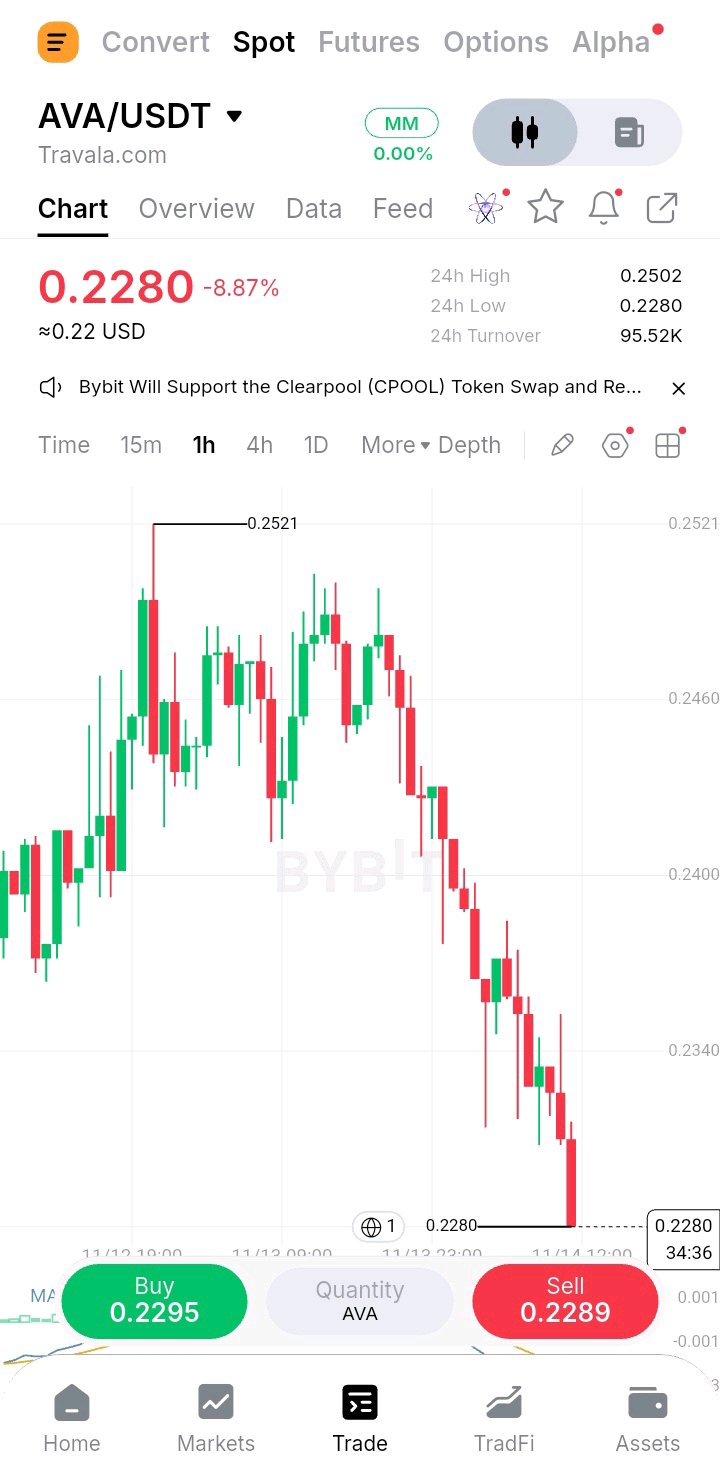
$LIT DAILY UPDATE — NEW LISTINGS AND REGULATORY WINDOW KEEP LIGHTER IN THE SPOTLIGHT** Lighter (LIT) is trading near $3.13 as of the latest sessions, down modestly on the day after testing highs around $3.40 earlier in the week. The chart shows the familiar pattern of sharp moves followed by consolidation that has defined the token since its stronger runs in late October. # Latest Developments The most immediate catalyst in the past 48 hours has been the WEEX WE-Launch campaign. LIT is live on the exchange with a 1,500 LIT airdrop window running from November 12 to November 19. Traders participating through volume or holding requirements can share in the rewards, and the listing generated a noticeable short-term lift on November 13, with reports of a roughly 3% hourly pop tied to the campaign and related social activity. Around the same period, Swiss digital asset bank Sygnum added LIT for trading, custody, and lending. That move, reported over the November 11–12 window, coincided with LIT rising more than 10% on a day when the broader market was softer. Institutional-style access of this kind remains relatively rare for mid-cap perp tokens and has drawn attention from holders looking beyond pure retail flow. Meanwhile, the bigger structural story continues. Lighter still plans to submit applications to the CFTC this month for Designated Contract Market (DCM) and Derivatives Clearing Organization (DCO) registrations. The intention was first outlined on the October 21 investor call. As of mid-November reporting, no formal filing has been confirmed, but the November window remains open. The project has described months of pre-engagement with regulators and is positioning itself as a candidate to become the first on-chain perpetual futures venue with U.S. derivatives registrations, initially targeting institutional clients. ### Why This Update Matters Exchange listings with active reward campaigns create short-term liquidity and visibility. The WEEX airdrop is time-bound, so it tends to concentrate volume while the window is open. The Sygnum addition is more structural — it expands the set of regulated venues where LIT can be held and used by institutions that prefer bank-grade custody and lending rails. The CFTC process is the longer-term variable. A formal filing would mark the start of a multi-month review (reported windows run 180–280 days). Success would open a clearer path for U.S. institutional participation on a regulated on-chain venue. Failure or delay would leave the project operating primarily through its existing non-U.S. and Robinhood Chain channels. Either outcome will shape how the market prices LIT’s regulatory premium. ### What’s Happening Behind the Scenes? Lighter continues to operate as a zero-fee (for standard retail accounts) central-limit-order-book perpetual DEX built as an application-specific ZK rollup on Ethereum. Recent technical notes mention the addition of app-level safeguard checks in partnership with infrastructure providers, aimed at blocking certain rule-violating transactions. Protocol revenue still feeds buybacks, and the Robinhood Chain integration remains a meaningful distribution channel outside the United States. On-chain and exchange data show healthy but not explosive activity. TVL has held in the high hundreds of millions, and the token remains sensitive to both sector-wide perp DEX sentiment and project-specific headlines. Circulating supply dynamics and the approach of team/investor vesting later this year continue to sit in the background of many discussions. ### What Should the Community Watch Next? - Confirmation (or absence) of the actual CFTC filing before the end of November. - Progress and participation metrics on the WEEX airdrop through November 19. - Any further regulated or institutional listings that expand custody and trading options. - Quarterly updates on volume, open interest, revenue, and buyback activity. - Clarity on vesting schedules and any new product launches (options and risk-engine features have been previously flagged). These are confirmed timelines or publicly stated intentions. Outcomes, especially on the regulatory side, remain uncertain. ### My Daily Perspective Lighter is one of the clearer examples of a perp DEX trying to close the gap between high-performance on-chain trading and traditional regulatory frameworks. The combination of a live WEEX campaign, a Swiss bank listing, and an open November filing window keeps the token more event-driven than many peers right now. Short-term price action will likely stay noisy around these catalysts. The more lasting question is whether the project can convert its technical base and distribution partnerships into durable institutional volume under a clearer U.S. regulatory umbrella. For now, the story is still being written in real time. The next few weeks of filings, listings, and campaign results will tell us more than any single daily candle. #ByXIMPACT $LITUSDT