
alhamee
4129Like0Shares40Fans3Follow
The Gold Is Holding $4,400 But CPI Could Trigger the Next Big Move $XAUT/USDT is trading around $4,400 after falling below the level Monday. Spot gold briefly reached roughly $4,396, extending the pressure from Friday's stronger-than-expected U.S. jobs report. August payrolls rose 162K versus 56K expected, while unemployment held at 4.1%, pushing markets to price around a 60% chance of a September Fed hike. The less-obvious part is how much macro pressure Gold is absorbing without completely breaking down. Higher Treasury yields, rising oil prices and renewed Fed-hike expectations are all working against the metal. But geopolitical risk is simultaneously supporting safe-haven demand, while the dollar has struggled to extend its gains. That leaves Gold caught between two opposing forces. There is also an interesting development specifically for $XAUT. Tether is winding down Alloy and aUSDT while explicitly shifting resources toward products with stronger demand, deeper liquidity and broader long-term opportunity, including XAU₮. Existing aUSDT users have until September 17 to return aUSDT and recover their XAU₮ collateral through the platform. Technically, $4,400 is now the battleground. Bearish: rejection around $4,450–$4,500 → lose $4,400 → targets $4,350, then $4,300. Bullish: reclaim $4,500 and break $4,540 → opens $4,600, then $4,700. Invalidation: sustained acceptance below $4,300 would significantly weaken the current recovery structure. The next major catalyst is U.S. inflation. PPI arrives Thursday and CPI Friday. A hotter inflation print could reinforce the Fed-hike narrative, keep yields elevated and put $4,400 under serious pressure. A softer CPI could reverse some of that hawkish repricing and give Gold room to attack $4,500 again. But here's the important distinction: Gold doesn't need to rally yet. It needs to prove that $4,400 is a real base. I don't want to chase the bounce. I want to see $4,500 turn from resistance into support. Until then, this is still a decision zone not a confirmed reversal. Does Gold reclaim $4,500 into CPI, or does $4,400 finally give way? $XAUTUSDT #ByXIMPACT


CRCL & TSLA: Two Growth Stories, Two Tests
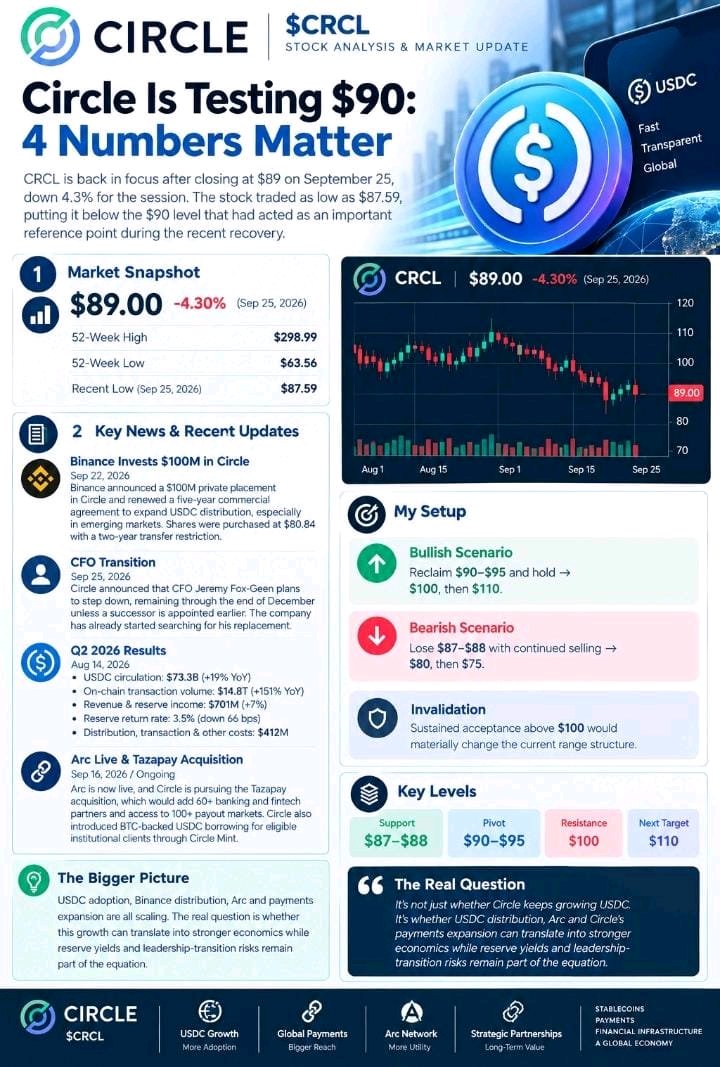
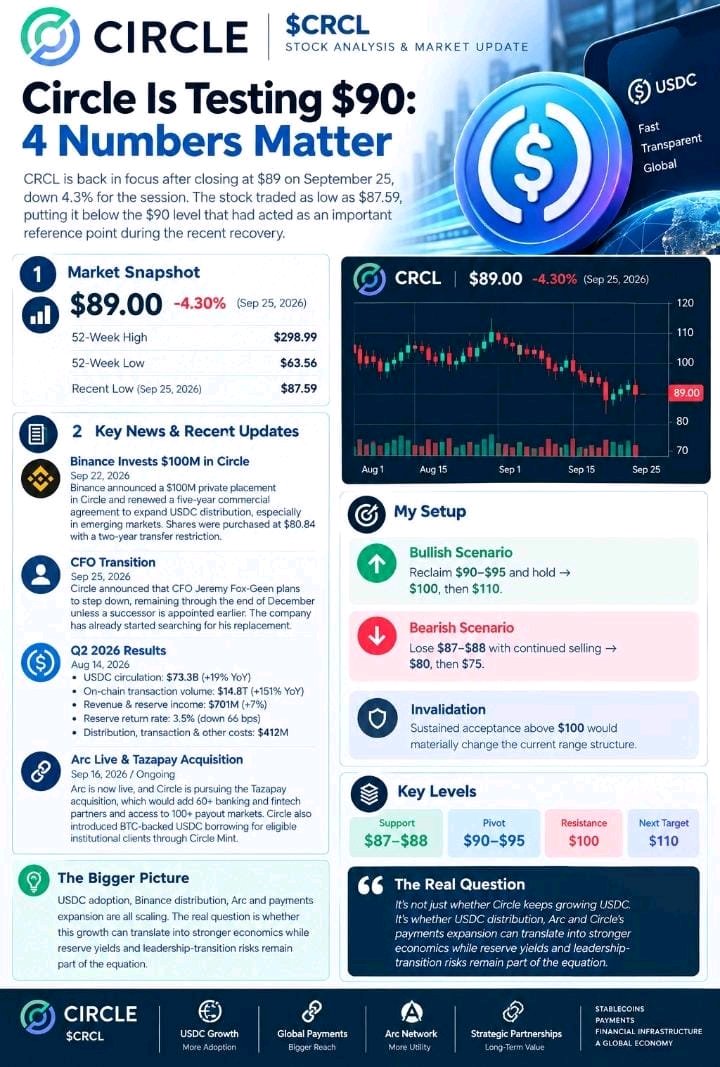
Circle and Tesla are telling very different growth stories, but both are approaching levels where execution matters more than the narrative. CRCL closed at $89 on September 25, down 4.3% for the session. The immediate pressure comes after a strong September rebound, but the fundamental backdrop remains active: Binance invested $100M in Circle at $80.84 per share and renewed a five-year USDC partnership. Circle also launched Arc mainnet with more than 100 institutional and ecosystem builders, while USDC circulation had surpassed $74B. The new risk is management transition. Circle announced CFO Jeremy Fox-Green will step down, with a transition planned through December unless a successor arrives sooner. That comes while the business is scaling: Q2 USDC circulation reached $73.3B (+19% YoY), on-chain volume hit $14.8T (+151%), and revenue plus reserve income reached $701M. TSLA closed at $372.11 on September 25, down 1.54%. Tesla now has several catalysts converging: Semi deliveries have begun from its Nevada facility, which is planned for 50,000 trucks annually, while the company recently received an order for 2,500 Semis from a group including Microsoft and PepsiCo. Czech regulators also provisionally approved Tesla's FSD system this week. But Tesla's autonomy story still faces a regulatory test. NHTSA is investigating the certification of up to 1,000 Cybercabs, and Tesla has been ordered to answer questions about the certification by September 30. That creates two very different setups. CRCL setup Bullish: reclaim $90–$95 → $100, then $110. Bearish: lose $87–$88 → $80, then $75. TSLA setup Bullish: reclaim $380–$385 → $400, then $420. Bearish: rejection below $380 and loss of $365 → $350, then $335. The interesting part isn't simply whether CRCL can grow USDC or Tesla can grow autonomy. It's whether Circle can convert stablecoin adoption into durable economics, while Tesla proves that its autonomy and new-product ambitions can scale without execution and regulatory issues becoming the bottleneck.. $TSLAXUSDT $CRCLXUSDT #ByXIMPACT
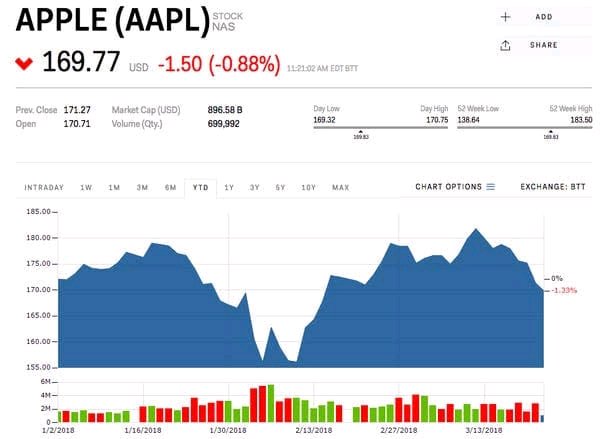
AAPL: The Event Delivered, But Price Still Needs To Confirm Apple gave investors plenty to digest yesterday: the $1,999 iPhone Duo, iPhone 18 Pro and Pro Max, upgraded AirPods, Apple Watch Series 12 and Ultra 4, plus a deeper AI push through its latest software experience. The foldable iPhone is clearly the headline, but for investors, the bigger question is whether this product cycle can translate into a meaningful upgrade cycle. What caught my attention is the reaction in AAPL itself. Despite the scale of the announcements, Apple finished around $315.34, down roughly 0.28%, with price still trading inside its broader ascending channel rather than breaking higher. 📈 The chart remains constructive, but AAPL is now approaching a key decision area. Higher lows are still developing inside the rising channel, while price continues to test the upper boundary. That makes the technical breakout more important than the event headline itself. If AAPL can push through the channel resistance and hold above it with volume, the structure would favor another upside leg. But there is another possibility. The market may be telling us that the iPhone Duo, higher Pro pricing and AI improvements were already partially priced in. Major Apple launches can also produce short-term sell-the-news reactions before the market reassesses the longer-term earnings impact. So I'm watching price confirmation rather than chasing the narrative. Bull case: breakout above channel resistance → volume confirmation → continuation toward the next resistance. Bear case: rejection at the upper boundary → loss of the rising channel → deeper pullback before another breakout attempt. The event delivered the narrative. Now AAPL needs to deliver the price confirmation. Would you buy the dip inside the channel, or wait for AAPL to break and hold above resistance first? $AAPLXUSDT #ByXIMPACT

The Gold is breaking below $4,300 and this selloff is becoming more than a normal pullback. XAU/USD fell to around $4,303 on Wednesday, its lowest level in more than three weeks, with gold now facing a fourth straight session of losses. The move comes as renewed U.S.-Iran tensions push oil higher, while the U.S. 10-year yield climbs toward 4.81% and markets price roughly a 70% chance of a Fed hike this month. The less-obvious part is the reaction to geopolitical risk. Normally, escalating conflict should strengthen gold's safe-haven bid. But this time, higher oil prices are creating another problem: inflation expectations are rising alongside yields, making the Fed more likely to stay restrictive. That is allowing the dollar and Treasury yields to overpower gold's traditional safe-haven demand. Technically, $4,300 is now the battleground. Gold is trading below its 200-day moving average, so buyers need to reclaim lost levels before the structure starts looking constructive again. Bearish: rejection around $4,350–$4,400 → targets $4,250, then $4,200. Bullish: reclaim $4,400 and hold → opens a recovery toward $4,480–$4,520. Invalidation: sustained acceptance above $4,520 would weaken the current bearish structure. The next major catalyst is U.S. labor data. A weak ADP/NFP sequence could reduce Fed-hike expectations and give gold the liquidity relief it needs. A strong labor report would reinforce the higher-yields narrative and potentially put $4,300 under much greater pressure. Gold isn't losing because safe-haven demand disappeared. It's losing because the market is currently treating inflation and higher rates as the bigger risk.. $XAUTUSDT #ByXIMPACT

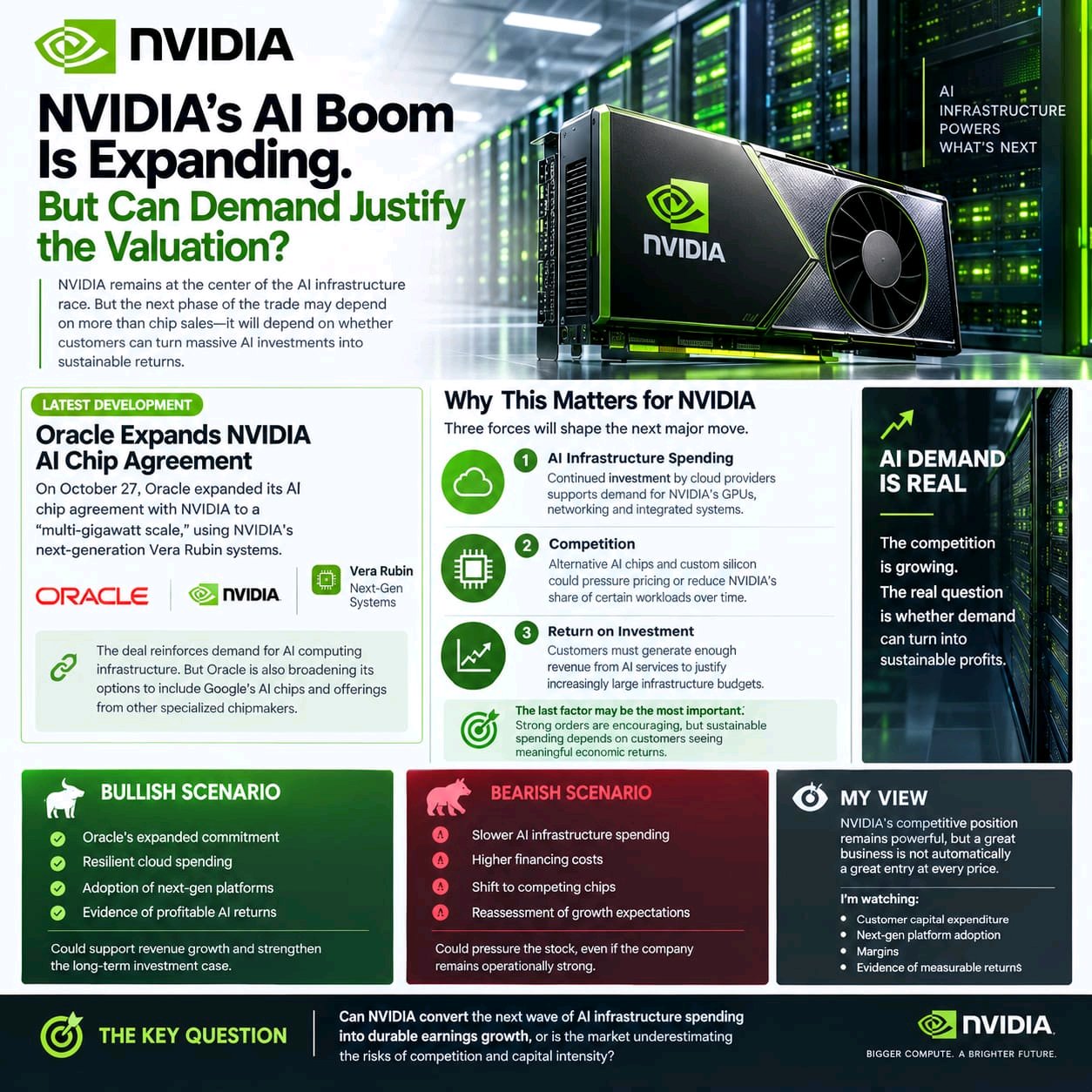
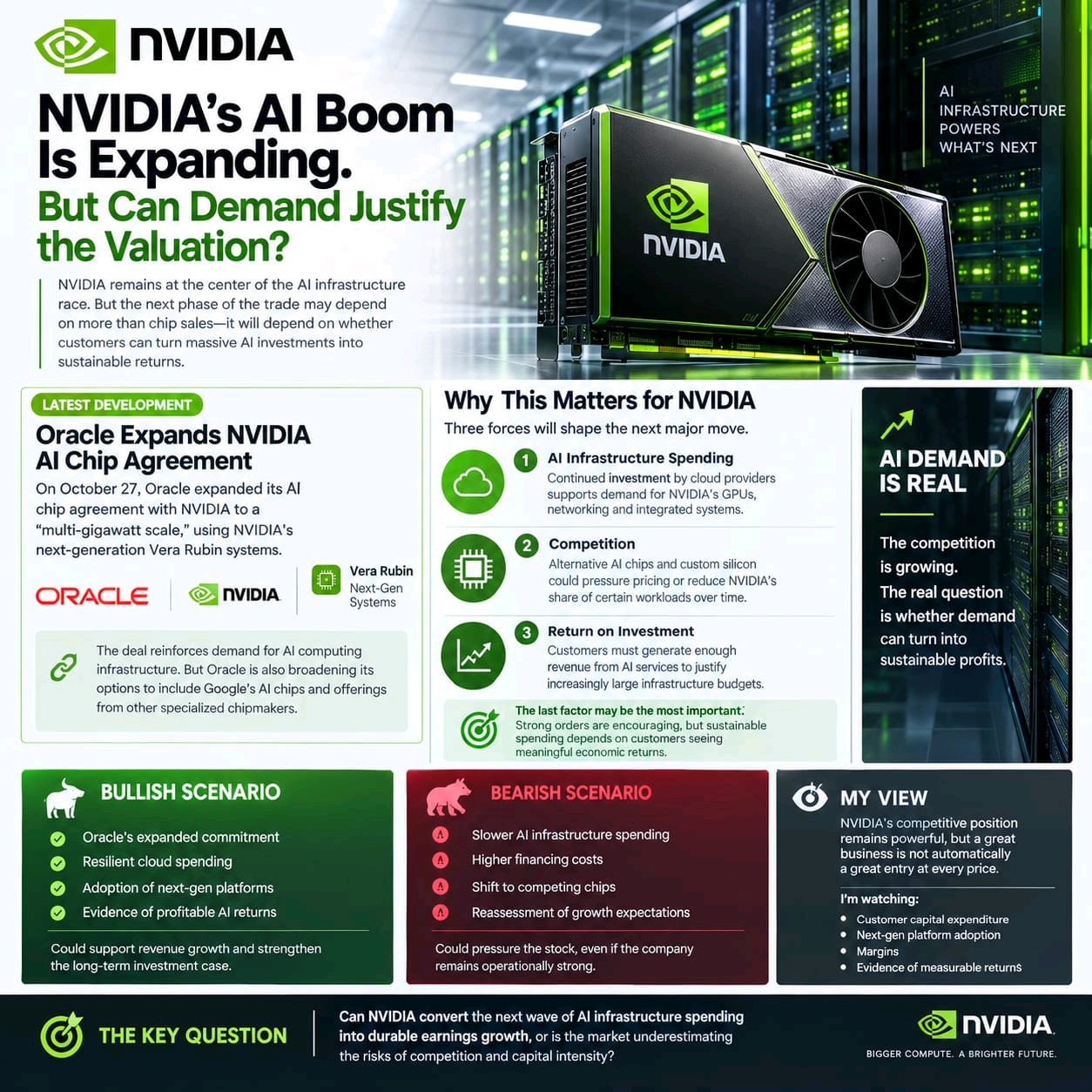
Nvidia is still growing at a rate most mega-cap companies can’t touch but the stock is starting to face a different test. Nvidia just reported $96.2B in quarterly revenue, up 106% YoY and 18% sequentially. Data Center revenue reached $89B, up 117% YoY. Even more important, management guided Q3 revenue to $108B ±2%. The less-obvious signal is the gap between fundamental growth and market expectations. Nvidia's Vera Rubin platform is already ramping into full production across major AI infrastructure partners, meaning the company isn't relying only on Blackwell to sustain the cycle. But macro has suddenly become a bigger problem. The U.S. 10-year yield has pushed toward 4.8%, while September Fed hike expectations have risen toward 67–68% as oil and inflation concerns intensify. That creates pressure on high-valuation technology stocks even when their underlying businesses remain strong. So the setup is becoming more interesting. Bullish: hold the $215–$220 area and reclaim $225–$230 → momentum can target $240, then $250. Bearish: lose $215 → watch $205, with $195 becoming the deeper support zone. Invalidation: sustained acceptance above $230 would weaken the short-term bearish thesis. The AI story hasn't broken. The question is whether NVDA can continue climbing while yields are telling investors to demand a higher return for owning growth. That's the divergence I'm watching now: record AI demand versus increasingly hostile macro conditions. $NVDAXUSDT #ByXIMPACT

Tesla and SpaceX are entering an important stretch where execution matters more than the Musk narrative. Tesla delivered 480,126 vehicles in Q2 and deployed 13.5 GWh of energy storage, but its China-made EV sales growth slowed sharply to 3.6% YoY in August. Meanwhile, Cybercab has moved into commercial deployment in Austin, but NHTSA has asked Tesla to answer questions by September 30 about its self-certification. SpaceX is facing a different test. Q2 revenue surged 91.9% YoY to $7.8B, with AI revenue jumping 247.5% to $2.6B and Starlink connectivity revenue reaching $4.3B. But the growth requires enormous investment: AI capex alone reached $15.8B in Q2. SpaceX is now targeting September 28 for Starship Flight 14, its first revenue-generating Starship mission, carrying 26 Starlink V3 satellites. The market is also giving investors a clear technical test. TSLA is around the $390 area, while SPCX closed at $148.36 on September 23 after falling 4.11%; the latest session has pushed it back toward the $146–$150 zone. SpaceX's upcoming lockup expiration is another near-term supply consideration, with roughly 328 million shares becoming eligible to trade. My setup: • $TSLA Bullish: reclaim $400 → $420, then $450. • $TSLA Bearish: lose $370 → $355, then $340. • $SPCX Bullish: reclaim $155–$160 → $175, then $190. • $SPCX Bearish: lose $145 → $135, then $125. The interesting question isn't which company has the bigger Musk-led narrative. It's whether Tesla can turn autonomy into a scalable business while SpaceX converts Starlink and AI growth into enough cash flow to support its massive capital spending without the market demanding a reset in valuation first.. $TSLAXUSDT $SPCXXUSDT #ByXIMPACT


$HYPE: Institutional Money Is Arriving. The Next Test Is Supply. Hyperliquid is entering a different phase. The question is no longer just whether traders want an on-chain derivatives exchange. It’s whether traditional financial institutions can help turn Hyperliquid into infrastructure for a much broader market—and whether HYPE holders will benefit. Three developments stand out. 1. Wall Street is exploring Hyperliquid’s infrastructure. On October 29, ICE announced a partnership with Trade[XYZ] to develop regulated U.S. perpetual markets using Hyperliquid technology. The planned products could cover crypto, equities, commodities, and foreign exchange. A separate development on October 26 saw Hyperliquid identify Kraken parent Payward as its intended first CFTC-regulated HIP-3 deployer, subject to approvals. These moves suggest that Hyperliquid’s potential market extends beyond crypto-native traders. But neither announcement guarantees direct value accrual to HYPE holders. 2. Regulated investment products are creating another demand channel. Spot HYPE investment products offer traditional investors exposure without requiring them to manage tokens directly. By October 30, three products collectively held approximately $450 million in assets, according to ETF flow tracking data. That is an encouraging sign of investor interest—but assets under management are not the same as fresh daily inflows, and flows can reverse. 3. Supply pressure remains part of the equation. The next major scheduled core-contributor unlock is November 6, with approximately 9.92 million HYPE listed for release by current market trackers. Unlocking tokens does not automatically mean they will be sold, but it creates another supply event for the market to absorb. Meanwhile, Hyperliquid’s Assistance Fund continues buying HYPE using protocol-related revenue. One tracker estimated roughly $65.7 million in buybacks over the previous 30 days as of October 31. The important question is whether sustained demand can outweigh the new supply entering circulation. My take: Hyperliquid is building a credible case as financial-market infrastructure. Institutional partnerships, regulated investment products, and protocol-driven buybacks are meaningful developments—but the strongest long-term signal would be growing real usage alongside durable demand for HYPE. I’m watching three things: regulatory progress, actual ETF inflows, and how the market handles the November unlock. Is $HYPE becoming a long-term infrastructure asset—or is the market pricing in the institutional story too early? #ByXIMPACT $HYPEUSDT

The Gold Is Holding $4,400 But CPI Could Trigger the Next Big Move $XAUT/USDT is trading around $4,400 after falling below the level Monday. Spot gold briefly reached roughly $4,396, extending the pressure from Friday's stronger-than-expected U.S. jobs report. August payrolls rose 162K versus 56K expected, while unemployment held at 4.1%, pushing markets to price around a 60% chance of a September Fed hike. The less-obvious part is how much macro pressure Gold is absorbing without completely breaking down. Higher Treasury yields, rising oil prices and renewed Fed-hike expectations are all working against the metal. But geopolitical risk is simultaneously supporting safe-haven demand, while the dollar has struggled to extend its gains. That leaves Gold caught between two opposing forces. There is also an interesting development specifically for $XAUT. Tether is winding down Alloy and aUSDT while explicitly shifting resources toward products with stronger demand, deeper liquidity and broader long-term opportunity, including XAU₮. Existing aUSDT users have until September 17 to return aUSDT and recover their XAU₮ collateral through the platform. Technically, $4,400 is now the battleground. Bearish: rejection around $4,450–$4,500 → lose $4,400 → targets $4,350, then $4,300. Bullish: reclaim $4,500 and break $4,540 → opens $4,600, then $4,700. Invalidation: sustained acceptance below $4,300 would significantly weaken the current recovery structure. The next major catalyst is U.S. inflation. PPI arrives Thursday and CPI Friday. A hotter inflation print could reinforce the Fed-hike narrative, keep yields elevated and put $4,400 under serious pressure. A softer CPI could reverse some of that hawkish repricing and give Gold room to attack $4,500 again. But here's the important distinction: Gold doesn't need to rally yet. It needs to prove that $4,400 is a real base. I don't want to chase the bounce. I want to see $4,500 turn from resistance into support. Until then, this is still a decision zone not a confirmed reversal. Does Gold reclaim $4,500 into CPI, or does $4,400 finally give way? $XAUTUSDT #ByXIMPACT


CRCL & TSLA: Two Growth Stories, Two Tests
Circle and Tesla are telling very different growth stories, but both are approaching levels where execution matters more than the narrative. CRCL closed at $89 on September 25, down 4.3% for the session. The immediate pressure comes after a strong September rebound, but the fundamental backdrop remains active: Binance invested $100M in Circle at $80.84 per share and renewed a five-year USDC partnership. Circle also launched Arc mainnet with more than 100 institutional and ecosystem builders, while USDC circulation had surpassed $74B. The new risk is management transition. Circle announced CFO Jeremy Fox-Green will step down, with a transition planned through December unless a successor arrives sooner. That comes while the business is scaling: Q2 USDC circulation reached $73.3B (+19% YoY), on-chain volume hit $14.8T (+151%), and revenue plus reserve income reached $701M. TSLA closed at $372.11 on September 25, down 1.54%. Tesla now has several catalysts converging: Semi deliveries have begun from its Nevada facility, which is planned for 50,000 trucks annually, while the company recently received an order for 2,500 Semis from a group including Microsoft and PepsiCo. Czech regulators also provisionally approved Tesla's FSD system this week. But Tesla's autonomy story still faces a regulatory test. NHTSA is investigating the certification of up to 1,000 Cybercabs, and Tesla has been ordered to answer questions about the certification by September 30. That creates two very different setups. CRCL setup Bullish: reclaim $90–$95 → $100, then $110. Bearish: lose $87–$88 → $80, then $75. TSLA setup Bullish: reclaim $380–$385 → $400, then $420. Bearish: rejection below $380 and loss of $365 → $350, then $335. The interesting part isn't simply whether CRCL can grow USDC or Tesla can grow autonomy. It's whether Circle can convert stablecoin adoption into durable economics, while Tesla proves that its autonomy and new-product ambitions can scale without execution and regulatory issues becoming the bottleneck.. $TSLAXUSDT $CRCLXUSDT #ByXIMPACT
AAPL: The Event Delivered, But Price Still Needs To Confirm Apple gave investors plenty to digest yesterday: the $1,999 iPhone Duo, iPhone 18 Pro and Pro Max, upgraded AirPods, Apple Watch Series 12 and Ultra 4, plus a deeper AI push through its latest software experience. The foldable iPhone is clearly the headline, but for investors, the bigger question is whether this product cycle can translate into a meaningful upgrade cycle. What caught my attention is the reaction in AAPL itself. Despite the scale of the announcements, Apple finished around $315.34, down roughly 0.28%, with price still trading inside its broader ascending channel rather than breaking higher. 📈 The chart remains constructive, but AAPL is now approaching a key decision area. Higher lows are still developing inside the rising channel, while price continues to test the upper boundary. That makes the technical breakout more important than the event headline itself. If AAPL can push through the channel resistance and hold above it with volume, the structure would favor another upside leg. But there is another possibility. The market may be telling us that the iPhone Duo, higher Pro pricing and AI improvements were already partially priced in. Major Apple launches can also produce short-term sell-the-news reactions before the market reassesses the longer-term earnings impact. So I'm watching price confirmation rather than chasing the narrative. Bull case: breakout above channel resistance → volume confirmation → continuation toward the next resistance. Bear case: rejection at the upper boundary → loss of the rising channel → deeper pullback before another breakout attempt. The event delivered the narrative. Now AAPL needs to deliver the price confirmation. Would you buy the dip inside the channel, or wait for AAPL to break and hold above resistance first? $AAPLXUSDT #ByXIMPACT

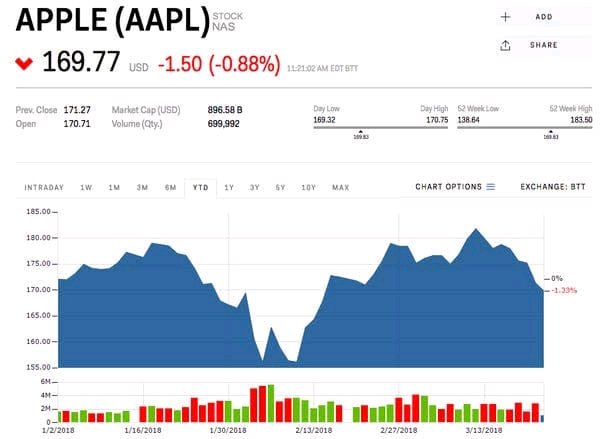
The Gold is breaking below $4,300 and this selloff is becoming more than a normal pullback. XAU/USD fell to around $4,303 on Wednesday, its lowest level in more than three weeks, with gold now facing a fourth straight session of losses. The move comes as renewed U.S.-Iran tensions push oil higher, while the U.S. 10-year yield climbs toward 4.81% and markets price roughly a 70% chance of a Fed hike this month. The less-obvious part is the reaction to geopolitical risk. Normally, escalating conflict should strengthen gold's safe-haven bid. But this time, higher oil prices are creating another problem: inflation expectations are rising alongside yields, making the Fed more likely to stay restrictive. That is allowing the dollar and Treasury yields to overpower gold's traditional safe-haven demand. Technically, $4,300 is now the battleground. Gold is trading below its 200-day moving average, so buyers need to reclaim lost levels before the structure starts looking constructive again. Bearish: rejection around $4,350–$4,400 → targets $4,250, then $4,200. Bullish: reclaim $4,400 and hold → opens a recovery toward $4,480–$4,520. Invalidation: sustained acceptance above $4,520 would weaken the current bearish structure. The next major catalyst is U.S. labor data. A weak ADP/NFP sequence could reduce Fed-hike expectations and give gold the liquidity relief it needs. A strong labor report would reinforce the higher-yields narrative and potentially put $4,300 under much greater pressure. Gold isn't losing because safe-haven demand disappeared. It's losing because the market is currently treating inflation and higher rates as the bigger risk. $XAUTUSDT #ByXIMPACT

Nvidia is still growing at a rate most mega-cap companies can’t touch but the stock is starting to face a different test. Nvidia just reported $96.2B in quarterly revenue, up 106% YoY and 18% sequentially. Data Center revenue reached $89B, up 117% YoY. Even more important, management guided Q3 revenue to $108B ±2%. The less-obvious signal is the gap between fundamental growth and market expectations. Nvidia's Vera Rubin platform is already ramping into full production across major AI infrastructure partners, meaning the company isn't relying only on Blackwell to sustain the cycle. But macro has suddenly become a bigger problem. The U.S. 10-year yield has pushed toward 4.8%, while September Fed hike expectations have risen toward 67–68% as oil and inflation concerns intensify. That creates pressure on high-valuation technology stocks even when their underlying businesses remain strong. So the setup is becoming more interesting. Bullish: hold the $215–$220 area and reclaim $225–$230 → momentum can target $240, then $250. Bearish: lose $215 → watch $205, with $195 becoming the deeper support zone. Invalidation: sustained acceptance above $230 would weaken the short-term bearish thesis. The AI story hasn't broken. The question is whether NVDA can continue climbing while yields are telling investors to demand a higher return for owning growth. That's the divergence I'm watching now: record AI demand versus increasingly hostile macro conditions. $NVDAXUSDT #ByXIMPACT

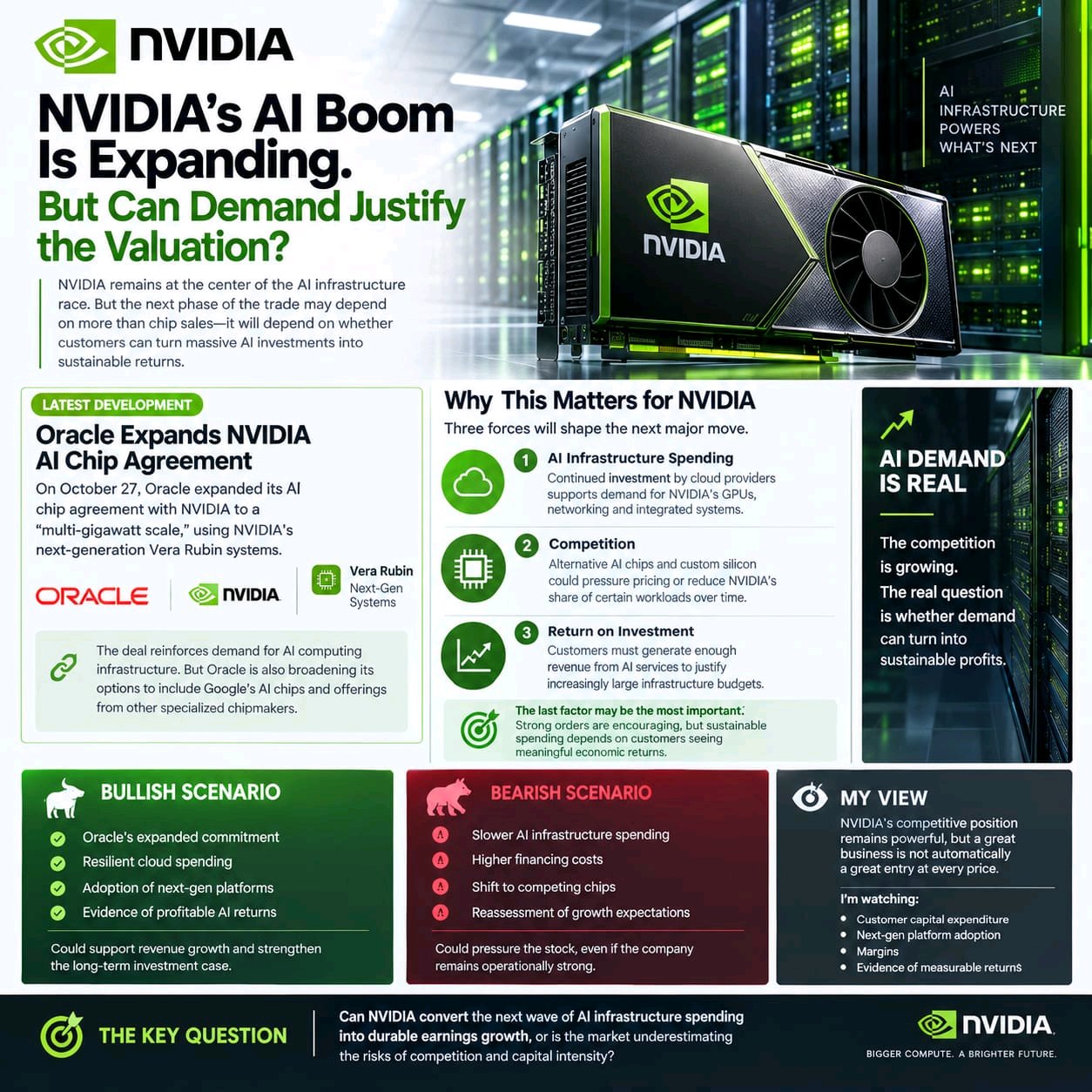
Tesla and SpaceX are entering an important stretch where execution matters more than the Musk narrative. Tesla delivered 480,126 vehicles in Q2 and deployed 13.5 GWh of energy storage, but its China-made EV sales growth slowed sharply to 3.6% YoY in August. Meanwhile, Cybercab has moved into commercial deployment in Austin, but NHTSA has asked Tesla to answer questions by September 30 about its self-certification. SpaceX is facing a different test. Q2 revenue surged 91.9% YoY to $7.8B, with AI revenue jumping 247.5% to $2.6B and Starlink connectivity revenue reaching $4.3B. But the growth requires enormous investment: AI capex alone reached $15.8B in Q2. SpaceX is now targeting September 28 for Starship Flight 14, its first revenue-generating Starship mission, carrying 26 Starlink V3 satellites. The market is also giving investors a clear technical test. TSLA is around the $390 area, while SPCX closed at $148.36 on September 23 after falling 4.11%; the latest session has pushed it back toward the $146–$150 zone. SpaceX's upcoming lockup expiration is another near-term supply consideration, with roughly 328 million shares becoming eligible to trade. My setup: • $TSLA Bullish: reclaim $400 → $420, then $450. • $TSLA Bearish: lose $370 → $355, then $340. • $SPCX Bullish: reclaim $155–$160 → $175, then $190. • $SPCX Bearish: lose $145 → $135, then $125. The interesting question isn't which company has the bigger Musk-led narrative. It's whether Tesla can turn autonomy into a scalable business while SpaceX converts Starlink and AI growth into enough cash flow to support its massive capital spending without the market demanding a reset in valuation first. $TSLAXUSDT $SPCXXUSDT #ByXIMPACT


$HYPE: Institutional Money Is Arriving. The Next Test Is Supply. Hyperliquid is entering a different phase. The question is no longer just whether traders want an on-chain derivatives exchange. It’s whether traditional financial institutions can help turn Hyperliquid into infrastructure for a much broader market—and whether HYPE holders will benefit. Three developments stand out. 1. Wall Street is exploring Hyperliquid’s infrastructure. On October 29, ICE announced a partnership with Trade[XYZ] to develop regulated U.S. perpetual markets using Hyperliquid technology. The planned products could cover crypto, equities, commodities, and foreign exchange. A separate development on October 26 saw Hyperliquid identify Kraken parent Payward as its intended first CFTC-regulated HIP-3 deployer, subject to approvals. These moves suggest that Hyperliquid’s potential market extends beyond crypto-native traders. But neither announcement guarantees direct value accrual to HYPE holders. 2. Regulated investment products are creating another demand channel. Spot HYPE investment products offer traditional investors exposure without requiring them to manage tokens directly. By October 30, three products collectively held approximately $450 million in assets, according to ETF flow tracking data. That is an encouraging sign of investor interest—but assets under management are not the same as fresh daily inflows, and flows can reverse. 3. Supply pressure remains part of the equation. The next major scheduled core-contributor unlock is November 6, with approximately 9.92 million HYPE listed for release by current market trackers. Unlocking tokens does not automatically mean they will be sold, but it creates another supply event for the market to absorb. Meanwhile, Hyperliquid’s Assistance Fund continues buying HYPE using protocol-related revenue. One tracker estimated roughly $65.7 million in buybacks over the previous 30 days as of October 31. The important question is whether sustained demand can outweigh the new supply entering circulation. My take: Hyperliquid is building a credible case as financial-market infrastructure. Institutional partnerships, regulated investment products, and protocol-driven buybacks are meaningful developments—but the strongest long-term signal would be growing real usage alongside durable demand for HYPE. I’m watching three things: regulatory progress, actual ETF inflows, and how the market handles the November unlock. Is $HYPE becoming a long-term infrastructure asset—or is the market pricing in the institutional story too early? $HYPEUSDT #ByXIMPACT

The Gold Is Holding $4,400 But CPI Could Trigger the Next Big Move $XAUT/USDT is trading around $4,400 after falling below the level Monday. Spot gold briefly reached roughly $4,396, extending the pressure from Friday's stronger-than-expected U.S. jobs report. August payrolls rose 162K versus 56K expected, while unemployment held at 4.1%, pushing markets to price around a 60% chance of a September Fed hike. The less-obvious part is how much macro pressure Gold is absorbing without completely breaking down. Higher Treasury yields, rising oil prices and renewed Fed-hike expectations are all working against the metal. But geopolitical risk is simultaneously supporting safe-haven demand, while the dollar has struggled to extend its gains. That leaves Gold caught between two opposing forces. There is also an interesting development specifically for $XAUT. Tether is winding down Alloy and aUSDT while explicitly shifting resources toward products with stronger demand, deeper liquidity and broader long-term opportunity, including XAU₮. Existing aUSDT users have until September 17 to return aUSDT and recover their XAU₮ collateral through the platform. Technically, $4,400 is now the battleground. Bearish: rejection around $4,450–$4,500 → lose $4,400 → targets $4,350, then $4,300. Bullish: reclaim $4,500 and break $4,540 → opens $4,600, then $4,700. Invalidation: sustained acceptance below $4,300 would significantly weaken the current recovery structure. The next major catalyst is U.S. inflation. PPI arrives Thursday and CPI Friday. A hotter inflation print could reinforce the Fed-hike narrative, keep yields elevated and put $4,400 under serious pressure. A softer CPI could reverse some of that hawkish repricing and give Gold room to attack $4,500 again. But here's the important distinction: Gold doesn't need to rally yet. It needs to prove that $4,400 is a real base. I don't want to chase the bounce. I want to see $4,500 turn from resistance into support. Until then, this is still a decision zone not a confirmed reversal. Does Gold reclaim $4,500 into CPI, or does $4,400 finally give way? $XAUTUSDT #ByXIMPACT


AAPL: The Event Delivered, But Price Still Needs To Confirm Apple gave investors plenty to digest yesterday: the $1,999 iPhone Duo, iPhone 18 Pro and Pro Max, upgraded AirPods, Apple Watch Series 12 and Ultra 4, plus a deeper AI push through its latest software experience. The foldable iPhone is clearly the headline, but for investors, the bigger question is whether this product cycle can translate into a meaningful upgrade cycle. What caught my attention is the reaction in AAPL itself. Despite the scale of the announcements, Apple finished around $315.34, down roughly 0.28%, with price still trading inside its broader ascending channel rather than breaking higher. 📈 The chart remains constructive, but AAPL is now approaching a key decision area. Higher lows are still developing inside the rising channel, while price continues to test the upper boundary. That makes the technical breakout more important than the event headline itself. If AAPL can push through the channel resistance and hold above it with volume, the structure would favor another upside leg. But there is another possibility. The market may be telling us that the iPhone Duo, higher Pro pricing and AI improvements were already partially priced in. Major Apple launches can also produce short-term sell-the-news reactions before the market reassesses the longer-term earnings impact. So I'm watching price confirmation rather than chasing the narrative. Bull case: breakout above channel resistance → volume confirmation → continuation toward the next resistance. Bear case: rejection at the upper boundary → loss of the rising channel → deeper pullback before another breakout attempt. The event delivered the narrative. Now AAPL needs to deliver the price confirmation. Would you buy the dip inside the channel, or wait for AAPL to break and hold above resistance first? $AAPLXUSDT #ByXIMPACT

CRCL & TSLA: Two Growth Stories, Two Tests
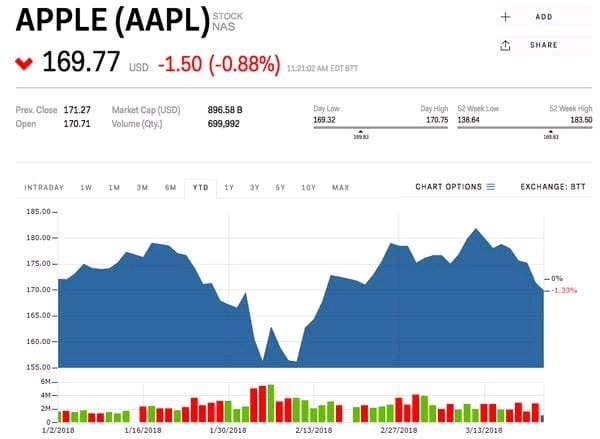
Circle and Tesla are telling very different growth stories, but both are approaching levels where execution matters more than the narrative. CRCL closed at $89 on September 25, down 4.3% for the session. The immediate pressure comes after a strong September rebound, but the fundamental backdrop remains active: Binance invested $100M in Circle at $80.84 per share and renewed a five-year USDC partnership. Circle also launched Arc mainnet with more than 100 institutional and ecosystem builders, while USDC circulation had surpassed $74B. The new risk is management transition. Circle announced CFO Jeremy Fox-Green will step down, with a transition planned through December unless a successor arrives sooner. That comes while the business is scaling: Q2 USDC circulation reached $73.3B (+19% YoY), on-chain volume hit $14.8T (+151%), and revenue plus reserve income reached $701M. TSLA closed at $372.11 on September 25, down 1.54%. Tesla now has several catalysts converging: Semi deliveries have begun from its Nevada facility, which is planned for 50,000 trucks annually, while the company recently received an order for 2,500 Semis from a group including Microsoft and PepsiCo. Czech regulators also provisionally approved Tesla's FSD system this week. But Tesla's autonomy story still faces a regulatory test. NHTSA is investigating the certification of up to 1,000 Cybercabs, and Tesla has been ordered to answer questions about the certification by September 30. That creates two very different setups. CRCL setup Bullish: reclaim $90–$95 → $100, then $110. Bearish: lose $87–$88 → $80, then $75. TSLA setup Bullish: reclaim $380–$385 → $400, then $420. Bearish: rejection below $380 and loss of $365 → $350, then $335. The interesting part isn't simply whether CRCL can grow USDC or Tesla can grow autonomy. It's whether Circle can convert stablecoin adoption into durable economics, while Tesla proves that its autonomy and new-product ambitions can scale without execution and regulatory issues becoming the bottleneck.. $TSLAXUSDT $CRCLXUSDT #ByXIMPACT
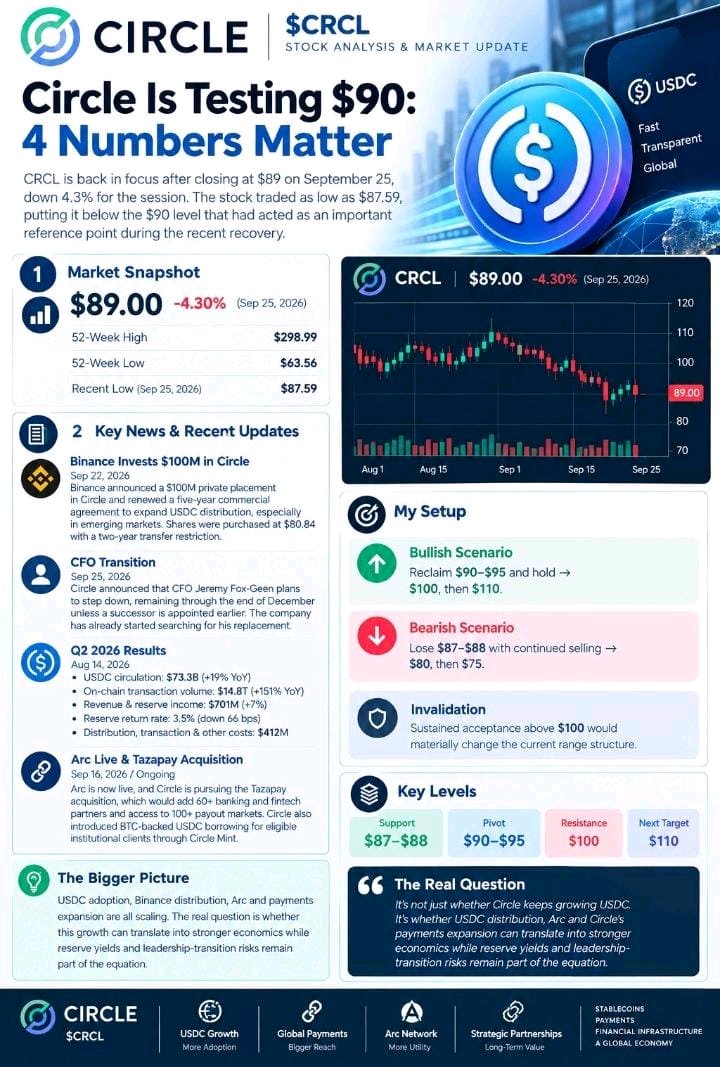
The Gold is breaking below $4,300 and this selloff is becoming more than a normal pullback. XAU/USD fell to around $4,303 on Wednesday, its lowest level in more than three weeks, with gold now facing a fourth straight session of losses. The move comes as renewed U.S.-Iran tensions push oil higher, while the U.S. 10-year yield climbs toward 4.81% and markets price roughly a 70% chance of a Fed hike this month. The less-obvious part is the reaction to geopolitical risk. Normally, escalating conflict should strengthen gold's safe-haven bid. But this time, higher oil prices are creating another problem: inflation expectations are rising alongside yields, making the Fed more likely to stay restrictive. That is allowing the dollar and Treasury yields to overpower gold's traditional safe-haven demand. Technically, $4,300 is now the battleground. Gold is trading below its 200-day moving average, so buyers need to reclaim lost levels before the structure starts looking constructive again. Bearish: rejection around $4,350–$4,400 → targets $4,250, then $4,200. Bullish: reclaim $4,400 and hold → opens a recovery toward $4,480–$4,520. Invalidation: sustained acceptance above $4,520 would weaken the current bearish structure. The next major catalyst is U.S. labor data. A weak ADP/NFP sequence could reduce Fed-hike expectations and give gold the liquidity relief it needs. A strong labor report would reinforce the higher-yields narrative and potentially put $4,300 under much greater pressure. Gold isn't losing because safe-haven demand disappeared. It's losing because the market is currently treating inflation and higher rates as the bigger risk. $XAUTUSDT #ByXIMPACT

Nvidia is still growing at a rate most mega-cap companies can’t touch but the stock is starting to face a different test. Nvidia just reported $96.2B in quarterly revenue, up 106% YoY and 18% sequentially. Data Center revenue reached $89B, up 117% YoY. Even more important, management guided Q3 revenue to $108B ±2%. The less-obvious signal is the gap between fundamental growth and market expectations. Nvidia's Vera Rubin platform is already ramping into full production across major AI infrastructure partners, meaning the company isn't relying only on Blackwell to sustain the cycle. But macro has suddenly become a bigger problem. The U.S. 10-year yield has pushed toward 4.8%, while September Fed hike expectations have risen toward 67–68% as oil and inflation concerns intensify. That creates pressure on high-valuation technology stocks even when their underlying businesses remain strong. So the setup is becoming more interesting. Bullish: hold the $215–$220 area and reclaim $225–$230 → momentum can target $240, then $250. Bearish: lose $215 → watch $205, with $195 becoming the deeper support zone. Invalidation: sustained acceptance above $230 would weaken the short-term bearish thesis. The AI story hasn't broken. The question is whether NVDA can continue climbing while yields are telling investors to demand a higher return for owning growth. That's the divergence I'm watching now: record AI demand versus increasingly hostile macro conditions. $NVDAXUSDT #ByXIMPACT

Tesla and SpaceX are entering an important stretch where execution matters more than the Musk narrative. Tesla delivered 480,126 vehicles in Q2 and deployed 13.5 GWh of energy storage, but its China-made EV sales growth slowed sharply to 3.6% YoY in August. Meanwhile, Cybercab has moved into commercial deployment in Austin, but NHTSA has asked Tesla to answer questions by September 30 about its self-certification. SpaceX is facing a different test. Q2 revenue surged 91.9% YoY to $7.8B, with AI revenue jumping 247.5% to $2.6B and Starlink connectivity revenue reaching $4.3B. But the growth requires enormous investment: AI capex alone reached $15.8B in Q2. SpaceX is now targeting September 28 for Starship Flight 14, its first revenue-generating Starship mission, carrying 26 Starlink V3 satellites. The market is also giving investors a clear technical test. TSLA is around the $390 area, while SPCX closed at $148.36 on September 23 after falling 4.11%; the latest session has pushed it back toward the $146–$150 zone. SpaceX's upcoming lockup expiration is another near-term supply consideration, with roughly 328 million shares becoming eligible to trade. My setup: • $TSLA Bullish: reclaim $400 → $420, then $450. • $TSLA Bearish: lose $370 → $355, then $340. • $SPCX Bullish: reclaim $155–$160 → $175, then $190. • $SPCX Bearish: lose $145 → $135, then $125. The interesting question isn't which company has the bigger Musk-led narrative. It's whether Tesla can turn autonomy into a scalable business while SpaceX converts Starlink and AI growth into enough cash flow to support its massive capital spending without the market demanding a reset in valuation first. $TSLAXUSDT $SPCXXUSDT #ByXIMPACT