Spectre
9046Like63Shares303Fans109Follow
KOL and Crypto Influencer, Marketer and strategist
KOL and Crypto Influencer, Marketer and strategist
$TSLAXUSDT reached $497.08 on December 22, 2025. On November 10, 2026, it is trading near $377.80, despite gaining approximately 6% in 24 hours. The rebound looks strong, but the token remains roughly 24% below its historical peak. CoinGlass +1 That's not really a crypto breakout. It's a repricing of Tesla equity exposure through blockchain infrastructure. The distinction matters because TSLAX is issued by Backed as a tracker certificate designed to follow Tesla shares. It is not an independent utility token, and its valuation ultimately depends on the underlying equity rather than crypto adoption alone. CoinGecko +1 The derivatives market adds another layer. CoinGlass recorded approximately $2.44M in futures volume against $846K in spot volume. Open interest increased 24.79% to $1.06M, while funding reached 0.0353% per 8 hours. That suggests leveraged positioning is expanding faster than spot participation. CoinGlass Worth watching: $382 is the immediate resistance, while $356 is the important downside level. A sustained breakout above $382 could open $408. A decisive close below $356 would invalidate the recovery thesis. For the next 24–72 hours, the key risk is a derivatives-led rally losing momentum while Tesla's underlying equity moves in the opposite direction. Will stronger spot demand confirm this recovery, or is leverage doing most of the work?

$INJUSDT is up 10.34% over the last 7 days, but its derivatives market is telling a less convincing story: futures volume reached $235.69M against just $33.12M in spot volume on November 10. That is a 7.1x difference. The rally is attracting traders, but genuine spot demand is not keeping pace. There is a fundamental reason INJ remains interesting. According to its September 2026 SEC filing, Injective had approximately 90,000 daily active wallets during Q3 and had facilitated more than $75B in cumulative spot trading volume. Its community buyback mechanism also connects application-generated fees with INJ accumulation and redistribution. However, adoption does not automatically translate into immediate price appreciation. The current market structure needs attention. INJ is trading around $8.02, with a 24-hour range of $7.82–$8.29. Meanwhile, aggregate futures open interest has declined 5.42% to approximately $149.39M. For the next 24–72 hours, watch the $8.25 resistance zone. A convincing breakout with stronger spot participation could open $8.55, followed by $8.80. On the downside, $7.82 is the immediate support. A decisive break below it invalidates the recovery setup. Risk: leveraged positioning could unwind before spot buyers step in. INJ needs real spot demand to validate this recovery. Until then, the rally remains vulnerable to a derivatives-driven reversal. #MidtermsMarketWatch

Polygon $POLUSDT distributed more than 5.4 million POL to validators in February 2026. By September 8, another 27.33 million POL had accumulated for stakers under a new fee-sharing formula but had not yet reached them. That's not simply a staking-reward increase. It's a change in who gets paid from Polygon's transaction fees, and the delivery mechanism has become the real story. PIP-85, finalized on March 25, redirects 50% of the post-commission priority-fee pool to POL stakers. The remaining validator allocation is split using a formula that gives 75% weight to equal distribution adjusted for performance, rather than relying entirely on stake size. The change activated at block 85,245,000 in April. The complication: the planned Ethereum-based Merkle claimers were never deployed. The staker allocation accumulated instead. By September 8, the five monthly accounting periods had produced 27,334,955.85 POL for stakers. Enter PIP-92, submitted by Adam Dossa on September 23. It proposes distributing that backlog through Polygon's existing StakeManager, temporarily raising checkpoint rewards from 25,212.79 to 64,500 POL between October 1 and December 1. The projected gross annualized staking reward rate rises from roughly 3.0% to 7.7% during that window. But PIP-92 is listed as a draft, not a finalized permanent mechanism. The automated long-term solution is deferred to PIP-93. Worth sitting with: fee sharing looks attractive on paper, but recurring delivery matters more than an accumulated reward balance. Can Polygon turn this allocation into a reliable, ongoing source of value for POL stakers? #WSOT2026

Hyperliquid’s biggest $HYPEUSDT catalyst may be coming from markets that have nothing to do with crypto. As of September 8, 2026, HIP-3 markets accounted for roughly 30% of Hyperliquid’s trailing 30-day trading volume, with more than $548.1 billion in cumulative volume since launch. That’s not just another perp expansion. It’s Hyperliquid trying to become trading infrastructure for assets beyond digital currencies—and HYPE is part of the access mechanism. Under HIP-3, deployers must bond HYPE to launch permissionless perpetual markets. HIP-4 takes this further: after its August 29 network upgrade, third-party builders could deploy event markets by staking 500,000 HYPE, subject to a minimum six-month lock and potential slashing. But there’s a distinction the volume headlines can hide. By September 8, HIP-4 was reporting around $445.8 million in daily volume, yet only three third-party builders had bonded tokens, and a substantial portion of activity was supported by deployer-funded incentives. Volume is real; durable organic demand is not yet proven. The other side of the equation is the Assistance Fund. 99% of protocol fees are allocated to it, and 47.1 million HYPE had been acquired and permanently removed from circulation by September 8. So HYPE has two competing forces: fee-driven buy pressure and expanding market utility on one side, contributor vesting and the need to sustain activity without incentives on the other. The question isn't whether Hyperliquid can attract volume. It's whether that volume becomes lasting demand for HYPE once the incentives fade. #WSOTPicktoEarn10U
I’m more interested in how $TRUMPUSDT behaves around $1.11 than in the small rebounds happening above it. The bigger trend is still pointing down. TRUMP is around $1.15 on Bybit Spot, with a 24H range of $1.108–$1.197. That’s an $0.089 range, and price is sitting near its midpoint. Bybit Spot volume is roughly 1.71M TRUMP. The recent weekly decline is close to 29%. The structure is weak across higher timeframes. The 4H chart remains below its major EMAs, while the daily RSI is deeply oversold. A confirmed falling wedge on the 15M chart offers a possible short-term recovery, but the broader 4H bear structure has not been reversed. What I like: - Buyers have a clearly defined area to defend near $1.11. - Short-term wedge formation gives a possible reversal trigger. What I don’t like: - 1H, 4H and daily trends remain bearish. - Resistance at $1.197 is close. - Oversold conditions make chasing a short risky. Key levels Support: $1.114–$1.108 Resistance: $1.197, then $1.278 Decision: WAIT. I’m not opening a short directly above support. A 4H close below $1.108 followed by a failed reclaim would make a breakdown-retest short worth evaluating. Invalidation: reclaim and hold above $1.197. No entry or targets until that confirmation appears; current R:R cannot be justified cleanly. The main risk is a sharp relief bounce driven by oversold conditions. Does $1.11 hold, or do sellers finally push price into a fresh lower range? #MidtermsMarketWatch
Apple returned $28 billion to shareholders in Q4 FY2026. Yet the tokenized version of its stock, AAPLX, has a reported crypto market cap of roughly $12.36 million. That's not really Apple moving on-chain. It's traditional equity exposure being repackaged into a blockchain-based financial instrument. $AAPLXUSDT is issued by Backed Assets (JE) Limited under ISIN CH1436219187. Its May 8, 2026 final terms identify Apple Inc. common stock as the underlying asset. The issuer’s reserve data, last reported for October 16, listed 36,928 Apple shares held with Alpaca against approximately 36,846 tokens in circulation. That is a useful backing snapshot—but it is not a guarantee against issuer, custody or redemption risk. The dividend mechanism is another detail worth understanding. Apple declared $0.27 per share on October 30, 2026, payable November 16. AAPLX’s terms describe dividends as being reinvested into the token’s value, with withholding applied. That is not the same as holding AAPL directly: token holders do not receive ordinary shareholder voting rights. Worth being precise about what is actually being adopted here: access to Apple-linked exposure across blockchain networks, not ownership of Apple itself. The real test is whether on-chain liquidity and redemption infrastructure can grow without weakening the connection to the underlying shares. Does tokenized equity become meaningful when it offers better access or only when its market structure is as dependable as the stock it tracks?

NVDAX is trading around $177.60, with approximately $74.37M in 24-hour volume against a $54.43M market cap. That turnover is roughly 136% of its market capitalization. But here's the distinction most token traders miss: NVDAX isn't a conventional crypto project competing for network adoption. It's a tokenized tracker certificate representing exposure to NVIDIA Corporation's stock. Issued by Backed Assets (JE) Limited, NVDAX is available as an ERC-20 and Solana SPL token. Its underlying asset is NVIDIA shares, identified by ISIN US67066G1040. The product is designed to track NVDA rather than generate independent protocol revenue. There's another detail worth understanding. Backed's September 8, 2026 documentation specifies no management fee currently, but reserves the right to introduce an annual fee of up to 0.25%. Issuance and redemption fees can reach 0.50%. Meanwhile, circulating supply stands at approximately 306,501 NVDAX against 1.1M total supply. That difference should not automatically be interpreted as a conventional token unlock schedule — issuance and redemption are linked to the underlying tracker product. The interesting part is the market structure: NVDAX offers blockchain-based access to traditional equity exposure, but its valuation ultimately depends on NVIDIA's stock performance, product accessibility, custody arrangements and redemption mechanics. If tokenized equities continue expanding, will investors value 24/7 blockchain access enough to make these instruments a meaningful part of financial markets? $NVDAXUSDT

$BTCUSDC — The reaction after the weekend sell-off is more important than the bounce itself. Current price: $74,549.70 24H: -1.67% 24H High: $75,996.50 24H Low: $73,664.54 24H Volume: $27.9B **Market Structure — 4H** BTC is struggling to recover after losing the $80K area. The recent drop toward $73.5K exposed weak demand, and price is still trading below the $75,451 average purchase price reported for Strategy's BTC holdings. **The Key Observation** The $73.5K–$73.7K region is the immediate downside area to watch. A reclaim of $75.5K would be the first meaningful improvement, but one green candle isn't enough. **Volume Check** 24H volume is around $27.9B. Selling pressure remains significant, while a sustained recovery still needs buyer confirmation. **What I Like** - Buyers reacted around $73.5K. - BTC still has substantial spot-market liquidity. - A reclaim could create room toward $78K. **What I Don't Like** - Price remains below $75,451. - Broader regulatory uncertainty. - Recent ETF outflows are an additional headwind. **My Plan** No chasing this bounce. I want confirmation first. **TRADE SETUP** Bias: WAIT Strategy: Conditional breakout + retest LONG Entry: $75,500–$75,900 Confirmation: 1H close above $75,500, followed by a successful retest. TP1: $76,200 TP2: $78,000 TP3: $80,000 TP4: $82,000 SL: $73,300 R:R: Approximately 1:0.4–1:1.7 to TP3, depending on entry. **Invalidation** A 4H close below $73,500 cancels the recovery thesis. The $73,300 stop is below the recent downside area. **Final Market View** BTC is at a decision point. I prefer missing the first part of a recovery over entering before buyers prove themselves. Will BTC reclaim $75.5K, or are sellers preparing another move lower? $BTCUSDT

XAUT added approximately 305,000 fine troy ounces of gold backing between December 31, 2025 and September 30, 2026, taking reserves to 827,417.63 ounces worth $3.44 billion. Yet on November 9, XAUT trades around $4,085.65 — roughly 25.8% below its January 2026 all-time high of $5,504.62. That's not simply declining demand for tokenized gold. It's a divergence between expanding physical backing and a gold market repricing lower. The distinction became clearer in Tether's Q3 disclosures. On November 4, Tether confirmed that XAUT reserves had increased 59% since year-end, with 2,057 London Good Delivery gold bars held in Swiss vaults. Each circulating token represents ownership of one fine troy ounce. Meanwhile, Reuters reported on November 3 that Tether's separate gold reserves backing USDT fell by 3.4 metric tonnes during Q3, reaching 142.8 tonnes. Those are two different reserve pools — treating the reduction as evidence of weaker XAUT backing would be misleading. XAUT also had 827,417.63 tokens in circulation at September quarter-end, matching its reported physical gold reserves. Worth watching: can growing tokenized-gold adoption translate into sustained demand when the underlying commodity itself remains volatile? $XAUTUSDT


$XPLUSDT — The part of this chart that concerns me isn't the red candle itself. It's how close price is trading to the bottom of its 24H range after a heavy selling move. XPL is hovering around $0.06896, down approximately 5.79% in 24 hours. The session high is $0.072841, while the low is $0.068882. Price is sitting almost directly on the session low. What I Like: - Strong trading activity, with approximately $64.42M in 24H volume. - $0.06888 is a clear support area to watch. - A recovery could develop if buyers step back in. What I Don't Like: - Price remains near its 24H low. - Selling pressure is still a concern. - $0.07284 is immediate resistance. - Moving-average confirmation is unavailable. Key Levels: Resistance: $0.07284 Support: $0.06888 Invalidation: Sustained price acceptance below $0.06888. Trade Decision: WAIT. I'm not forcing a LONG here. I want to see XPL reclaim $0.07284 with stronger volume before considering an entry. If support breaks and the retest fails, a SHORT continuation becomes more interesting. No entry or targets until confirmation. Protecting capital matters more than chasing a possible bounce. Will buyers defend $0.06888, or is XPL preparing for another move lower?
$BTCUSDT is recovering, but buyers still have one important level to reclaim. Price is holding around $78,270 after the sharp October 29 rejection from above $81,900. The recovery is interesting, but I wouldn't call it a trend reversal just yet. $BTC — 4H Market Structure Current Price: $78,271 24H Change: +0.64% 24H High: $78,724 24H Low: $77,544 24H Volume: $15.1B The Key Observation BTC has recovered from the $76K–$77K area, but the broader structure remains under pressure. The $79,200–$79,300 zone is the immediate resistance to watch. A clean 4H close above this area could improve the bullish picture. Until then, this recovery remains vulnerable to another rejection. Volume Check Trading activity is healthy, but a convincing expansion alongside a resistance breakout is still needed. What I Like - Recovery from the recent $76K–$77K area. - Price holding above the recent daily lows. - Room for another upside attempt if resistance breaks. What I Don't Like - Resistance is still overhead. - The previous rejection near $82K weakened the structure. - Breakout confirmation is missing. My Plan I'm not chasing BTC in the middle of this range. Let price confirm its next direction. TRADE SETUP Bias: WAIT Strategy: Conditional breakout + retest LONG Timeframe: 4H Entry: Not activated yet. Confirmation: 4H candle close above $79,300, followed by a successful retest. TP1: $80,000 TP2: $80,800 TP3: $81,800 SL: Below $78,500 after a confirmed retest entry. Invalidation: Failure to hold the reclaimed $79,300 zone cancels the long idea. A 4H close below $76,500 would weaken the broader recovery further. R:R: Not applicable until an actual retest entry is confirmed. Final Market View BTC is showing recovery, not yet a confirmed reversal. I'd rather miss the first part of a move than enter before the chart gives a clear signal. Can BTC reclaim $79,300, or will sellers defend this level again? #IMPACTbyTrade

$XAUTUSDT — The recovery is gaining traction, but buyers still have one important level to clear. After the sharp sell-off toward $3,875 on October 30, Tether Gold has started recovering. What interests me is that buyers are pushing price back toward $3,910, but a confirmed breakout is still missing. Current Market Snapshot * Price: ~$3,906.49 * 24H Change: +0.81% * 24H High: $3,911.20 * 24H Low: ~$3,873.76 * 24H Turnover: ~$35.3M on the reported XAUT/USDT market ChartExchange +1 1H / 4H Market Structure The bigger picture still needs repair after the October 30 breakdown from above $4,000. Short-term buyers are recovering ground, but $3,910–$3,911 is the immediate resistance zone. Key levels I'm watching: * Resistance: $3,911 * Support: $3,887 * Major support: $3,873–$3,876 The Key Observation Price has recovered from the recent lows, but it is approaching the upper boundary of its current range. I don't want to confuse a recovery with a confirmed trend reversal. Volume Check Reported trading activity is meaningful, but I don't have reliable current candle-level volume comparisons to confirm breakout strength. I'll wait for price action to provide that evidence. What I Like * Recovery from the $3,873–$3,876 area. * Buyers are testing the recent range high. * Short-term momentum has improved. What I Don't Like * $3,911 resistance remains unbroken. * The larger structure is still recovering from a sharp decline. * Chasing price near resistance offers poor execution. My Plan I'm not entering blindly here. A 1H close above $3,911 followed by a successful retest would make the long idea more interesting. TRADE SETUP Bias: Strategy: Breakout + Retest LONG Timeframe: 15M / 1H Entry: Await confirmed breakout and retest above $3,911. Confirmation: 1H candle close above resistance, followed by a successful retest. TP1: Not assigned yet TP2: Not assigned yet TP3: Not assigned yet TP4: Not assigned yet SL: Below the confirmed retest low. R:R: Cannot be calculated honestly before the entry and structural stop are established. Invalidation If price fails to break $3,911 and loses the $3,887 area, the immediate bullish recovery weakens. A break below $3,873 would further damage the recovery structure. Final Market View XAUT is showing signs of recovery, but resistance is where buyers need to prove themselves. I'd rather miss the first part of a move than enter just before another rejection. Capital protection comes first. Will XAUT finally reclaim $3,911, or are sellers preparing another rejection? #PiecesOf8
$ETHUSDT is trading around $2,292, roughly 54% below its $4,953.73 all-time high. Yet Ethereum's 2026 roadmap targets an L1 gas limit of 100 million or more, up from 60 million. That's not really a development problem. It's a value-capture question: better infrastructure doesn't automatically mean stronger demand for ETH. The Ethereum Foundation's February 18 protocol update identified three priorities: L1 scaling, blob scaling, and better user experience. Its technical agenda includes EIP-7928 (Block-Level Access Lists) and EIP-7732 (Enshrined Proposer-Builder Separation). On September 7, the Foundation reported 62 EIPs proposed for Hegotá, with around 60 researchers and engineers involved in prioritization. It also outlined a December 2029 target for quantum resistance across Ethereum's execution, consensus, and data layers. Worth watching: Ethereum is working on capacity, usability, and long-term security. But will those improvements translate into stronger ETH demand, or will more network activity continue shifting value elsewhere? #WSOT2026

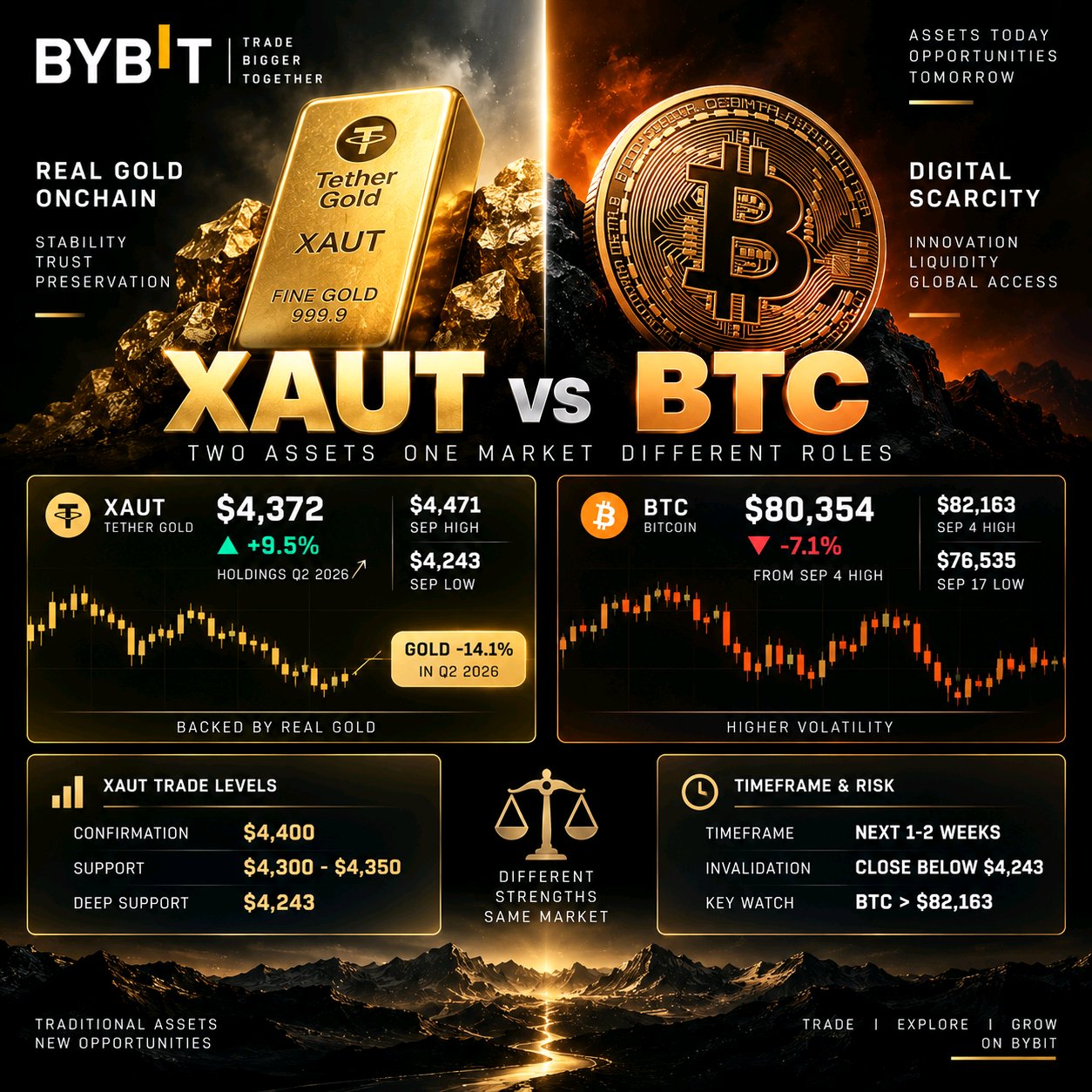
Tether Gold holdings increased 9.5% in Q2 2026 even as physical gold fell 14.1% during the quarter, with gold ending June at $4,008.02/oz. Yet Bitcoin has not shown the same defensive profile: BTC traded near $76,535 on September 17 after reaching $82,163 on September 4. XAUT is now around $4,372, near the upper end of its September range, while BTC is around $80,354. That divergence is the tell — XAUT is behaving more like defensive collateral while BTC remains sensitive to rates, liquidity and crypto-specific risk. This is a relative-strength watch, not a confident long or short. For XAUT/USDT, $4,400 is the confirmation zone: sustained closes above it would put September's $4,471.83 high back in play. Support sits around $4,300-$4,350, with the September 17 low near $4,243 providing the deeper structural line. Below $4,243, the September recovery starts breaking down. Timeframe: next 1-2 weeks — enough to see whether post-Fed positioning continues favoring gold over BTC. A confirmed XAUT close below $4,243 invalidates the relative-strength thesis. Conversely, a BTC recovery above September's $82,163 high could compress XAUT/BTC even without weakness in gold. For now, XAUT/BTC is a watch — not a conviction trade. #ByXIMPACT $BTCUSDT $XAUTUSDT
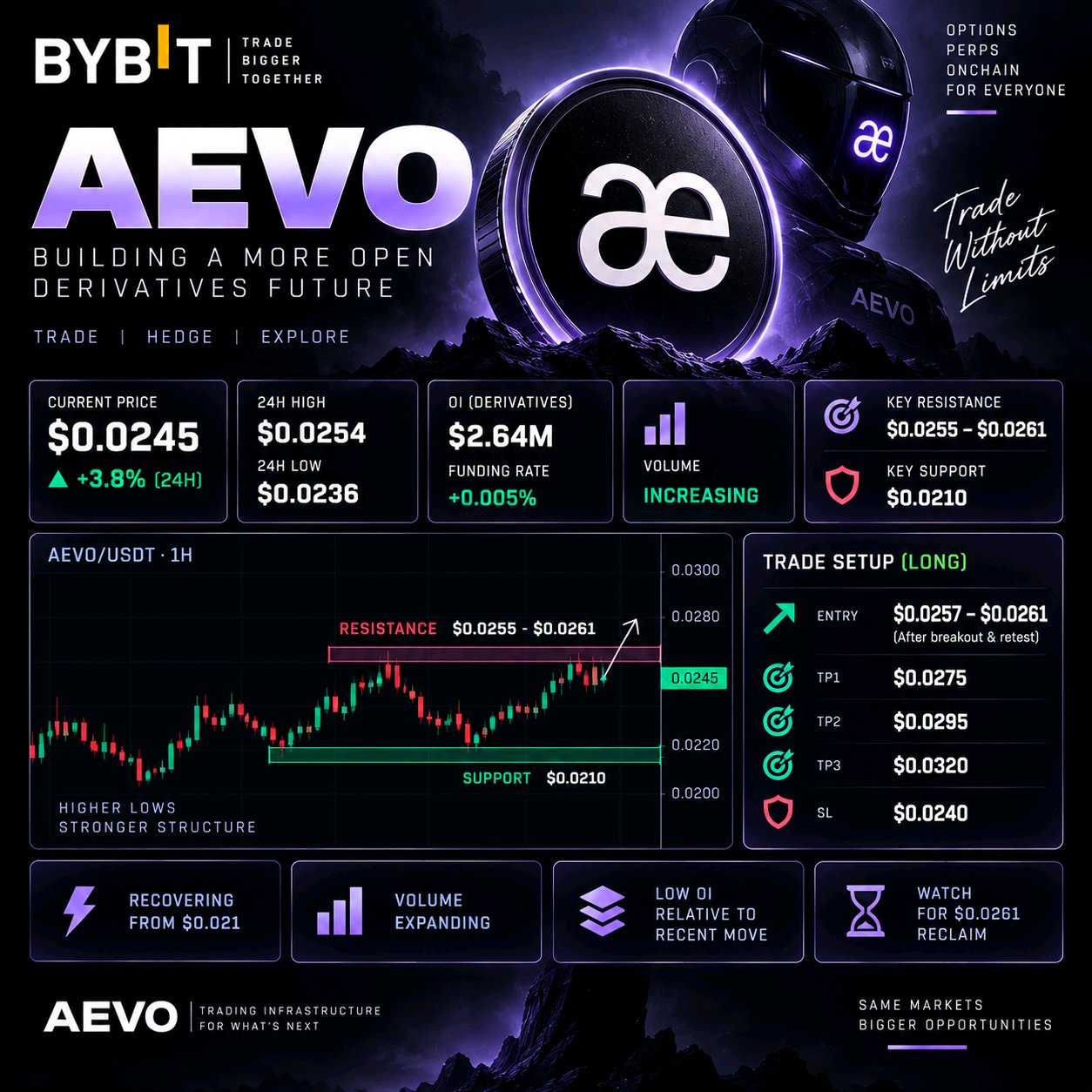
$AEVO is finally pressing into the top of a short-term range, but I wouldn't chase the move yet. Price is around $0.0245, with today's range near $0.0236-$0.0254. Recent sessions show a clear recovery from the $0.0207-$0.0210 area, while volume expanded during the September 17-19 push. 1H Market Structure The structure has shifted from lower lows toward higher lows. The immediate ceiling is $0.0255-$0.0261, where previous rallies have struggled. A clean break here would matter more than another candle inside the range. The Key Observation AEVO is compressing directly beneath resistance. That's interesting because derivatives positioning remains relatively light: aggregated OI was about $2.64M on September 18, with funding around +0.005%. Volume Check Spot activity has increased during the recent rebound, but I want to see another expansion on the actual breakout. Without it, a rejection from $0.0261 remains the higher-risk scenario. What I Like - Higher-low structure - Recovery from ~$0.021 - Compression beneath resistance What I Don't Like - $0.0261 is still unbroken - Positive funding means longs already pay to hold - Small-cap liquidity can create fast reversals My Plan I am not buying the middle of the range. I want the breakout first. TRADE SETUP Bias: LONG Strategy: Breakout + retest Timeframe: 1H Entry: $0.0257-$0.0261 Confirmation: 1H close above $0.0261 with expanding volume, followed by a successful retest TP1: $0.0275 TP2: $0.0295 TP3: $0.0320 SL: $0.0240 R:R: approximately 1:1.2 to TP1, 1:2.5 to TP2 Invalidation A failed breakout followed by a 1H close below $0.0240 cancels the setup. The trade is conditional. I'd rather miss the first candle than chase a fake breakout. Would you wait for the $0.0261 reclaim or trade the range? #ByXIMPACT $AEVOUSDT
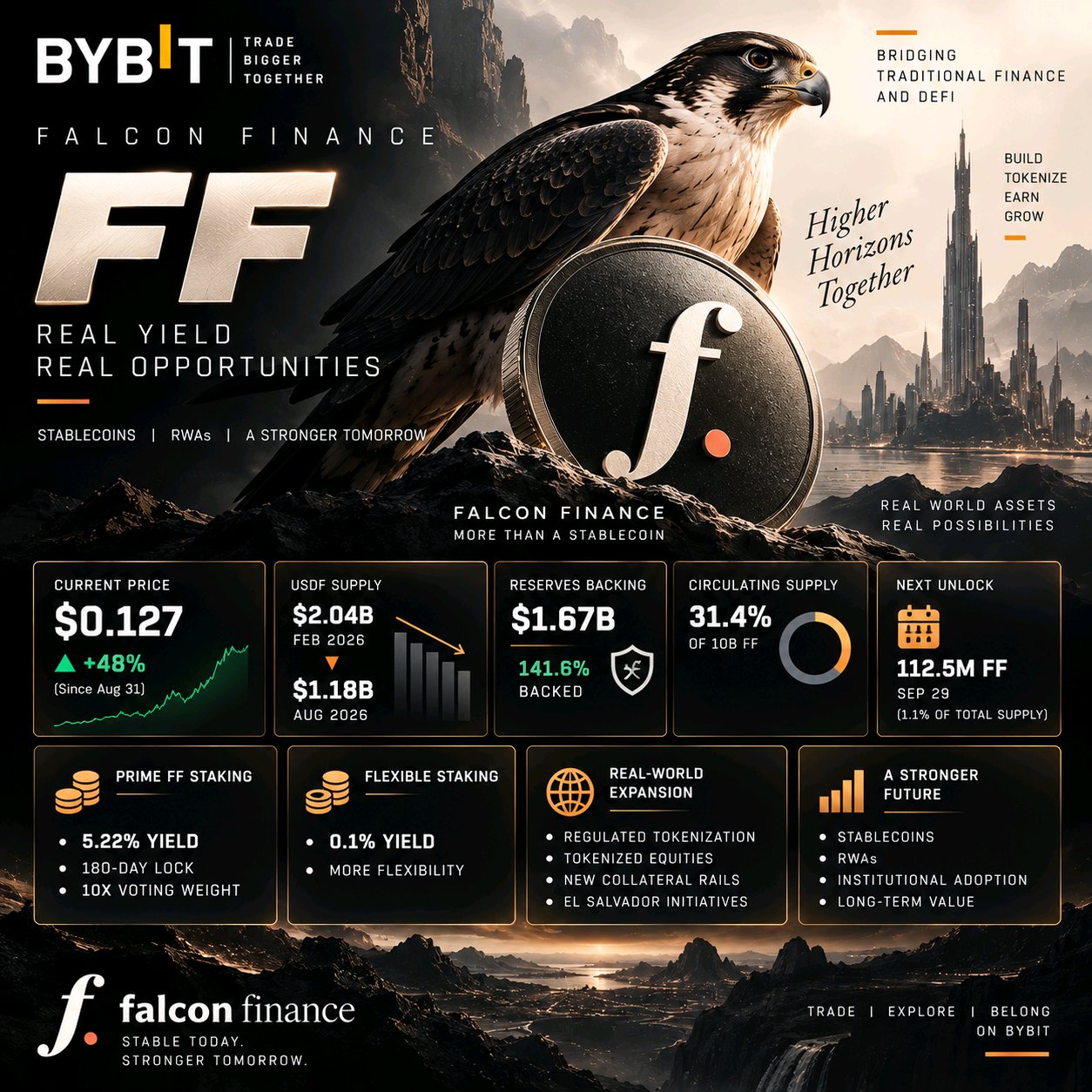
$FF has quietly rallied from $0.0856 on August 31 to around $0.127 today, a gain of roughly 48%. But the interesting part is what happened underneath that move. Falcon Finance's core product, USDf, has actually contracted. The protocol reported $2.04B of USDf supply in February, while its latest August 31 update showed $1.18B. That's roughly a 42% decline from the February level. So the market is repricing the token upward while the headline stablecoin metric is smaller. That doesn't automatically mean the protocol is weakening. Falcon has been shifting toward a broader collateralization and RWA infrastructure, including regulated tokenization work in El Salvador, tokenized equities, and new collateral rails. The August update reported $1.67B of reserves against $1.18B USDf, or 141.6% backing. FF's utility has also become more defined. FIP-1 introduced Prime FF Staking with a 180-day lock, 5.22% native FF yield and 10x Snapshot voting weight, while flexible staking carries 0.1% native yield. Then comes the supply problem. Only about 31.4% of the 10B FF supply is currently unlocked. The next scheduled release is September 29, with Tokenomics.com tracking about 112.5M FF, or 1.1% of total supply. The real question isn't whether FF has momentum. It's whether the market is pricing Falcon as a growing RWA infrastructure layer before USDf growth actually confirms that thesis. #ByXIMPACT $FFUSDT
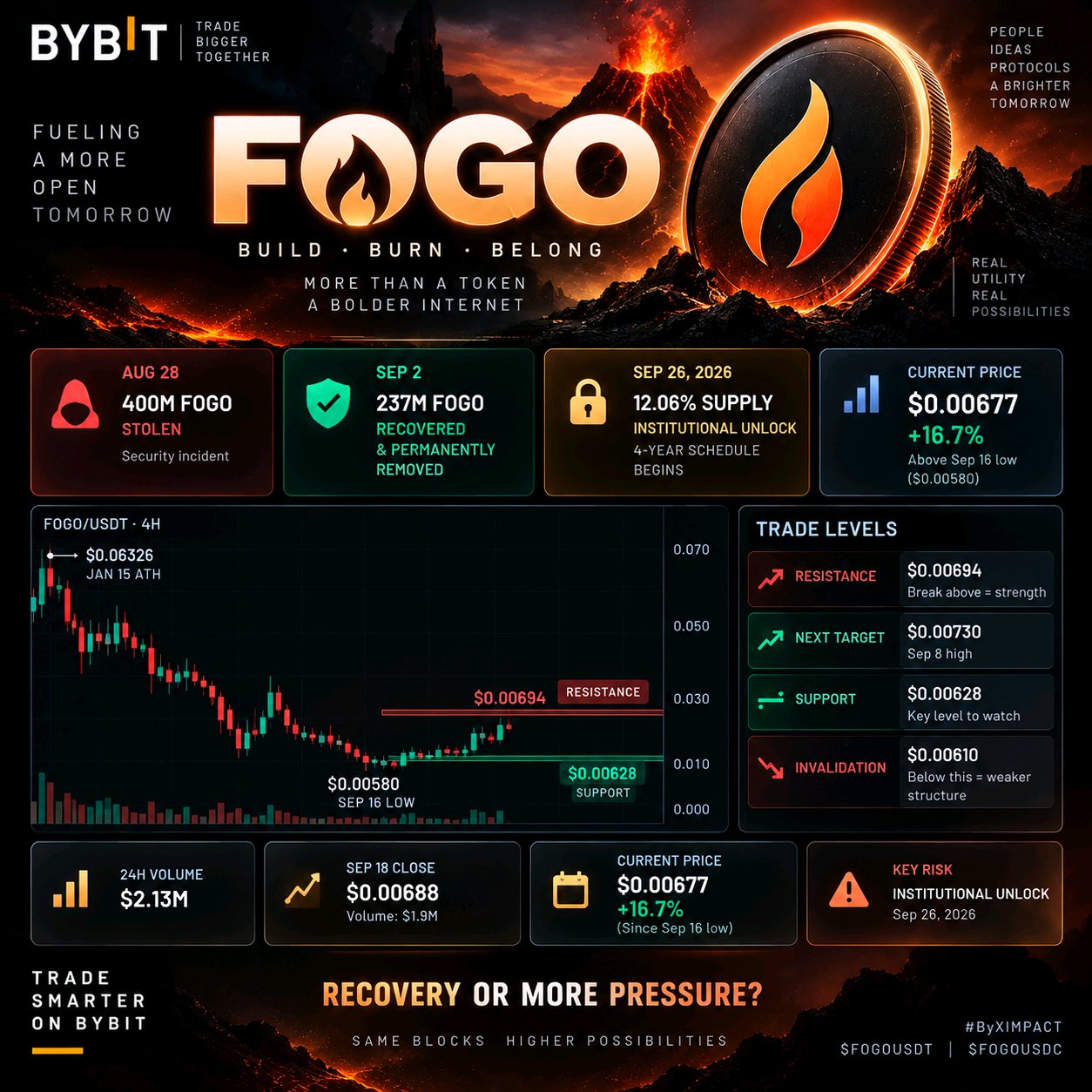
On August 28, 400M FOGO were stolen in the security incident, while by September 2, Fogo had recovered and permanently removed 237M of those tokens. Yet FOGO is still around $0.00677, only 16.7% above its September 16 all-time low of $0.00580, with 24H volume near $2.13M. That's not really a recovery story. It's a trust-and-liquidity test. The network is back online, but 163M stolen FOGO remain unrecovered, according to reporting on the September 2 restart. Meanwhile, Fogo's own tokenomics put the institutional allocation at 12.06% of supply, with its four-year unlock schedule beginning September 26, 2026. The chart reflects that uncertainty. FOGO closed at $0.00688 on September 18 after $1.9M of volume, versus $0.00596 on September 16. That rebound is measurable, but the token remains far below its January 15 ATH of $0.06326. Worth watching: $0.00694 is the immediate resistance. A confirmed close above it could open $0.00730, the September 8 high. Support is $0.00628, with $0.00610 as invalidation. Timeframe: 3-7 days. The structural risk is the September 26 institutional unlock. Does FOGO reclaim $0.00694 before the unlock, or does supply pressure keep the recovery capped? #ByXIMPACT $FOGOUSDT
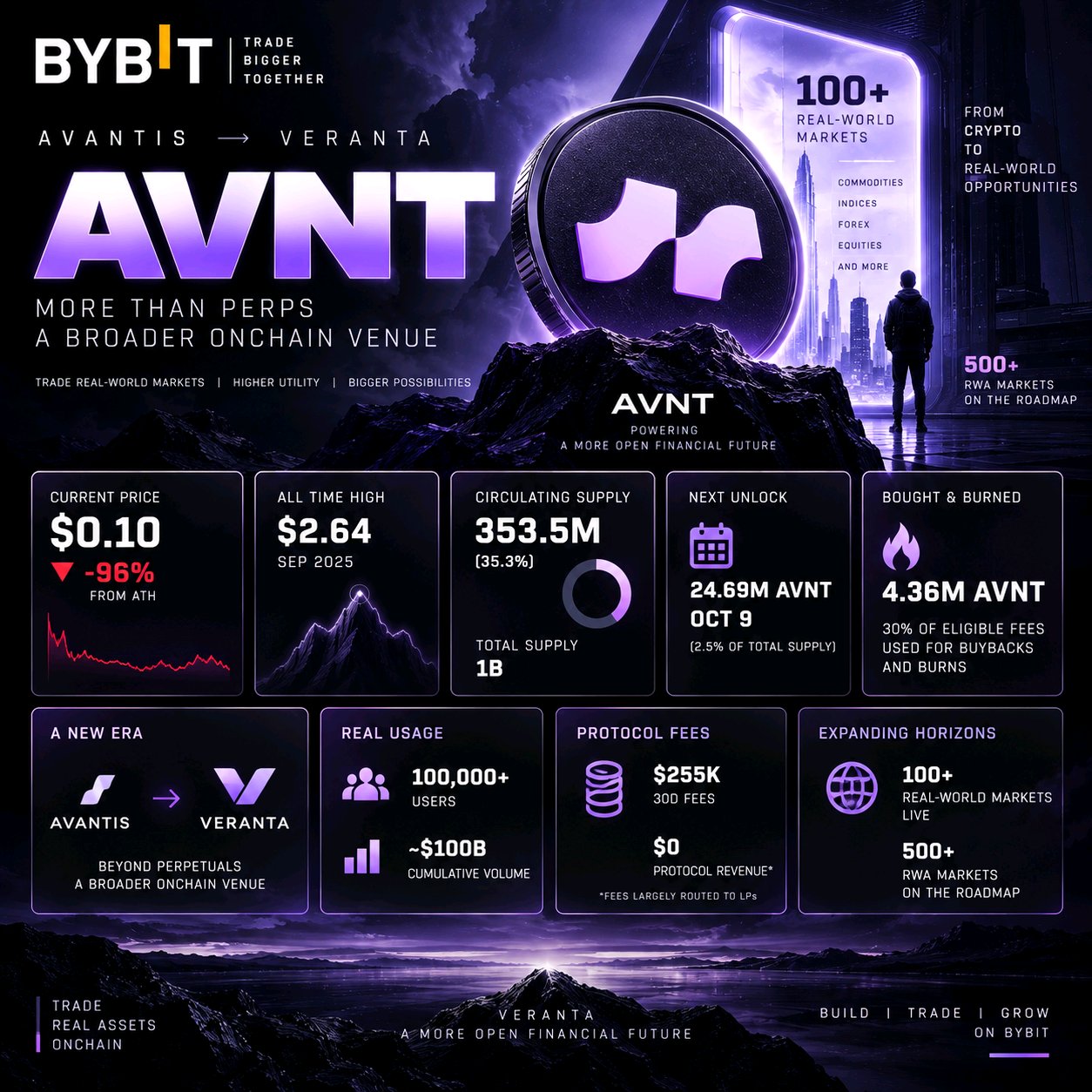
$AVNT is sitting around $0.10, roughly 96% below its September 2025 ATH of $2.64. Yet the underlying protocol looks very different from the one that launched the token. That's the part worth sitting with. On September 14, Avantis officially became Veranta, moving beyond crypto perpetuals toward a broader onchain venue covering 100+ real-world markets, with a roadmap for 500+ RWAs. The protocol says nearly $100B in cumulative volume has now passed through the platform across 100,000+ users. The token economics have also changed materially. Since March, 30% of eligible daily opening, closing and win fees have been used to buy and permanently burn AVNT. The official dashboard shows more than 4.36M AVNT already bought and burned. A 50%+ allocation is planned after further economic and liquidity upgrades. But there is a catch. Only about 353.5M of 1B AVNT is currently circulating. Another 64.5% remains locked, with the next 24.69M-token unlock scheduled for October 9. That's 2.5% of total supply and roughly 7% of current market cap. There is also an accounting distinction worth noting: DefiLlama currently records roughly $255K in 30-day fees but $0 protocol revenue because fees are largely routed to LPs, while Veranta's own mechanism redirects 30% of eligible fees into AVNT buybacks. So the real question isn't whether Veranta is growing. It's whether expanding usage and recurring burns can outpace the large remaining supply overhang. #ByXIMPACT $AVNTUSDT
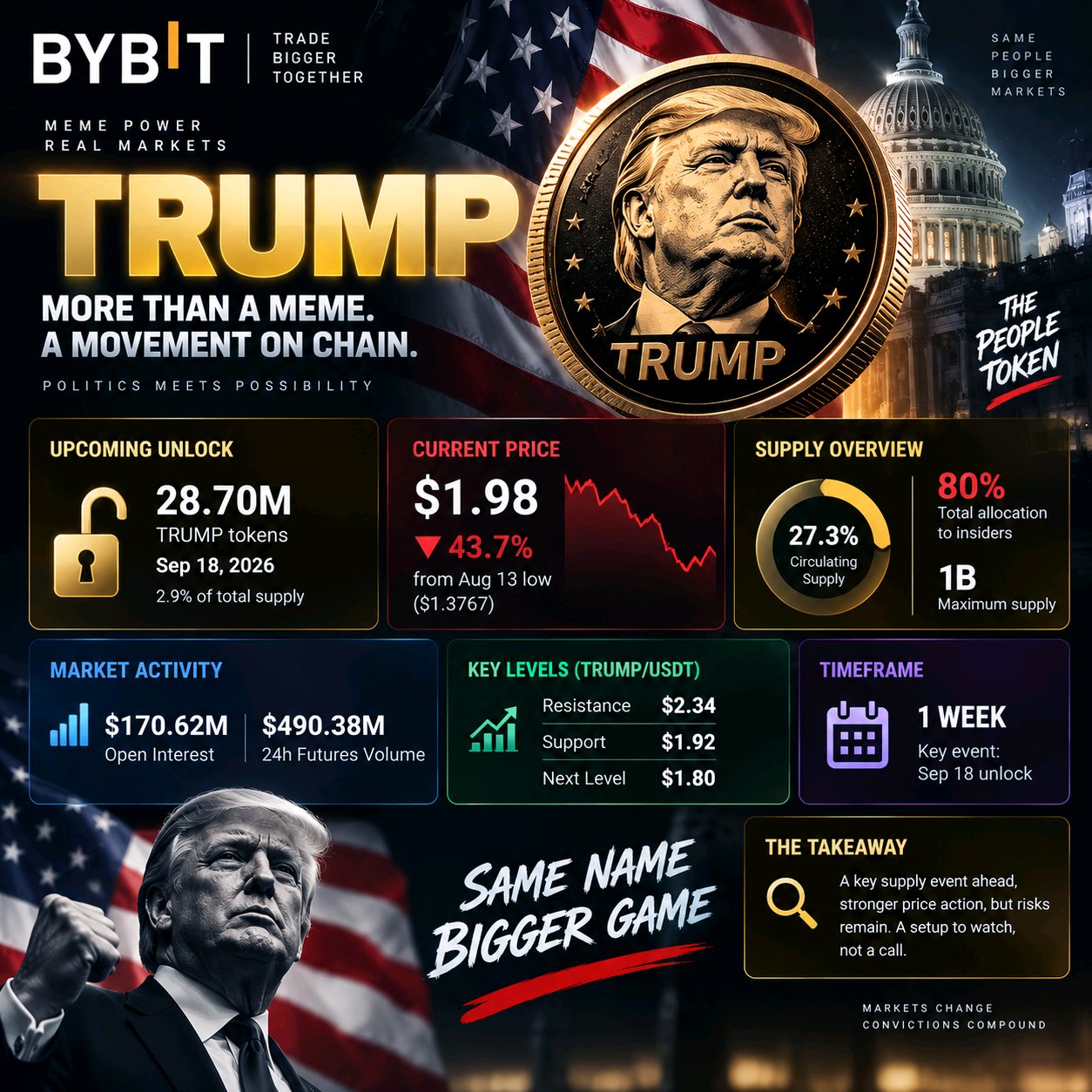
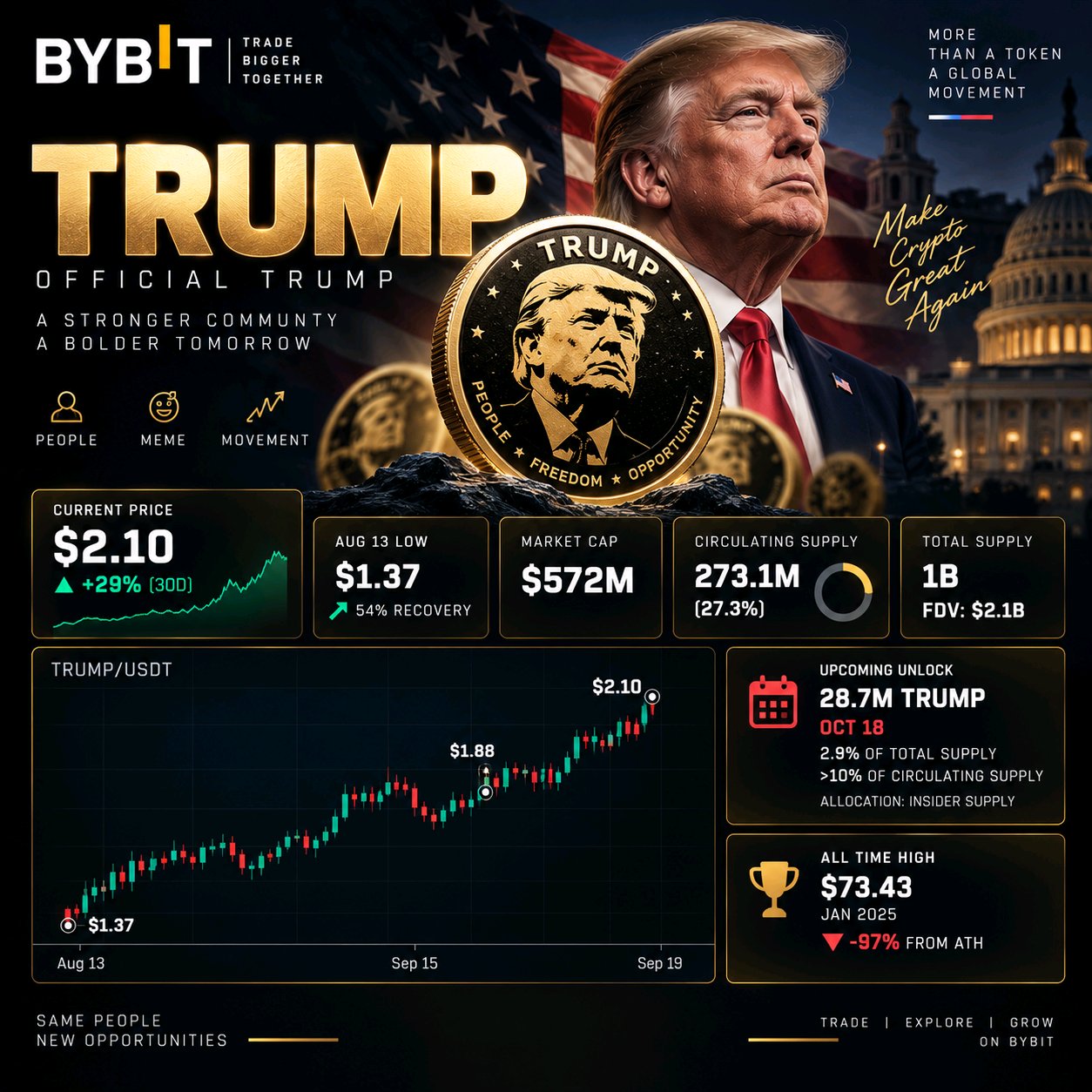
TRUMP has recovered nearly 54% from its August 13 low of $1.37, with the token now around $2.10 and up roughly 29% over 30 days. But the more interesting story isn't the rebound. It's how little of the supply is actually circulating. Only about 273.1M TRUMP, or 27.3% of the 1B maximum supply, is currently circulating. That puts market cap around $572M against an FDV near $2.1B. And the supply pressure hasn't disappeared. The September 18 unlock was followed by continued vesting, while the next major scheduled unlock is October 18: about 28.7M TRUMP, equal to roughly 2.9% of total supply and more than 10% of today's circulating float. The scheduled allocation is listed as insider supply. That's the part worth sitting with. TRUMP's price has strengthened from $1.88 on September 15 to $2.10 on September 19, despite the ongoing release structure. That suggests current demand has been capable of absorbing supply so far, but it does not prove that future unlocks will be absorbed at the same rate. The token also remains about 97% below its January 2025 ATH of $73.43, showing how different today's market structure is from its launch phase. The real question now isn't simply whether TRUMP can recover. It's whether demand can keep pace as the tradable float expands. #ByXIMPACT $TRUMPUSDT
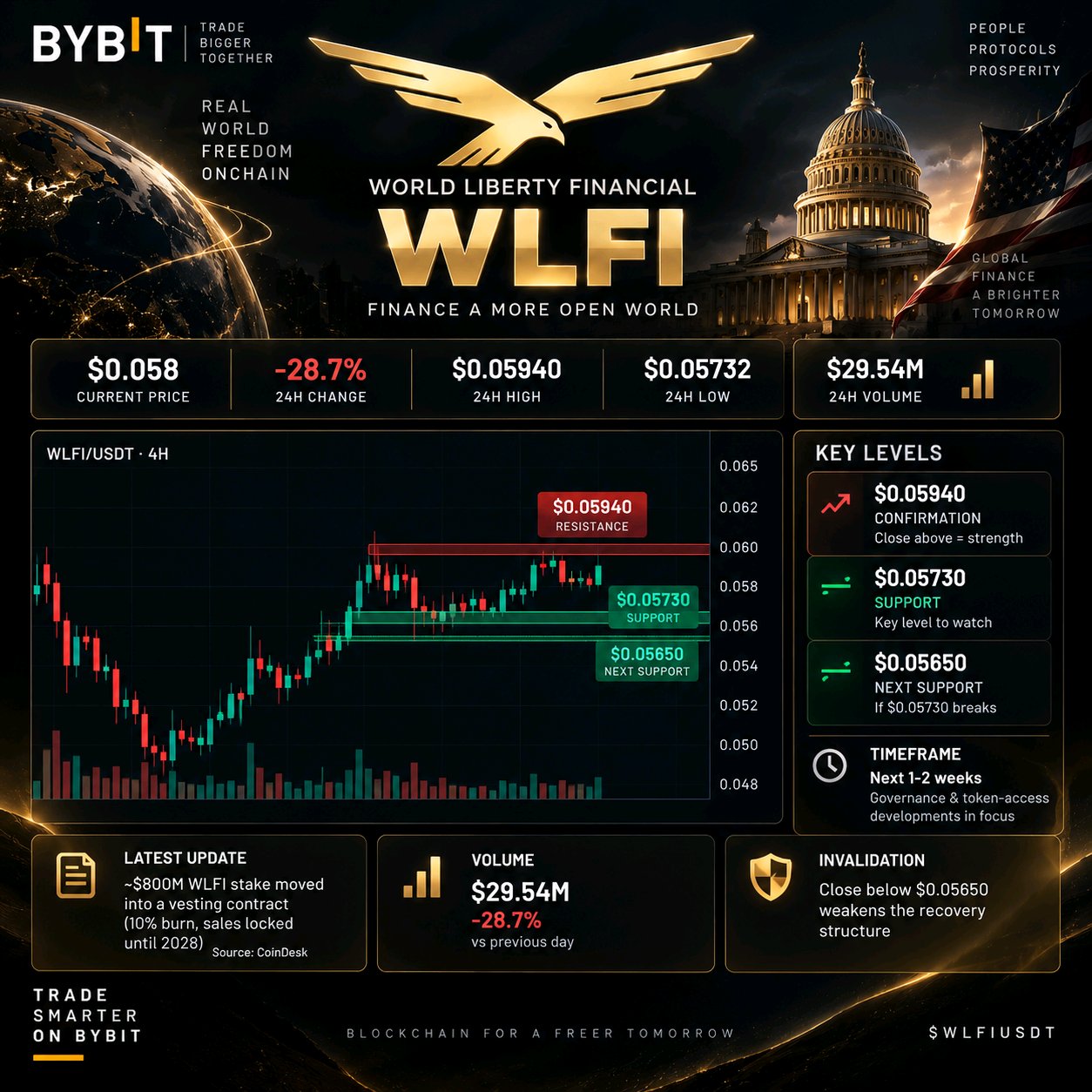
WLFI’s latest price action is getting quieter while the underlying token story remains unusually active. WLFI is around $0.058, with a 24H range of $0.05732-$0.05940 and roughly $29.54M in 24H volume, down 28.7% from the prior day. Yet the token has held above the September 11 low near $0.0483, while recent daily closes have gradually moved from $0.05527 on September 11 to $0.05844 on September 19. The gap is participation: price has recovered, but volume has not followed. That makes this a watch, not a confident long or short. Separately, CoinDesk reported that an approximately $800M WLFI stake was moved into a vesting contract, with sales locked until 2028 after a mandatory 10% burn. Trade Levels For $WLFI/USDT, $0.05940 is the confirmation line. A clean close above it with expanding volume would signal renewed demand. Support sits at $0.05730, matching the current 24H floor. Below that, $0.05650 is the next structural reference from September 18. Timeframe: Next 1-2 weeks, while governance and token-access developments continue shaping supply expectations. Invalidation: A confirmed close below $0.05650 weakens the recovery structure. The line to watch is $0.05940. Until volume returns, WLFI stays on a short leash. #ByXIMPACT $WLFIUSDT