c
choffstein
187點贊0分享11粉絲0關注
Exactly. And just to reiterate, the toy model is only there as an illustrative example. In the paper, they back out the actual inelasticity from the empirical data.
You thought AI was a huge productivity boost? Wait until your email goes down for a full day.
I’m not convinced passive flows would really pull back (401(k) participants, for example, probably aren’t going to switch into actively managed TDFs), but I could see more active capital being drawn in from other asset classes.
Corey Hoffstein is the manager at Newfound, and his posts mostly focus on quant investing, volatility, and how to think about portfolio construction.
He’s said he was long-only in the past, so you’d expect it to be at least a step up from U.S. T-bills—which, for all intents and purposes, is what this amounts to.
How niche is it really? Most brokerages have an institutional desk you can call to run an RFQ for you. They can quote you a spread for immediate execution, or you can ask for pricing as a spread versus end-of-day NAV.
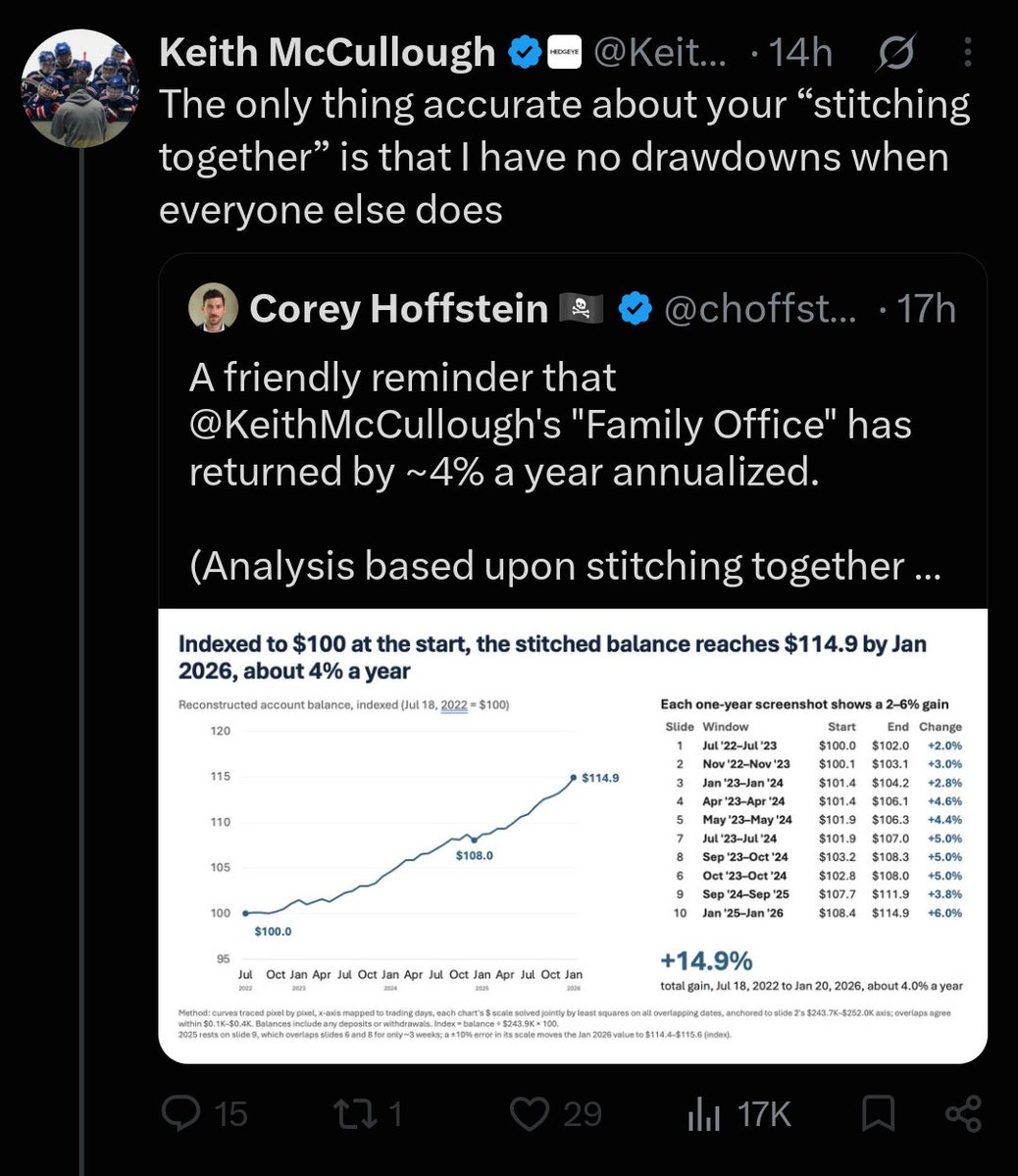
My guy, this takes basically no time. The first time I did it, it was literally two screenshots and a one-line back-of-the-envelope calculation. And now? Claude can stitch the whole thing together for you. To be clear, I’m not taking a shot at Hedgeye. I’m taking a shot at Keith lobbing rocks from a glass house—because the account he keeps bragging about has, as far as I can tell, delivered essentially zero excess return the entire time he’s been bragging about it.
To be clear, the “Mucker Family Office” he mentions is the same thing he refers to as his “Long-Only Retirement” account. And between that and the screenshot he shared showing real account balances, it looks to me like this is just a regular retirement account.
If you’re trying to keep the paint protected, I don’t think polishing is going to do the trick.
Keith has me blocked, so I can’t respond to him directly. But this is easy to settle: just hand the account statement to an independent third party. Honestly, I’d even take @dsaleminvestor—he’s got every reason to lean Keith’s way. And I’m confident I can peg the end‑of‑quarter account value within $1,000 for any quarter from Q3 2022 through Q4 2025.
That “old wall” framing is straight out of the classic marketing playbook—pure Ries & Trout, Positioning (1981).
So let me see if I’ve got this right: when Keith throws out baseless shots at Josh Brown and Ryan Derrick, that’s “good character,” but when I push back using his own evidence, it’s suddenly “snowflake behavior”? Resorting to ad hominem is usually what happens when the actual argument can’t hold up.