Spectre
9046Me gusta63Compartir en el chat303Aficionados109Seguir
KOL and Crypto Influencer, Marketer and strategist
KOL and Crypto Influencer, Marketer and strategist
$TSLAXUSDT reached $497.08 on December 22, 2025. On November 10, 2026, it is trading near $377.80, despite gaining approximately 6% in 24 hours. The rebound looks strong, but the token remains roughly 24% below its historical peak. CoinGlass +1 That's not really a crypto breakout. It's a repricing of Tesla equity exposure through blockchain infrastructure. The distinction matters because TSLAX is issued by Backed as a tracker certificate designed to follow Tesla shares. It is not an independent utility token, and its valuation ultimately depends on the underlying equity rather than crypto adoption alone. CoinGecko +1 The derivatives market adds another layer. CoinGlass recorded approximately $2.44M in futures volume against $846K in spot volume. Open interest increased 24.79% to $1.06M, while funding reached 0.0353% per 8 hours. That suggests leveraged positioning is expanding faster than spot participation. CoinGlass Worth watching: $382 is the immediate resistance, while $356 is the important downside level. A sustained breakout above $382 could open $408. A decisive close below $356 would invalidate the recovery thesis. For the next 24–72 hours, the key risk is a derivatives-led rally losing momentum while Tesla's underlying equity moves in the opposite direction. Will stronger spot demand confirm this recovery, or is leverage doing most of the work?

$INJUSDT is up 10.34% over the last 7 days, but its derivatives market is telling a less convincing story: futures volume reached $235.69M against just $33.12M in spot volume on November 10. That is a 7.1x difference. The rally is attracting traders, but genuine spot demand is not keeping pace. There is a fundamental reason INJ remains interesting. According to its September 2026 SEC filing, Injective had approximately 90,000 daily active wallets during Q3 and had facilitated more than $75B in cumulative spot trading volume. Its community buyback mechanism also connects application-generated fees with INJ accumulation and redistribution. However, adoption does not automatically translate into immediate price appreciation. The current market structure needs attention. INJ is trading around $8.02, with a 24-hour range of $7.82–$8.29. Meanwhile, aggregate futures open interest has declined 5.42% to approximately $149.39M. For the next 24–72 hours, watch the $8.25 resistance zone. A convincing breakout with stronger spot participation could open $8.55, followed by $8.80. On the downside, $7.82 is the immediate support. A decisive break below it invalidates the recovery setup. Risk: leveraged positioning could unwind before spot buyers step in. INJ needs real spot demand to validate this recovery. Until then, the rally remains vulnerable to a derivatives-driven reversal. #MidtermsMarketWatch

Polygon $POLUSDT distributed more than 5.4 million POL to validators in February 2026. By September 8, another 27.33 million POL had accumulated for stakers under a new fee-sharing formula but had not yet reached them. That's not simply a staking-reward increase. It's a change in who gets paid from Polygon's transaction fees, and the delivery mechanism has become the real story. PIP-85, finalized on March 25, redirects 50% of the post-commission priority-fee pool to POL stakers. The remaining validator allocation is split using a formula that gives 75% weight to equal distribution adjusted for performance, rather than relying entirely on stake size. The change activated at block 85,245,000 in April. The complication: the planned Ethereum-based Merkle claimers were never deployed. The staker allocation accumulated instead. By September 8, the five monthly accounting periods had produced 27,334,955.85 POL for stakers. Enter PIP-92, submitted by Adam Dossa on September 23. It proposes distributing that backlog through Polygon's existing StakeManager, temporarily raising checkpoint rewards from 25,212.79 to 64,500 POL between October 1 and December 1. The projected gross annualized staking reward rate rises from roughly 3.0% to 7.7% during that window. But PIP-92 is listed as a draft, not a finalized permanent mechanism. The automated long-term solution is deferred to PIP-93. Worth sitting with: fee sharing looks attractive on paper, but recurring delivery matters more than an accumulated reward balance. Can Polygon turn this allocation into a reliable, ongoing source of value for POL stakers? #WSOT2026
Hyperliquid’s biggest $HYPEUSDT catalyst may be coming from markets that have nothing to do with crypto. As of September 8, 2026, HIP-3 markets accounted for roughly 30% of Hyperliquid’s trailing 30-day trading volume, with more than $548.1 billion in cumulative volume since launch. That’s not just another perp expansion. It’s Hyperliquid trying to become trading infrastructure for assets beyond digital currencies—and HYPE is part of the access mechanism. Under HIP-3, deployers must bond HYPE to launch permissionless perpetual markets. HIP-4 takes this further: after its August 29 network upgrade, third-party builders could deploy event markets by staking 500,000 HYPE, subject to a minimum six-month lock and potential slashing. But there’s a distinction the volume headlines can hide. By September 8, HIP-4 was reporting around $445.8 million in daily volume, yet only three third-party builders had bonded tokens, and a substantial portion of activity was supported by deployer-funded incentives. Volume is real; durable organic demand is not yet proven. The other side of the equation is the Assistance Fund. 99% of protocol fees are allocated to it, and 47.1 million HYPE had been acquired and permanently removed from circulation by September 8. So HYPE has two competing forces: fee-driven buy pressure and expanding market utility on one side, contributor vesting and the need to sustain activity without incentives on the other. The question isn't whether Hyperliquid can attract volume. It's whether that volume becomes lasting demand for HYPE once the incentives fade. #WSOTPicktoEarn10U
I’m more interested in how $TRUMPUSDT behaves around $1.11 than in the small rebounds happening above it. The bigger trend is still pointing down. TRUMP is around $1.15 on Bybit Spot, with a 24H range of $1.108–$1.197. That’s an $0.089 range, and price is sitting near its midpoint. Bybit Spot volume is roughly 1.71M TRUMP. The recent weekly decline is close to 29%. The structure is weak across higher timeframes. The 4H chart remains below its major EMAs, while the daily RSI is deeply oversold. A confirmed falling wedge on the 15M chart offers a possible short-term recovery, but the broader 4H bear structure has not been reversed. What I like: - Buyers have a clearly defined area to defend near $1.11. - Short-term wedge formation gives a possible reversal trigger. What I don’t like: - 1H, 4H and daily trends remain bearish. - Resistance at $1.197 is close. - Oversold conditions make chasing a short risky. Key levels Support: $1.114–$1.108 Resistance: $1.197, then $1.278 Decision: WAIT. I’m not opening a short directly above support. A 4H close below $1.108 followed by a failed reclaim would make a breakdown-retest short worth evaluating. Invalidation: reclaim and hold above $1.197. No entry or targets until that confirmation appears; current R:R cannot be justified cleanly. The main risk is a sharp relief bounce driven by oversold conditions. Does $1.11 hold, or do sellers finally push price into a fresh lower range? #MidtermsMarketWatch
Apple returned $28 billion to shareholders in Q4 FY2026. Yet the tokenized version of its stock, AAPLX, has a reported crypto market cap of roughly $12.36 million. That's not really Apple moving on-chain. It's traditional equity exposure being repackaged into a blockchain-based financial instrument. $AAPLXUSDT is issued by Backed Assets (JE) Limited under ISIN CH1436219187. Its May 8, 2026 final terms identify Apple Inc. common stock as the underlying asset. The issuer’s reserve data, last reported for October 16, listed 36,928 Apple shares held with Alpaca against approximately 36,846 tokens in circulation. That is a useful backing snapshot—but it is not a guarantee against issuer, custody or redemption risk. The dividend mechanism is another detail worth understanding. Apple declared $0.27 per share on October 30, 2026, payable November 16. AAPLX’s terms describe dividends as being reinvested into the token’s value, with withholding applied. That is not the same as holding AAPL directly: token holders do not receive ordinary shareholder voting rights. Worth being precise about what is actually being adopted here: access to Apple-linked exposure across blockchain networks, not ownership of Apple itself. The real test is whether on-chain liquidity and redemption infrastructure can grow without weakening the connection to the underlying shares. Does tokenized equity become meaningful when it offers better access or only when its market structure is as dependable as the stock it tracks?

NVDAX is trading around $177.60, with approximately $74.37M in 24-hour volume against a $54.43M market cap. That turnover is roughly 136% of its market capitalization. But here's the distinction most token traders miss: NVDAX isn't a conventional crypto project competing for network adoption. It's a tokenized tracker certificate representing exposure to NVIDIA Corporation's stock. Issued by Backed Assets (JE) Limited, NVDAX is available as an ERC-20 and Solana SPL token. Its underlying asset is NVIDIA shares, identified by ISIN US67066G1040. The product is designed to track NVDA rather than generate independent protocol revenue. There's another detail worth understanding. Backed's September 8, 2026 documentation specifies no management fee currently, but reserves the right to introduce an annual fee of up to 0.25%. Issuance and redemption fees can reach 0.50%. Meanwhile, circulating supply stands at approximately 306,501 NVDAX against 1.1M total supply. That difference should not automatically be interpreted as a conventional token unlock schedule — issuance and redemption are linked to the underlying tracker product. The interesting part is the market structure: NVDAX offers blockchain-based access to traditional equity exposure, but its valuation ultimately depends on NVIDIA's stock performance, product accessibility, custody arrangements and redemption mechanics. If tokenized equities continue expanding, will investors value 24/7 blockchain access enough to make these instruments a meaningful part of financial markets? $NVDAXUSDT

$BTCUSDC — The reaction after the weekend sell-off is more important than the bounce itself. Current price: $74,549.70 24H: -1.67% 24H High: $75,996.50 24H Low: $73,664.54 24H Volume: $27.9B **Market Structure — 4H** BTC is struggling to recover after losing the $80K area. The recent drop toward $73.5K exposed weak demand, and price is still trading below the $75,451 average purchase price reported for Strategy's BTC holdings. **The Key Observation** The $73.5K–$73.7K region is the immediate downside area to watch. A reclaim of $75.5K would be the first meaningful improvement, but one green candle isn't enough. **Volume Check** 24H volume is around $27.9B. Selling pressure remains significant, while a sustained recovery still needs buyer confirmation. **What I Like** - Buyers reacted around $73.5K. - BTC still has substantial spot-market liquidity. - A reclaim could create room toward $78K. **What I Don't Like** - Price remains below $75,451. - Broader regulatory uncertainty. - Recent ETF outflows are an additional headwind. **My Plan** No chasing this bounce. I want confirmation first. **TRADE SETUP** Bias: WAIT Strategy: Conditional breakout + retest LONG Entry: $75,500–$75,900 Confirmation: 1H close above $75,500, followed by a successful retest. TP1: $76,200 TP2: $78,000 TP3: $80,000 TP4: $82,000 SL: $73,300 R:R: Approximately 1:0.4–1:1.7 to TP3, depending on entry. **Invalidation** A 4H close below $73,500 cancels the recovery thesis. The $73,300 stop is below the recent downside area. **Final Market View** BTC is at a decision point. I prefer missing the first part of a recovery over entering before buyers prove themselves. Will BTC reclaim $75.5K, or are sellers preparing another move lower? $BTCUSDT

XAUT added approximately 305,000 fine troy ounces of gold backing between December 31, 2025 and September 30, 2026, taking reserves to 827,417.63 ounces worth $3.44 billion. Yet on November 9, XAUT trades around $4,085.65 — roughly 25.8% below its January 2026 all-time high of $5,504.62. That's not simply declining demand for tokenized gold. It's a divergence between expanding physical backing and a gold market repricing lower. The distinction became clearer in Tether's Q3 disclosures. On November 4, Tether confirmed that XAUT reserves had increased 59% since year-end, with 2,057 London Good Delivery gold bars held in Swiss vaults. Each circulating token represents ownership of one fine troy ounce. Meanwhile, Reuters reported on November 3 that Tether's separate gold reserves backing USDT fell by 3.4 metric tonnes during Q3, reaching 142.8 tonnes. Those are two different reserve pools — treating the reduction as evidence of weaker XAUT backing would be misleading. XAUT also had 827,417.63 tokens in circulation at September quarter-end, matching its reported physical gold reserves. Worth watching: can growing tokenized-gold adoption translate into sustained demand when the underlying commodity itself remains volatile? $XAUTUSDT


$XPLUSDT — The part of this chart that concerns me isn't the red candle itself. It's how close price is trading to the bottom of its 24H range after a heavy selling move. XPL is hovering around $0.06896, down approximately 5.79% in 24 hours. The session high is $0.072841, while the low is $0.068882. Price is sitting almost directly on the session low. What I Like: - Strong trading activity, with approximately $64.42M in 24H volume. - $0.06888 is a clear support area to watch. - A recovery could develop if buyers step back in. What I Don't Like: - Price remains near its 24H low. - Selling pressure is still a concern. - $0.07284 is immediate resistance. - Moving-average confirmation is unavailable. Key Levels: Resistance: $0.07284 Support: $0.06888 Invalidation: Sustained price acceptance below $0.06888. Trade Decision: WAIT. I'm not forcing a LONG here. I want to see XPL reclaim $0.07284 with stronger volume before considering an entry. If support breaks and the retest fails, a SHORT continuation becomes more interesting. No entry or targets until confirmation. Protecting capital matters more than chasing a possible bounce. Will buyers defend $0.06888, or is XPL preparing for another move lower?
$BTCUSDT se está recuperando, pero los compradores todavía tienen un nivel importante que reclamar. El precio se mantiene alrededor de los $78,270 tras el fuerte rechazo del 29 de octubre desde arriba de los $81,900. La recuperación es interesante, pero aún no la llamaría un cambio de tendencia. $BTC — Estructura de Mercado 4H Precio actual: $78,271 Cambio en 24H: +0.64% Máximo 24H: $78,724 Mínimo 24H: $77,544 Volumen 24H: $15.1 mil millones La observación clave BTC se ha recuperado desde el área de los $76K–$77K, pero la estructura general sigue bajo presión. La zona de $79,200–$79,300 es la resistencia inmediata a vigilar. Un cierre claro en 4H por encima de esta área podría mejorar el panorama alcista. Hasta entonces, esta recuperación sigue siendo vulnerable a otro rechazo. Revisión de volumen La actividad de trading es saludable, pero aún se necesita una expansión convincente junto con una ruptura de resistencia. Lo que me gusta - Recuperación desde el área reciente de los $76K–$77K. - El precio se mantiene por encima de los mínimos diarios recientes. - Espacio para otro intento alcista si se rompe la resistencia. Lo que no me gusta - La resistencia sigue estando por encima. - El rechazo anterior cerca de los $82K debilitó la estructura. - Falta confirmación de ruptura. Mi plan No voy a perseguir a BTC en medio de este rango. Dejaré que el precio confirme su próxima dirección. CONFIGURACIÓN DE TRADE Sesgo: ESPERAR Estrategia: Ruptura condicional + retesteo LONG Temporalidad: 4H Entrada: Aún no activada. Confirmación: Cierre de vela de 4H por encima de $79,300, seguido de un retesteo exitoso. TP1: $80,000 TP2: $80,800 TP3: $81,800 SL: Debajo de $78,500 después de una entrada confirmada por retesteo. Invalidación: No lograr mantener la zona reclamada de $79,300 cancela la idea en largo. Un cierre de 4H por debajo de $76,500 debilitaría aún más la recuperación general. R:R: No aplicable hasta que se confirme una entrada por retesteo real. Visión final del mercado BTC está mostrando recuperación, no aún una reversión confirmada. Prefiero perderme la primera parte de un movimiento que entrar antes de que el gráfico dé una señal clara. ¿Podrá BTC reclamar los $79,300, o los vendedores defenderán este nivel de nuevo? #IMPACTbyTrade

$XAUTUSDT — La recuperación está cobrando impulso, pero a los compradores todavía les queda un nivel importante por superar. Tras la fuerte venta masiva hacia los $3,875 el 30 de octubre, Tether Gold ha comenzado a recuperarse. Lo que me interesa es que los compradores están empujando el precio de regreso hacia los $3,910, pero aún falta una ruptura confirmada. Resumen actual del mercado * Precio: ~$3,906.49 * Cambio en 24H: +0.81% * Máximo en 24H: $3,911.20 * Mínimo en 24H: ~$3,873.76 * Volumen en 24H: ~$35.3M en el mercado reportado XAUT/USDT ChartExchange +1 Estructura de mercado 1H / 4H El panorama general aún necesita repararse después de la caída del 30 de octubre desde arriba de los $4,000. Los compradores a corto plazo están recuperando terreno, pero la zona de resistencia inmediata se encuentra entre $3,910 y $3,911. Niveles clave que estoy observando: * Resistencia: $3,911 * Soporte: $3,887 * Soporte mayor: $3,873–$3,876 La observación clave El precio se ha recuperado desde los mínimos recientes, pero se está acercando al límite superior de su rango actual. No quiero confundir una recuperación con una reversión de tendencia confirmada. Verificación de volumen La actividad comercial reportada es significativa, pero no cuento con comparaciones de volumen confiables a nivel de vela actual para confirmar la fuerza de la ruptura. Esperaré a que la acción del precio proporcione esa evidencia. Lo que me gusta * La recuperación desde el área de $3,873–$3,876. * Los compradores están probando el máximo reciente del rango. * El impulso a corto plazo ha mejorado. Lo que no me gusta * La resistencia de $3,911 sigue sin romperse. * La estructura mayor todavía se está recuperando de una fuerte caída. * Perseguir el precio cerca de la resistencia ofrece una mala ejecución. Mi plan No entraré a ciegas aquí. Un cierre en 1H por encima de $3,911 seguido de una prueba exitosa haría que la idea de compra (long) fuera más interesante. CONFIGURACIÓN DE LA OPERACIÓN (TRADE SETUP) Sesgo: Estrategia: Ruptura + Retest (Compra/LONG) Marco temporal: 15M / 1H Entrada: Esperar una ruptura confirmada y un retest por encima de $3,911. Confirmación: Cierre de vela de 1H por encima de la resistencia, seguido de un retest exitoso. TP1: Aún no asignado TP2: Aún no asignado TP3: Aún no asignado TP4: Aún no asignado SL: Debajo del mínimo confirmado del retest. R:R (Riesgo:Beneficio): No se puede calcular honestamente antes de que se establezcan la entrada y el stop estructural. Invalidación Si el precio no logra romper los $3,911 y pierde el área de $3,887, la recuperación alcista inmediata se debilita. Una ruptura por debajo de $3,873 dañaría aún más la estructura de recuperación. Visión final del mercado XAUT está mostrando signos de recuperación, pero la resistencia es donde los compradores necesitan demostrar su valía. Prefiero perderme la primera parte de un movimiento que entrar justo antes de otro rechazo. La protección del capital es lo primero. ¿Logrará XAUT finalmente recuperar los $3,911, o los vendedores están preparando otro rechazo? #8voAniversarioBybit
$ETHUSDT se cotiza alrededor de los $2,292, aproximadamente un 54% por debajo de su máximo histórico de $4,953.73. Sin embargo, la hoja de ruta de Ethereum para 2026 apunta a un límite de gas L1 de 100 millones o más, frente a los 60 millones actuales. Ese no es realmente un problema de desarrollo. Es una cuestión de captura de valor: una mejor infraestructura no significa automáticamente una mayor demanda de ETH. La actualización del protocolo de la Fundación Ethereum del 18 de febrero identificó tres prioridades: escalabilidad L1, escalabilidad de blobs y una mejor experiencia de usuario. Su agenda técnica incluye EIP-7928 (Listas de acceso a nivel de bloque) y EIP-7732 (Separación consagrada entre proponente y constructor). El 7 de septiembre, la Fundación informó que se habían propuesto 62 EIP para Hegotá, con cerca de 60 investigadores e ingenieros involucrados en la priorización. También estableció un objetivo para diciembre de 2029 para la resistencia cuántica en las capas de ejecución, consenso y datos de Ethereum. Vale la pena observar: Ethereum está trabajando en la capacidad, la usabilidad y la seguridad a largo plazo. Pero, ¿se traducirán esas mejoras en una mayor demanda de ETH, o una mayor actividad en la red seguirá desplazando el valor a otra parte? #WSOT2026

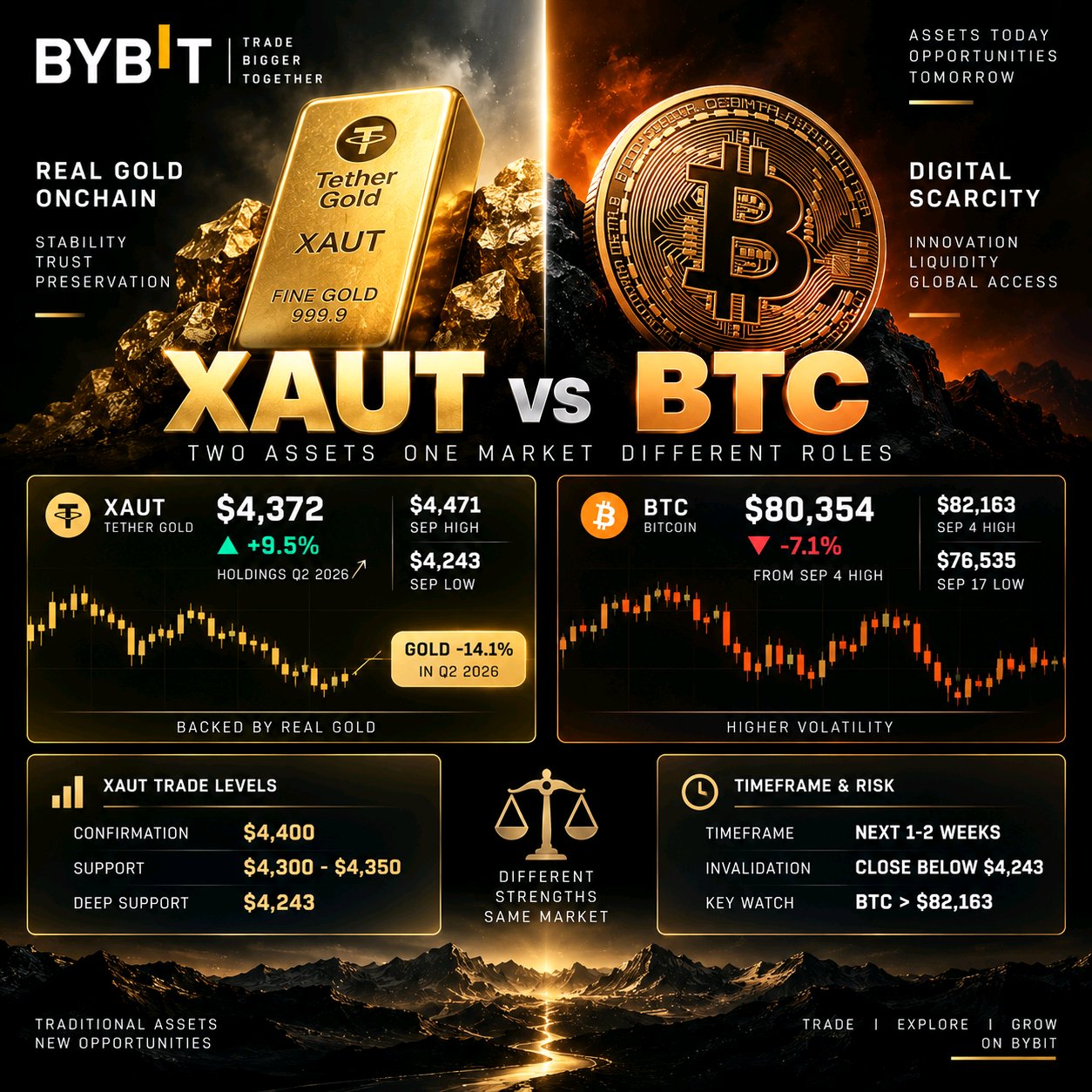
Las tenencias de Tether Gold aumentaron un 9.5% en el Q2 de 2026, incluso mientras el oro físico cayó un 14.1% durante el trimestre, y el oro terminó junio en $4,008.02/oz. Sin embargo, Bitcoin no ha mostrado el mismo perfil defensivo: el BTC cotizaba cerca de $76,535 el 17 de septiembre después de alcanzar los $82,163 el 4 de septiembre. XAUT está ahora alrededor de $4,372, cerca del extremo superior de su rango de septiembre, mientras que BTC está alrededor de $80,354. Esa divergencia es la clave: XAUT se está comportando más como una garantía defensiva mientras que BTC sigue siendo sensible a las tasas, la liquidez y el riesgo específico de las criptomonedas. Este es un seguimiento de fortaleza relativa, no una operación larga o corta con confianza. Para XAUT/USDT, $4,400 es la zona de confirmación: cierres sostenidos por encima de ella pondrían el máximo de septiembre de $4,471.83 de nuevo en juego. El soporte se sitúa alrededor de $4,300-$4,350, con el mínimo del 17 de septiembre cerca de $4,243 proporcionando la línea estructural más profunda. Por debajo de $4,243, la recuperación de septiembre comienza a desmoronarse. Marco de tiempo: próximas 1-2 semanas — suficiente para ver si el posicionamiento post-Fed continúa favoreciendo el oro sobre BTC. Un cierre confirmado de XAUT por debajo de $4,243 invalida la tesis de fortaleza relativa. Por el contrario, una recuperación de BTC por encima del máximo de septiembre de $82,163 podría comprimir XAUT/BTC incluso sin debilidad en el oro. Por ahora, XAUT/BTC es un seguimiento — no una operación de convicción. #ByXIMPACT $BTCUSDT $XAUTUSDT
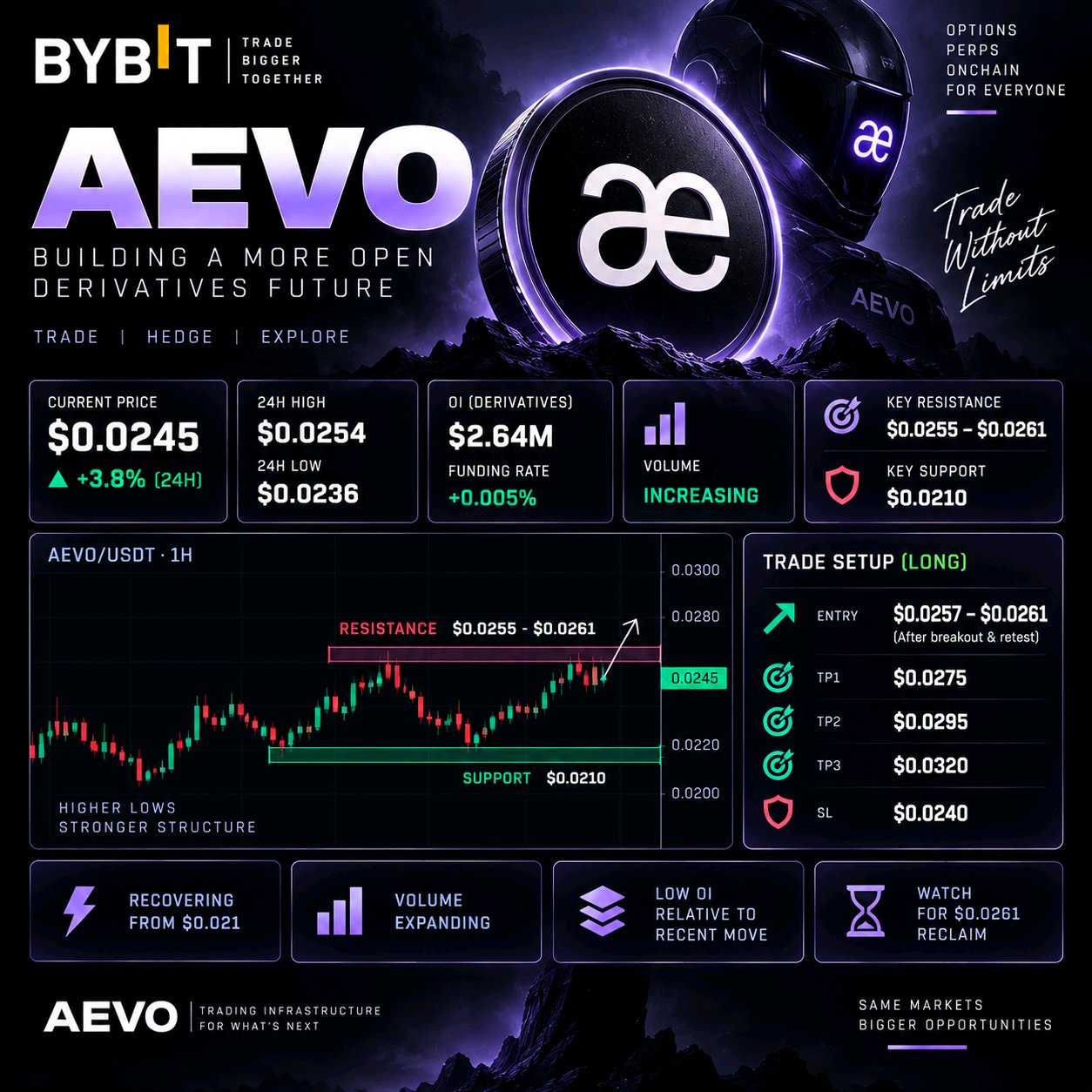
$AEVO finalmente está presionando hacia la parte superior de un rango a corto plazo, pero aún no me lanzaría a perseguir el movimiento. El precio está alrededor de $0.0245, con el rango de hoy cerca de $0.0236-$0.0254. Las sesiones recientes muestran una clara recuperación del área de $0.0207-$0.0210, mientras que el volumen se expandió durante el impulso del 17 al 19 de septiembre. Estructura de Mercado de 1H La estructura ha pasado de mínimos decrecientes a mínimos crecientes (higher lows). El techo inmediato es de $0.0255-$0.0261, donde los repuntes anteriores han tenido dificultades. Una ruptura limpia aquí importaría más que otra vela dentro del rango. La Observación Clave AEVO se está comprimiendo directamente debajo de la resistencia. Eso es interesante porque el posicionamiento en derivados sigue siendo relativamente ligero: el OI agregado era de aproximadamente $2.64M el 18 de septiembre, con una financiación de alrededor de +0.005%. Revisión de Volumen La actividad al contado (spot) ha aumentado durante el rebote reciente, pero quiero ver otra expansión en la ruptura real. Sin ella, un rechazo desde $0.0261 sigue siendo el escenario de mayor riesgo. Lo que me gusta - Estructura de mínimos crecientes (higher-low structure) - Recuperación desde ~$0.021 - Compresión debajo de la resistencia Lo que no me gusta - $0.0261 aún no se ha roto - La financiación positiva significa que los longs ya pagan por mantener la posición - La liquidez de las small caps puede crear reversiones rápidas Mi Plan No voy a comprar en medio del rango. Quiero ver la ruptura primero. TRADE SETUP Sesgo: LONG Estrategia: Breakout + retest Marco temporal: 1H Entrada: $0.0257-$0.0261 Confirmación: Cierre de 1H por encima de $0.0261 con volumen en expansión, seguido de un retest exitoso TP1: $0.0275 TP2: $0.0295 TP3: $0.0320 SL: $0.0240 R:R: aproximadamente 1:1.2 a TP1, 1:2.5 a TP2 Invalidación Una ruptura fallida seguida de un cierre de 1H por debajo de $0.0240 cancela el setup. La operación es condicional. Prefiero perderme la primera vela que perseguir una ruptura falsa. ¿Esperarías la reconquista de $0.0261 o operarías el rango? #ByXIMPACT $AEVOUSDT
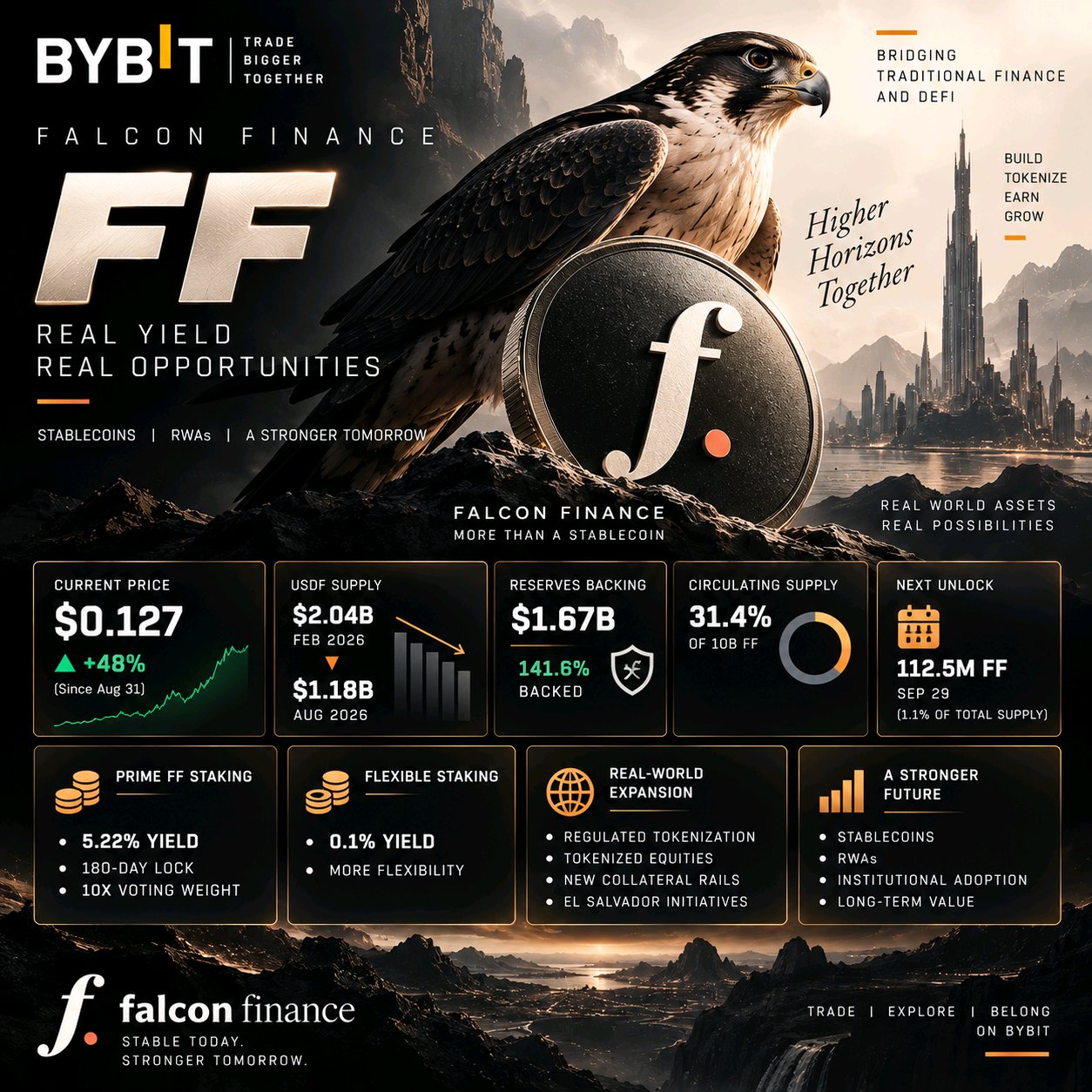
$FF ha subido silenciosamente de $0.0856 el 31 de agosto a alrededor de $0.127 hoy, una ganancia de aproximadamente 48%. Pero lo interesante es lo que sucedió debajo de ese movimiento. El producto principal de Falcon Finance, USDf, se ha contraído. El protocolo reportó $2.04 mil millones de suministro de USDf en febrero, mientras que su última actualización del 31 de agosto mostró $1.18 mil millones. Eso es aproximadamente una disminución del 42% desde el nivel de febrero. Entonces, el mercado está revalorizando el token al alza mientras la métrica principal de stablecoin es menor. Eso no significa automáticamente que el protocolo se esté debilitando. Falcon ha estado cambiando hacia una infraestructura de RWA (Real World Assets) y colateralización más amplia, incluido trabajo de tokenización regulada en El Salvador, acciones tokenizadas y nuevos canales de colateral. La actualización de agosto reportó $1.67 mil millones en reservas contra $1.18 mil millones de USDf, o un respaldo del 141.6%. La utilidad de FF también se ha vuelto más definida. FIP-1 introdujo Prime FF Staking con un bloqueo de 180 días, rendimiento nativo de FF del 5.22% y peso de votación de Snapshot 10x, mientras que el staking flexible ofrece un rendimiento nativo del 0.1%. Luego viene el problema del suministro. Solo alrededor del 31.4% del suministro de 10 mil millones de FF está desbloqueado actualmente. La próxima liberación programada es el 29 de septiembre, con Tokenomics.com rastreando alrededor de 112.5 millones de FF, o el 1.1% del suministro total. La verdadera pregunta no es si FF tiene impulso. Es si el mercado está valorando a Falcon como una capa de infraestructura RWA en crecimiento antes de que el crecimiento de USDf confirme realmente esa tesis. #ByXIMPACT $FFUSDT
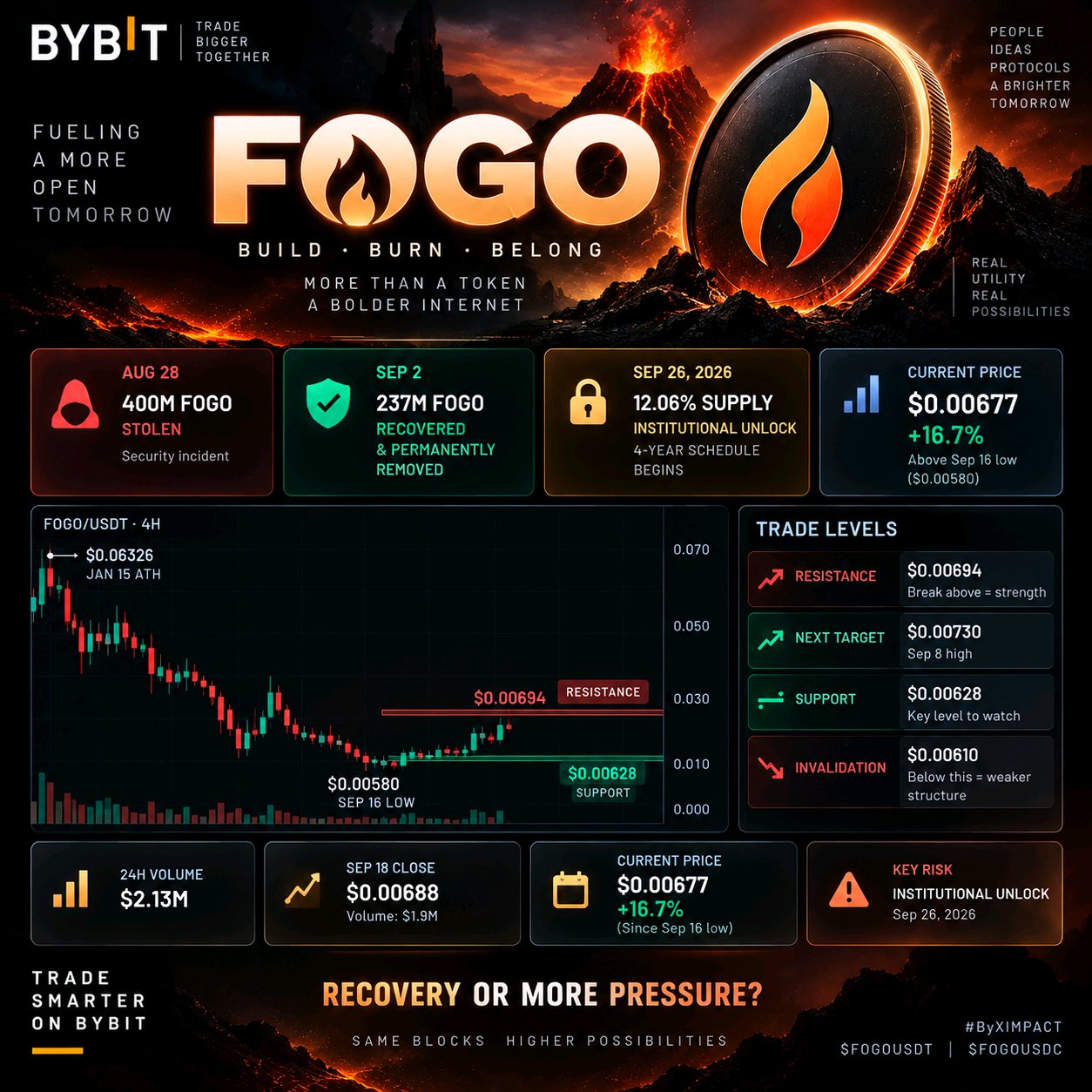
El 28 de agosto se robaron 400M de FOGO en el incidente de seguridad, mientras que para el 2 de septiembre, Fogo había recuperado y eliminado permanentemente 237 millones de esos tokens. Sin embargo, FOGO todavía ronda los $0.00677, solo un 16.7% por encima de su mínimo histórico del 16 de septiembre de $0.00580, con un volumen de 24 horas cercano a los $2.13M. Eso realmente no es una historia de recuperación. Es una prueba de confianza y liquidez. La red volvió a estar en línea, pero 163M de FOGO robados siguen sin recuperarse, según informes sobre el reinicio del 2 de septiembre. Mientras tanto, la propia tokenómica de Fogo sitúa la asignación institucional en el 12.06% del suministro, con su calendario de desbloqueo de cuatro años que comienza el 26 de septiembre de 2026. El gráfico refleja esa incertidumbre. FOGO cerró en $0.00688 el 18 de septiembre después de $1.9M de volumen, frente a $0.00596 el 16 de septiembre. Ese repunte es medible, pero el token permanece muy por debajo de su ATH del 15 de enero de $0.06326. A tener en cuenta: $0.00694 es la resistencia inmediata. Un cierre confirmado por encima podría abrir los $0.00730, el máximo del 8 de septiembre. El soporte es de $0.00628, con $0.00610 como invalidación. Horizonte temporal: 3-7 días. El riesgo estructural es el desbloqueo institucional del 26 de septiembre. ¿Reclamará FOGO los $0.00694 antes del desbloqueo, o la presión de la oferta mantendrá limitada la recuperación? #ByXIMPACT $FOGOUSDT
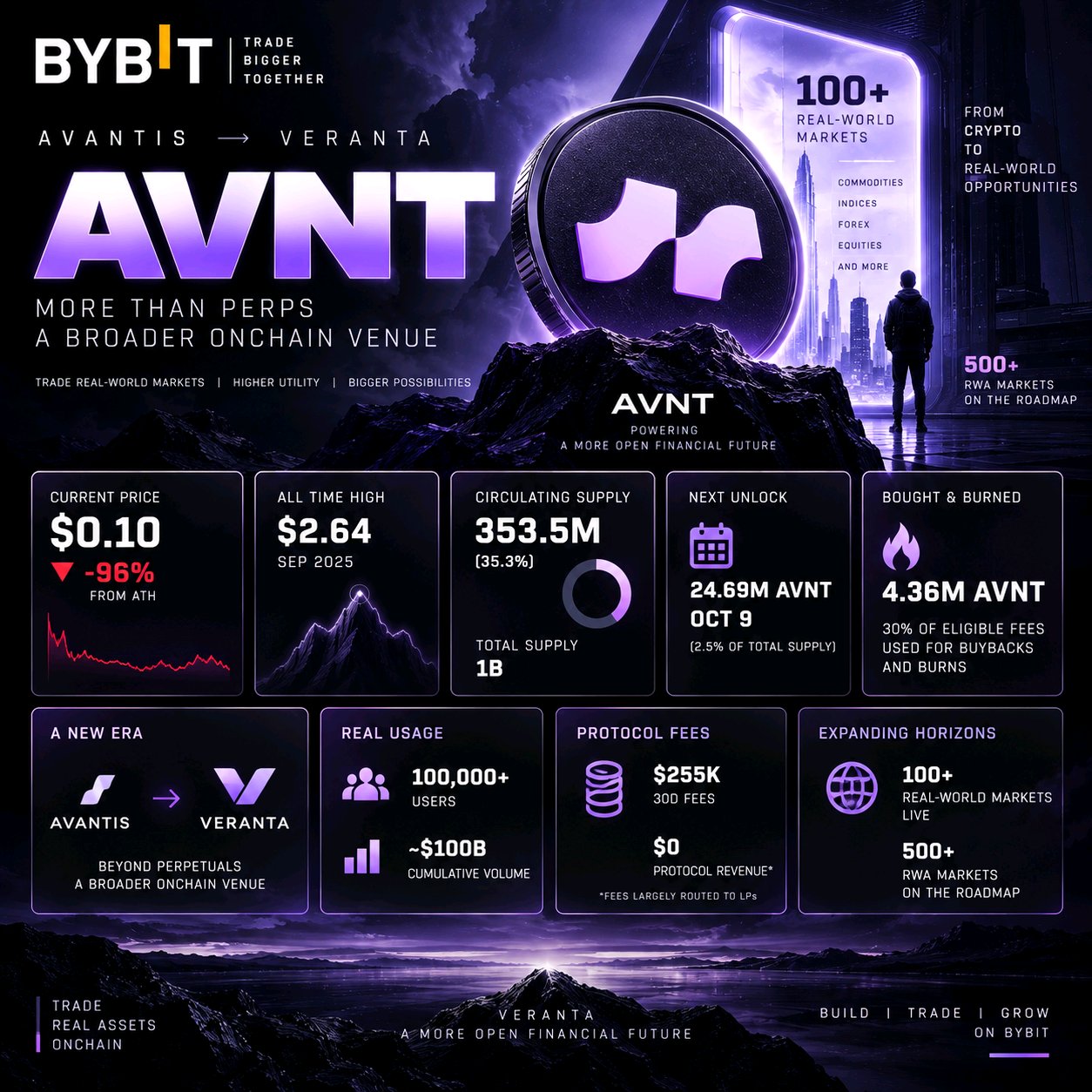
$AVNT está en alrededor de $0.10, aproximadamente 96% por debajo de su ATH de $2.64 en septiembre de 2025. Sin embargo, el protocolo subyacente se ve muy diferente al que lanzó el token. Esa es la parte en la que vale la pena reflexionar. El 14 de septiembre, Avantis se convirtió oficialmente en Veranta, pasando de los perpetuos de criptomonedas hacia una plataforma en cadena más amplia que cubre más de 100 mercados del mundo real, con una hoja de ruta para más de 500 RWAs. El protocolo afirma que casi $100 mil millones en volumen acumulado han pasado ahora por la plataforma para más de 100,000 usuarios. La economía del token también ha cambiado materialmente. Desde marzo, el 30% de las tarifas elegibles de apertura, cierre y ganancia diarias se ha utilizado para comprar y quemar permanentemente AVNT. El panel oficial muestra más de 4.36 millones de AVNT ya comprados y quemados. Se planea una asignación de más del 50% después de futuras mejoras económicas y de liquidez. Pero hay un detalle. Solo alrededor de 353.5 millones de 1 mil millones de AVNT están circulando actualmente. Otro 64.5% permanece bloqueado, con el próximo desbloqueo de 24.69 millones de tokens programado para el 9 de octubre. Eso es el 2.5% del suministro total y aproximadamente el 7% de la capitalización de mercado actual. También hay una distinción contable que vale la pena notar: DefiLlama registra actualmente alrededor de $255K en tarifas de 30 días pero $0 de ingresos del protocolo porque las tarifas se redirigen en gran medida a los LPs, mientras que el propio mecanismo de Veranta redirige el 30% de las tarifas elegibles a las recompras de AVNT. Así que la pregunta real no es si Veranta está creciendo. Es si el uso en expansión y las quemas recurrentes pueden superar el gran excedente de suministro restante. #ByXIMPACT $AVNTUSDT
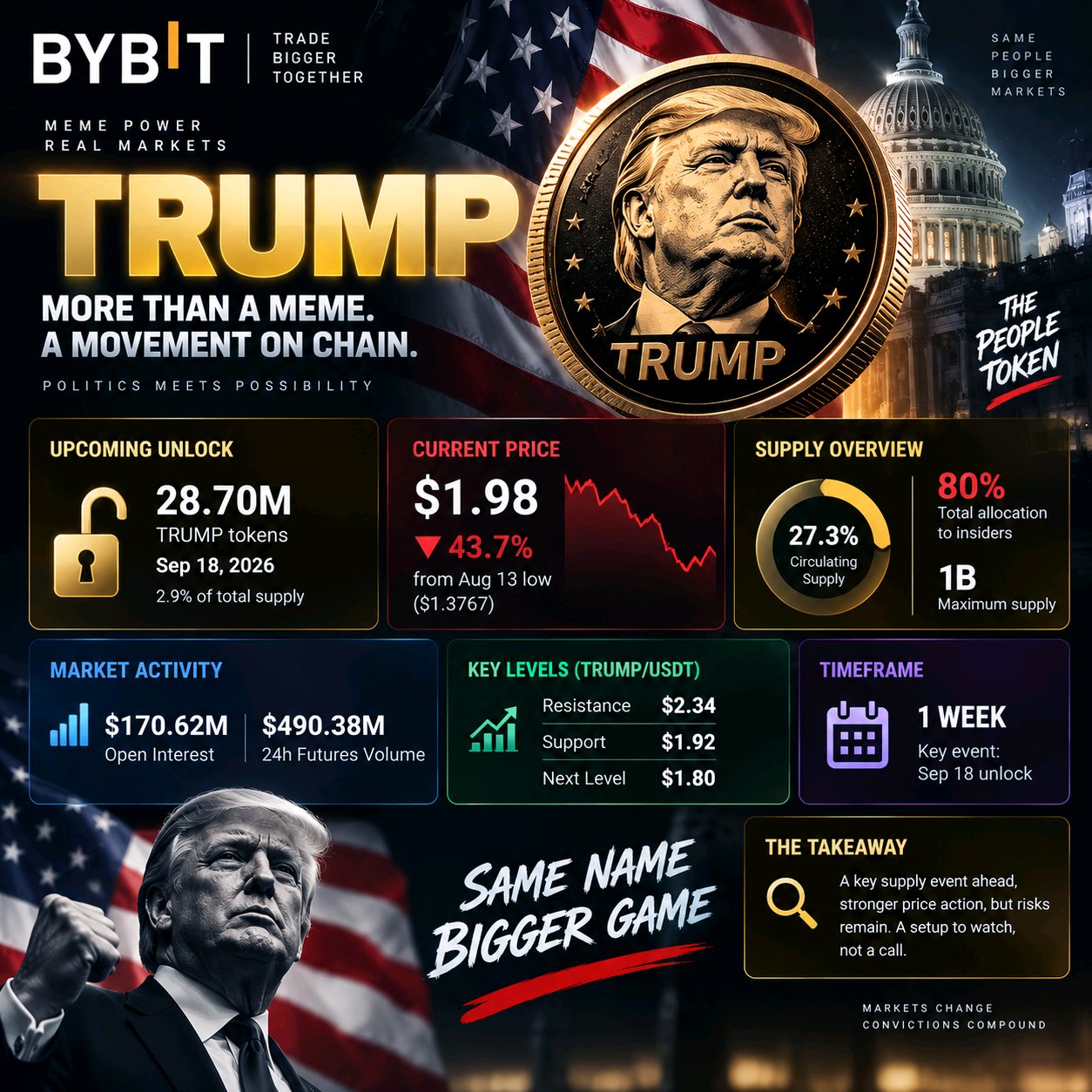
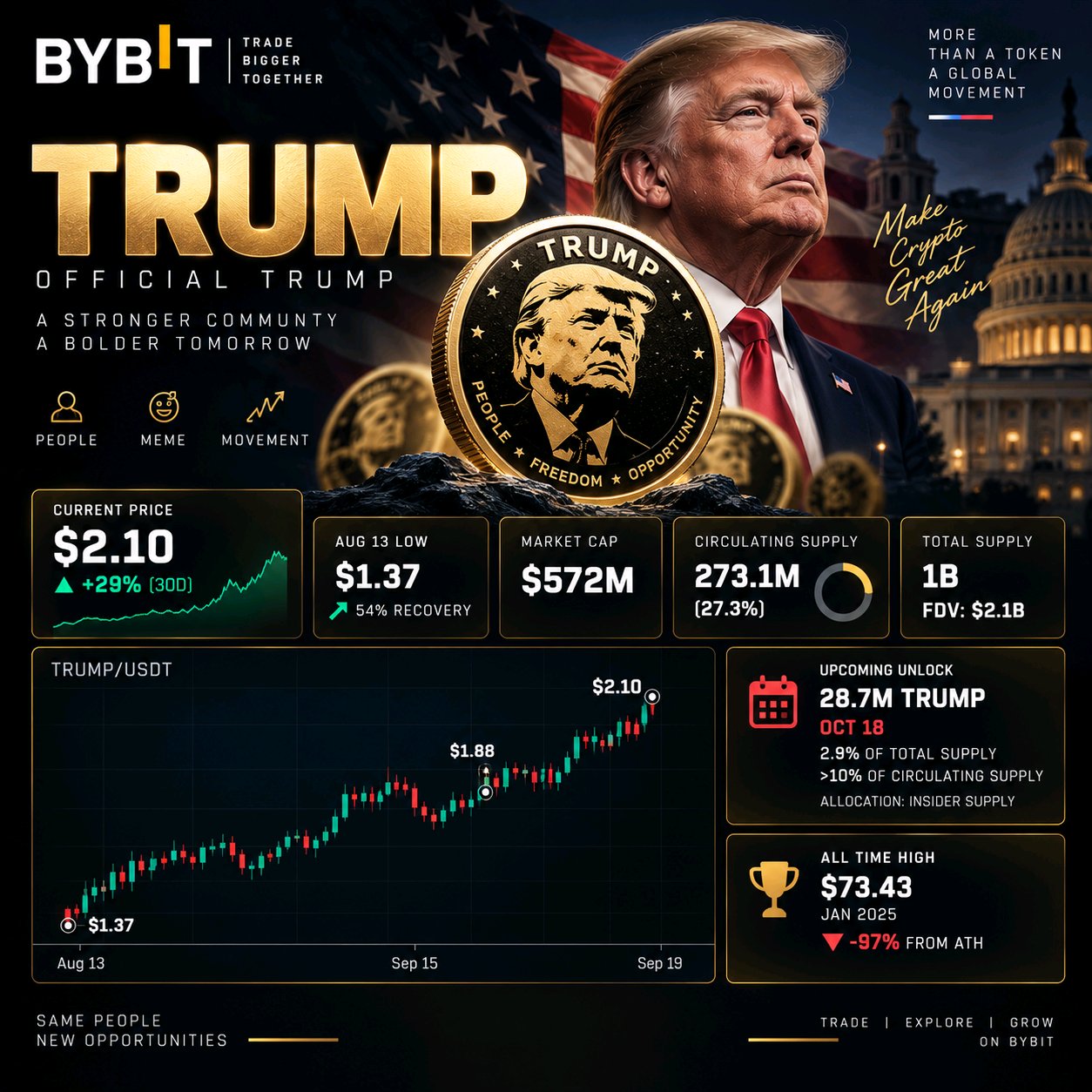
TRUMP ha recuperado casi el 54% desde su mínimo del 13 de agosto de $1.37, con el token ahora alrededor de $2.10 y con un aumento aproximado del 29% en 30 días. Pero la historia más interesante no es la recuperación. Es cuánta oferta está realmente circulando. Solo unos 273.1 millones de TRUMP, o el 27.3% del suministro máximo de 1000 millones, está circulando actualmente. Eso sitúa la capitalización de mercado en alrededor de $572 millones frente a un FDV cercano a $2.1 mil millones. Y la presión de la oferta no ha desaparecido. El desbloqueo del 18 de septiembre fue seguido por un vesting continuo, mientras que el próximo desbloqueo importante programado es el 18 de octubre: aproximadamente 28.7 millones de TRUMP, igual a alrededor del 2.9% del suministro total y más del 10% del flotante circulante actual. La asignación programada se lista como suministro interno. Esa es la parte en la que vale la pena pensar. El precio de TRUMP se ha fortalecido de $1.88 el 15 de septiembre a $2.10 el 19 de septiembre, a pesar de la estructura de liberación continua. Esto sugiere que la demanda actual ha sido capaz de absorber la oferta hasta ahora, pero no prueba que los futuros desbloqueos serán absorbidos a la misma velocidad. El token también permanece aproximadamente un 97% por debajo de su ATH de $73.43 de enero de 2025, lo que muestra cuán diferente es la estructura del mercado actual de su fase de lanzamiento. La verdadera pregunta ahora no es simplemente si TRUMP puede recuperarse. Es si la demanda puede seguir el ritmo a medida que el flotante negociable se expande. #ByXIMPACT $TRUMPUSDT
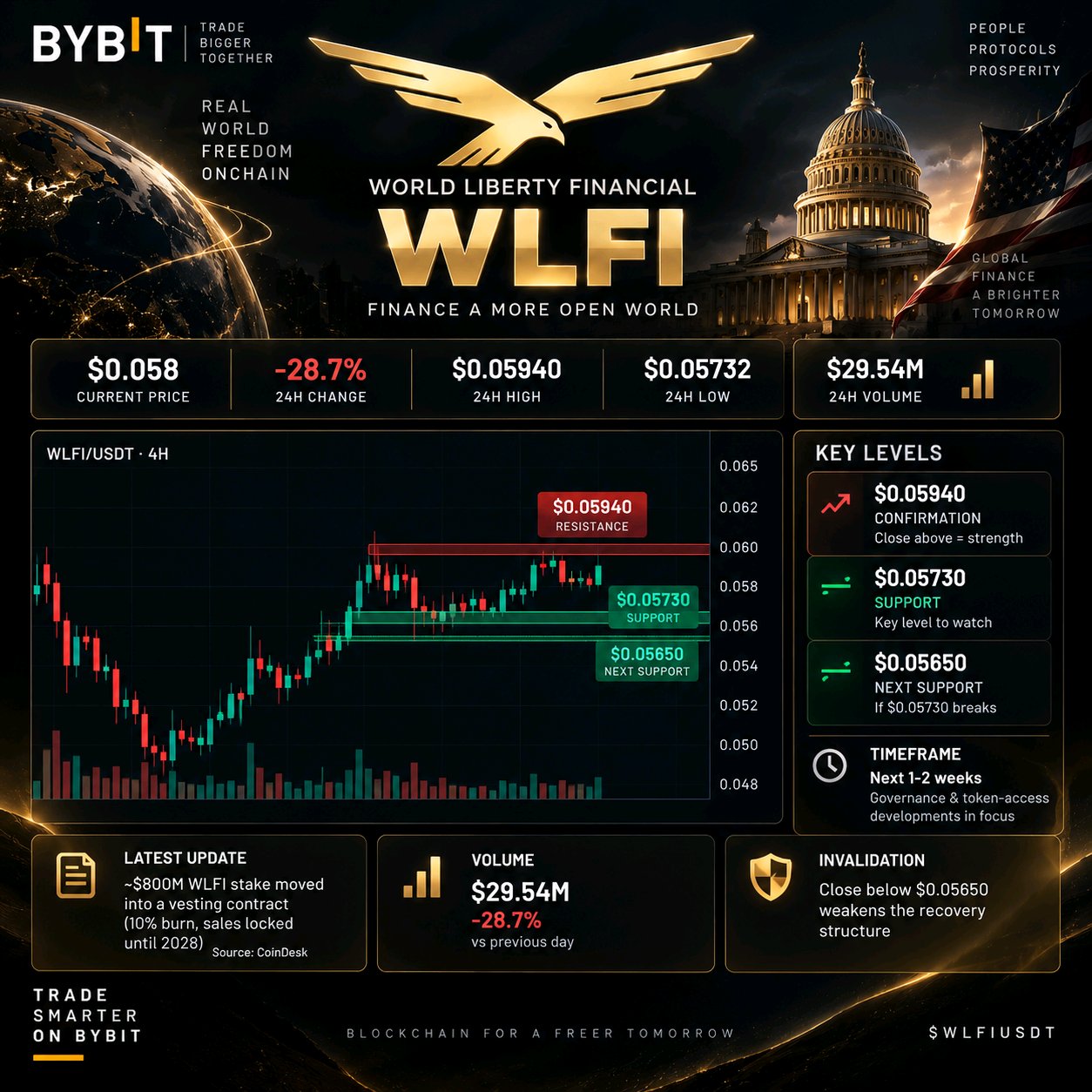
La acción del precio más reciente de WLFI se está calmando mientras la narrativa del token subyacente se mantiene inusualmente activa. WLFI ronda los $0.058, con un rango de 24H de $0.05732-$0.05940 y aproximadamente $29.54M en volumen de 24H, un 28.7% menos que el día anterior. Sin embargo, el token se ha mantenido por encima del mínimo del 11 de septiembre cerca de $0.0483, mientras que los cierres diarios recientes han subido gradualmente de $0.05527 el 11 de septiembre a $0.05844 el 19 de septiembre. La brecha está en la participación: el precio se ha recuperado, pero el volumen no ha seguido. Eso hace que esto sea algo a vigilar, no un largo o corto de confianza. Por separado, CoinDesk informó que una participación de WLFI de aproximadamente $800M se movió a un contrato de vesting, con ventas bloqueadas hasta 2028 después de una quema obligatoria del 10%. Niveles de Trading Para $WLFI/USDT, $0.05940 es la línea de confirmación. Un cierre limpio por encima de ella con volumen en expansión señalaría una demanda renovada. El soporte se encuentra en $0.05730, igualando el piso actual de 24H. Por debajo de eso, $0.05650 es la siguiente referencia estructural del 18 de septiembre. Marco de Tiempo: Próximas 1-2 semanas, mientras los desarrollos de gobernanza y acceso al token continúan dando forma a las expectativas de suministro. Invalidez: Un cierre confirmado por debajo de $0.05650 debilita la estructura de recuperación. La línea a vigilar es $0.05940. Hasta que el volumen regrese, WLFI se mantiene con la correa corta. #ByXIMPACT $WLFIUSDT