
JOHNS KING
QNT: Quant Could Win Institutional Finance Without Automatically Creating Value for Its Token The most important development for Quant may also expose its biggest tokenomic question: institutional adoption and QNT demand are not necessarily the same thing. On September 24, 2026, The Clearing House selected Quant to power its On-Chain Money Initiative, connecting tokenized bank deposits with established US payment infrastructure, including RTP and CHIPS. The Clearing House already operates payment networks handling more than $2 trillion daily. The initiative is expected to become available to participating institutions in the first half of 2027. This is a meaningful commercial milestone, not just another blockchain partnership. But here is what investors should examine more closely: where does QNT actually enter this economic activity? Quant's Overledger infrastructure uses QNT for licensing and access, while its newer Fusion Rollup introduces QNT utility through gas, execution fees and trusted-node staking. Fusion also launched with connectivity to 74 blockchain networks. These developments expand the potential economic role of the ecosystem. However, Quant's own FAQ confirms that customers can pay platform fees in USD or subscribe using QNT. That distinction matters enormously. If institutional customers purchase software services through conventional commercial arrangements, growing business revenue does not automatically translate into proportional token purchases. There is another important distinction: QNT has no shareholder rights, dividend entitlement or automatic claim on Quant's corporate revenue. Its supply is approximately 14.6 million tokens, with no remaining scheduled vesting unlocks. Scarcity is attractive, but scarcity alone cannot manufacture demand. The bullish argument is that Fusion, institutional licensing and trusted-node participation could eventually create recurring, measurable demand for QNT. The counterargument is that Quant could become a successful enterprise infrastructure provider while tokenholders capture only a limited portion of that success. For me, the decisive metric is not another partnership announcement. It is evidence of actual institutional transaction activity, the proportion of fees settled in QNT, and the amount of QNT genuinely locked by network participants. Quant's commercial opportunity is becoming increasingly interesting. But the real investment thesis depends on whether its success becomes QNT's success. Would you value QNT differently if Quant became a major player in institutional finance but most of its commercial revenue remained disconnected from token demand? #ByXIMPACT $QNTUSDT

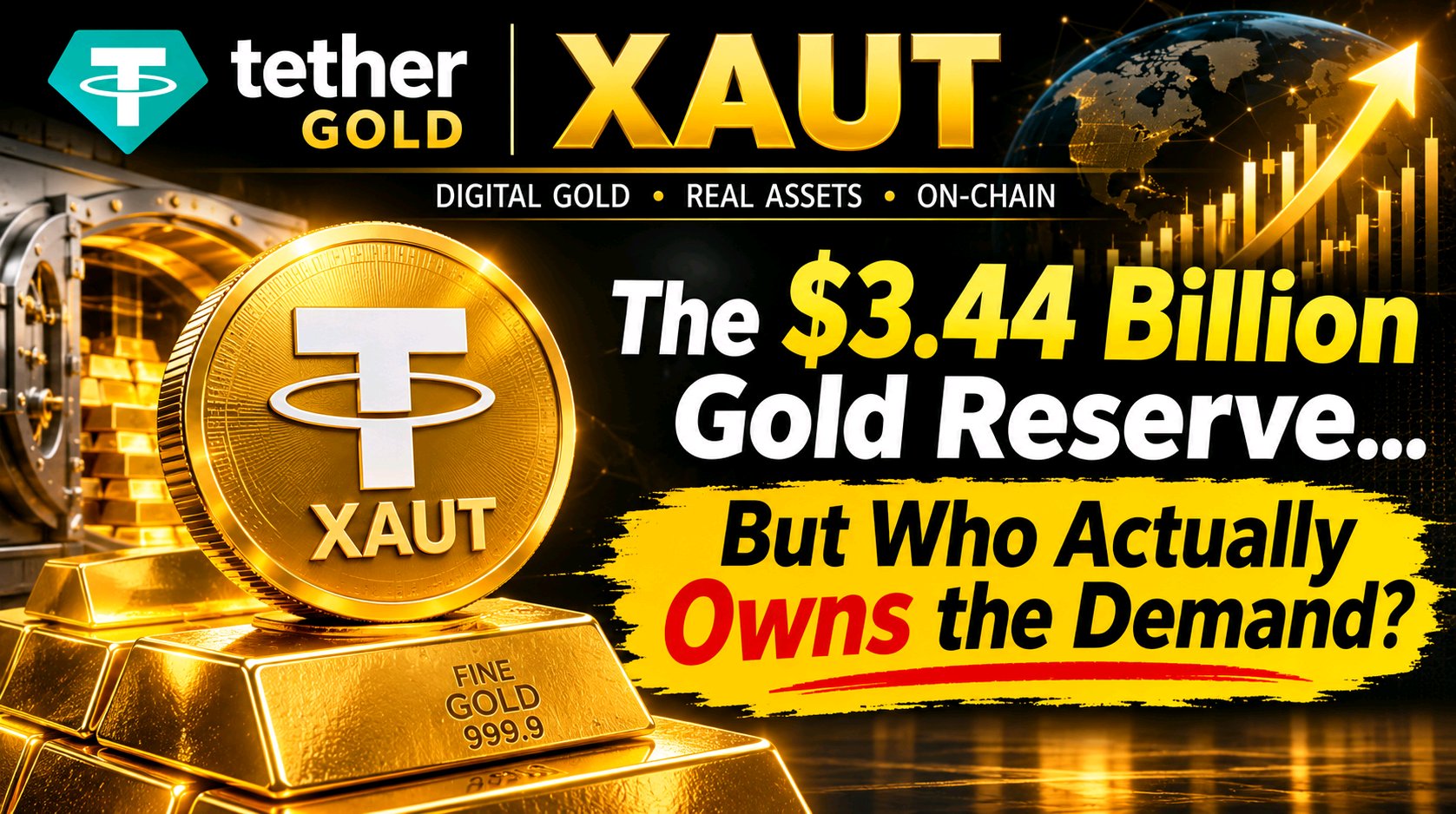
XAUT: The $3.44 Billion Gold Reserve Has a Detail Most Investors May Be Overlooking Tether Gold's September 2026 reserve report reveals something more interesting than its headline market value. XAUT has 827,417.63 tokens backed by exactly 827,417.63 fine troy ounces of physical gold. But only 709,323.66 tokens had been sold. Another 118,093.97 tokens, representing approximately $491 million in gold, remained available for sale through an entity related to the issuer. That means roughly 14.3% of the reported token supply was issuer-related inventory rather than tokens already sold to customers. This distinction changes how investors should interpret XAUT's $3.44 billion headline backing. The underlying business is expanding. Physical reserves increased from 520,089 ounces at the end of 2025 to 827,418 ounces in September 2026, a 59% increase. The inventory also grew from 1,291 to 2,057 gold bars held in Switzerland. But reserve expansion and customer acquisition are not identical economic events. Here is the important mechanism: Tether must acquire and vault physical gold before issuing corresponding XAUT. This creates genuine asset backing, but minting alone does not establish independent market demand. Tokens held by the related entity still represent potential future distribution, not completed customer purchases. There is another encouraging development. On November 12, Tether announced that KPMG U.S. had issued an unqualified audit opinion on TG Commodities' 2025 financial statements, following physical inspection of the gold bars. That strengthens the transparency story, although it should not be confused with a continuous audit of current reserves. The counterargument is equally important: the 118,093-token inventory is fully gold-backed. It is not evidence of unbacked issuance or a reserve deficit. If customers purchase that inventory, distribution can expand without requiring the same amount of additional gold to be acquired immediately. My decisive signal is therefore not simply the next increase in XAUT supply. It is the relationship between tokens sold, issuer-related inventory, and independently verified physical reserves. XAUT's real competitive advantage may be the combination of physical ownership and blockchain portability. But its next stage of growth should be measured by how much gold-backed inventory reaches genuine customers, not merely how much gold sits in vaults. Is XAUT becoming a genuinely adopted digital gold market, or is its valuation still being driven primarily by the rising value of gold itself? #ByXIMPACT $XAUTUSDT
LINK: Chainlink Is Becoming Financial Infrastructure — But Is Token Value Capture Growing Fast Enough? The biggest question surrounding Chainlink is no longer whether traditional finance will use its infrastructure. It is whether that adoption can generate enough recurring economic demand to materially strengthen LINK. Consider what happened in Q3 2026. More than $15 billion in token value migrated to Chainlink CCIP during the year, while the network surpassed $85 billion in total cross-chain token value secured. Institutional adoption is moving beyond announcements and into infrastructure decisions. But here is the less discussed part. Chainlink's Reserve accumulated 1.54 million LINK during Q3, bringing its holdings to approximately 6.05 million. Its official reserve dashboard subsequently showed approximately 6.57 million LINK. That is meaningful accumulation, but compared with roughly 767 million circulating LINK, the reserve still represents less than 1% of circulating supply. This reveals an important distinction: Chainlink is developing a mechanism that connects enterprise revenue and onchain service fees to LINK accumulation through Payment Abstraction. Customers can pay in other assets or fiat, while payments are converted into LINK. That is a genuine economic connection. However, it does not mean every dollar of institutional transaction value becomes LINK demand. CCIP fees are service charges, not a percentage of all transferred assets. The value of assets secured or migrated therefore cannot be treated as protocol revenue. Furthermore, reserve accumulation is not the same as distributing earnings directly to token holders. The bullish argument is that growing institutional usage, paid data services, CCIP and Smart Value Recapture could progressively strengthen LINK's economic foundation. The counterargument is equally important: adoption must translate into recurring fees and sustained LINK purchases at a scale that matters relative to circulating supply and future token releases. For me, the decisive metric is not another institutional partnership or another billion-dollar migration announcement. It is the quarterly growth of the Chainlink Reserve relative to circulating supply, supported by transparent evidence of recurring service revenue. Chainlink may be winning the infrastructure race. The next challenge is proving that LINK captures enough of the economic value created by that victory. Is LINK's real investment opportunity still ahead, or is the market already pricing in institutional adoption before token value capture reaches its full potential? #ByXIMPACT $LINKUSDT

MNT: Mantle Is Building a Financial Empire, But Is the Token Capturing Its Value? What if Mantle succeeds in becoming a major destination for institutional capital, yet MNT holders capture much less economic value than the market expects? I think this is the most important question surrounding Mantle's current expansion. The ecosystem is developing an interesting position in tokenized finance. On September 25, 2026, Mantle reported 1,473 tokenized assets, compared with just 71 at the beginning of the year, alongside $476 million in distributed asset value. This is meaningful progress, particularly with integrations involving Securitize, Paxos, Franklin Templeton and tokenized equities. prnewswire.com +1 But there is another side to the story. As of November 16, DefiLlama reports approximately $90.89 million in DeFi TVL, $523.41 million in stablecoin market capitalization and only $276 in daily chain revenue. These numbers reveal an important distinction: Mantle can attract financial assets without automatically generating substantial revenue for its underlying network. DefiLlama The treasury makes this situation even more interesting. Mantle Foundation's dashboard reported approximately $1.655 billion in treasury assets on November 15, including around $1.138 billion in MNT. This gives the ecosystem considerable financial capacity to fund growth, liquidity and institutional initiatives. However, treasury wealth is not the same as recurring protocol income, and its deployment can also influence future token supply dynamics. Mantle For MNT holders, the distinction matters. MNT provides network gas utility and governance rights, but its regulatory whitepaper explicitly states that holders have no contractual claim to project profits or revenues. There is currently no automatic guarantee that institutional activity translates into token-holder distributions. assets.bitstamp.net +1 The strongest counterargument is that Mantle is still building its financial infrastructure. Tokenized assets, stablecoins and deeper DeFi integrations could eventually generate meaningful network activity and stronger demand for MNT. My decisive metric would be the relationship between growing RWA activity, actual network fees and recurring revenue. If all three expand together, the economic case becomes stronger. If asset growth continues while network revenue remains negligible, the gap deserves serious attention. Mantle's biggest opportunity may be institutional finance. But its biggest challenge is converting that opportunity into measurable economic value for MNT. What matters more in the long run: the amount of capital a network attracts, or the amount of economic value its native token actually captures? #ByXIMPACT $MNTUSDT
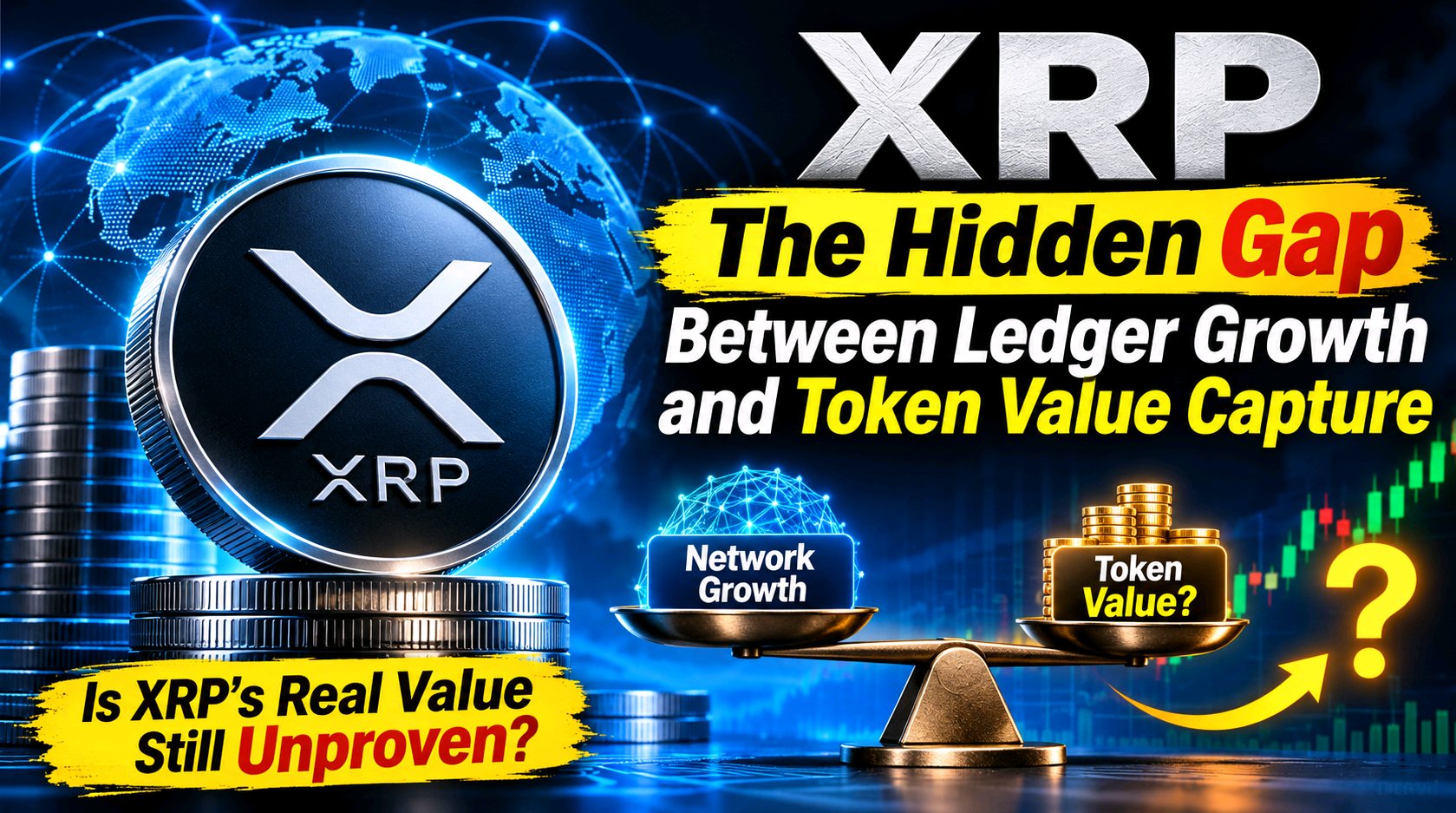
XRP: The Hidden Gap Between Ledger Growth and Token Value Capture XRP Ledger adoption is increasingly becoming a stablecoin and financial infrastructure story, but there is an important distinction the market should not ignore: a network can become more useful without creating proportional economic demand for its native token. The strongest example is RLUSD. During Q3 2026, XRPL-native stablecoin supply increased 25.2%, reaching approximately $1.03 billion. RLUSD accounted for roughly $1.01 billion of that supply. This is meaningful progress for the ledger, but it also raises a question: how much of that economic activity actually requires XRP rather than simply using the network as its settlement environment? teapawt The distinction becomes clearer when looking at transaction economics. XRPL requires XRP for transaction fees, but its standard minimum fee is only 10 drops, or 0.00001 XRP. These fees are permanently destroyed rather than distributed to validators, the treasury or token holders. That creates a real connection between network usage and XRP scarcity, but the direct economic effect of ordinary transactions remains extremely small. xrpl.org The wider numbers reinforce this gap. Stablecoin transfer volume climbed 39.5% to $14.09 billion, yet total XRPL transactions declined 8.6% to 203.23 million. Average daily active addresses barely moved, reaching 16,829. More importantly, the entire network burned just 35,852 XRP during Q3, worth approximately $46,100 at the reported valuation. That is the difference between impressive settlement activity and meaningful token-level value capture. teapawt There is a counterargument worth taking seriously. XRP is also a bridge asset, provides account reserves and supports liquidity across the native DEX. Its role could expand considerably as institutional settlement and tokenized assets mature. But even AMM growth needs careful interpretation: trading fees accrue to liquidity providers through their pool positions, not directly to every XRP holder. xrpl.org +1 For me, the most important development to watch is the XRPL Lending Protocol. It remained inactive at Q3-end, pending validator approval of three amendments. If lending becomes operational and creates sustained demand for XRP as collateral or borrowed capital, that would represent a stronger economic connection than transaction-fee burning alone. teapawt My conclusion is that XRP's infrastructure story is advancing, but its token value-capture story still has something to prove. The decisive question is not how much financial activity XRPL can process. It is how much of that activity eventually needs XRP itself. Can XRPL become a major institutional settlement network while XRP captures only a relatively small share of the economic value it creates? #ByXIMPACT $XRPUSDT
Bitcoin’s Biggest Economic Question Isn’t Scarcity — It’s Who Pays for Security Bitcoin has successfully established digital scarcity, but there is a different economic question that deserves more attention: can the network maintain its security when newly issued BTC becomes a smaller part of miners’ income? The overlooked issue is the growing separation between Bitcoin's monetary demand and its security budget. Institutional adoption, ETF holdings and long-term ownership can strengthen Bitcoin's market position, but they do not automatically generate transaction fees for miners. The numbers make this distinction important. A November 2026 analysis from Cambridge's Centre for Alternative Finance found that transaction fees represented just 0.67% of miner revenue over the 90 days ending October 4, 2026. Meanwhile, miners still receive a block subsidy of 3.125 BTC, established by the April 2024 halving. Cambridge Judge Business School +1 This is not simply a temporary revenue problem. Cambridge also found that fee income was 11.7 times more volatile from day to day than Bitcoin's price. That means miners depend on an income source that can fluctuate sharply, while their operating costs and investment requirements do not disappear during quiet periods. Cambridge Judge Business School +1 The next halving, expected around 2028, will reduce the subsidy from 3.125 BTC to 1.5625 BTC per block. Unless transaction fees or BTC's dollar value compensate, the economics of mining will face another adjustment. Bitcoin There is an interesting contradiction here. US spot Bitcoin ETFs held approximately 1.29 million BTC at the end of Q3 2026, representing around 6.4% of Bitcoin's supply. Yet institutional ownership does not automatically translate into on-chain settlement demand. Bitcoin can attract enormous capital while its base-layer fee market remains relatively quiet. 21shares.com The strongest counterargument is that Bitcoin's security model does not require today's fee structure to remain unchanged. More settlement demand, financial applications, high-value transactions and future fee-market competition could gradually replace part of the subsidy. The 2024 Runes launch also demonstrated that fee demand can increase dramatically during periods of congestion. But temporary spikes are not proof of sustainable revenue. For me, the important metric to watch is not simply Bitcoin's hashrate or institutional holdings. It is the 90-day average transaction-fee share of total miner revenue, alongside mining-pool concentration and the cost of mounting an attack. Bitcoin's scarcity story is already well established. Its next major economic test is whether the demand to use block space can eventually support the security of the asset that institutions increasingly want to own. Can Bitcoin become a much larger financial asset without developing a sufficiently strong fee economy to protect its network? #ByXIMPACT $BTCUSDT

SOLANA'S BIGGEST ECONOMIC CONTRADICTION: APPS ARE EARNING MORE THAN THE NETWORK Solana's application economy is generating substantial fees, but there is an important distinction that SOL holders should not ignore: the success of applications does not automatically translate into equivalent value for the network's native token. The latest November 16 snapshot from DefiLlama shows approximately $4.7 billion in DeFi TVL, $14.08 billion in stablecoin supply and $1.44 billion in daily DEX volume. Yet the more interesting figure is the gap between application economics and network economics. Solana applications generated approximately $2.54 million in revenue over the latest 24-hour period, while the network itself recorded around $26,719 in chain revenue. These are different economic layers, but the difference raises an important question: who actually captures the value created by Solana's activity? The fee mechanism explains part of the answer. Solana's base transaction fee is divided equally between burning SOL and rewarding validators. However, 100% of prioritization fees goes to validators under the current fee structure. This means network activity can generate economic rewards without creating an equivalent reduction in SOL supply. I think this is where the market sometimes oversimplifies the Solana thesis. A growing application ecosystem strengthens the network's relevance, creates demand for blockspace and increases the importance of SOL as its execution asset. But application revenue largely belongs to the applications themselves, not automatically to SOL holders. There is a strong counterargument: cheap transactions, expanding stablecoin liquidity and a competitive application ecosystem can attract more users and eventually increase sustainable demand for SOL. That possibility should not be dismissed. However, the decisive metric I would watch is the relationship between sustained application activity, actual SOL-denominated network fees and net token issuance. If economic activity grows faster than supply expansion, the token's value-capture story becomes stronger. Solana may already have a powerful application economy. The bigger question is how much of that economic success ultimately reaches SOL itself. #ByXIMPACT $SOLUSDT

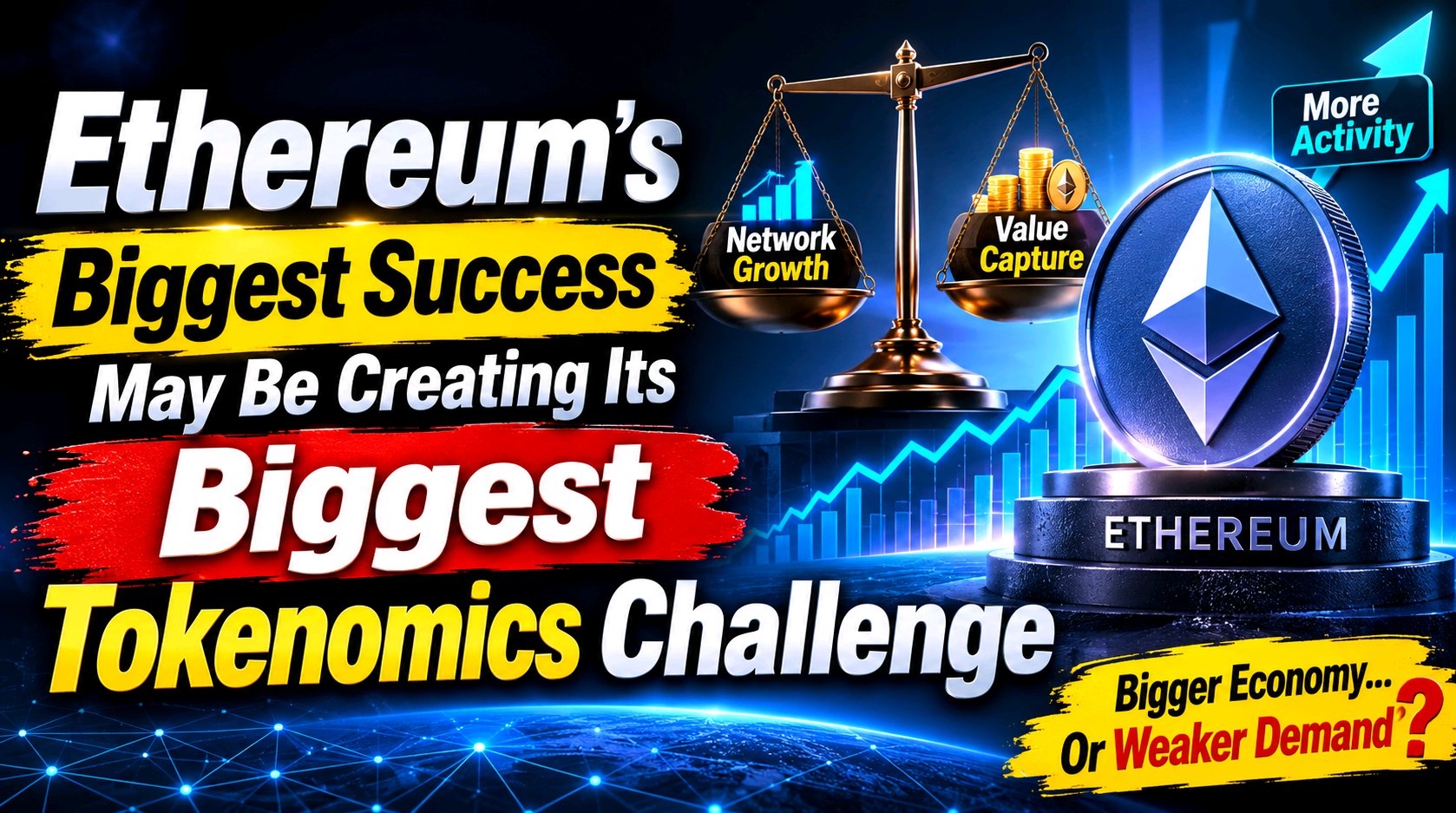
Ethereum’s Biggest Success May Be Creating Its Biggest Tokenomics Challenge Ethereum is becoming more useful, but there is an economic detail that deserves more attention: increasing network activity does not automatically translate into increasing value capture for ETH. Recent data makes this contradiction interesting. Ethereum mainnet averaged approximately 2.17 million daily transactions between January and October 2026, up 54% year over year. Meanwhile, median transaction fees fell from roughly $0.35 to just $0.035. Stablecoin transfers on Ethereum mainnet also reached $25.8 trillion during the same period, representing 61% growth year over year. These are meaningful signs of adoption. However, cheaper transactions also change the economics of the network. Ethereum's scaling strategy increasingly allows Layer 2 networks to process activity cheaply while using Ethereum for settlement and data availability. This expands the ecosystem, but it also means that millions of additional transactions do not necessarily generate proportional ETH burns. The supply figures highlight the gap. In the 12 months through November 12, estimated ETH issuance was approximately 1.03 million ETH, while estimated burning was only around 20,540 ETH. ETH therefore remained inflationary over that period, despite growing network activity. That does not make Ethereum's model unsuccessful. Around 36% of its supply was staked by November 2026, strengthening economic security and giving ETH an important role beyond transaction fees. But staking rewards and network fee demand are different economic mechanisms. My main question is whether Ethereum can turn its growing settlement importance into stronger direct demand for ETH, rather than simply becoming the infrastructure layer supporting activity elsewhere. The next important signal is whether rising blob demand, Layer 2 settlement and mainnet usage eventually increase fee burning faster than issuance. If that connection strengthens, Ethereum's scaling strategy could become a much stronger economic story. If it doesn't, ecosystem growth and ETH value capture may continue moving at different speeds. Is Ethereum building a bigger economy for ETH, or a bigger economy that does not necessarily need more ETH? #ByXIMPACT $ETHUSDT
NEAR: The Real Value Is Moving Beyond the Blockchain Itself NEAR may be developing an interesting economic model, but the biggest change is happening somewhere many traditional Layer-1 investors might not be watching: its cross-chain transaction business. The important question is whether NEAR can turn that activity into lasting demand for NEAR tokens, rather than simply becoming infrastructure that other applications use. What makes this interesting is the difference between NEAR's base-layer activity and the business developing on top of it. According to Bitwise's Q4 2026 staking report, NEAR Intents processed $10.41 billion in Q3 volume, up 66.8% quarter over quarter. Its gross fees reached $14.43 million, compared with just $208,000 in gross fees generated by the underlying NEAR chain during the same quarter. That is roughly a 70-fold difference. Amazon Web Services, Inc. +1 This changes how I look at NEAR. Its emerging economic strength may come less from people paying to use its blockchain and more from people using its infrastructure to move assets between different blockchains. NEAR Intents allows users to specify the transaction they want while competing solvers handle execution. Ethereum alone accounted for 47% of its Q3 volume. Amazon Web Services, Inc. But there is an important distinction: $14.43 million in gross fees does not mean $14.43 million goes to NEAR token holders. NEAR introduced revenue-capture mechanisms involving front-end fees, quote improvements and B2B partner agreements. Its February tokenomics update also introduced a framework for directing captured revenue toward NEAR buybacks. The actual amount captured and converted into token demand matters far more than headline transaction volume. near.org +1 There is also a risk that deserves attention. On October 1, NEAR Intents suffered an exploit involving approximately $3.8 million. The funds were subsequently returned in full, but the incident exposed how critical contract security is when a platform becomes a major cross-chain liquidity gateway. CoinDesk +1 My biggest question is whether NEAR can maintain this Intents growth while increasing the percentage of economic activity that actually reaches NEAR holders. I would watch monthly net protocol revenue, verified buyback transactions and Intents volume after the security improvements. NEAR might be evolving beyond the traditional Layer-1 business model. But becoming important infrastructure and creating sustainable token value are two different achievements. What do you think matters more for NEAR's future: growing cross-chain transaction volume or proving stronger value capture for NEAR holders? #ByXIMPACT $NEARUSDT

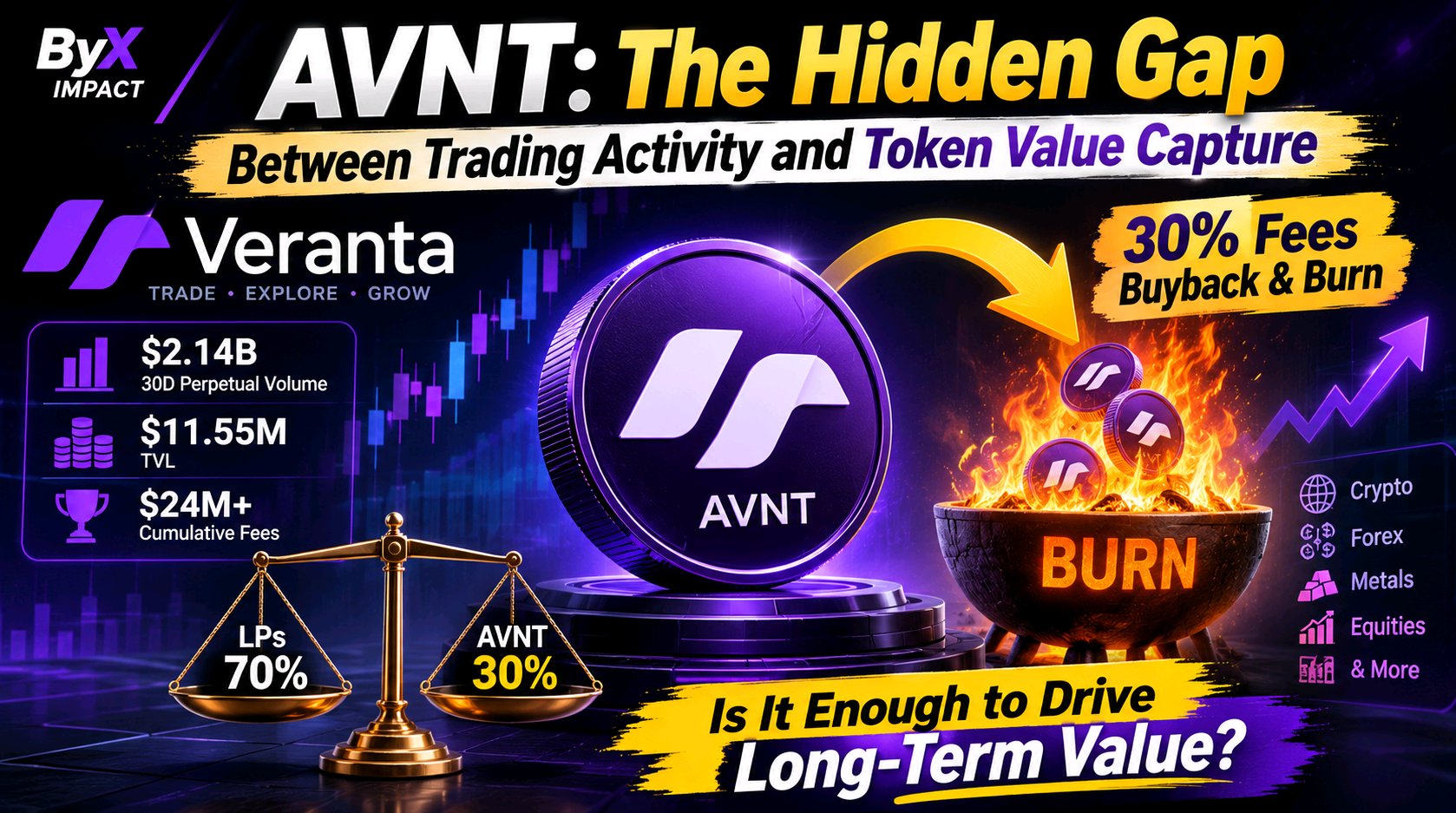
AVNT: The Hidden Gap Between Trading Activity and Token Value Capture The most interesting thing about Avantis is not how much trading volume it generates. It is how little of that activity currently translates into directly measurable protocol revenue. Avantis has established meaningful activity in on-chain leveraged trading. DeFiLlama reports approximately $2.14 billion in 30-day perpetual trading volume, around $11.55 million in TVL, and more than $24 million in cumulative fees. These figures demonstrate real market activity, but they reveal an important distinction: trading success and token-holder value capture are not automatically the same thing. DefiLlama +1 The overlooked part is Avantis's fee distribution model. Its documentation states that liquidity providers currently receive 100% of opening, closing, win and margin fees, while the protocol treasury receives 0% of those fees. This is a deliberate growth strategy: compensate liquidity providers to attract deeper liquidity, support larger positions and improve the trading experience. Avantis But this creates an important economic question for AVNT holders. If trading volume expands, LPs receive the direct fee benefit, while the token does not automatically receive an equivalent increase in economic value. DeFiLlama's reported zero protocol revenue makes this distinction particularly important. DefiLlama That picture has since changed, and this is where the analysis becomes more interesting. On March 11, 2026, Avantis introduced a systematic buyback-and-burn mechanism. Currently, 30% of eligible opening, closing and winning-trade fees are allocated to purchasing and permanently burning AVNT. LPs retain the remaining 70% of those fees, while margin fees remain allocated to LPs and liquidation fees support the treasury. The official buyback dashboard has recorded more than 4.29 million AVNT bought and burned. Veranta +1 This changes the token economics, but it does not eliminate the challenge. The buyback mechanism only captures specified fee categories, not every dollar generated by the exchange. Furthermore, the proposed increase to 50% or more remains a future milestone dependent on improvements to liquidity efficiency and risk management. Avantis +1 Another development deserves attention: Avantis rebranded as Veranta in September 2026, expanding its ambition beyond crypto perpetuals into forex, metals, equities and other real-world markets. The opportunity is significant, but zero-commission RWA trading and expanding asset listings do not automatically create equivalent buyback demand. Sustainable economic activity matters more than the number of available markets. Global Onchain Markets +1 My conclusion is that AVNT is becoming more than an incentive token, but its long-term value proposition still depends on execution. I would watch one metric particularly closely: actual AVNT bought and burned relative to circulating supply growth. The next scheduled unlock on December 9 adds another important supply consideration, with approximately 24.7 million tokens scheduled for release. Veranta +1 If trading expands while buybacks consistently outpace new circulating supply, the economic case for AVNT becomes stronger. If activity grows but supply expansion dominates, the gap remains. The real question is not how many markets Veranta can launch. It is how much sustainable economic value those markets can deliver to AVNT holders. #ByXIMPACT $AVNTUSDT
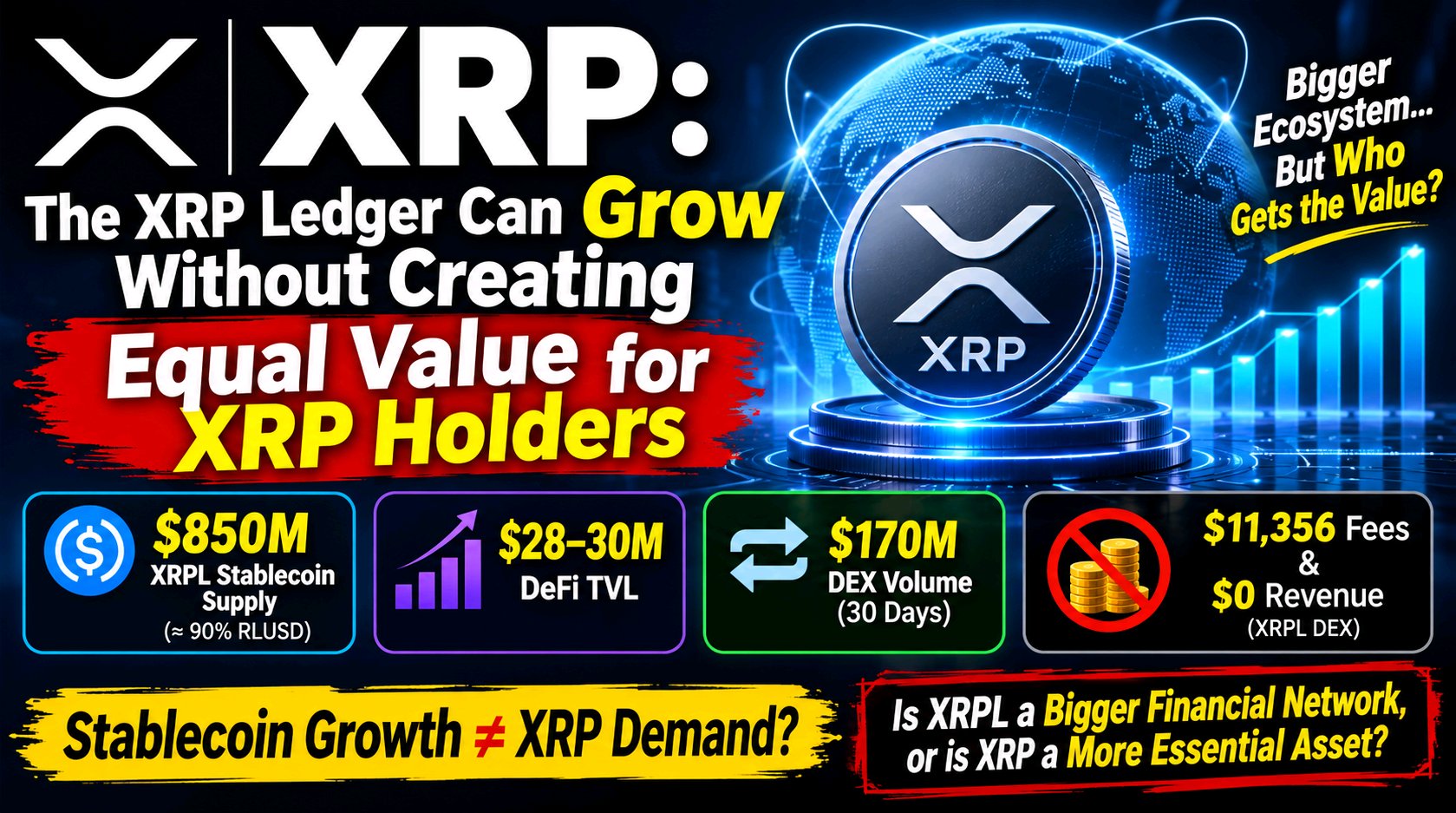
XRP: The XRP Ledger Can Grow Without Creating Equal Value for XRP Holders The most interesting question about XRP is no longer whether the XRP Ledger can attract stablecoins, tokenized assets and more transactions. It is whether that economic activity actually creates additional demand for XRP itself. There is an important distinction here. As of November 15, 2026, DefiLlama reports approximately $850 million in XRPL stablecoin supply, but only around $28–30 million in DeFi TVL. RLUSD accounts for almost 90% of the stablecoin market on the network. This shows that XRPL is developing a meaningful stablecoin settlement environment, but stablecoin growth should not automatically be interpreted as XRP demand. DefiLlama +1 The more revealing evidence comes from the native DEX. DefiLlama records approximately $170 million in 30-day trading volume, yet its XRPL DEX data reports $11,356 in fees and zero protocol revenue. The explanation matters: AMM trading fees go to liquidity providers, not the XRP Ledger itself. Meanwhile, standard network transaction fees are destroyed rather than distributed to XRP holders. DefiLlama +2 This creates an unusual economic situation. XRPL can process payments, facilitate stablecoin transfers and expand tokenized asset activity without automatically generating meaningful financial returns for XRP holders. RLUSD is particularly important because it can settle on XRPL without requiring every transfer to use XRP as the payment asset. Ripple itself distinguishes RLUSD's dollar-settlement role from XRP's role as a potential bridge asset. Ripple +1 I don't consider this a failure of XRP. It is a question of how the ecosystem converts infrastructure adoption into native-asset demand. XRP still has genuine utility through transaction fees, account reserves, liquidity and potential cross-currency settlement. But utility alone does not establish proportional value capture. The strongest counterargument is that stablecoin and institutional settlement growth could eventually increase demand for XRP as a bridge asset, particularly where direct currency pairs lack liquidity. That possibility deserves attention, but it needs measurable evidence rather than assumptions. For me, the decisive metric is the relationship between RLUSD growth, XRP-paired liquidity and actual XRP usage in settlement. If stablecoin adoption expands while XRP's role in those activities remains marginal, the ecosystem could become more successful without delivering equivalent economic benefits to XRP holders. The question I would watch is simple: Is XRPL becoming a bigger financial network, or is XRP becoming a more essential financial asset? Those are two very different outcomes. #ByXIMPACT $XRPUSDT
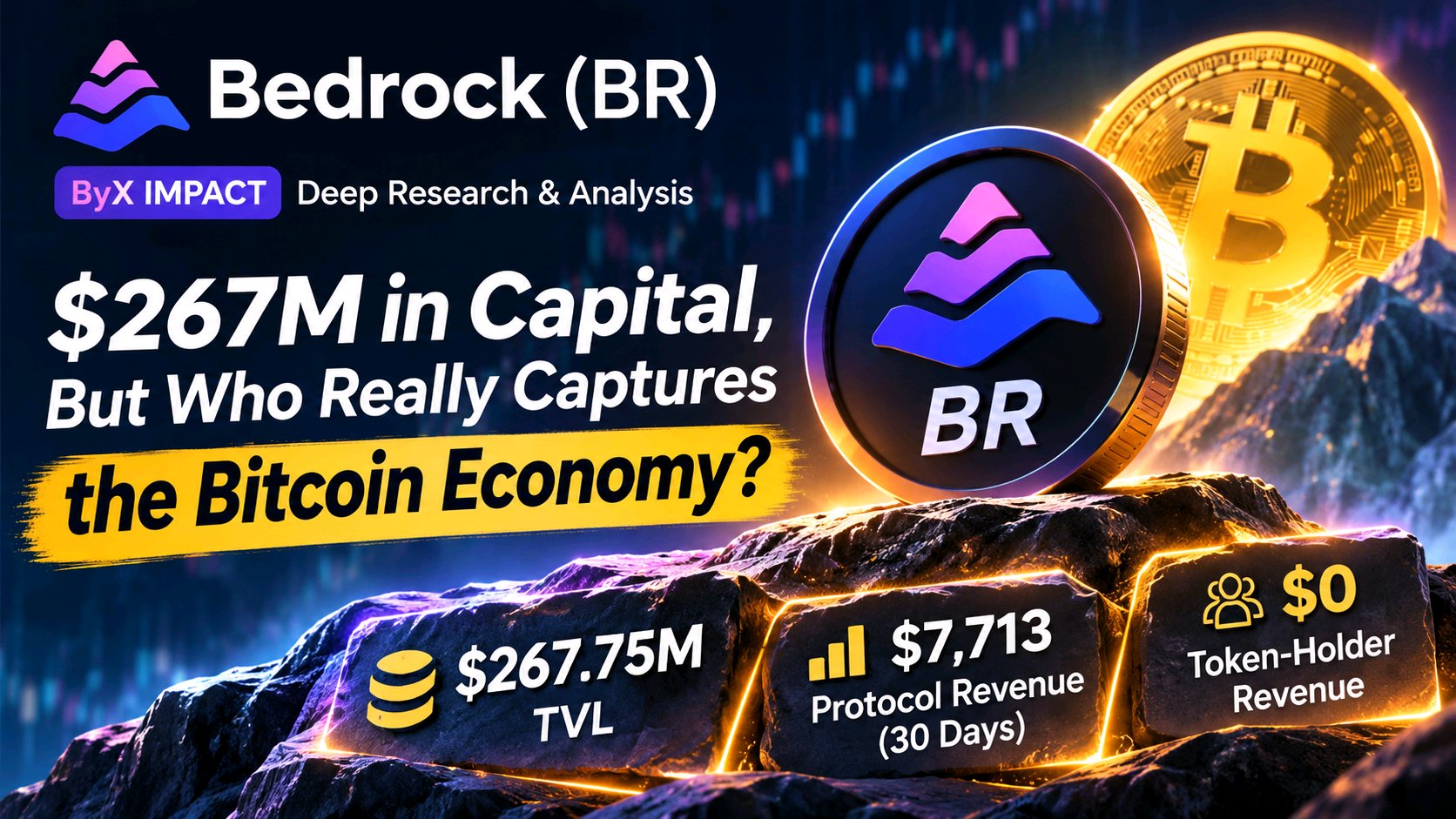
Bedrock (BR): $267M in Capital, But the Real Question Is Who Captures the Bitcoin Economy? Bedrock has built something the Bitcoin DeFi market wants: access to productive Bitcoin capital. But there is an important distinction investors may be overlooking — controlling a growing yield infrastructure does not automatically make its governance token economically valuable. The numbers reveal an interesting disconnect. According to DeFiLlama, Bedrock currently holds approximately $267.75 million in TVL, yet generated only $7,713 in protocol revenue over the last 30 days. More importantly, tracked token-holder revenue remains at zero. The Bitcoin side makes this gap even more interesting. Bedrock's uniBTC product accounts for approximately $247 million in TVL, but generated just $1,047 in fees and revenue over the same 30-day period. This is the economic challenge behind Bedrock's next evolution. Bedrock 2.0 is positioning itself beyond traditional liquid staking, aiming to route Bitcoin into delta-neutral strategies, DeFi liquidity, lending and real-world asset opportunities. That could create a much larger business than simply issuing liquid staking tokens. But the critical question is whether those new activities generate recurring protocol income and, eventually, meaningful demand for BR. Currently, BR primarily provides governance through veBR. Locking tokens gives holders influence over strategy selection and capital allocation. That creates governance utility, but it is not equivalent to a direct claim on protocol earnings. There is also a supply consideration. BR has a maximum supply of 1 billion tokens, while CoinGecko lists a 4.92 million BR unlock scheduled for November 20, 2026. The counterargument is legitimate: Bedrock is still developing its broader yield infrastructure, and today's revenue may not reflect tomorrow's potential. If institutional capital enters its new vaults, the economics could change substantially. However, the decisive signal is not another TVL milestone. It is sustained growth in BTC-related protocol revenue, followed by a transparent mechanism connecting that revenue to BR holders. My takeaway: Bedrock may be building a valuable Bitcoin yield business. The unresolved question is whether BR becomes a meaningful economic asset within that business, rather than simply the token governing it. Would you value BR differently if its Bitcoin infrastructure succeeds but token holders still receive no direct economic distribution? #ByXIMPACT $BRUSDT
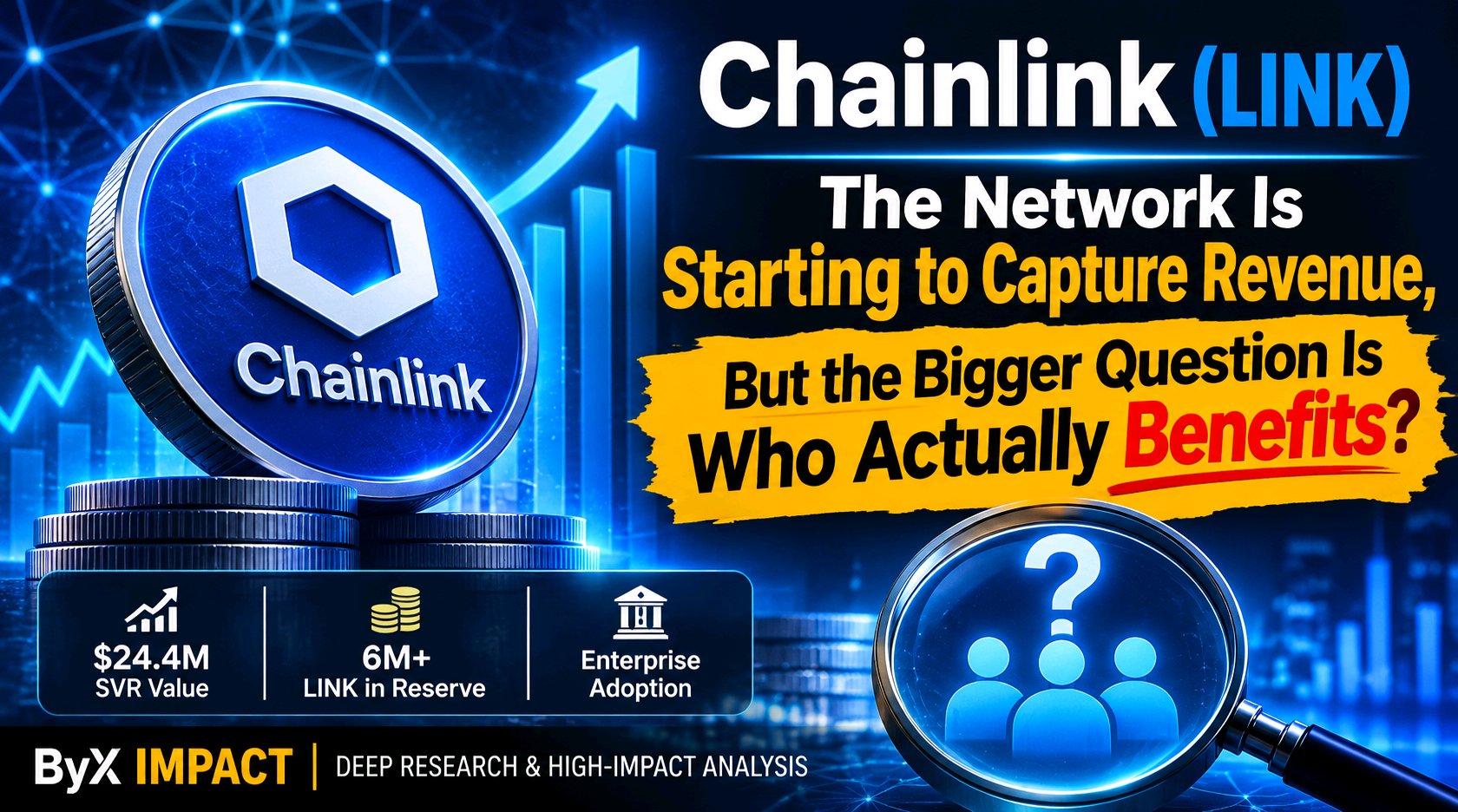
The real development is not simply that Chainlink is accumulating LINK. It is that Chainlink is beginning to connect enterprise revenue and on-chain service demand to an actual token acquisition mechanism. Its Q3 2026 report revealed that the Chainlink Reserve had surpassed 6 million LINK. The mechanism behind this matters: Payment Abstraction allows customers to pay in fiat or other digital assets, which are programmatically converted into LINK. Enterprise adoption can therefore create LINK purchasing activity even when customers never directly purchase the token themselves. There is another important signal. Chainlink reported more than $24.4 million in cumulative SVR value recaptured by Q3 2026. SVR creates an additional economic channel by recovering oracle-related MEV, with value shared between participating DeFi protocols and the Chainlink Network. But here is where the investment thesis needs more scrutiny. A growing Reserve is not the same as a dividend, and accumulated LINK does not automatically become circulating-supply reduction or direct income for holders. It is an asset held to support the network's long-term sustainability. Supply also remains relevant. Chainlink's published release schedule is currently 7% of total supply annually, against a maximum supply of 1 billion LINK. That means genuine network-driven acquisition demand must be evaluated against continuing token releases. The overlooked opportunity is the potential convergence of three forces: enterprise payments converted into LINK, growing service revenue, and increasing demand for LINK as a security asset through staking. However, the critical question is whether these mechanisms can scale faster than new supply enters the market. My decisive metric for LINK is not another partnership announcement or transaction-value milestone. It is the rate of net LINK accumulation in the Reserve relative to new token releases, alongside independently verifiable service revenue growth. If that relationship strengthens consistently, Chainlink's economic model becomes much more interesting. Chainlink may be building something more valuable than an oracle network: an infrastructure business with a measurable mechanism for converting adoption into token demand. But the conversion mechanism still has to prove its long-term strength. What do you think matters more for LINK's future valuation: network adoption or the amount of economic value that actually flows back into LINK? #ByXIMPACT $LINKUSDT
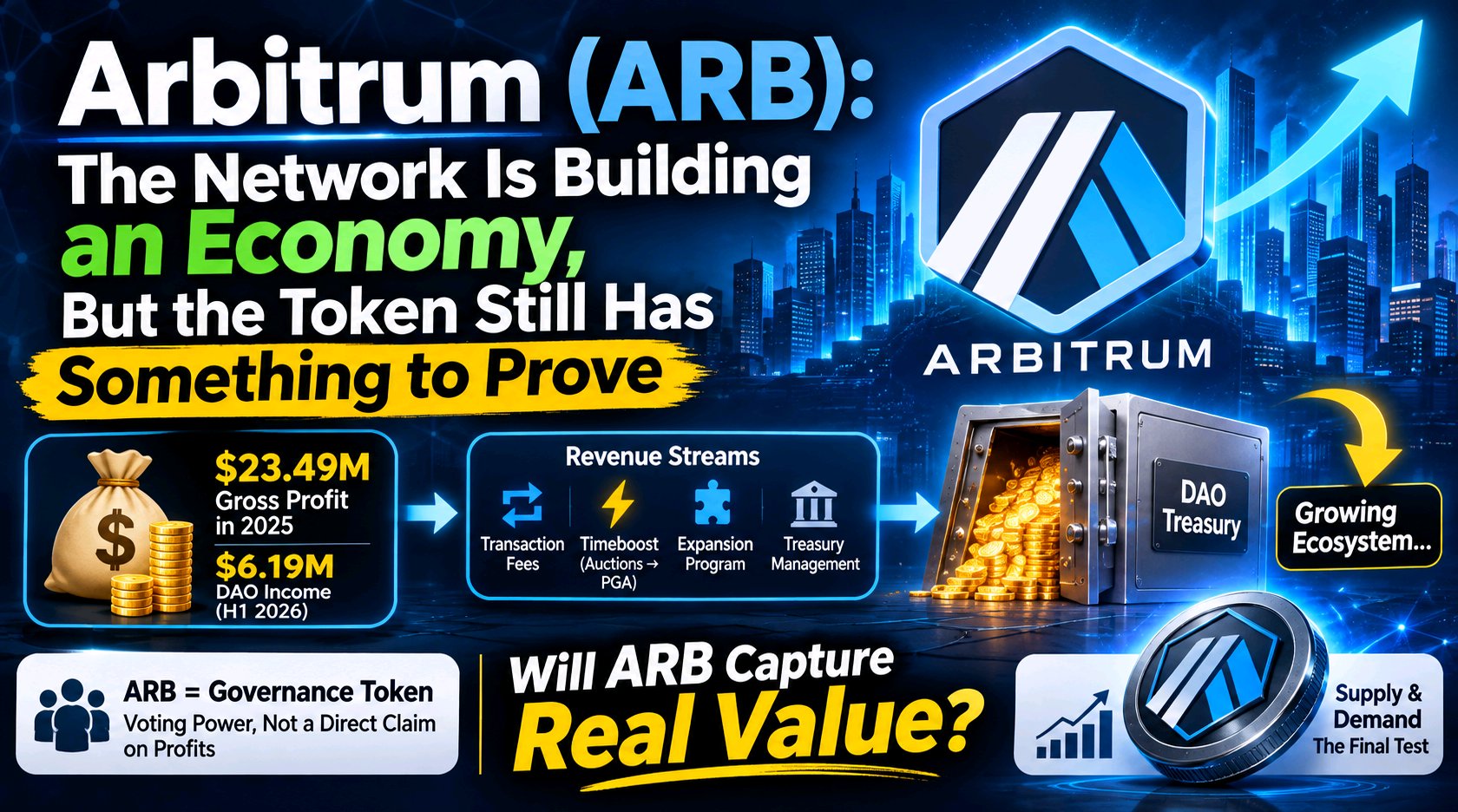
Arbitrum (ARB): The Network Is Building an Economy, But the Token Still Has Something to Prove Arbitrum has an economic development that deserves more attention than another TVL milestone: its ecosystem is generating income, but that does not automatically mean ARB holders are receiving economic value. According to the Arbitrum Foundation's 2025 transparency report, the ecosystem generated more than $6 million from Timeboost in its first year. It also reported $23.49 million in gross profit for 2025, supported by four revenue streams: transaction fees, Timeboost auctions, the Arbitrum Expansion Program and treasury management. docs.arbitrum.foundation +1 The interesting part is where this money goes. ArbitrumDAO has developed an economic model in which network activity can strengthen its treasury and fund ecosystem development. That is meaningful progress for the network, but ARB is primarily a governance token. Holding it gives voting power over protocol decisions and treasury allocations; it does not automatically provide a claim on network profits. Arbitrum DAO - Governance docs +1 The next development makes this distinction even more important. In June 2026, a governance proposal introduced a transition from Timeboost to Priority Gas Auctions (PGA). The proposed model sends 97% of collected priority fees to the DAO treasury and 3% to the Arbitrum Developer Guild. This could broaden participation in transaction-priority auctions, but the proceeds still flow to the ecosystem rather than directly to ARB holders. Arbitrum There is genuine growth behind the story. Arbitrum reported $6.19 million in DAO income during the first half of 2026, while processing 478 million transactions. Its Expansion Program also creates another income channel by returning 10% of net protocol revenue from qualifying external chains. Robinhood Chain became a contributor under this model in July. Arbitrum However, my biggest question is whether this expanding economic system will eventually create stronger demand for ARB itself. The remaining original vesting allocation was approximately 770 million tokens as of August 17, 2026, with final vesting scheduled for March 2027. Supply expansion and token demand therefore remain important considerations. Arbitrum The counterargument is that ARB holders govern a growing treasury and can influence how its income is deployed. If those decisions create sustainable ecosystem growth, governance could become increasingly valuable. For me, the decisive signal is not another transaction milestone. It is whether Arbitrum introduces a durable mechanism connecting its expanding treasury economics to ARB ownership, while maintaining sustainable demand for the token. Arbitrum may be building a successful blockchain economy. But will ARB become an asset that captures meaningful value from that economy, or remain primarily the token that governs it? #ByXIMPACT $ARBUSDT
Dogecoin’s Biggest Economic Question: Is Money Actually Moving, or Just Circulating Between Large Wallets? Dogecoin can move billions of dollars across its blockchain without necessarily gaining billions of dollars in genuine payment adoption. That distinction is becoming increasingly important when evaluating DOGE as a payment network rather than simply a highly recognized cryptocurrency. Recent Dogechain data shows that the network processed 193,442 transactions during the week of November 7, 2026, down 17% year over year. Average daily active addresses fell to 37,197, a 27% annual decline. Yet approximately 8.71 billion DOGE moved during that same week. The apparent contradiction deserves attention. Dogechain +1 The composition of that activity is particularly interesting. Around 76% of the reported DOGE transfer volume came from transactions involving at least one million DOGE. Meanwhile, Bitquery's September investigation found that 87.5% of DOGE moved during 2026 returned to the sending address, suggesting that exchange operations, custody movements and change outputs can make gross blockchain volume look much larger than genuine economic payments. Dogechain +1 This does not mean those transfers are meaningless. Large holders and exchanges need settlement infrastructure. But it does mean that total DOGE transferred cannot independently prove growing consumer adoption. The deeper issue is how this activity supports network economics. Dogecoin pays miners a fixed 10,000 DOGE per block, approximately 5 billion newly issued DOGE annually. Bitquery estimates that miners collected only around $250,000 in transaction fees during 2026, leaving block issuance as the dominant source of mining compensation. This keeps transaction costs low and supports network security, but it also means organic payment demand contributes very little to miner revenue today. Bitquery +1 There is a reasonable counterargument: Dogecoin was designed for inexpensive transfers, not to maximize transaction fees. Its Litecoin merged-mining arrangement also provides an important security advantage. Low fees are therefore not necessarily a weakness. The problem is assuming that cheap transfers automatically translate into expanding economic adoption. I would watch one signal particularly closely: growth in ordinary payment activity after removing change outputs, custodial transfers and inscription-related traffic. If genuine payment activity starts recovering while the network maintains its security, the adoption argument becomes considerably stronger. My conclusion is that Dogecoin's biggest challenge is not proving that its blockchain works. It has operated for more than a decade. The real challenge is demonstrating that people increasingly need DOGE to exchange value, rather than simply holding it because of its cultural recognition and market liquidity. A payment network should ultimately be judged by the economic activity it facilitates, not just the amount of currency its blockchain reports moving. What do you think: can DOGE develop into a meaningful everyday payment currency, or will market sentiment remain more important than actual payment adoption? #ByXIMPACT $DOGEUSDT

HYPE: Hyperliquid está expandiendo su exchange, pero ¿quién captura la nueva economía? Hyperliquid ha construido algo inusual en DeFi: un exchange donde la actividad de trading puede traducirse directamente en demanda en el mercado abierto para su token nativo. Pero hay una distinción importante que los inversionistas no deben pasar por alto: no cada dólar de actividad económica generado por Hyperliquid pertenece a los titulares de HYPE. La presentación de resultados del 5 de noviembre revela un desarrollo interesante. Hyperliquid generó aproximadamente $208 millones en valor económico total durante el tercer trimestre de 2026, un aumento del 14% respecto al segundo trimestre. Sin embargo, $36.6 millones fueron atribuibles a las comisiones compartidas de constructores y desarrolladores. Esa distinción importa porque los operadores de mercado externos están participando cada vez más en la economía del exchange. HIP-3 es fundamental para esta transformación. Los constructores pueden lanzar sus propios mercados perpetuos vinculando 500,000 HYPE, mientras Hyperliquid suministra el libro de órdenes, el motor de emparejamiento, la infraestructura de margen y la liquidación. Esto expande el exchange hacia materias primas, acciones y otros activos sin requerir que Hyperliquid opere cada mercado por sí mismo. Pero descentralizar la creación de mercados también significa compartir la economía. Los constructores y desarrolladores pueden recibir porciones de las tarifas de trading, por lo que el volumen de trading titular no le dice a los inversionistas cuánto valor llega finalmente al Fondo de Asistencia. El lado positivo sigue siendo sustancial. Aproximadamente el 99% de las tarifas de protocolo elegibles se destinan a la recompra de HYPE a través del Fondo de Asistencia. Para el 28 de octubre, se habían recomprado aproximadamente 48.3 millones de HYPE, con cerca de $1.4 mil millones gastados. Esto crea una conexión significativa entre la actividad del exchange y la demanda del token. Sin embargo, el suministro sigue siendo un contrapeso importante. HYPE tiene un suministro máximo de mil millones de tokens, incluidos 238 millones asignados a los colaboradores principales con un periodo de vesting que se extiende hasta 2027-2028. Por lo tanto, las recompras y los desbloqueos deben evaluarse en conjunto. Mi observación central es que la próxima fase de crecimiento de Hyperliquid no debe juzgarse solo por el volumen de HIP-3. La métrica decisiva es cuánto valor económico neto sobrevive a los pagos de constructores y desarrolladores y llega a las recompras de HYPE. Si esa conversión se mantiene fuerte mientras se expanden nuevos mercados, la base económica de HYPE se vuelve más convincente. Si el volumen crece pero el valor dirigido al token se estanca, es posible que el mercado esté sobreestimando los beneficios de la adopción. La verdadera pregunta no es cuánto opera Hyperliquid. Es qué parte de esa actividad pertenece finalmente a HYPE. #ByXIMPACT $HYPEUSDT

Litecoin’s Hidden Strength Is Growing, But Its Biggest Economic Test Remains Unsolved Litecoin has achieved something many older payment networks struggle with: it has maintained meaningful transaction activity while expanding its privacy capabilities. But there is an important difference between a network becoming more useful and its native token capturing more economic value. One development worth watching is MimbleWimble Extension Blocks (MWEB). Activated in May 2022, MWEB introduced optional confidential transactions, allowing users to conceal transaction amounts and improve fungibility without replacing Litecoin’s transparent main chain. litecoin.com +1 Its adoption has become more interesting. Litecoin's official 15-year milestone report records an MWEB balance of 402,000 LTC in December 2025, rising to an all-time high of 567,921 LTC on September 11, 2026. That is a substantial increase in coins held within the privacy extension. It suggests MWEB is becoming more than an unused technical feature. litecoin.com However, the more important economic question sits behind this growth. MWEB usage does not automatically create additional fee revenue or direct value capture for LTC holders. The coins remain LTC, but increased privacy usage is not the same as increased monetary demand. There is an even bigger issue: Litecoin's security economics are increasingly connected to Dogecoin. Bitquery's October 2026 investigation found that approximately 85% of miners' combined rewards came from Dogecoin in September. Litecoin transaction fees represented just 0.2% of its own block rewards. Litecoin still processed 6.8 times as many transactions as Dogecoin that month, yet Dogecoin generated substantially more mining income. Bitquery +1 This creates an unusual situation: Litecoin can remain operationally useful while depending heavily on another cryptocurrency's mining economics. The next halving, expected around July 2027, will reduce Litecoin's block reward from 6.25 to 3.125 LTC. Unless fees or LTC-denominated rewards become more economically significant, Dogecoin's contribution to miner incentives could become even more important. sec.gov +1 The strongest counterargument is that merged mining is an advantage, not necessarily a weakness. Litecoin benefits from additional mining incentives without requiring Dogecoin to share its monetary supply or consensus rules. But dependence on external mining economics still deserves attention. For me, the decisive metric is the relationship between Litecoin's own transaction-fee revenue, block rewards and Dogecoin mining income after the 2027 halving. If genuine payment activity starts generating a larger share of miner compensation, Litecoin's economic independence improves. If not, its security model will remain closely tied to Dogecoin's incentives. The question is no longer simply whether Litecoin is being used. It is whether the economic value of that usage can eventually support the network independently. I can also track Litecoin's miner economics, MWEB adoption and fee revenue to identify whether this thesis strengthens over time. #ByXIMPACT $LTCUSDT
Avalanche’s Biggest Growth Opportunity May Not Translate Into AVAX Demand One detail about Avalanche deserves more attention: building a new blockchain on Avalanche has become dramatically cheaper, but that does not automatically mean stronger economic demand for AVAX. The Etna upgrade changed the economics of Avalanche Layer-1 networks. Previously, subnet validators needed to stake 2,000 AVAX. Under the new ACP-77 model, L1 validators can operate without that staking requirement, paying a continuous fee that starts at approximately 1.33 AVAX per month instead. This is an important improvement for adoption. It makes launching independent networks more accessible to gaming companies, financial institutions and application developers. But there is an economic trade-off that investors should understand. A growing number of Avalanche L1s does not necessarily create proportional demand for AVAX. These networks can establish their own validator arrangements and even use different gas tokens. AVAX remains important for Primary Network security, P-Chain coordination and the L1 validator fee mechanism, but the economic relationship is not as direct as many might assume. The fee data makes this distinction interesting. Avalanche's official explorer reported approximately 32,900 AVAX burned through C-Chain fees over the 30 days from October 9 to November 7, 2026. Meanwhile, cumulative L1 validator fees stood at approximately 18,800 AVAX. These figures cover different periods, but they highlight how much more established C-Chain activity currently contributes to fee burning than the L1 validator model. There is another important factor: AVAX staking rewards are newly minted, while transaction fees are burned. Therefore, increased network activity does not automatically make the supply deflationary. I think Avalanche's real challenge is no longer simply attracting more chains. It is converting that expanding ecosystem into sustained economic activity that requires AVAX. The strongest counterargument is that cheaper L1 creation could eventually generate substantial cross-chain activity, validator participation and AVAX-denominated fees. That possibility should not be dismissed. But I would watch one metric closely: whether AVAX burned through actual network usage begins consistently outpacing newly minted staking rewards. Avalanche may be succeeding at making blockchain creation easier. The bigger question is whether that success will become meaningful value capture for AVAX holders. #ByXIMPACT $AVAXUSDT
INIT: The Biggest Risk to Initia May Be the Infrastructure Connecting Its Rollups Initia was designed to solve one of blockchain's biggest problems: fragmented liquidity and disconnected application-specific chains. But its recent security incidents have exposed a weakness that could be more important than its technology — the infrastructure connecting those chains can become a single point of systemic risk. On October 23, 2026, Initia halted its Layer 1 and rollups following a MoveVM security vulnerability. The network resumed on November 2 after a patch and restoration of affected asset backing. Just eight days later, another incident forced a second shutdown. This time, the problem was infrastructure security. According to Initia's November 10 disclosure, compromised cloud credentials gave an attacker access to its rollup hosting infrastructure. Fraudulent IBC withdrawals from five rollups enabled approximately $3.27 million in assets to be moved. Around $2.16 million remained frozen on the halted network, and Initia stated that no INIT tokens were withdrawn. The team committed to rebuilding affected infrastructure and restoring asset backing. The economic implications deserve attention. Initia's competitive advantage is its interconnected architecture. Shared liquidity, interoperability and coordinated incentives are supposed to make independent rollups function like one ecosystem. But this creates an important trade-off: infrastructure failures can affect multiple applications simultaneously. There is also a separate value-capture challenge. DefiLlama currently reports approximately $3.2 million in Initia DeFi TVL. InitiaDEX generated around $16,187 in fees over 30 days, but reported zero protocol revenue because swap fees remain with liquidity providers. This means trading activity does not automatically translate into revenue for the protocol or direct economic returns for INIT holders. The strongest counterargument is that Initia's rapid response, frozen assets and planned infrastructure rebuild demonstrate meaningful defensive capabilities. The incidents do not prove the architecture is fundamentally broken. They do, however, raise the standard of proof required before investors trust it with larger amounts of capital. For INIT, I would monitor one decisive development: a successful network restart followed by sustained, incident-free cross-rollup activity and restoration of affected asset backing. Initia does not just need more rollups. It needs to prove that connecting them creates resilience rather than concentrating risk. Can Initia turn its interconnected architecture into a genuine security advantage, or has its biggest design strength become its greatest vulnerability? #ByXIMPACT $INITUSDT
BIRB: The Hidden Risk Is Not Token Inflation. It Is Whether Incentive-Driven Loyalty Can Become Permanent Demand BIRB has a fixed maximum supply of one billion tokens, but that does not automatically make its economics predictable. The more important question is how much of its future demand will come from people who genuinely want the token, rather than people receiving it through ecosystem incentives. Moonbirds' token allocation reveals an interesting imbalance. According to its official tokenomics, 27% of supply is allocated to holder rewards, 12% to ecosystem partner expansion and 10% to value-chain incentives. Meanwhile, investors and advisors receive 25%, with the team allocated another 10%. Both allocations have a 12-month lockup followed by 24 months of vesting. This creates two simultaneous economic forces: rewards encourage participation, while scheduled distributions increase the amount of supply that the market may eventually need to absorb. The latest Collector Profile transition makes this especially interesting. Moonbirds has moved Nesting into a unified collector platform, where monthly BIRB allocations continue on the 28th. Nested NFTs can also earn eggs, which function as claims on upcoming physical collectible drops. The ecosystem is therefore moving beyond simply distributing tokens toward rewarding participation in a broader collectibles economy. But there is a critical distinction: earning BIRB and needing BIRB are not the same thing. If collectors participate because rewards are available, activity can remain dependent on incentives. If physical products, exclusive access and recurring experiences eventually create reasons to acquire and retain BIRB independently, the economic model becomes considerably stronger. There is also a meaningful supply consideration. Only 285 million of the one billion maximum tokens are currently reported as circulating. That leaves 715 million outside the reported circulating supply, making future distribution an important valuation variable. The counterargument is that staged emissions can build a community before commercial demand matures. That strategy could work, particularly if Orange Cap Games successfully expands its consumer ecosystem. The decisive metric is whether BIRB develops recurring, non-reward-driven demand as monthly distributions continue. If participation grows but organic token demand does not, ecosystem expansion may benefit the brand more than token holders. The real test for BIRB is not how many people it can reward. It is how many people eventually choose to buy into the economy without being paid to participate. #ByXIMPACT $BIRBUSDT